SIPLACE Vision Customer_en.pdf - 第137页
SIPLACE Vision - T eaching Fiducials Synthetic Fiducials for Position Rec ognition Applications Fiducial shapes S tudent Guide SIPLACE Vision (Customer) Edition 12/2008 EN SIPLACE Vision - T eaching Fiducials 137 6.2.1.4…
SIPLACE Vision - Teaching Fiducials
Fiducial shapes Synthetic Fiducials for Position Recognition Applications
Student Guide SIPLACE Vision (Customer)
SIPLACE Vision - Teaching Fiducials Edition 12/2008 EN
136
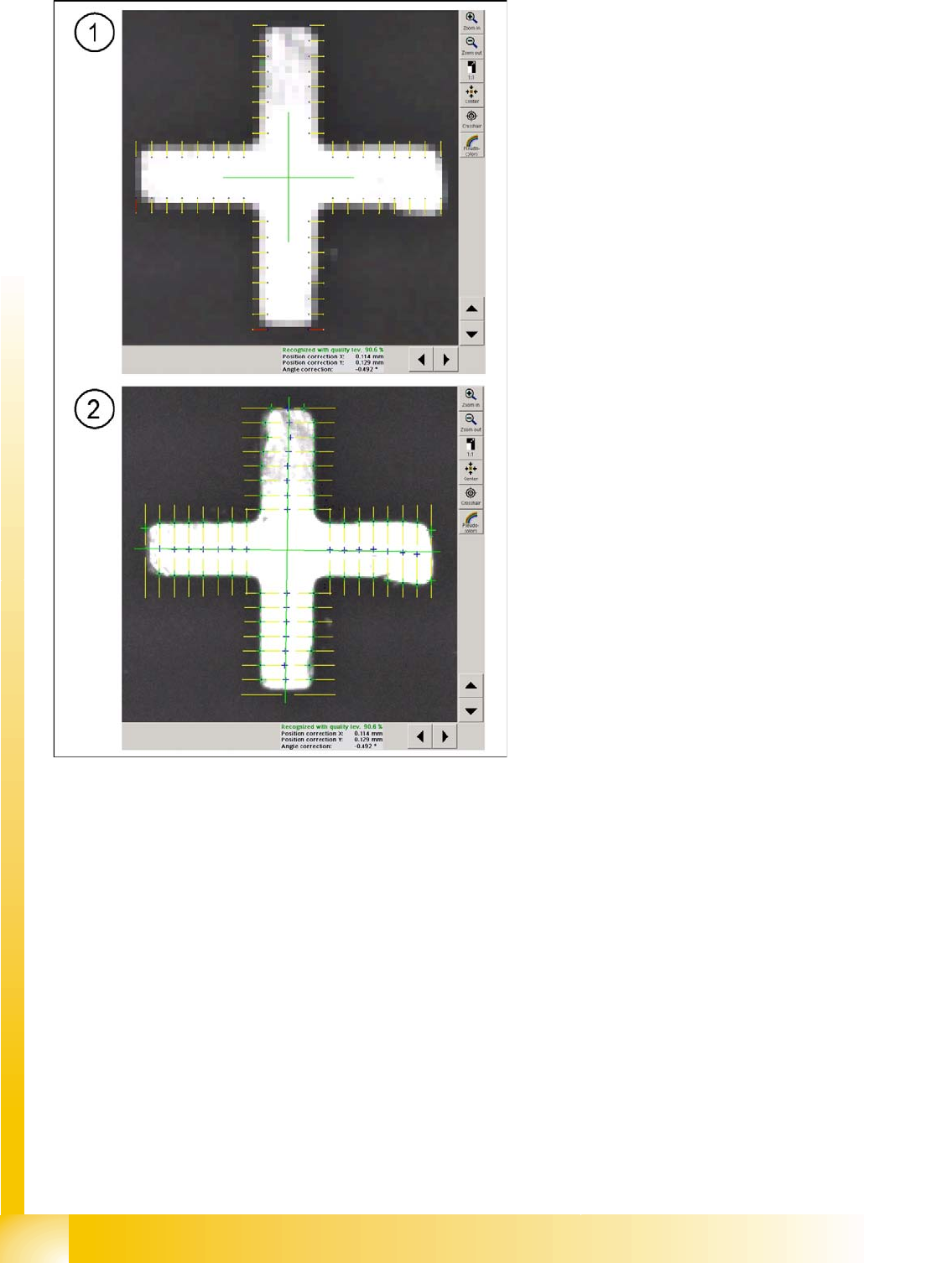
75% (standard) of the point pairs (edge search positions) need to be recognized, so that the fiducial
measurement results are shown at the bottom (middle) of the image (see also algorithm settings).
The tolerance values for the bar width (max. 20%) alter the point pair pitch for the precentering of the
cross fiducial and therefore also affect the marking lines for the fine edge search.
6-6: Fiducial centering steps with standard algorithm settings
Legend
1. Subsampling shows the 16 (standard in
algorithm setting) point pairs of the cross bars.
One of the pixels (marked blue) in the pair
must reach the bright fiducial foreground and
one (yellow) must reach the dark background,
before the point pair connection is marked
yellow and can be used for precentering the
fiducial position. Positions which are marked
red will be rejected.
2. The Fine search examines the brightness
transitions along the lines connecting the 16
point pairs, determined in the rough search, to
determine the exact fiducial center point. The
green crosses mark the position of greatest
gradient change. The blue dot marks this
position if the distance is within the bar width
tolerance range (fine structure).
The fiducial edge positions are calculated and
used to accurately interpolate the fiducial
center.
SIPLACE Vision - Teaching Fiducials
Synthetic Fiducials for Position Recognition Applications Fiducial shapes
Student Guide SIPLACE Vision (Customer)
Edition 12/2008 EN SIPLACE Vision - Teaching Fiducials
137
6.2.1.4 Illuminating Fiducials with the Different PCB Cameras
2 camera systems with different illumination technology are available for fiducial recognition.
Camera data SST34 and 24:
– Field of vision 494x494 mm (494x494 pixels)
– Max. fiducial size 3x3 mm
– Resolution~12 µm/pixels
The standard PCB camera SST34 supports the following illumination options:
– Red LEDs, which support diffuse illumination of the structure, through opaque or milky glass.
This type of illumination can be selected on its own.
– Red LEDs, which support direct illumination of the structure, through an opening in the opaque
or milky glass. This can only be selected in combination with diffuse illumination.
– Direct illumination with blue LEDs as ring arrangement - suitable for white ceramic PCBs with
metallic fiducial shapes.
The multicolor illumination camera SST24 supports the following illumination options:
– Infrared and white LEDs, which support diffuse illumination of the structure, through opaque or
milky glass. These types of illumination can be selected on their own.
– Infrared and white LEDs, which support direct illumination of the structure, through an opening
in the opaque or milky glass. This can only be selected in combination with diffuse illumination.
– Direct illumination with blue LEDs as ring arrangement - suitable for white ceramic PCBs with
metallic fiducial shapes.
– This camera is only available as an option for X machines.
The intensity of each illumination type can be set to between 0 and 255. The illumination colors can not
be combined with one another.
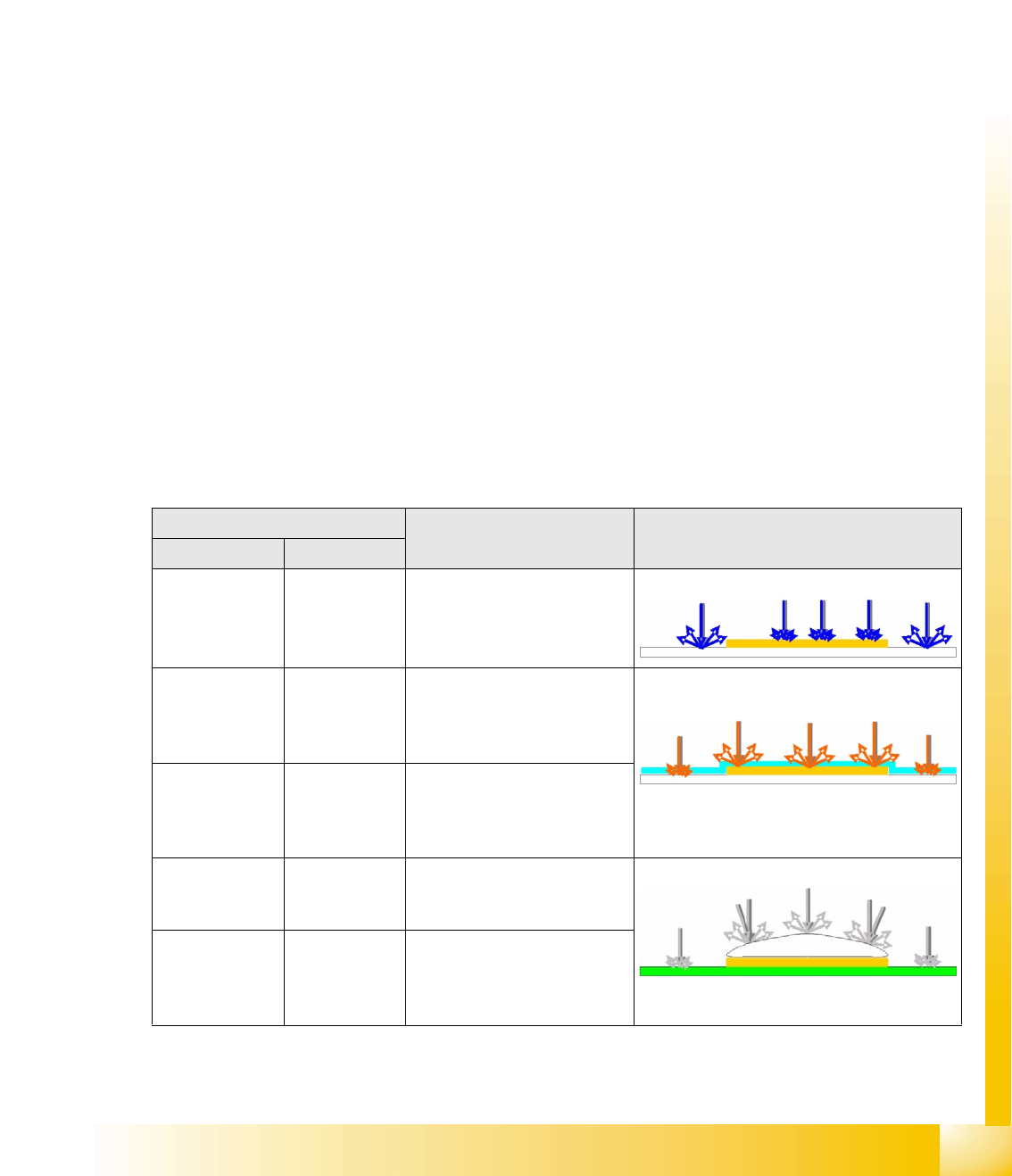
Illumination type/color PCB material Example
SST24 SST34
Blue Blue For recognition of gold or silver
colored fiducials on white
(ceramic) material
e.g. gold on ceramic
Infrared (IR)
diffuse
Red, diffuse For recognition of fiducials
under soldering paste and of
matt coated fiducials, plus
fiducials on glass sheets.
IR penetrates soldering paste and illuminates
covered structures.
IR steep is
always
combined with
diffuse
Red steep is
always
combined with
diffuse
For recognition of shiny coated
fiducials
White, diffuse Red, diffuse For recognition of matt
fiducials on any PCB material
and PCB surface.
Fiducials tin-plated with hot air
White steep is
always
combined with
diffuse
Red steep is
always
combined with
diffuse
For recognition of fiducials with
shiny surfaces
SIPLACE Vision - Teaching Fiducials
Fiducial shapes Synthetic Fiducials for Position Recognition Applications
Student Guide SIPLACE Vision (Customer)
SIPLACE Vision - Teaching Fiducials Edition 12/2008 EN
138
6.2.1.5 Algorithm Setting
In contrast to the algorithm settings for ICOS, measuring methods can not be selected or deselected
here.
In the SIPLACE Vision method, you can only change parameters or quality thresholds.
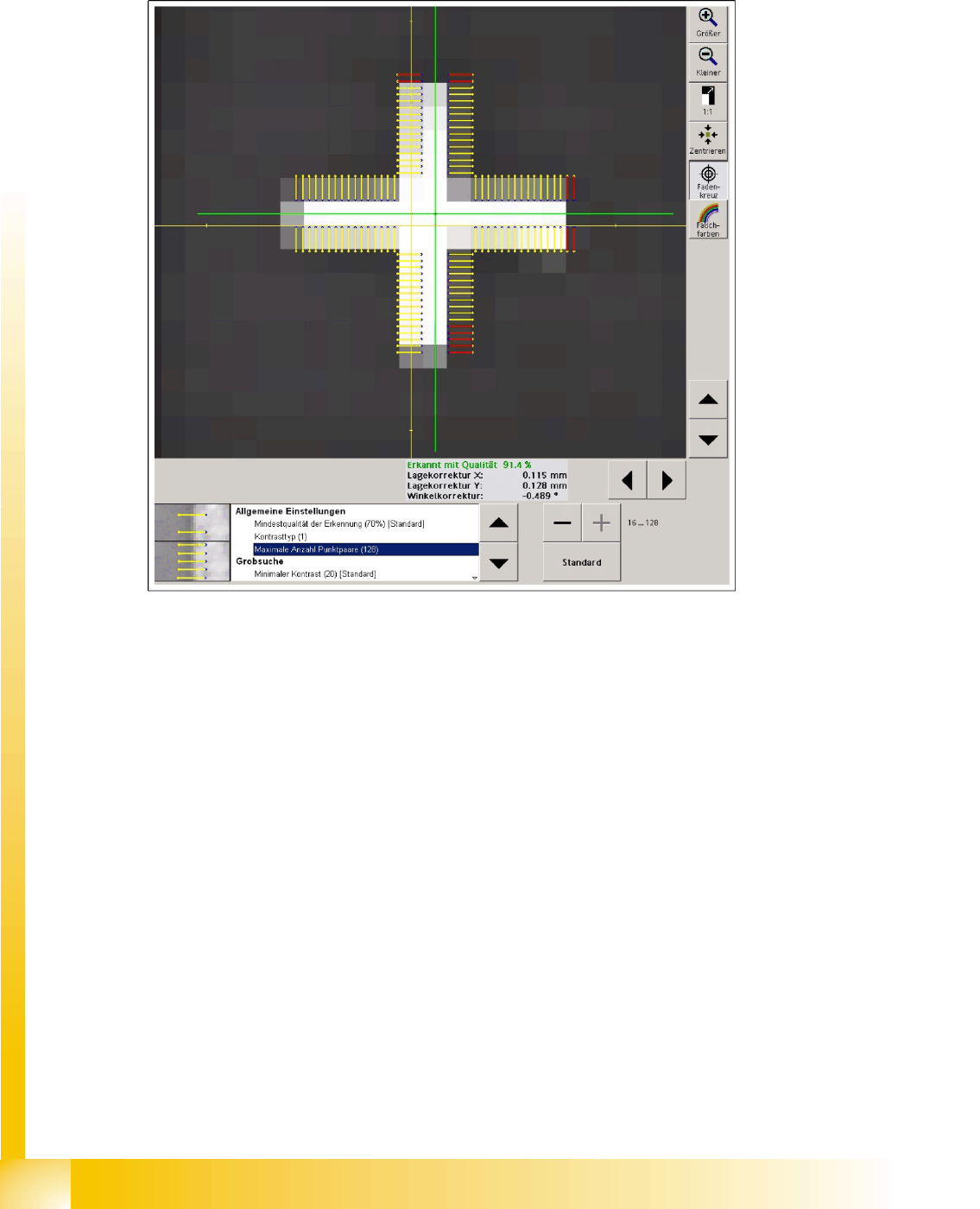
6-7: Algorithm setting shown with cross fiducial as example
The Minimum recognition quality of 70% is set so that no fiducial shape faults will lead to incorrect
calculation of the fiducial reference position and therefore to a placement offset.
Contrast type ’1’ indicates a light fiducial on a dark background. If you evaluated a dark fiducial on a
light background, contrast type ’-1’ would be shown.
The minimum number of image pairs can be increased or reduced in steps of 8. The default value
is 64. The cross-shaped fiducial has 8 image pairs for the edge on one side of the cross. If similar
structures are expected near the fiducial area, in the camera field of vision, the number of image pairs
should be increased accordingly to ensure reliable recognition of the shape.