SIPLACE Vision Customer_en.pdf - 第64页
Component Shapes Specific Component Shapes Optical Rec ogn ition and Evaluation of Unleaded COs S tudent Guide SIPLACE V ision (Customer) Component Shapes Edition 12/2008 EN 64 5.3.6.3 Algorithm V alues These settings do…
Component Shapes
Optical Recognition and Evaluation of Unleaded COs Specific Component Shapes
Student Guide SIPLACE Vision (Customer)
Edition 12/2008 EN Component Shapes
63
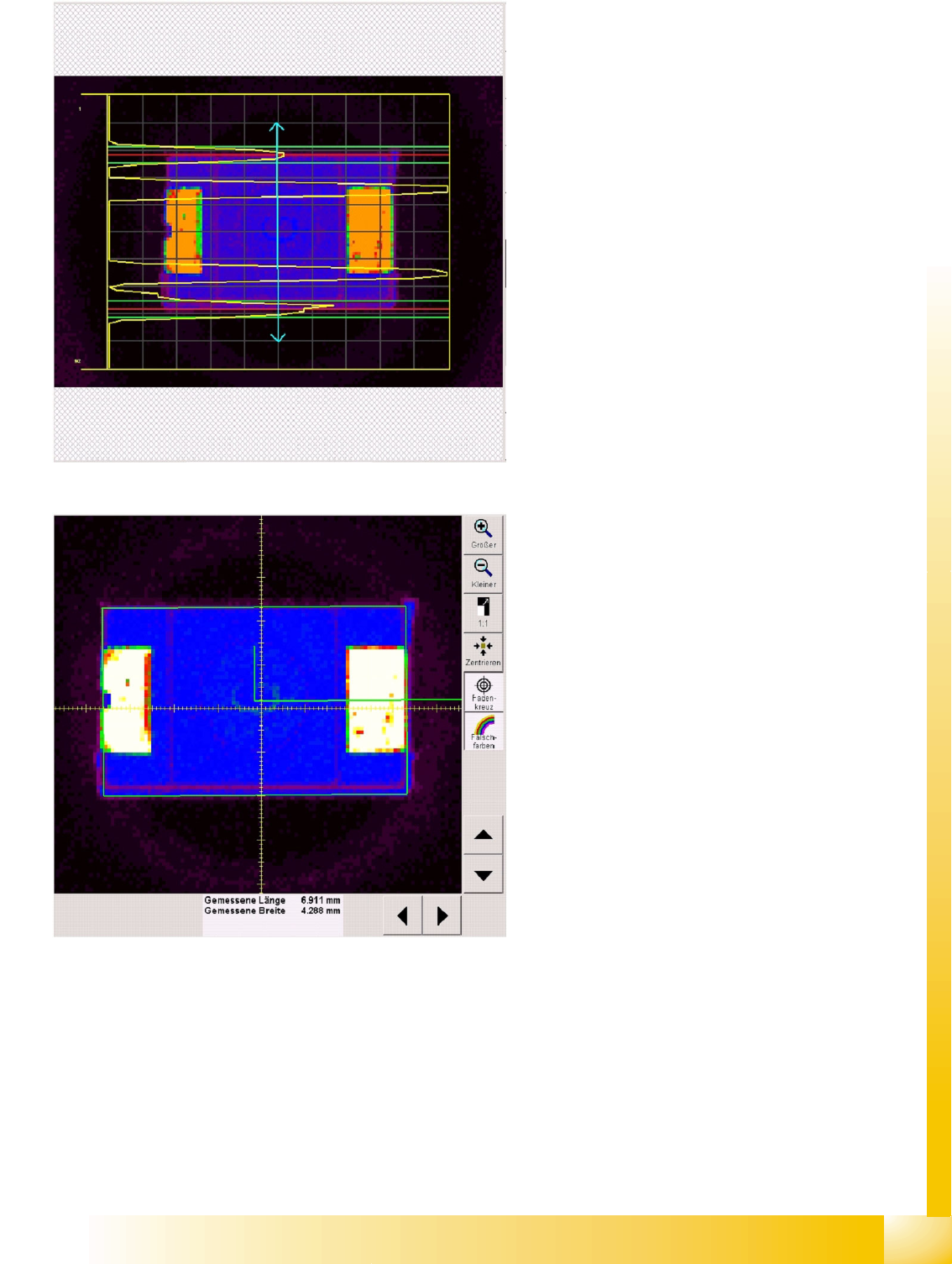
Y dimension measurement step
The brightness gradients are determined for the Y
direction.
The light blue double arrow shows the CO width
and width tolerance. The gradient signal for the
CO width is displayed in yellow.
Lower gradients indicate the CO outer edge (due
to dark body). If these are high enough, the outer
edge of the body can be determined. If not, the
high gradients for the lead side are used to
determine the alternative body width Y of the
Moulded CO.
The horizontal green lines on each side of the
CO show the tolerance field which the CO edge (or
lead side) must be within.
The horizontal red lines show the detected CO
outer edge.
Measurement window showing Dimension
result recognition step
The dimension rectangle for the determined CO
length (X) and width (Y) is displayed in green in the
CO fine position and fine angle.
At the edge of the rectangle shown, you can
clearly see the pseudo-color image, with the
injection edge of the Tantal capacitors (Moulded
COs).
The dimension check result is only shown here, in
the dimension result step.
Component Shapes
Specific Component Shapes Optical Recognition and Evaluation of Unleaded COs
Student Guide SIPLACE Vision (Customer)
Component Shapes Edition 12/2008 EN
64
5.3.6.3 Algorithm Values
These settings do not normally need to be changed.
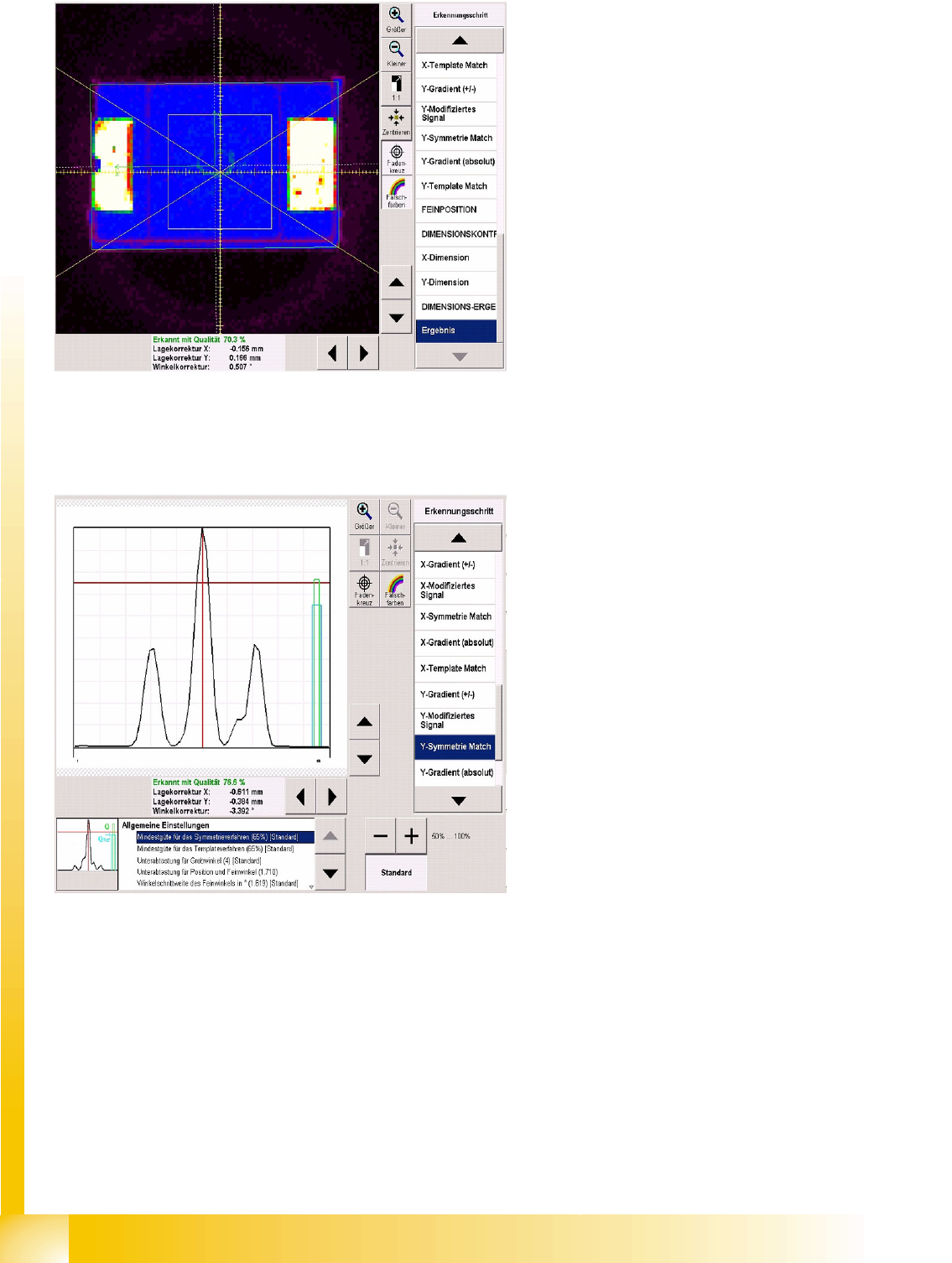
Diagram centering result
The diagram shows the following:
CS X/Y orientation: green angle in CO center.
CO center recognized for placement: white
dotted line.
Permitted CO angle tolerance: diagonal
yellow lines in CO camera center.
Since the results display is so important, it was
already shown during the intermediate centering
steps. If an error occurs, this will also be displayed,
so you can make the necessary adjustments.
The minimum thresholds for various measurement
steps can be altered here.
The relevant threshold and measurement value
bars will then be redrawn in the recognition step
diagram.
If the quality values for the symmetry procedure
are not achieved, centering will be performed with
the template method.
Sub sampling coarse/fine angle: gathers
several points of the image together, to form one
evaluation point.
Attention: The predefined recognition menus will
change when you switch over threshold values!

Component Shapes
Leaded Component Shapes Specific Component Shapes
Student Guide SIPLACE Vision (Customer)
Edition 12/2008 EN Component Shapes
65
5.3.7 Leaded Component Shapes
In SIPLACE Vision, leaded components are defined as those which have measurable i.e. visible
(narrow) leads. In most cases, the leads are aligned towards the outside.
The CO position and angle are determined from various algorithms such as lead selection, filtering the
recorded image etc.. In a second step, the so-called inspection stage, the system uses gradient
formation to determine the number of leads, lead position and lead grid (pitch) for the CO position
measured in the previous step.
From SR/MC 603, the position of asymmetrical leads can be optically recognized and then corrected
with "Orientation". The operator gets the notification "component picked up at a wrong angle". In the
case of components such as SOT 23, the additional measuring time required is due to the dynamics
times for the C&P 6/12 head.
Important! This function may NOT be activated for symmetrical lead arrangements! It would lead to
random angle placement errors.
From SR/MC 702 (SV 4.0.1), SOxx, SOT, DPACK, QFP, Socket, Connector and Nonstandard can
use 'non-specific component features’ for FaceDown recognition.
ECV, SOT, SOXX, SOJ, QFP, PLCC, DPACK, Socket, Connector and Nonstandard now have a lead
width measurement function. This also functions with programmed notches for nonstandard CSs.
Notes for Joint Datasets (ICOS and SIPLACE Vision)
In the following special cases, you may need to program separate group descriptions for ICOS
and SIPLACE Vision:
In ICOS systems, these bodies are occasionally described as leads when bright component bodies
are used.
Group and/or lead descriptions were also consciously omitted in this system.
Components with leads were often trained with only the SIZE measurement mode. In this case,
check whether a general correction for both systems needs to be made in ICOS!