IPC-SM-782A-表面贴装焊盘图形设计标准.pdf.pdf - 第35页
need to use a soldermask to prevent the migration of solder away from the component land. B. Routing conductors into the lands as shown in Figures 3–20, 3–21 may restrict discrete component movement during reflow solderin…
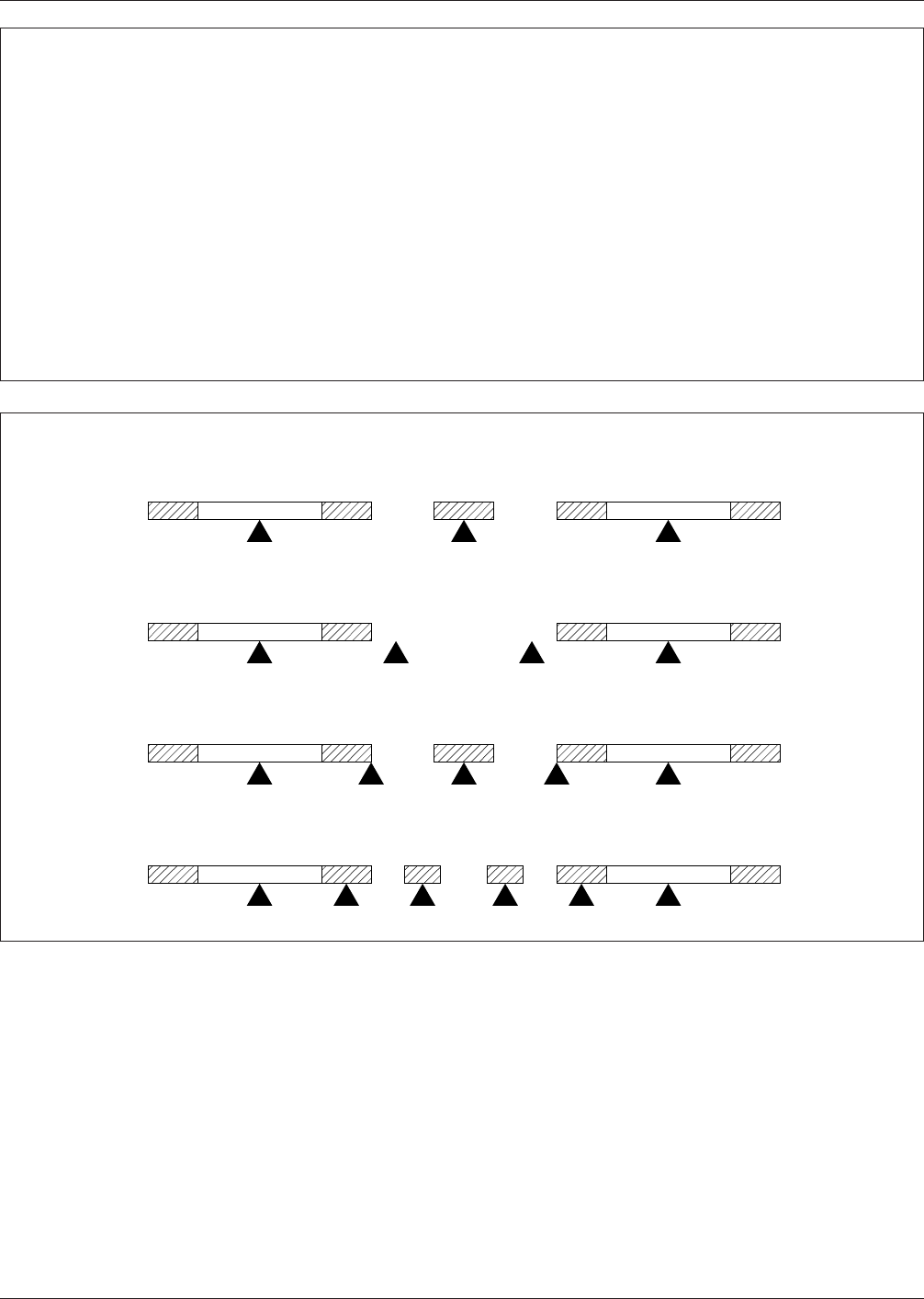
shows a grid routing analysis with vias on 1.0 mm [0.050
in] centers. On the left side are listed the routing grids with
the actual routing channels denoted by solid triangular
points. It can be seen that with SMT geometry of vias
placed on 1.0 mm [0.040 in] centers, there is one routing
channel between lands using a 0.3 mm [0.012 in] grid with
0.15 mm [0.006 in] conductor width/clearances. The bot-
tom routing grid of 0.25 mm [0.010 in] with 0.125 mm
[0.005 in] has two routing channels between vias.
3.6.2.2 Surface Conductors Wide conductors connect-
ing to a land area can act as a solder thief by drawing sol-
der away from the land and down the conductor. Further-
more, if the conductor goes to a via which is connected to
an inner layer power or ground plane, the wide conductor
may act as a heat sink and draw heat away from the land/
lead area during reflow solder resulting in a cold solder
joint.
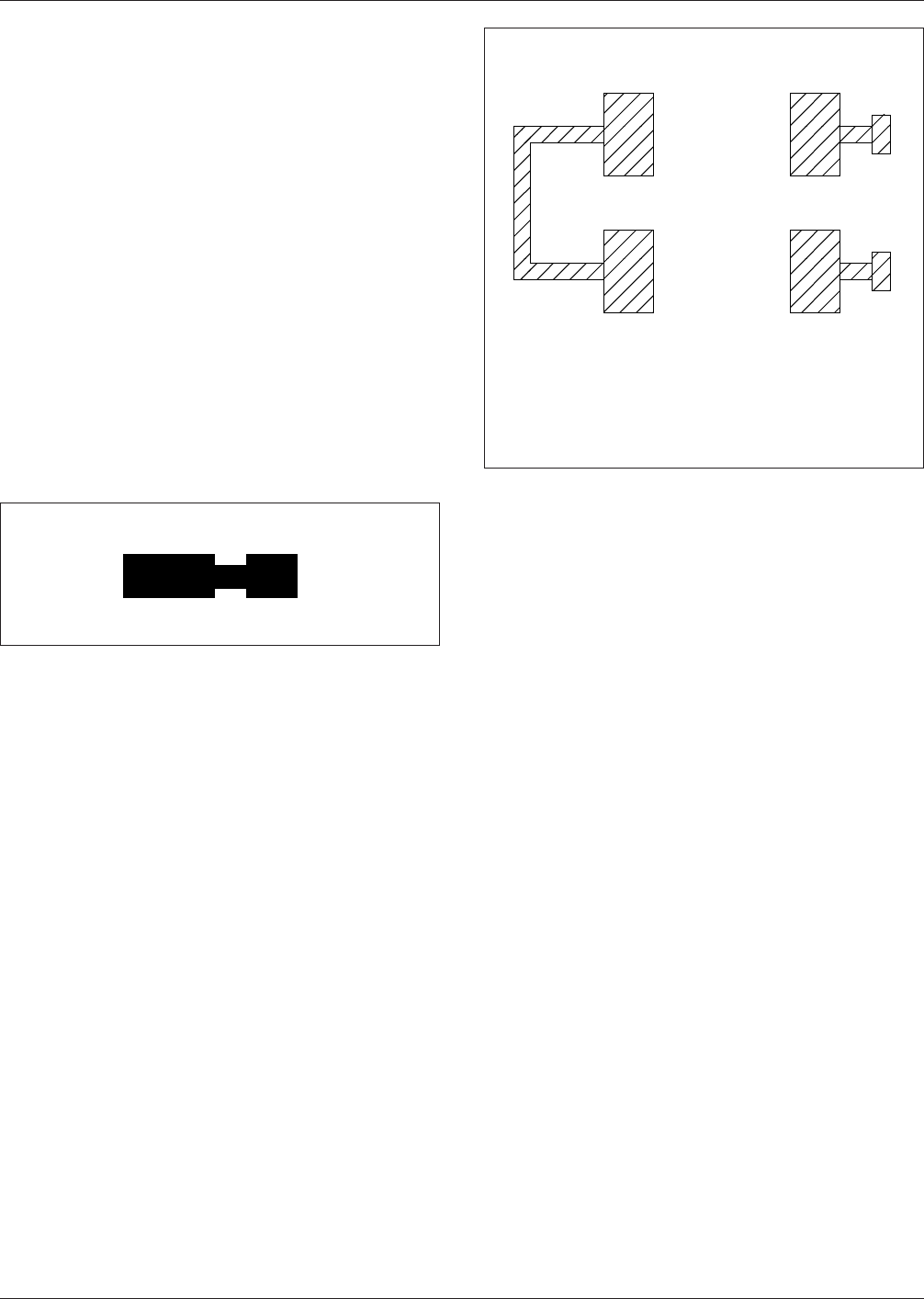
A. Narrow the conductor as it enters the land area. Maxi-
mum conductor width should be 0.25 mm [0.010 in]
(see Figure 3–19). The minimum conductor length
should be 0.50 mm [0.020 in]. This neckdown provides
an effective solder restriction, and may eliminate the
IPC-782-3-17
Figure 3–17 Surface mount conductor widths/clearances vs. routing grids
ROUTING GRIDS
.63mm
0.5mm
0.4mm
0.3mm
0.25mm
MANUFACTURING
ALLOWANCE
0.1mm
0.1mm
0.05mm
0.05mm
0.05mm
MINIMUM
CONDUCTORS/CLEARANCE
0.3/0.2mm
0.2/0.2mm
0.2/0.15mm
0.15/0.1mm
0.10/0.10mm
IPC-782-3-18
Figure 3–18 Section view of multilayer board with vias on 1.0 mm [0.040 in] centers
0.5mm SQ Land MIN 0.25mm DRILL
.5mm
GRID
.33mm
GRID
.25mm
GRID
.20mm
GRID
One
Track
Zero
Track
One
Track
Two
Track
.16mm .16mm
.18mm
.18mm
.16mm .16mm
.125mm .125mm
.125mm .125mm.125mm
IPC-SM-782A December 1999
26
need to use a soldermask to prevent the migration of
solder away from the component land.
B. Routing conductors into the lands as shown in Figures
3–20, 3–21 may restrict discrete component movement
during reflow soldering. In the case of active IC’s this
routing geometry will allow the designer to use the
same library shape for surface routing or pad cap (no
surface routing) printed board configuration. Addition-
ally, using this generic library shape allows ease of
switching between the two configurations midstream in
the design process without changing or editing compo-
nent libraries. In either case, 100% test node access is
retained. If wider conductors are required, the via land
size may be decreased accordingly to allow sufficient
spacing between the conductor and the land.
C. Use solder mask over bare copper (SMOBC) or copper
that has had the solder plating selectively removed.
The solder mask and bare copper provide an effective
barrier to solder migration. This may provide sufficient
protection even if options A and B are not possible.
3.6.2.3 Inner Layer Conductors The use of 0.2 mm
[0.008 in] conductors and clearance often drives layer
counts up because there is no routing channel available
between vias on 1.27 mm [0.050 in] centers. It is for this
reason that there is an increased usage of the conductors on
internal layers at or less than 0.15 mm [0.006 in] for SMT
designs, and 0.125 mm [0.005 in] conductors and clear-
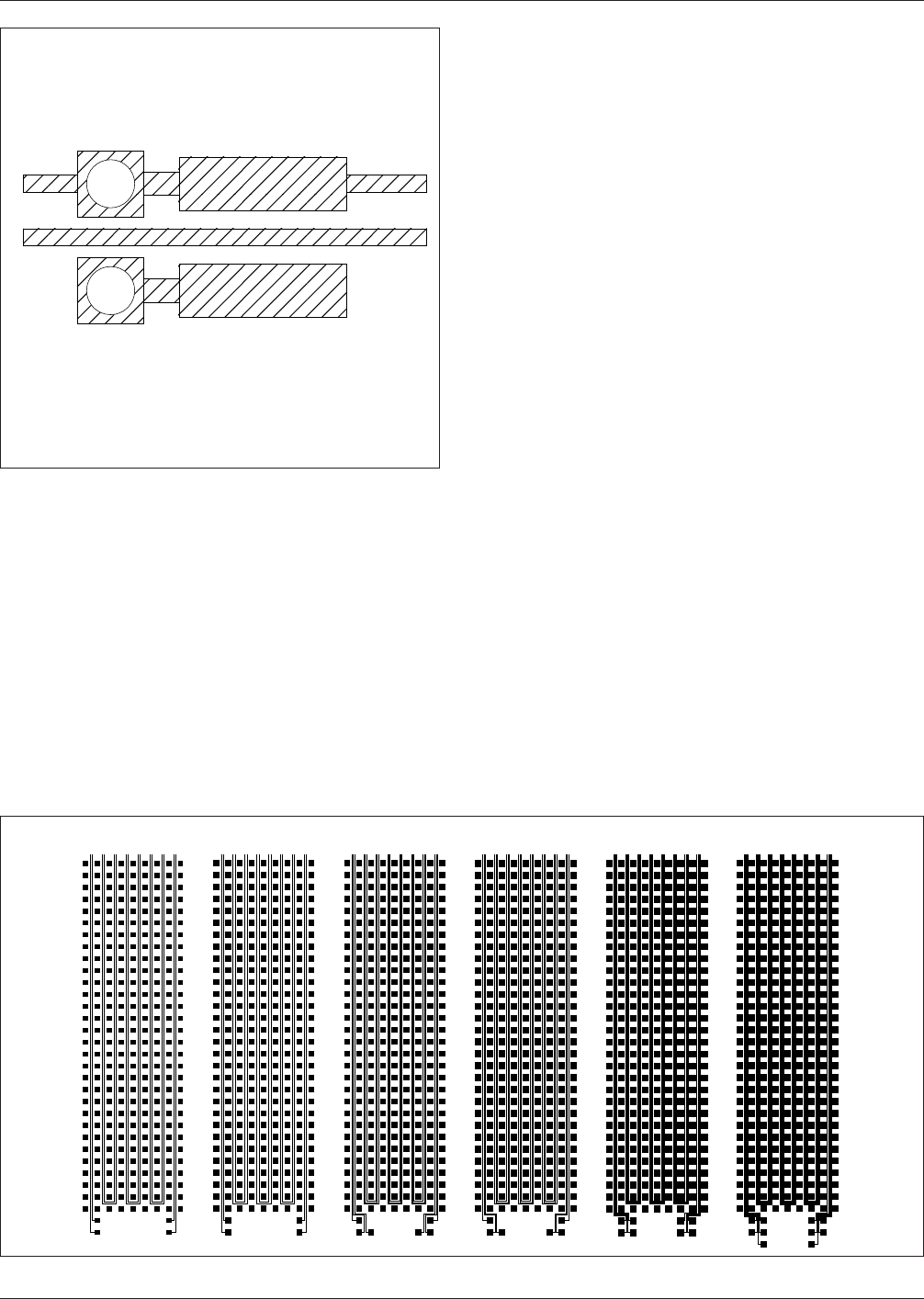
ances for designs with heavy usage of FPT. Figure 3–22
and 3–23 show the number of routing channels available
between lands using the 0.15 and 0.125 mm [0.006 and
0.005 in] geometries. Since conductor width control is
much more difficult to maintain on outer layers of the PB,
it is better to keep the small geometries on the inner layers
of a multilayer printed board. Doing so may reduce the
need for soldermask and dramatically improve printed
board fabrication yields. Generally, the option of using
smaller geometries is driven by the need to reduce layer
counts. Decreasing layer counts may reduce the overall
board thickness and improve the aspect ratio for small hole
drilling.
3.6.3 Via Location Guidelines
3.6.3.1 Via Holes
Size of the via holes should be
selected based upon the printed board thickness vs. hole
diameter or aspect ratio limits as defined by printed board
fabricator. In addition, specific via lands and holes can be
accessed for automatic in-circuit test (ICT). See 5.3.1. Fig-
ure 3–24 shows the land pattern-to-via relationships.
3.6.3.2 Vias and Land Pattern Separation Vias are
plated-through holes for example 0.63 mm to 1.0 mm
[0.025 to 0.040 in] diameter lands. They must be located
away from the component lands to prevent solder migra-
tion off the component land during reflow soldering. This
migration will cause insufficient solder fillets on compo-
nents. (Solder drain) The solder migration can be restricted
by providing a narrow bridge between the land area and the
via or prevented by using the soldermask over bare copper
circuitry. (See Figures 3–19 and 3–20.)
The relationship for mounting land and via locations
should consider the conductor routing requirements. Figure
3–25 provides several examples of via positioning con-
cepts.
Specifying tented or filled vias will also reduce solder
migration on assemblies manufactured with a solder reflow
process. Filled or tented vias also take care of potential flux
entrapment problems under components and are highly
desirable for attaining good vacuum seal during in-circuit
bed-of-nails testing. Tenting is done with a dry film type of
soldermask, or the via may be filled with a resin prior to
liquid soldermask application.
3.6.3.3 Vias Under Components If the assembly is to be
wave soldered, via holes underneath zero clearance compo-
nents on the primary side should be avoided on boards
unless tented with soldermask. During wave soldering of
the assembly, flux may potentially become trapped under
IPC-782-3-19
Figure 3–19 Narrowed conductor
IPC-782-3-20
Figure 3–20 Conductor routing
Conductors routing
away from lands
Conductors routing
to vias
December 1999 IPC-SM-782A
27
zero clearance devices. Via holes may be located under-
neath zero clearance surface mount packages in full surface
mount assemblies that will not be wave soldered. See Fig-
ure 3–26.
3.6.3.4 Vias as Test Points Via holes are used to con-
nect surface mounted component lands to conductor layers.
They may also be used as test targets for bed-of-nails type
probes and/or rework ports. Via holes may be tented if they
are not required for node testing or rework. When a via is
used as a test point it is required that the location of a test
land be defined. See Section 5.0.
3.6.4 Standard Fabrication Allowances Manufacturing
tolerances or Standard Fabrication Allowances (SFA) exist
in all PB fabrication shops. Virtually every registration or
alignment operation that is performed has some potential
for misregistration. There are approximately 42 basic steps
in fabricating a multilayer PB, several of which involve
operations that require precision in location. They are as
follows: artwork generation, artwork tooling hole locations,
core material tooling hole size, inner layer image printing
operation, laminating fixture tooling pin locations, material
shrinkage during lamination, drill tooling pin location, drill
x/y table tolerances, drill spindle tolerances, drill wander,
outer layer imaging, to name a few. The SFA considers all
of the tolerances of all the steps mentioned above. If all of
the equipment in a fabrication shop is old and worn the
SFA could be as high as 0.3 mm, whereas, a manufacturer
with new, precise equipment may have an SFA of 0.2 mm.
An industry average SFA of 0.4 mm may be used. The tol-
erance varies according to the printed board maximum
diagonal dimension and must be included in the land size
calculations. The fabricator should be consulted prior to
beginning a design to determine his SFA. With this num-
ber, the designer can proceed accordingly, preventing toler-
ances from stacking up and creating yield and/or produc-
tion problems. (See IPC-2221.)
3.6.4.1 Manufacturing Characteristics Figure 3–27
shows the various characteristics of conductor geometry.
End product drawings and specifications should specify
only minimums for conductor width and spacing. Tolerance
with plating of ±0.03 mm [±0.001 in] can be achieved
under special conditions. Artwork allowances that should
be incorporated into a design are shown in Table 3–8.
IPC-782-3-21
Figure 3-21 Surface routing geometries
SURFACE ROUTING GEOMETRIES
DETAILS OF THIS GEOMETRY:
Conductors and clearances may be 0.15 mm
Requires liquid photoimageable soldermask
100% Grid based test node accessibility from either side
0.8 mm
Square Via
0.6 X 2.0 mm
Component land
IPC-3-22
Figure 3–22 Conductor routing capability test pattern
2 Channel 2 Channel 3 Channel 3 Channel 4 Channel 5 Channel
IPC-SM-782A December 1999
28