00196614-03_AI_Vakuumpumpe_SXDX12_de_en.pdf - 第72页
Introduction Safety Instructions 1.1.7 Safety Instructions on Hazardous Materials 72 Vacuum Pump Vakuumpumpe Consumable s Cleaning and lubri cation Danger of c utting on the IC and FC camera Only one perso n must be pres…
Introduction
1.1.4 Safety Instructions for the Compressed Air Supply Safety Instructions
Vacuum Pump Vakuumpumpe 71
1.1.4
1.1.4 Safety Instructions for the Compressed Air Supply
Safety Instructions for the Compressed Air Supply
Risk of injury from compressed air
Prolonge d interruptions to the compr essed air supply can cause d amage
1.1.5
1.1.5 Safety Instructions for the Gantry
Safety Instructions for the Gantry
1.1.6
1.1.6 Safety Instructions for Maintenance Tasks
Safety Instructions for Maintenance Tasks
Danger of burning
Ethanol
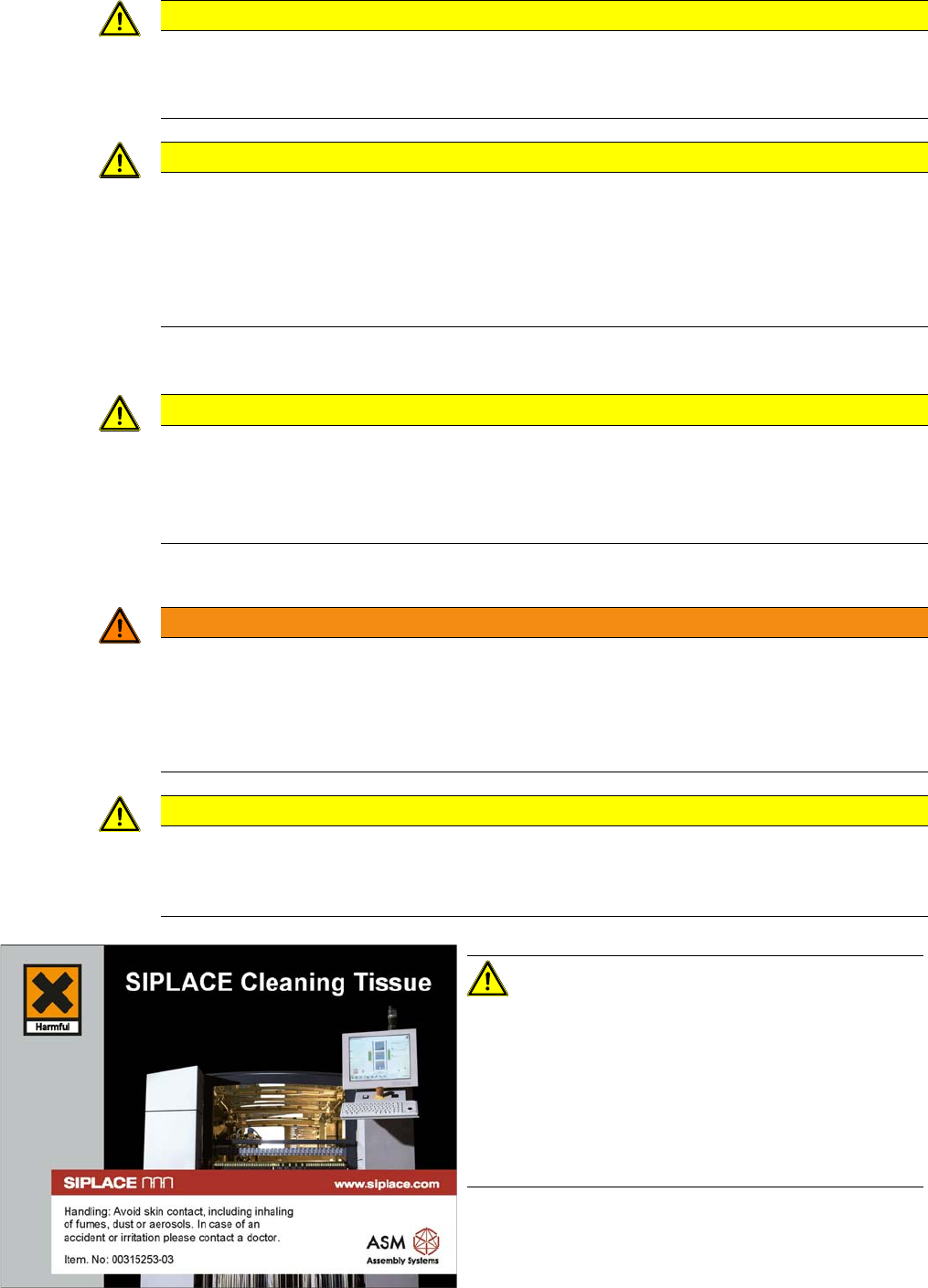
SIPLACE cleaning tissue
CAUTION
Risk of injury from compressed air!
Risk of injury when disconnecting the compressed air lines.
► NEVER disconnect compressed air lines while they are still pressurized.
CAUTION
Prolonged interruptions to the compressed air supply can cause damage.
When the machine is switched on, do not use the shutoff valve to interrupt the compressed air
supply for more than 30 minutes.
► If you need to shut off the compressed air system for longer in order to carry out your work,
you must switch the placement system off at the main switch and disconnect it from the
power supply.
CAUTION
Moving the gantry can damage the placement head.
When moving the gantry, observe the following:
► NEVER move the gantry by pushing with your hands against the placement head.
► NEVER push the gantry while the Z axis is lowered.
WARNING
Danger of burning
► Never use inflammable fluids (e.g. alcohol) for cleaning purposes when working in the vi-
cinity of a naked flame or fire.
► Never spray lubricants or cleaning agents from aerosol cans in the vicinity of a naked flame
or fire.
CAUTION
Ethanol
► Always wear safety goggles and gloves when using concentrated ethanol to clean modules.
► If ethanol should accidentally get into your eyes, rinse your eyes immediately with water.
CAUTION!
SIPLACE cleaning tissue
Harmful: may cause lung damage if swallowed.
Do not inhale vapor / aerosol.
Avoid contact with the skin. If swallowed, do not induce
vomiting. See medical attention immediately and show
the packaging or label.
Wear latex gloves while using the cleaning tissue.

Introduction
Safety Instructions 1.1.7 Safety Instructions on Hazardous Materials
72 Vacuum Pump Vakuumpumpe
Consumables
Cleaning and lubri cation
Danger of c utting on the IC and FC camera
Only one person must be present at each component preparation station at any given time
1.1.7
1.1.7 Safety Instructions on Hazardous Materials
Safety Instructions on Hazardous Materials
CAUTION
Consumables
Observe the safety data sheets for consumable materials!
CAUTION
Cleaning and lubrication
► Always use ethanol for cleaning – do not use solvents.
► Isopropanol – IPA can be used as an alternative.
► NEVER use compressed air to clean units inside the placement machine or modules.
CAUTION
Danger of cutting on the IC and FC camera
There is a risk of cutting your fingers along the edges of the mirror.
► Wear laboratory gloves as protection and avoid touching the edges.
► The laboratory gloves are also required for effective cleaning (fingerprints!).
CAUTION
Only one person must be present at each component preparation station at any given time.
This is to ensure the safety of the operator and the safety of the second person. Pulling in the
component trolley is a two-handed operation, so only one person can be reliably protected from
the possible risks.
CAUTION
Observe the safety data sheets
Observe the applicable safety data sheet, when handling hazardous materials (e. g. Loctite
241, ethanol).
Introduction
1.1.7 Safety Instructions on Hazardous Materials Preparatory Work...
Vacuum Pump Vakuumpumpe 73
1.2
1.2 Preparatory Work...
Preparatory Work...
Purpose and Scope
Before performing any preventive maintenance work, conversion work or service work, a procedure of
locking and tagging must be followed and warning signs must be attached if not stated otherwise. If it is
not necessary to switch off the machine, it is explicitly mentioned.
The procedure, when followed correctly, eliminates the possibility of an employee being injured.
Description
Whenever it becomes necessary to isolate, control and release energy, the following procedure is to be
followed.
► Notify affected employees.
► Switch off the machine and all additional devices. Carry out all normal stopping procedures:
⇨ Press the STOP button.
⇨ Shut down the station computer.
⇨ Switch the machine off at the main switch.
► Isolate the machine from all its energy sources:
⇨ Shut off the compressed air supply.
⇨ Shut off the main power supply.
► Lock out the machine.
⇨ Attach a lock wherever possible (e.g. to the main power switch or the motor contactor).
► Alternative: attaching warning signs
If a machine can be locked, it must be. However, there are situations where energy isolating devices
cannot accommodate locks. In these cases, the energy isolating devices must be tagged to warn
employees that the machine is de-energized for servicing. The tag or label must be securely fas-
tened, it must be placed in a position visible to all and it may only be removed by the person who
attached it.
NOTICE
Additional safety measures
These procedures represent the minimum lock/tag out requirements for the machine during
preventive maintenance work and service work. Any additional safeguards needed to complete
work safely can be specified by facilities supervision, the safety officer, the safety committee
and the health department.
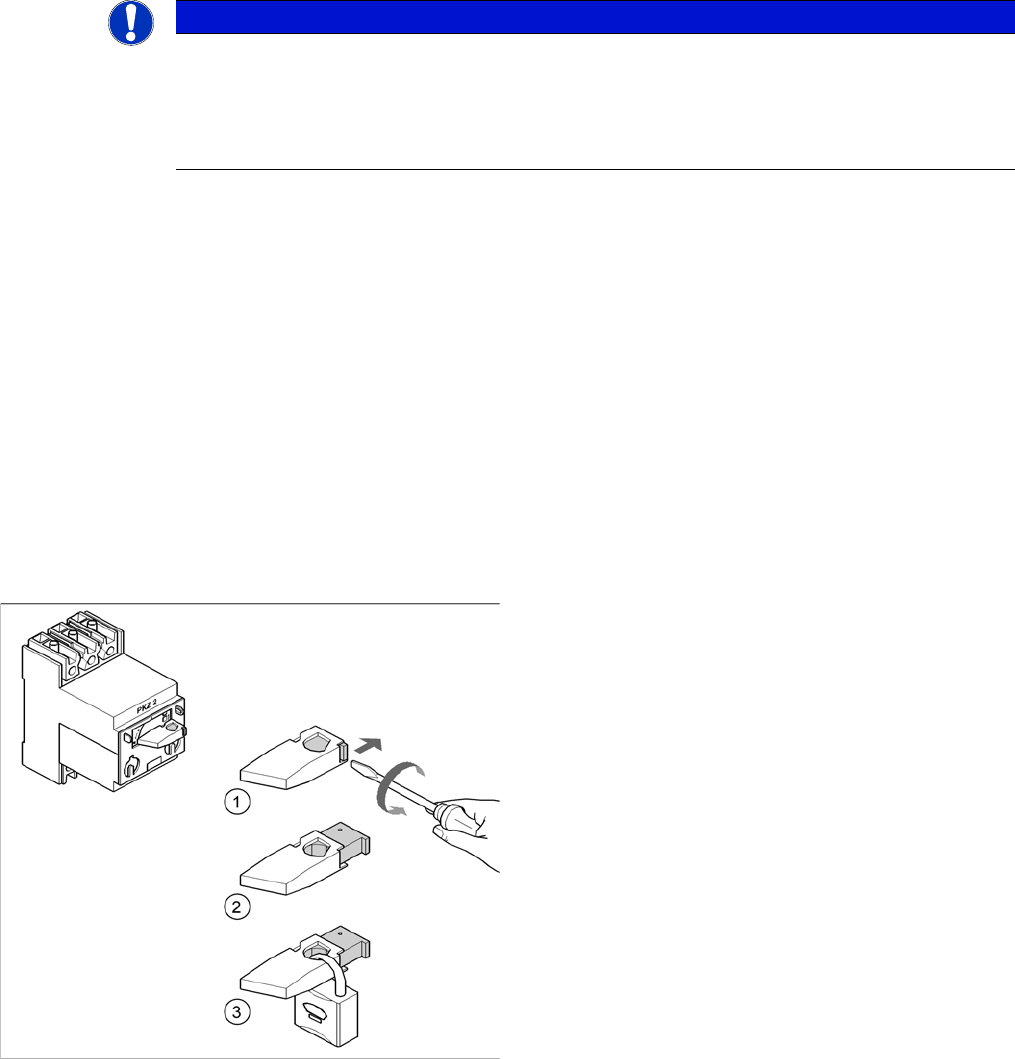
Example: attaching a padlock to the motor contactor
► Turn the operating lever (1) counterclockwise.
► Use the screwdriver to push the locking lug (2) out of
the operating lever (1).
► Secure the operating lever with a padlock (3).