PS288_PS388_PS588_981-0424-002D - 第105页
■ Administrator Functions ◘ Teaching the Reference Vision File PS Series Owner’s Manual 3—35 back online Help for instruct ions editing the WinAH400.int file. For an image of the Setup W indow , see Figur e 3-20 on page …
Operation ■ Administrator Functions
3—34 Data I/O • 981-0424-002
back
Teaching the Reference Vision File
A reference vision file stores a photo image of a specific device to
verify proper alignment of devices picked from the input media.
Therefore, each new device type must have a reference vision file cre-
ated and vision images made (taught).
Note: If the vision camera needs calibrating, it must be done
BEFORE creating the Vision file for your device.
Calibrate the Vision Camera first if any of the following are true:
• The PS Machine has been moved
• The camera has been replaced, moved, refocused, or contrast
changed
For instructions on recalibration, see Calibrating The Vision System on
page 4-50.
To teach the Vision File:
1. Creating the Vision File (and Package File) for Editing—
1a. Start TaskLink by double-clicking its icon.
1b. Select a job in the Task Manager.
1c. Click Edit.
1d. Click the System Files tab.
1e. Click the Package File Browse button, then copy the PS
Package
Template.txt
file and paste it into the same folder, renaming
the copy. Hint: use the Socket Adapter name, for example
PAG007.txt
.
1f. Click the Reference Vision File Browse button, then copy the PS
VisionTemplate.vpp
file and paste it into the same folder,
renaming the copy. Hint: use the Socket Adapter name, for
example
PAG007.vpp
.
Note: The required Socket Adapter ID number can be found in
Tasklink Task Manager.
Highlight your target Task and click Edit.
Select the Task tab and click FootNotes.
1g. Click OK.
2. Run a Job; Start AH500; Create a User and Password—
2a. With the same job selected, click Run. OK the Pass Limit. Note
the Socket Adapter Board Name on the Footnotes dialog and
then OK to close it.
2b. At the AH500 (PS System Software), click Start.
2c. At the Setup Window > Options tab, select the desired input,
output, and reject media.
Note: The WinAH400.ini file may require editing to display your
desired setup configuration. Then in the AH500 Application, the
desired options will be available in the Setup Window. See the
Videos of Vision File cre-
ation are available in the
online Help. Creating a
Reference Vision File is
listed under the Setting
Up and Teaching booklet
in the Table of Contents.
We will work with the
Package File later; how-
ever, it is convenient to
copy it now, also.
Package Files reside in the
Handler Computer in folder
C:\AH500\Package.
Copy & paste tip: Right
click the file and select
Copy from the popup
menu. Right click on blank,
white space for the same
popup menu and click
Paste.
■ Administrator Functions ◘ Teaching the Reference Vision File
PS Series Owner’s Manual 3—35
back
online Help for instructions editing the WinAH400.int file. For an
image of the Setup Window, see Figure 3-20 on page 3–18.
2d. Click System. If asked to enter password, click OK. Open the
Security Dialog and enter your password.
Note: If you don’t have a user profile, either have a supervisor
enter the correct password, or have them create a new User and
Password for you. Use the drop-down arrow, select your new user.
Click System and enter your password. See Creating Security Pro-
files on page 3-31.
2e. Click Gantry.
3. Center the probe over the device: rough-in and then more
accurately—
3a. [PS288, PS388, PS588 Optima] Ensure that the Socket Opener
ribs are adjusted for the current Socket Adapter. For instruc-
tions, see Adjust Socket Opener Ribs on page 3-41.
3b. Click Park (a yellow label).
3c. Manually place a device into socket 1 of the programmer closest
to the Vision camera. (We'll call it Pv, where v is the programmer
number closest to Vision.)
3d. Click label Pv.
3e. If necessary, adjust the position of the probe so that it is centered
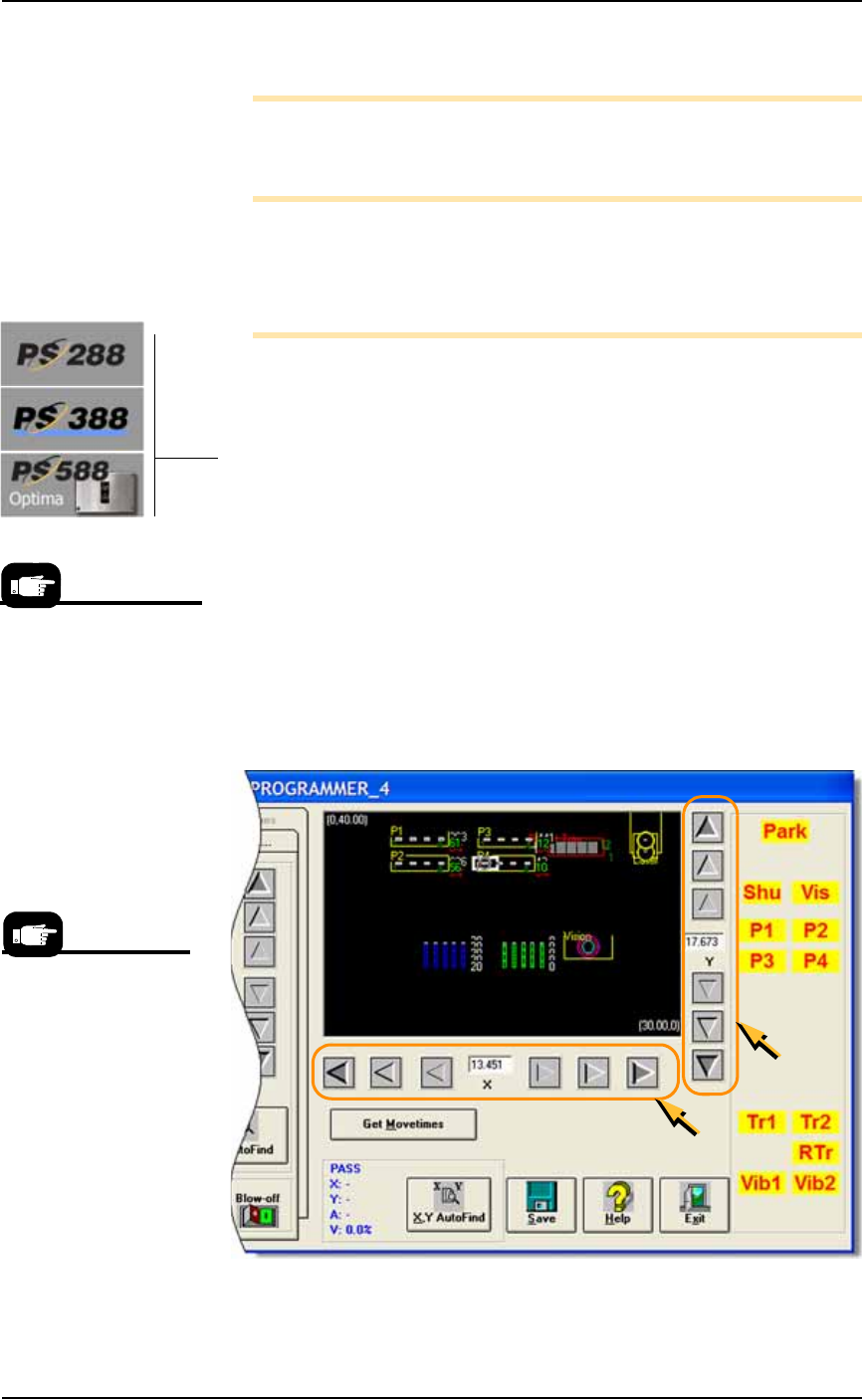
over the device in Pv. Use the X and Y-axis arrows (along the bot-
tom and right side of the black work area) so the probe is cen-
tered over the device.
3f. Save, and click Yes to overwrite the previous values.
Figure 3-27: The Arrow Buttons (circled) on the Gantry Window: From
the center working outboard, the arrow buttons adjust the probe
position ±0.001, 0.010, and 0.100 inches respectively. (PS388 shown.)
A Gantry Window posi-
tion label blinking RED &
YELLOW indicates the
location of the PNP head.
Your model may display
the yellow labels differ-
ently than shown here.
Operation ■ Administrator Functions
3—36 Data I/O • 981-0424-002
back
4. Teach the Z-value (pick height)—
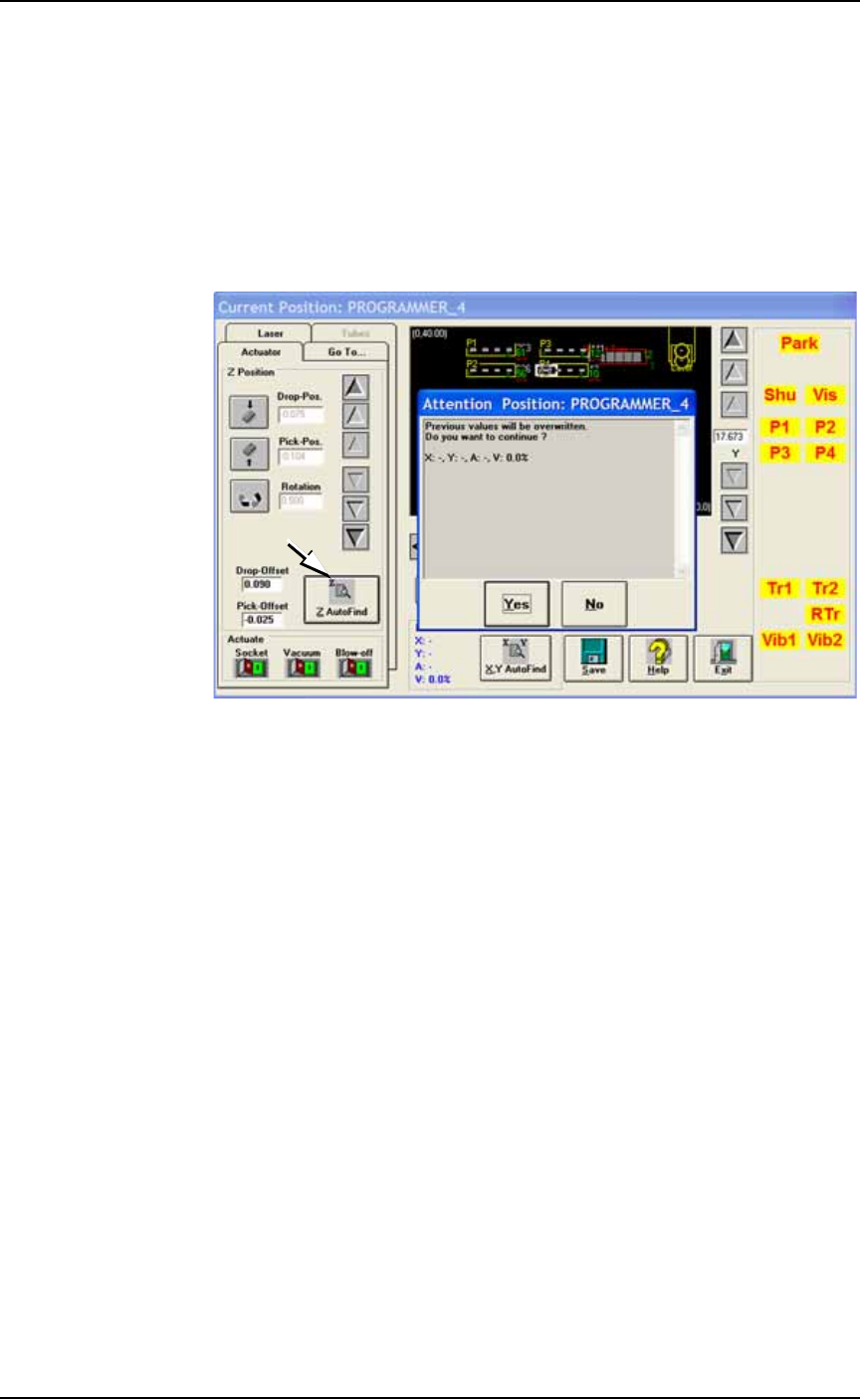
4a. Click Z AutoFind: the probe lowers to the device (to set the vertical
distance) and then click Yes.
4b. Right-click on Pv (using the Track Pad buttons) to pick up the
device and visually verify center.
4c. If it is not centered, right-click again to replace the device. Then
repeat the centering process with the X and Y-axis arrows. Click
Save. Pick the device again to recheck center.
If it is centered, right-click again to replace the device.
Figure 3-28: The ZAutoFind button is on the Actuator tab of the Gantry
Window. It uses the probe to determine the Z-value, or height, of a
component. (PS388 shown.)
5. Teach the vision system—
5a. With a device still in socket 1 of the programmer nearest the
vision camera (we’ll call it Pv), right-click label Pv to pick up the
device.
5b. Click the Go To tab.