PS288_PS388_PS588_981-0424-002D - 第200页
Maintenance ■ Troubleshoot ing 4—60 Data I/O • 981-0424 -002 back Other Problems For problems that are NOT programmer related, run the Collect PS Logs application any time after the problem has been seen. Starting Collec…
■ Troubleshooting ◘ Monitoring Daily Operation Logs
PS Series Owner’s Manual 4—59
back
Monitoring Daily Operation Logs
Daily operation logs are saved for each operation that the PS System
performs. As the operation is performed, its completion status is
noted in the log file. Log files can be used for troubleshooting and
viewing machine status.
To view the daily operation logs:
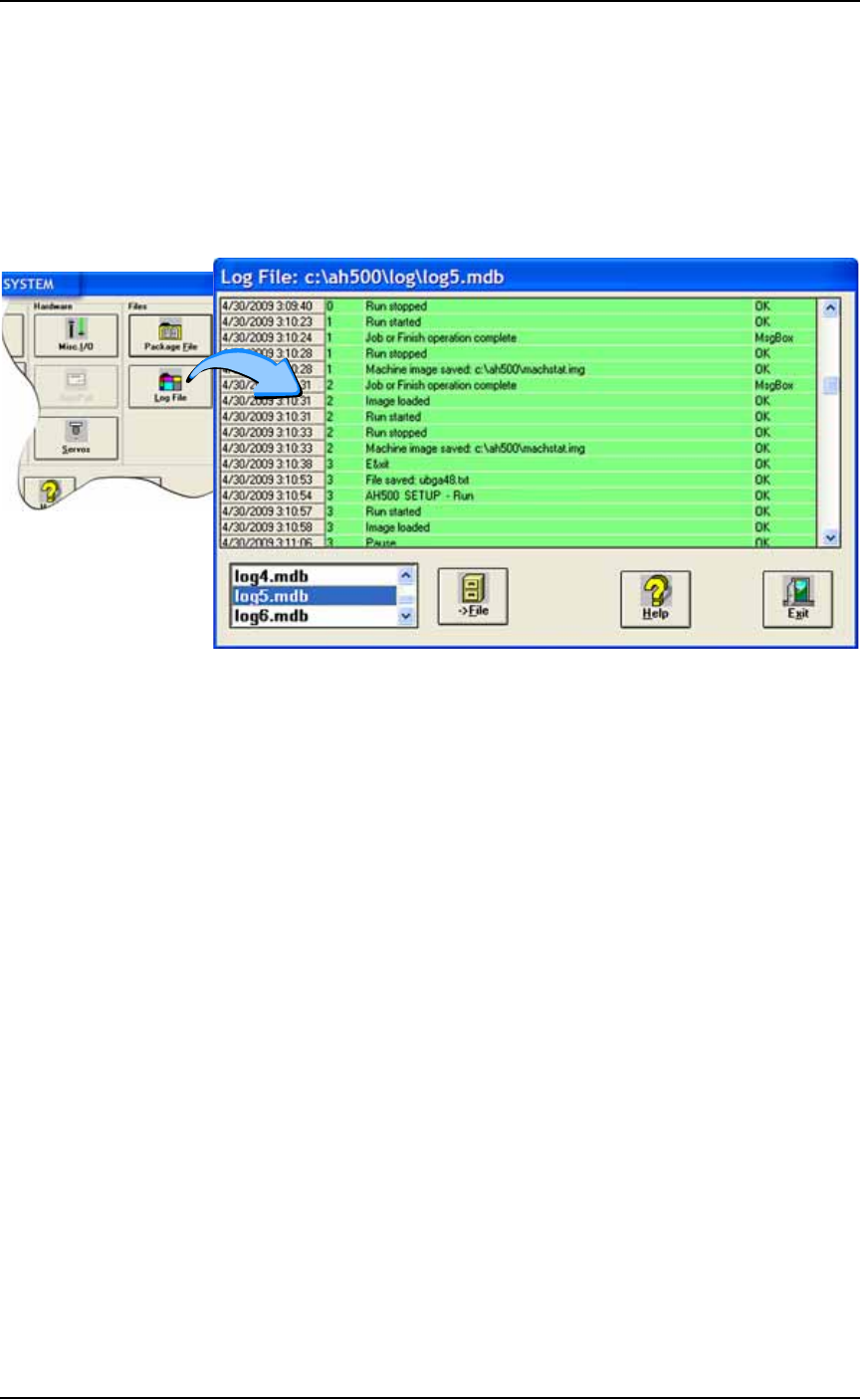
•At the Setup Window, select System > Log File.
Figure 4-54: At the Log File Window, Information is displayed about the
successful or unsuccessful completion of any operation of the
PS System. The system keeps a maximum of 7 days of history.
The Log Files are named
log1.mdb, log2.mdb, log3.mdb
, and so
on up to
log7.mdb
. They correspond to the days of the week,
log1.mdb
is for Sunday,
log2.mdb
is for Monday, and so on. On the
eighth day, the first file is overwritten. To save a record of daily oper-
ation logs, print the files or save them to another location.
Collect all PS System Logs
Collect PS Logs is a software utility on AH500 Software Version 6.3.6
and later, that collects all log files from the PS Machine. It creates a
ZIP file containing all the information that Data I/O, or trained ser-
vice technicians, need to evaluate your PS Machine status.
Programmer Related Problems
When you experience a programmer related problem:
1. Force the error to re-appear by running a job, or performing the
same steps that led to the trouble.
2. Close all Data I/O software like TaskLink, AH500. (Close AH500
the usual way: click Finish to stop a job, Exit the Run Window,
Exit the program.)
3. Start Collect PS Logs.
Maintenance ■ Troubleshooting
4—60 Data I/O • 981-0424-002
back
Other Problems
For problems that are NOT programmer related, run the Collect PS
Logs application anytime after the problem has been seen.
Starting Collect PS Logs
There are two methods to start the Collect PS Logs application.
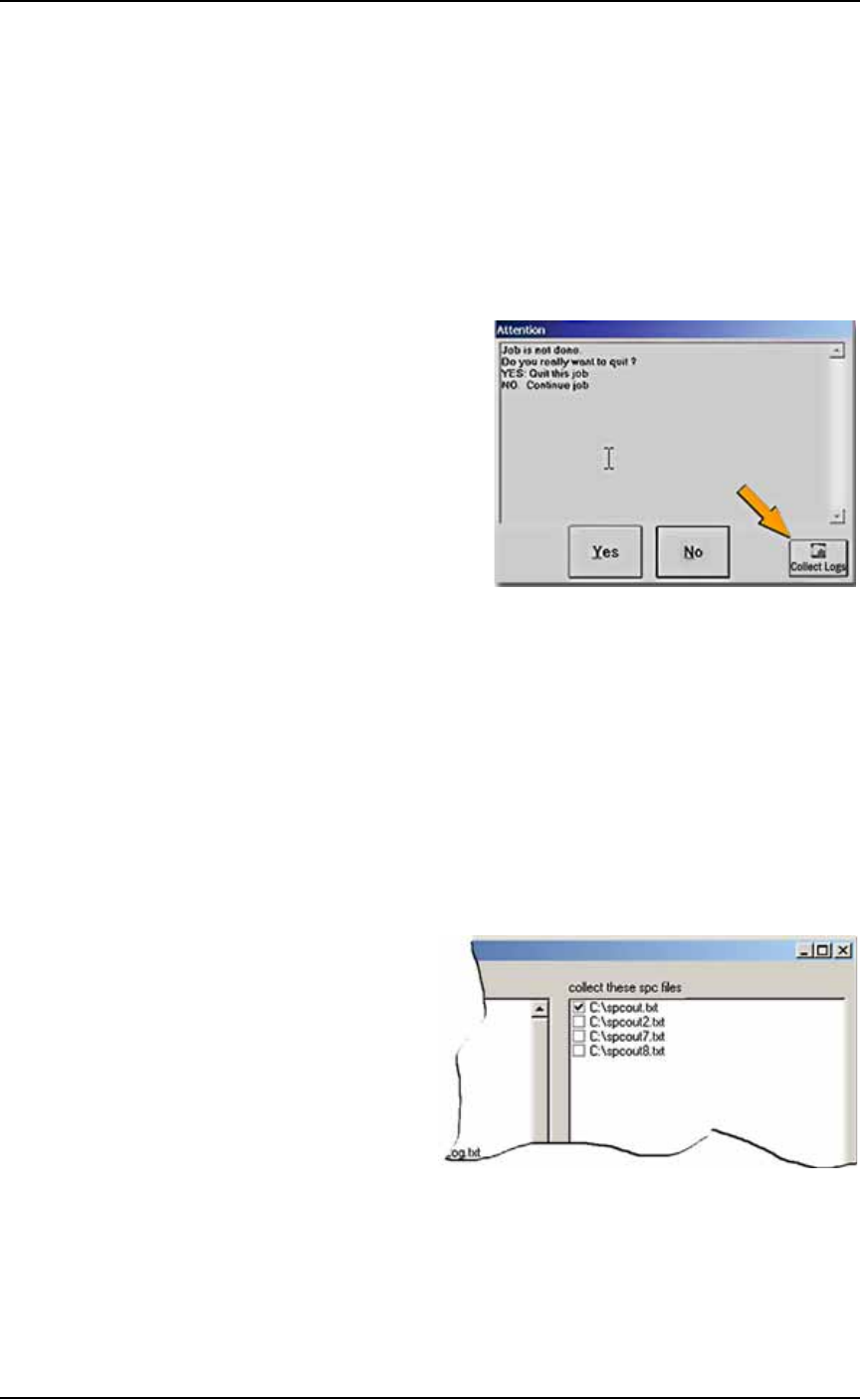
AUTO Mode uses default settings— The AH500 Software displays a
button in each message box that allows you to start the Collect PS
Logs application in AUTO Mode.
Figure 4-55: The Collect Logs button starts the Collect PS Logs Appli-
cation in Auto Mode.
When starting Collect PS Logs from a Message box (AUTO Mode),
only a progress screen is shown on the lower left corner of the screen.
All defaults are used and no user action is required.
The other method is to start from the Start menu (Windows XP) and
and it offers some options. An icon appears in Start > All Programs >
AH500 > Collect PS Logs.
After starting Collect PS Logs from the Start menu, the main window
appears where you can select which items you wish to collected.
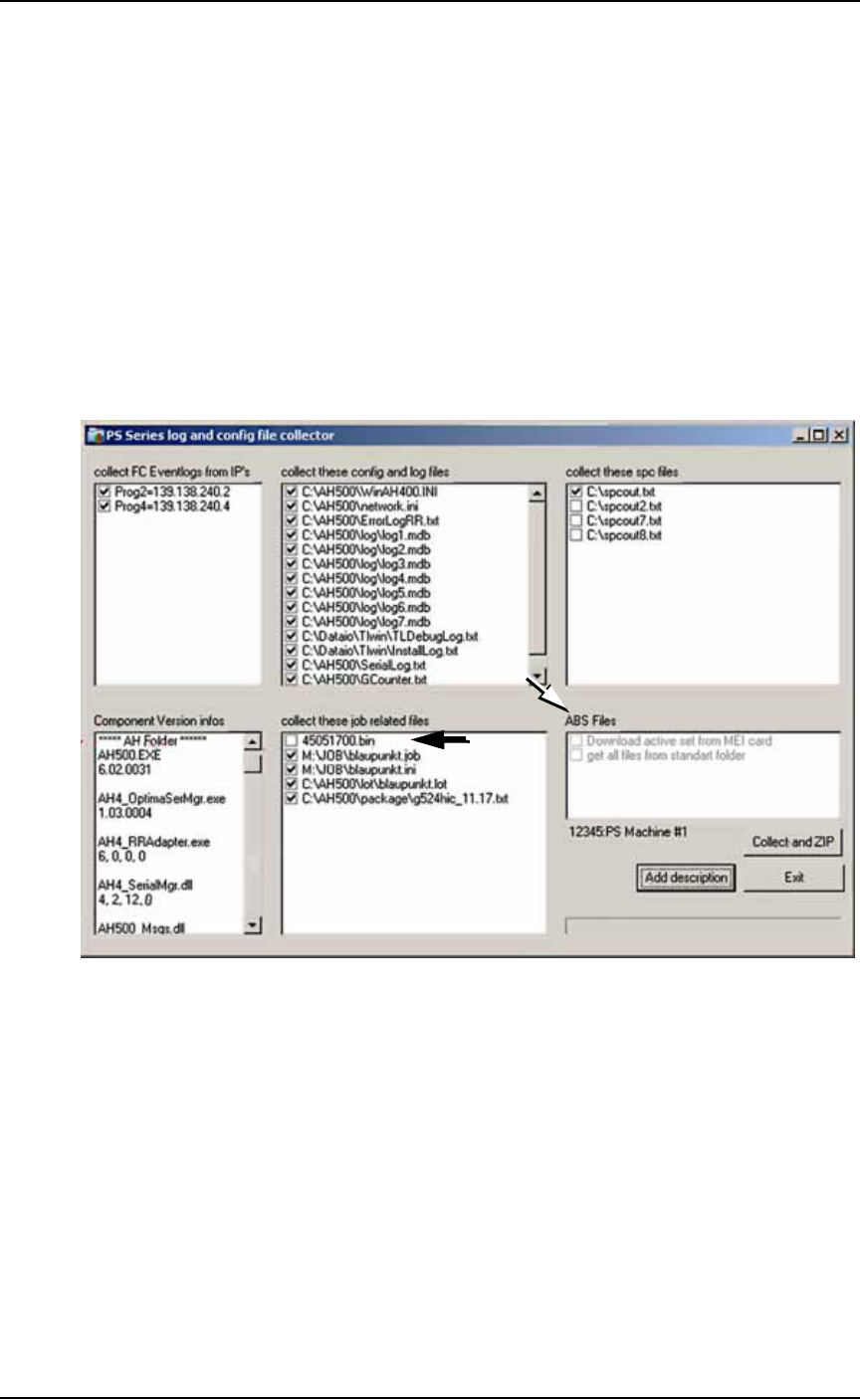
1. Select or clear check boxes for files as desired.
Figure 4-56: Only files with checked boxes are collected. The Collect PS
Logs Application automatically detects the name of the last job run. It
then identifies job-related files, including the data file used and serial
number configurations (if present).
■ Troubleshooting ◘ Collect all PS System Logs
PS Series Owner’s Manual 4—61
back
2. (Optional) Check additional SPC files if the error rarely
appears or appeared a long time ago.
3. (Optional) To enter a text description to the Zip file:
3a. Click Add description.
3b. Type a description into the field available. In addition to what
you type, the description will include the Date and Time the log
was captured and the serial number information from the
winah400.ini file.
4. Click Collect and ZIP.
A ZIP file is created in the same folder as the Collect PS Logs execut-
able. The ZIP file remains there even after exiting the Collect PS Logs
application. It is also copied to the Windows Clipboard.
5. Click OK to the message about pasting the ZIP file to another
desired folder.
Figure 4-57: . The ABS files (white arrow) are collected only when the
AH500 is not active. This ABS file field is disabled (dimmed as shown)
when an active handler is detected. By default, the data file (black
arrow) is not checked and therefore, will not be collected into the ZIP
file.
Command Line Support
When the command line parameter [
auto
] is passed to the applica-
tion, no Log Collector Window is displayed and all defaults are used.
A file with date/time stamp is being created. The naming format is
LogFiles__DD_MM_YYYY__HH_MM_SS.zip
for example:
LogFiles__13_09_2010__16_20_07.zip
.