PS288_PS388_PS588_981-0424-002D - 第37页
■ Laser Safety ◘ La ser Specifications PS Series Owner’s Manual 1—25 back Laser Specifications Specifications for las er Model 48-1(S) i nstalled in t he Option Bay: . Laser Safety Interlocks The Option Bay has five safe…
Introduction ■ Laser Safety
1—24 Data I/O • 981-0424-002
back
Laser Safety
The laser marking system, located in the Option Bay attached to the
PS Machine, has been designed in accordance with the following
safety guidelines:
• Operates as a Class 1 laser (CDRH classification).
• Fume extractor traps marking fumes and other by-products of
the laser marking operation.
• System designed to comply with OSHA guarding standards.
• Integrated safety interlocks prevent the laser from firing while
any interlock is activated.
• Refer to and follow laser and safety precautions in ANSI
X136.1-1993, American National Standard for the Safe Use of
Lasers. Procedures listed under the Standard include: appoint-
ment of a Laser Safety Officer, operation of the product in an
area of limited access by trained personnel, servicing of the
equipment only by trained and authorized personnel, and post-
ing of signs warning of potential hazards.
WARNING: Blindness hazard! When servicing, always wear eye
protection when the laser access doors are open. Direct or diffuse
laser radiation can damage eyes. Goggles must block 10.57 to
10.63
μ
m laser radiation. Goggles protect against scattered
energy but not against direct viewing of the laser beam or reflec-
tions from metallic surfaces.
WARNING: Serious burn hazard! Laser radiation, whether direct
or diffuse, can cause serious burns. When servicing, keep hands
and other parts of the body out of the path of the laser beam.
WARNING: Toxic fume hazard! Laser marking generates vapors,
fumes, and particles that may be noxious, toxic, or even fatal. Fol-
low maintenance procedures on the fume extractor. Use proper
ventilation.
■ Laser Safety ◘ Laser Specifications
PS Series Owner’s Manual 1—25
back
Laser Specifications
Specifications for laser Model 48-1(S) installed in the Option Bay:
.
Laser Safety Interlocks
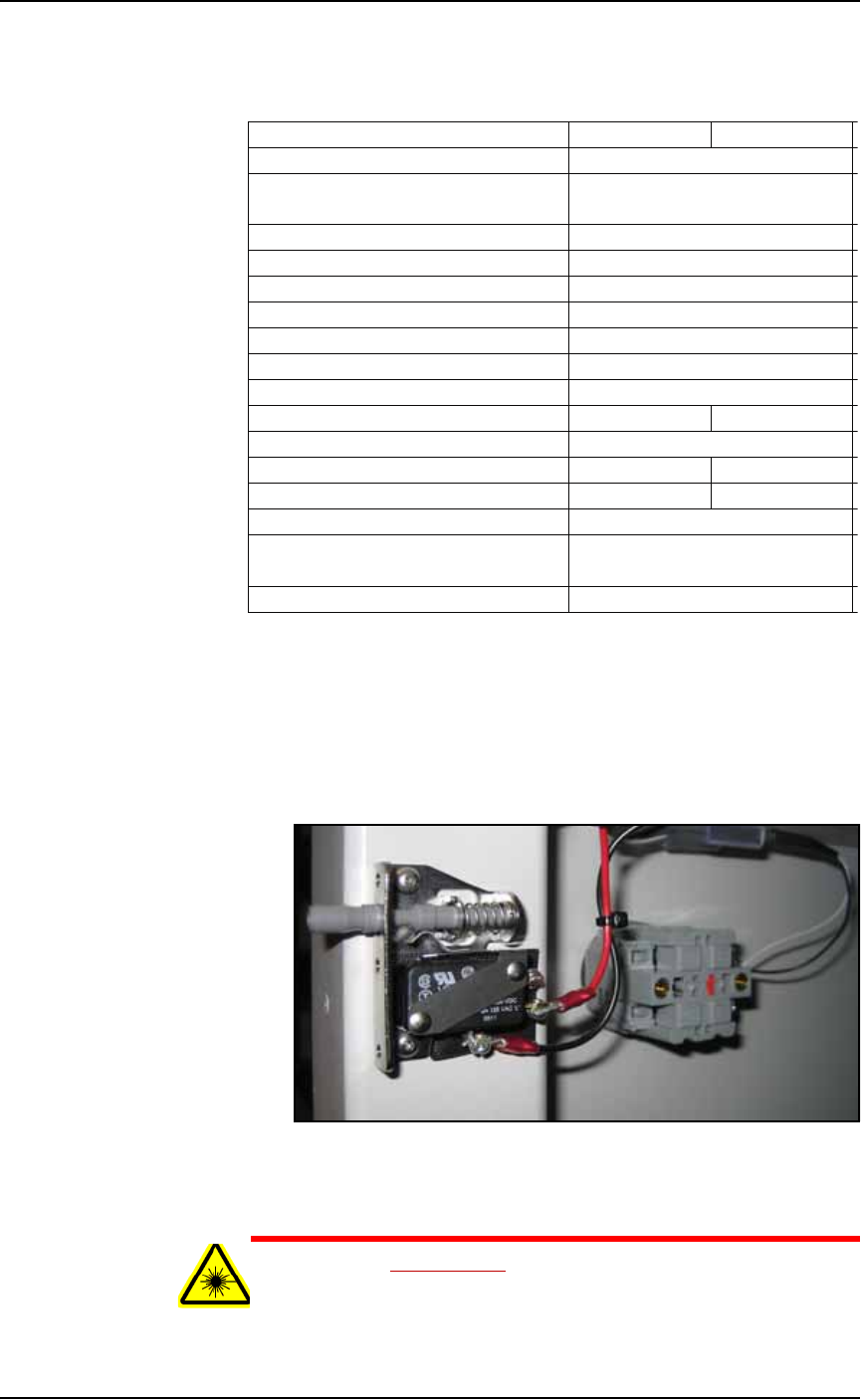
The Option Bay has five safety interlocks that prevent the laser from
firing when any cabinet panel on the Option Bay is removed. To
physically enable the laser, all panels must be closed. A laser safety
interlock is shown in Figure 1-13.
Figure 1-13: Laser safety interlock is visible when an access panel is
removed.
WARNING: Safety hazard—Never leave the PS Machine unat-
tended with a safety shield removed.
(S) O f (
Weight
Model 48-1(S) 48-1(S)W
Output Power
Mode Quality
Ellipticity
Rise Time
Beam Diameter
Beam Divergence (full angle)
Wavelength
Power Stability, from cold start (guaranteed)
Polarization
Cooling
Air Water
Heat Load (max)
Flow Rate, Air
250 CFM x 2 N/A
Flow Rate, Water (18-22ºC)
N/A 0.5 GPM
Input Voltage / Current
Dimensions (in)
(mm)
3.5mm
4mR
10.57-10.63μm
Linear (Vertical)
±10
429 x 71 x 107
9 lbs / 4.1 kg
16.9 x 2.8 x 4.2
30 VDC / 7A
10W
300W
TEM
00
, 95% Purity
M
2
<1.2
<1.2
<150μsec

Introduction ■ Laser Safety
1—26 Data I/O • 981-0424-002
back
Serious burn hazard—Direct or diffuse laser radiation can cause
serious burns.
Blindness hazard
—Direct or diffuse laser radiation can damage
eyes.
Disposal of Laser Vacuum Filters
The laser marking system uses a vacuum to remove the smoke and
other by-products of the laser marking process. The smoke fumes
pass through a series of filters designed to remove airborne particles
from the operating environment. Material Safety Data Sheets (MSDS)
for materials being processed should be thoroughly evaluated and
the adequacy of provisions for fume extraction, filtering, and venting
should be carefully considered.
The exact composition of the materials trapped by the filters depends
upon the materials used by the semiconductor manufacturer to create
the device package. Dispose of the filters in accordance with the
facility’s hazardous waste policy and in a manner that meets all appli-
cable government (local, state, and federal—or equivalent) regula-
tions.
Review the following references for further information regarding
exposure criteria:
• ANSI Z136.1-1993, Standards for the Safe Use of Lasers, section 7.3.
• U.S. Government’s Code of Federal Registers: 29 CFR 1910,
subpart Z.
• Threshold Limit Values (TLVs) published by the American Confer-
ence of Environmental Industrial Hygienists (ACEIH).
Determining Hazardous Contents
The company contracted to dispose of your facility’s hazardous waste
may be required to perform a profile of the filter contents to deter-
mine the specific composition of the particulate matter. The manufac-
turer of the semiconductor devices being marked may be able to
provide a profile sheet describing the composition of their packaging
material.
Standard plastic device packages typically contain antimony hydroxide
as a fire retardant, the source of the antimony in the vacuum filters.
Other hazardous materials may also be present depending upon the
type of device packages that are laser marked.
After the initial profile is performed and on record with the company
that disposes of the facility’s hazardous waste, additional testing of
contaminated filters should not be needed unless the contents of the
device packages or type of device packages being marked changes
significantly.
The licensed hazardous waste disposal company can provide the nec-
essary information to label the bags containing the filters and paper-
Analysis of filter con-
tents obtained following
marking a representa-
tive variety of devices
has revealed a sufficient
level of hazardous
materials, such as anti-
mony and other heavy
metals, to require that
the filter be treated as
hazardous waste.