00900330-01_UM_ASM-ProcessLens_EN.pdf - 第59页
4 Setting up and commissioning 4.1 Transport and delivery configuration Instruction manual ASM ProcessLens 03/2021 59 4.1.4 Transporting the machine in the crate 4.1.4.1 Services As a special service, ASM SMT Solutions o…
4 Setting up and commissioning
4.1 Transport and delivery configuration
58 Instruction manual ASM ProcessLens 03/2021
4.1.2 Checking a delivery
► Store the machine in the packaging until room temperature has been reached (minimum 4
hours). There is otherwise a risk of condensation occurring.
► Check the delivery for damage.
► Check the shock sensors on the transportation crate.
► Unpack the machine and the accessories and check the delivery for completeness (reference
delivery note).
► Document the results in the installation report /acceptance protocol.
4.1.3 Configuration when delivered
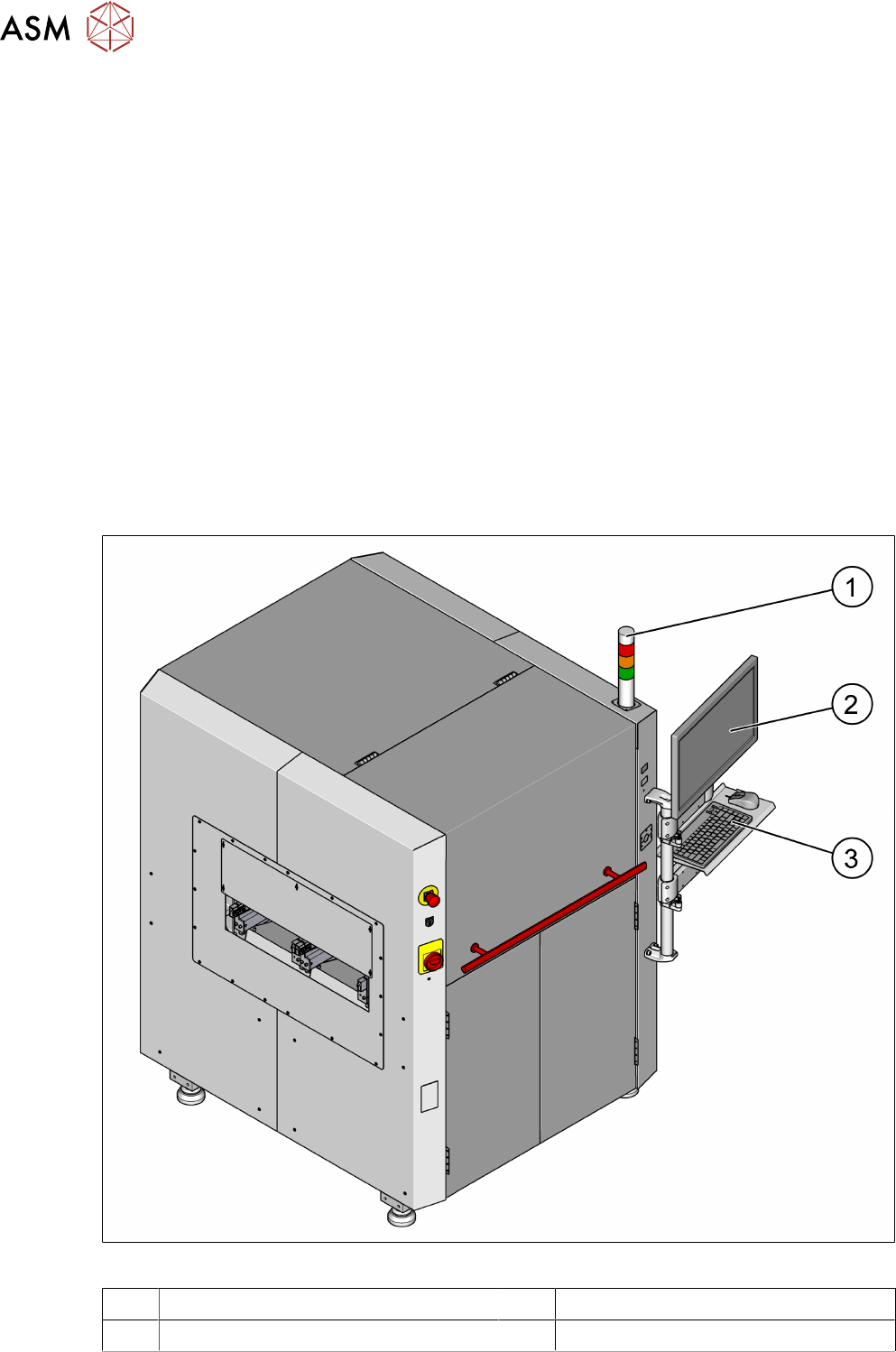
The machine is configured as follows when delivered:
●
The lane of the conveyor is set to a width of 210 mm. This width setting will be important when
fine-tuning the machine.
●
The keyboard is disconnected and dismantled.
●
The monitor is dismantled.
●
The tower lamp is dismantled.
●
All moving axes are fixed with shipping braces.
Fig.39: Configuration when delivered
1 Tower lamp (dismantled) 2 Monitor (dismantled)
3 Keyboard (dismantled)
4 Setting up and commissioning
4.1 Transport and delivery configuration
Instruction manual ASM ProcessLens 03/2021 59
4.1.4 Transporting the machine in the crate
4.1.4.1 Services
As a special service, ASM SMT Solutions offers to realize the complete integration of your ASM
ProcessLens in your production line. With our extensive expertise and by using the right tools and
equipment, we can ensure that the installation process runs smoothly and efficiently. However, this
will require you to clarify the infrastructure aspects in advance and make any necessary changes at
your production facility.
Please note that the safest way to transport the machine is always in the transport crate - or at the
very least on the pallet. This will prevent serious damage to the machine caused by the feet collid-
ing with obstacles, for example.
4.1.4.2 Safety instructions
WARNING
Risk of injury
► The applicable accident prevention regulations concerning the transportation of heavy
goods must be followed.
► If you do not use the forklift truck specified in section 4.1.4.3 "Means of trans-
port" [}59] to transport the machine, you will risk that the machine tips over.
► In particular, you should wear safety boots to minimize the risk of crushing your feet.
4.1.4.3 Means of transport
To transport the machine on a palette or on a transportation crate, use a forklift truck -with the fol-
lowing specifications:
Fork length min. 1800 mm
Lifting power min. 1000 kg
Distance between forks with the forks running parallel
to the direction of PCB transport.
Approx. 420 mm
4.1.4.4 Forklift attachment points on the transport crate or pallet
Position the forklift truck only at the points marked (1) in section 4.1.1.2 "Shipping packaging di-
mensions" [}57]. We recommend that you keep the crate or the pallet with packaging for later use.
WARNING
Risk of injury
If you still decide to transport the machine without a crate or pallet, you MUST follow the
instructions in the next section to avoid serious damage to your machine.
4.1.5 Transporting the machine without a crate or pallet
4.1.5.1 Safety instructions
WARNING
Risk of injury
► The applicable accident prevention regulations concerning the transportation of heavy
goods must be followed.
► In particular, you should wear safety boots to minimize the risk of crushing your feet.
► Read this section in full before transporting the machine to avoid severe damage.
► When you are transporting the machine, make sure that all the feet are clear of the
floor. If they are not clear, the feet will drag along the floor and bump into obstacles.
This could damage the machine foot thread in the machine frame.
4 Setting up and commissioning
4.1 Transport and delivery configuration
60 Instruction manual ASM ProcessLens 03/2021
4.1.5.2 Means of transport
Use a forklift truck with the following specification to carry the machine:
Fork length min. 1800 mm
Lifting power min. 1000 kg
Distance between forks with the forks running parallel
to the direction of PCB transport.
Approx. 420 mm
4.1.5.3 Forklift attachment points on the machine
The diagram in 4.1.5.3 "Forklift attachment points on the machine" [}60] shows the forklift attach-
ment points on the machine for lifting the machine off the pallet or transporting it without the pallet.
WARNING
Risk of injury
► Always use a pallet and forklift to transport the machine over longer distances in order
to avoid damaging the machine.
WARNING
Risk of injury
Please note the following points before you raise the machine in order to avoid irreversible
damage to the machine.
► The forks must be aligned parallel to the PCB conveyor.
► Make sure to push the forks all the way through. Not pinching cables. There is an area
in the center of the machine's base plate where there is a fan. If the forks are not go-
ing through fully, they could lift up the machine and be in contact with the fan and not
the machine's base plate which means the fan would get destroyed.
► The forks may only be opened to a degree which ensures that they are still within the
contact area of the machine underside (see 4.1.5.3 "Forklift attachment points on the
machine" [}60]).
► Do not increase the distance between the forks so that the machine is lifted outside
this contact surface. This would lead to deformation of the machine frame and/or dam-
age to the cables and leads.
► Make sure that the forks are evenly loaded when you lift the machine.
► A firm support between the forks and machine will prevent the machine tilting when it
is raised. This will also prevent a one-sided load on the machine feet, which would de-
form the fixing of the machine feet. We recommend that a second person watch the
machine as it is raised, and make sure that the machine does not tip to one side when
lifted with the forklift.