VALID-LINE-WEB - 第9页
V alid line LEGACY REPLA CEMENT Seica can safely claim to have the most experience on Legacy Replacement of obsolete A TE, inclusive of the replacement solution , the tools for TPS migration and the service to provide tu…
REAL TIME TEST EMULATION
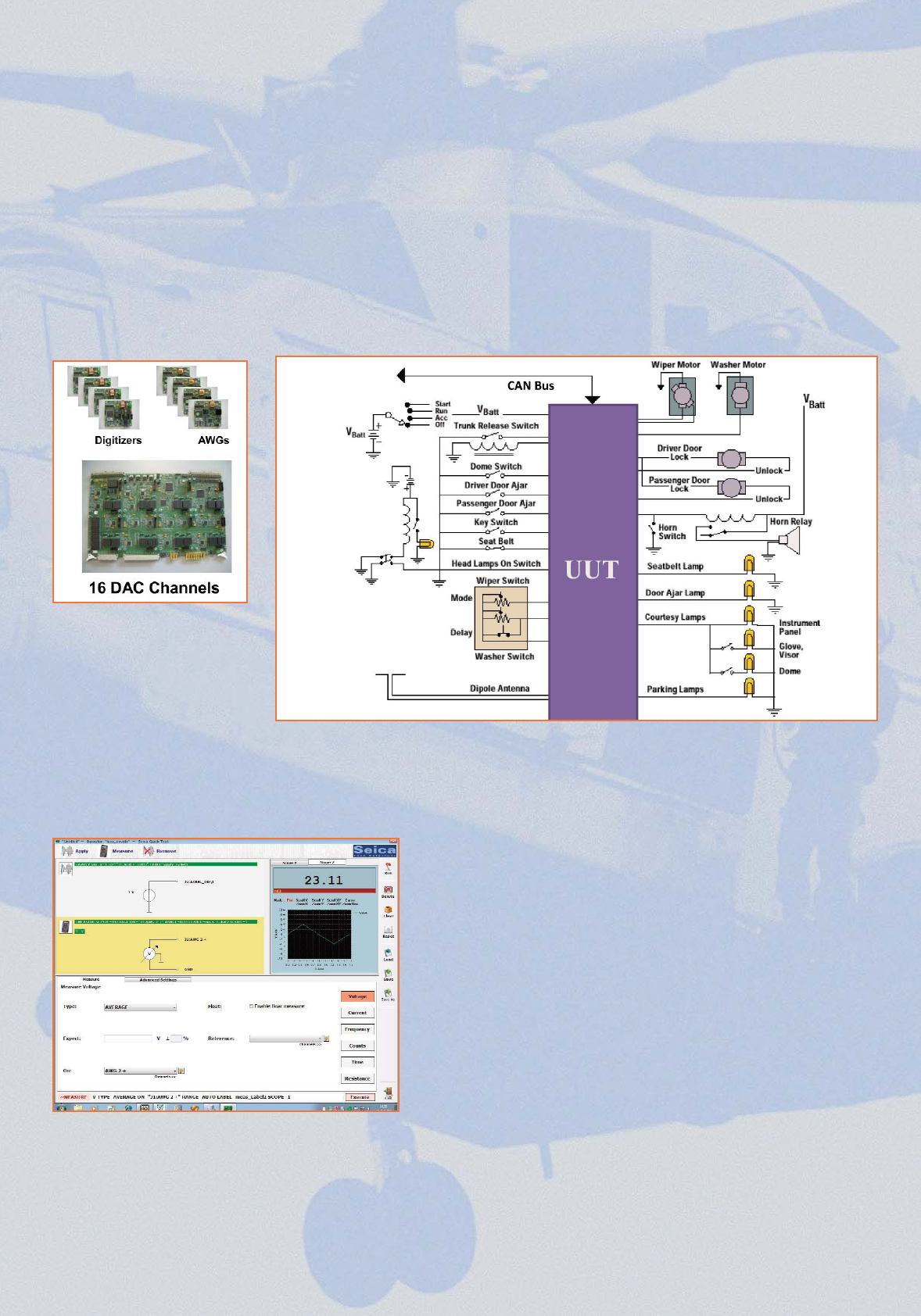
When UUTs are part of complex systems, the ATE will be able to emulate the operating conditions by applying multiple stimuli
and making multiple measurements in parallel. The iFUN is an analog test card designed to fulfil these requirements of real-
time signal generation and measurement at functional test. The card includes 16 four quadrant, grounded DC voltage
generators, programmable up to 20V with 16 bit resolution. The DC generators allow simultaneous application of independent
signals at the inputs of the UUT, to precisely reproduce discrete signals coming, for example, from sensors that are part of the
system, as frequently encountered in automotive, defence, aerospace, and industrial applications. The card can also mount up
to eight additional, independent test modules, either Arbitrary Waveform Generators (AWG) or Digitizers, in any combination,
to extend operations to a real parallel test scenario. Each AWG module has four floating voltage generators, with
programmable current limiting, and 16 bit resolution. Generation is through DDS (Direct Digital Synthesis) technique and
supported by 2M word of memory. The Digitizers allow simultaneous synchronized measurement as required by real-time test,
featuring floating mode with 16 bit resolution and up to 50MS/s sample frequency. The Valid system can hold up to four iFUN
boards, thus offering virtually unlimited parallel test capability in a matrix-free architecture.
Your Test Problem
Our iFUN Solution
Quick Test has been developed to offer engineers the ability to
combine the power of an ATE with the simplicity of a hand held
instrument. With direct graphical access to the complete path from the
instrumentation to the UUT, Quick Test allows preparing and executing
functional test scenarios in minimal time, without knowledge of the
architecture of the resources and the intricacies of language to be
used. With the test specification in one hand, the user will transfer the
information directly into the graphical environment of Quick Test and, at
a glance, get it executed and display the results.
Quick Test is easy to manipulate and to experiment with assisting the
engineer or technician in verifying test proposals.
Quick Test can be used like a Lab Instrument, for example, prior to
starting to prepare complex test procedures or as an interactive
diagnostic tool to confirm the location of a fault. The tremendous
flexibility of Quick Test makes it an ideal compliment to the Level 1
Portable Test Equipment, but also very beneficial as a tool for Level 2
STE integrators, or as a common tool between test engineers and
design engineers for the preparation of Level 3 board test programs.
Quick Test gives direct access to connections between instrumentation
and the UUT, and also supports a solid rules based control scenario,
which warns the user of potential dangerous operations to protect the
system and the UUT. Individual test operations, once created and
accepted, can be automatically converted on equivalent language
statements and stored for automatic documentation or later re-
execution.
The figure below shows the main operating screen of Quick Test.
In the upper left-hand corner, the system displays the
connection(s) being made. The upper right-hand corner serves to
have oscilloscope displays of the measurements made. The
bottom part of the screen is to modify the parameters of the
measurement; Tin the bottom line, the system directly creates the
correspondent language statement to the action graphically
executed.
QUICK TEST
Valid line
LEGACY REPLACEMENT
Seica can safely claim to have the most experience on Legacy Replacement of obsolete ATE, inclusive of the replacement solution,
the tools for TPS migration and the service to provide turn-key solutions. From the old GR179X/GR2750,Computer Automation (CA)
Marathon, and S79X test systems, to the more recent L3XX systems, Seica has successfully served customers worldwide to
migrate thousands of test programs, assuring life extension to long term defense products. There are several reasons to make
Seica the preferred partner, and the Valid Line the preferred solution, for Legacy Replacement:
- Since the start of the company in 1984, development of TPS for defense customers has been a key activity for Seica engineers.
- The Valid Line architecture is scalable to reproduce the most sophisticated digital and analog ATE configurations.
- The digital, analog, routing capabilities of the Valid Line match and exceed those of the ATE to be replaced.
- The Valid Line is committed to invest in new technologies, while at the same time retaining legacy techniques, like wide range
digital logic levels (+/- 30V),, guided probe diagnostics and fault dictionary, and analog guided probe routines, etc.
- The Valid Line can be provided with the same receiver used on the ATE to be replaced, thus accepting old fixtures without any
signal degradation.
- The Legacy Replacement environment of the Valid Line, which includes a wide number of input paths from most common
functional ATEs, is designed to fully automate TPS migration, with minimal user intervention, without loss of coverage and with
comparable, self documenting program structure.
From L300 To ValidFrom S790 To Valid
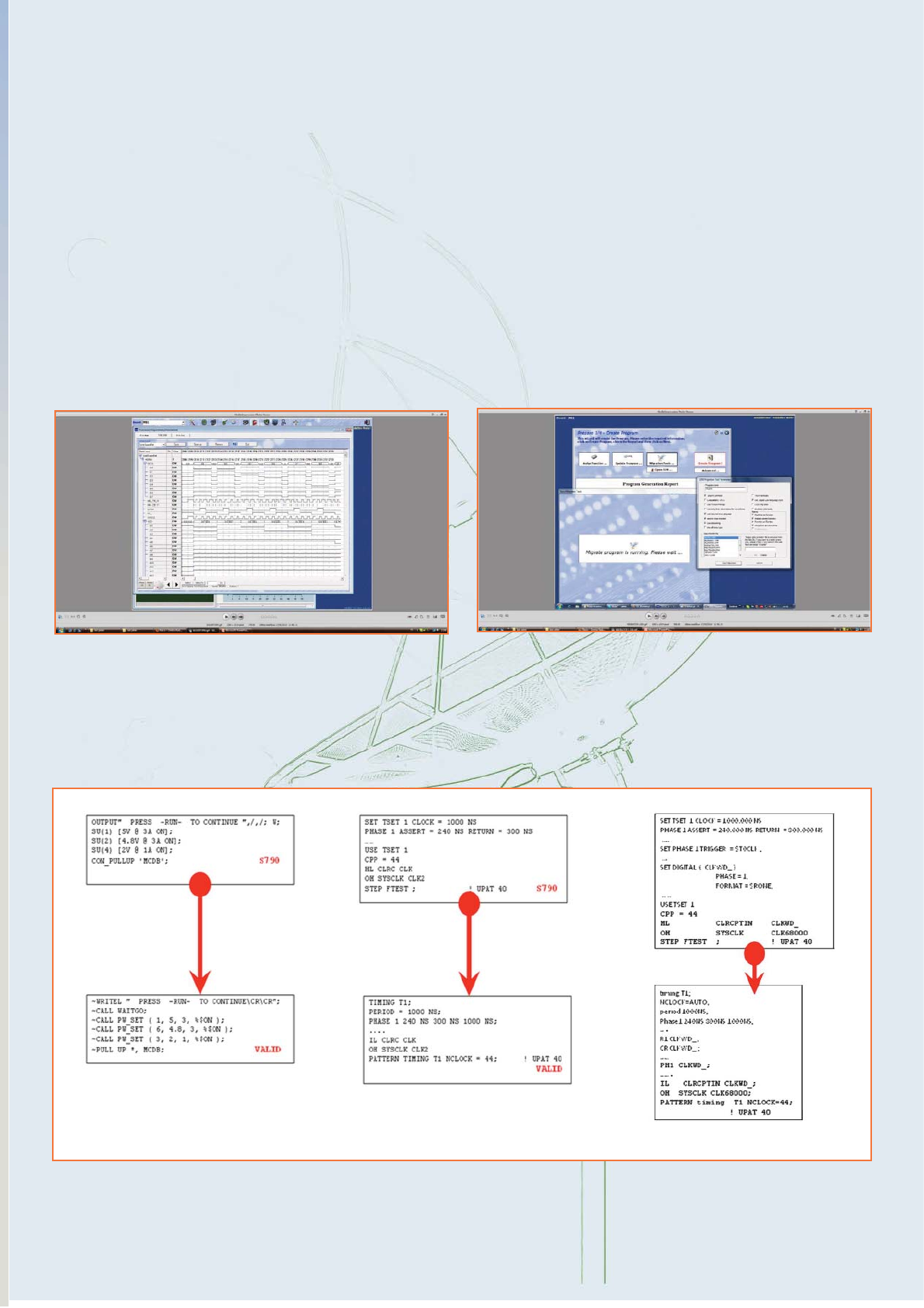
The figure below shows the correspondence between the original L300 instructions and the correspondent translation for execution by the Valid
hardware. The translation environment allows selecting different formats for the Valid language so that not only the characteristics and
performance of the test action are maintained, but also the readability is optimal, should some corrections be required at verification. The
translator operates with the same accuracy to convert the diagnostic data files; the translator for L300 also covers conversion of the analog tests
and associated routing.
Legacy Replacement Environment
Legacy Replacement Logic Analyzer
OPEN SOFTWARE ENVIRONMENT
All Seica instruments are fully supported by COM libraries to allow direct integration
with external environments, such as NI TestStand or Agilent VEE, and can be
programmed by external languages or graphic tools. Similarly, the Seica test
environment can call directly and execute software objects developed within external
test engines like LabView, LabWindows CVI, etc. This architecture allows the user the
advantages of years of experience embedded in Seica’s products and the flexibility to
take advantage of other commercial products as well.
For example, allowing customers the freedom to use the most suitable test sequencer,
test language, or graphic tool.
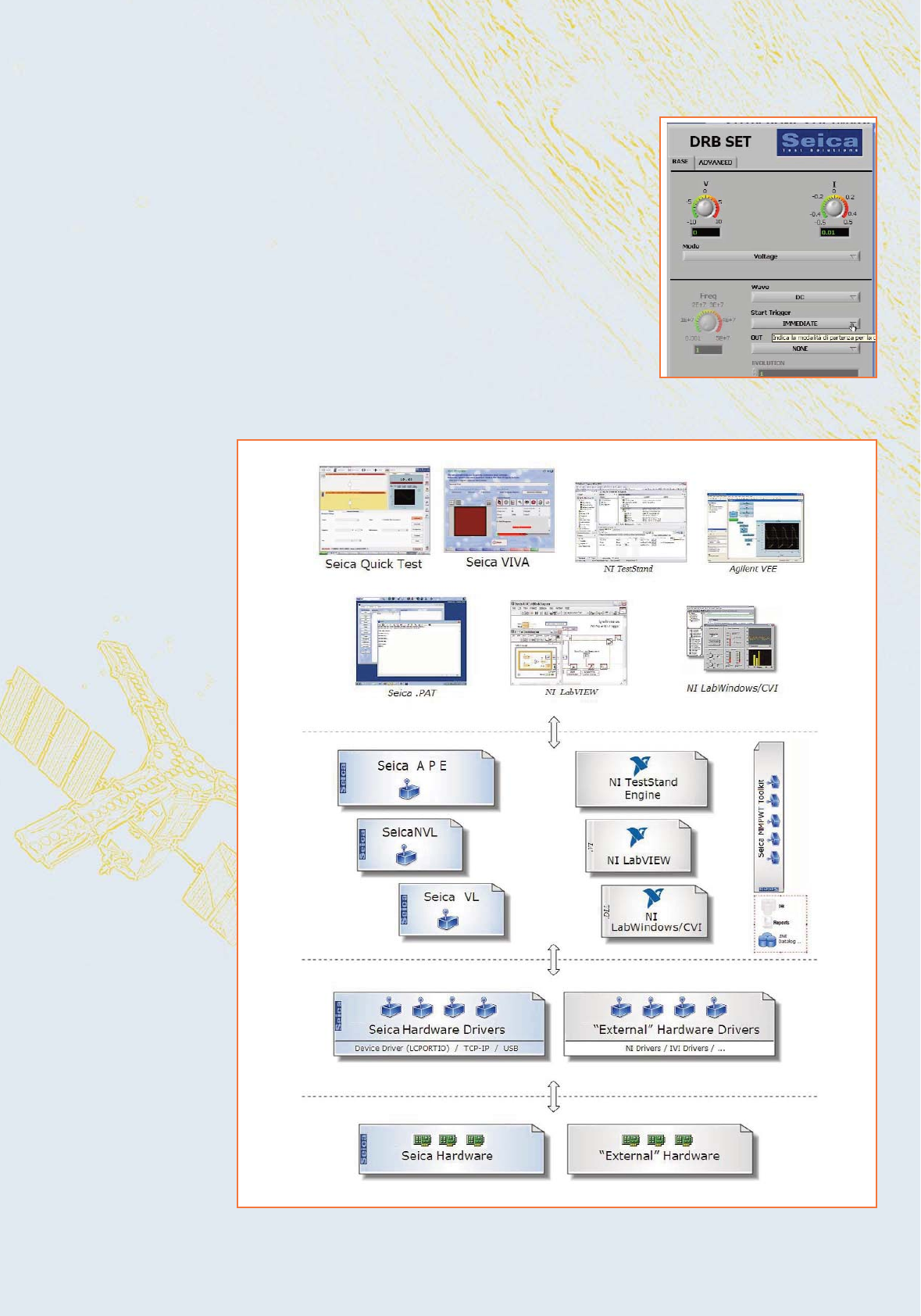
The figure below shows one of the
instruments of the ACL card,
controlled within LabView.
The following block diagram
shows the diversity, flexibility,
and interconnection of the
software modules within the
Valid Line.