Autosite_Users_Manual.pdf - 第54页
Setup and Ins tallation 2-32 Auto Site Us er Man ual Ways to Control AutoSite Once communica tion with Auto Site is established, you could control AutoSite i n any of the follo wing ways: • Termin al Mo de —Thi s interfa…

Setup and Installation
AutoSite User Manual 2-31
Finish Up
Establishing
Communication
By this point, AutoSite should have completed and passed a power-up
self-test. To establish communication with AutoSite, do the following:
1. After AutoSite has powered up, start your terminal or terminal
emulator (such as TaskLink) that you are using to communicate with
AutoSite. This terminal or terminal emulator must be capable of
emulating one of the following terminal types:
• ANSI 3.64 compatible terminals
• DEC VT-100 compatible terminals (supported by TaskLink)
• Qume QVT-101 compatible terminals
• TELEVIDEO TVI--910 compatible terminals
• Wyse WY-30 compatible terminals
If you are using handler control software, consult the documentation
to see if it supports one of the terminal types listed above.
2. If you are using terminal emulation software, configure your
software to match the following parameters:
• 9600 baud
•No parity
• 8 data bits
•1 stop bit
For more information, refer to the documentation supplied with the
software you will be using to control AutoSite.
If you are using TaskLink, the communication parameters listed above
can be set from the
Options
menu, in the
Programmer Port
dialog box.
TaskLink
If you are controlling AutoSite from TaskLink, make sure TaskLink is
running and press
C
TRL
+ F1
to check communication between TaskLink
and AutoSite.
If TaskLink responds with
Contact With Programmer Established
,
then TaskLink and AutoSite are communicating. If TaskLink cannot
contact AutoSite, check the cables connecting AutoSite to the PC and then
see the
TaskLink documentation for more information.
Note: Unless otherwise noted, all references to TaskLink in this manual refer to
the DOS TaskLink product. TaskLink for Windows performs similar
operations using different user interface commands. Refer to the
TaskLink for Windows Getting Started Guide
and online Help for
additional information.
Setup and Installation
2-32 AutoSite User Manual
Ways to Control
AutoSite
Once communication with AutoSite is established, you could control
AutoSite in any of the following ways:
•
Terminal Mode
—This interface is the standard menu system that is
built into AutoSite.
•
CRC Mode
—This mode uses Computer Remote Control codes to
instruct AutoSite. In order to use this mode, AutoSite must be
running in Remote Mode. CRC mode is described in Appendix A of
this manual.
•
Custom Software Interface or TaskLink
—This interface is a custom
interface or a PC-based menu interface (such as TaskLink, which
offers a full menu-driven user interface). For more information about
TaskLink, refer to the documentation included with TaskLink or
contact Customer Support.
More About Terminal
Mode
In most cases, the emulation software must be set to
full screen
terminal
mode before you can view
terminal mode
. If you are using TaskLink,
start TaskLink and select
Programmer Interface
from the
Utilities
menu
to access terminal mode. See your TaskLink documentation for more
information.
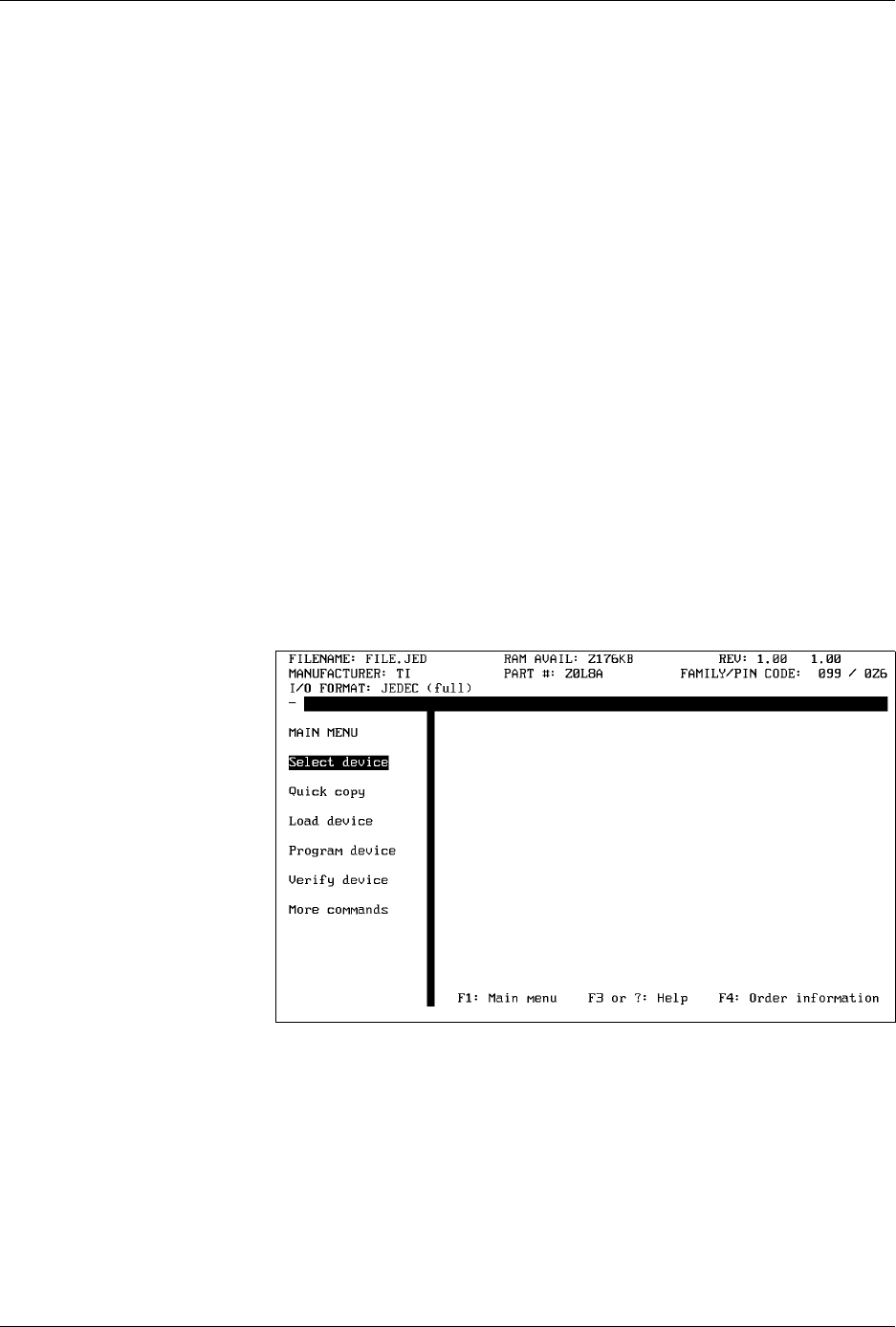
While in terminal mode, you can access the Main Menu, shown in Figure
2-23, which is the starting point from which you can select commands.
Selecting a Command in
Terminal Mode
You can select a command while in terminal mode by using one of two
methods:
• Type the first letter of the command, or
• Move the cursor to the menu item and press
E
NTER
.
If you get lost in the menu structure, press
F1
to return to the Main Menu.
Figure 2-23
The AutoSite Main Menu

Setup and Installation
AutoSite User Manual 2-33
Backing Up the
AutoSite Disks
When you have successfully powered up AutoSite, and you have
established communication between AutoSite and TaskLink, we suggest
you make a backup copy of your AutoSite disks.
If you have access to a DOS-based PC with a 1.44MB disk drive, use the
DOS DISKCOPY command to make a copy of your disks.
CAUTION: Make sure you use DISKCOPY and not COPY. The backup
must be an exact, bit-for-bit, sector-for-sector copy of the
original. Store the backup copy in a safe place.
To use the DISKCOPY command:
1. Insert an AutoSite disk (the “source” disk) into you PC’s disk drive.
2. At the DOS prompt, type
diskcopy
a
:
a
:
, where
a
represents the letter
of the disk drive into which the AutoSite disk has been inserted, and
press
E
NTER
.
DOS will copy a portion of the “source” disk into RAM. It will then
ask for the “target” disk, the disk to which you want to copy the
“source” information.
3. Remove the “source” disk and insert a formatted floppy disk into
your disk drive. DOS will then copy the information it has stored in
RAM onto the “target” diskette.
Note: You may be prompted to switch diskettes more than once.
What to Do Next Time
Next time you power up AutoSite, you probably do not need to follow all
the steps outlined in this chapter. Listed below are the normal steps for
preparing for another session on AutoSite.
Note: If you have not used AutoSite for a while, or if you suspect AutoSite might
have been moved from one area to another, follow the procedure below
before you use AutoSite.
To prepare AutoSite for another session, follow the procedure below:
1. Check the power cords and cables between AutoSite and the
connected equipment.
2. If you are controlling AutoSite from a PC, make sure it is on and that
the controlling software, such as TaskLink, is running.
3. If a Mass Storage Module (hard drive) is not installed, insert the
AutoSite Boot Files disk into the disk drive.
4. Select and insert a programming module (or Base) into the pin driver
head. Make sure the programming module (or Base) is locked in
place.
5. Connect the pin driver head to the handler.