semi合集-English.pdf - 第1014页
SEMI E137-1104 © SEMI 2004 7 17 Inspection Procedures 17.1 The custom er should insp ect external surfaces of the SME, separate s ubassemblies, and/ or support components f or cleanliness after removal of t he inner wrap…
SEMI E137-1104 © SEMI 2004 6
Fragile
Keep Dry
Any other markings as applicable (e.g., Center of
Balance, Do Not Stack, Keep Upright, Do Not
Freeze)
13.2 The following text should be applied by stencil
with lettering height of 1.3 cm (0.5 in.):
To/From information
PO number
Customer’s SME identification number, if
provided
Box ___ of ___
Tare weights
Dimensions
13.3 No markings should appear on the crate other than
information pertinent to the current shipment.
14 Packing List Procedures
14.1 The packing list should be affixed to exterior of
the crate in a weatherproof holder.
14.2 The packing list should specify what
component(s) of the SME each crate and container
holds.
15 Transportation Procedures
15.1 For shipment over land, the SME should be
transported in vehicles with air-ride suspension for all
support axles (e.g., with air-ride trailers).
15.2 The trailer should have no holes to the exterior in
the floor, walls, or roof.
15.3 Shipping containers should be secured using bars
and/or straps connected to the trailer.
15.4 If a shipping container is neither a wooden crate
nor a cardboard box (e.g., bubble pack), then
transportation provider should supply and wrap the
shipping container in clean protective covers and/or
pads.
15.4.1 The transportation provider, supplier, and
customer should keep the protective covers and/or pads
on the shipping containers during all phases of loading,
shipment, and unloading.
15.5 Shipping containers should not be stacked (i.e.,
top loaded).
16 Unloading, Unpacking, and Relocation
Procedures
16.1 The supplier should provide their requirements to
the customer for correctly unloading the SME from the
vehicle, unpacking it, and relocating it from the loading
dock/receiving area to its final location in the
cleanroom.
16.2 The supplier should work with the customer and
the movers to review and agree on their SME relocation
plan.
16.3 The crating and the monitors should be inspected
for any damage or indications of mishandling and
conditions recorded.
16.4 The outer shipping materials (e.g., crates, bubble
pack) should be carefully removed on the loading
dock/receiving area to prevent damage to the triple
wrapping.
16.5 The outer wrap should be cleaned and removed on
the loading dock/receiving area.
16.6 The middle wrap should be cleaned before the
SME, separate subassemblies, or support components
leave the loading dock/receiving area.
16.7 The SME, separate subassemblies, or support
components should be relocated to the at least ISO
Class 7 intermediate staging area.
16.8 The middle wrap should be cleaned again before
it is removed in the intermediate staging area.
16.9 The middle wrap should be carefully removed in
the intermediate staging area.
16.10 The inner wrap should be cleaned before the
SME, separate subassemblies, or support components
leave the intermediate staging area.
16.11 The SME, separate subassemblies, or support
components should be relocated to the final cleanroom
or a final staging area of the same cleanliness level as
the cleanroom.
16.12 The inner wrap should be cleaned again before it
is removed in the final cleanroom or a final staging area
of the same cleanliness level as the cleanroom.
16.13 The inner wrap should be carefully removed in
the final cleanroom or a final staging area of the same
cleanliness level as the cleanroom.
16.14 The humidity indicator should be inspected and
the reading recorded.
16.15 If the inner wrap is removed in a final staging
area, the SME, separate subassemblies, or support
components should be relocated into the final
cleanroom location for installation.
SEMI E137-1104 © SEMI 2004 7
17 Inspection Procedures
17.1 The customer should inspect external surfaces of
the SME, separate subassemblies, and/or support
components for cleanliness after removal of the inner
wrapping.
17.1.1 If the SME, separate subassemblies, or support
components fail the cleanliness inspection, supplier
should reclean the failed areas and pass a cleanliness
reinspection prior to start of installation.
17.2 The customer should provide the supplier with a
completed copy of their cleanliness inspection results.
18 Related Documents
Lin, Steve and Graves, Sarah, “Comparing The
Molecular Contamination Contribution Of Clean
Packaging Films,” Micro, October, 1998. p. 95.
http://www.micromagazine.com/archive/98/10/graves.h
tml
Nappi, John J. Jr., “A Guide to Ultra Clean Film
Packaging,” Cleanroom News, Vol. 7, No. 1, August
2003. http://www.liberty-ind.com/newsletter_0503.htm
NOTICE: SEMI makes no warranties or
representations as to the suitability of the standards set
forth herein for any particular application. The
determination of the suitability of the standard is solely
the responsibility of the user. Users are cautioned to
refer to manufacturer's instructions, product labels,
product data sheets, and other relevant literature,
respecting any materials or equipment mentioned
herein. These standards are subject to change without
notice.
By publication of this standard, Semiconductor
Equipment and Materials International (SEMI) takes no
position respecting the validity of any patent rights or
copyrights asserted in connection with any items
mentioned in this standard. Users of this standard are
expressly advised that determination of any such patent
rights or copyrights, and the risk of infringement of
such rights are entirely their own responsibility.
Copyright by SEMI® (Semiconductor Equipment and Materials
International), 3081 Zanker Road, San Jose, CA 95134. Reproduction of
the contents in whole or in part is forbidden without express written
consent of SEMI.
SEMI E140-0305 © SEMI 2005 1
SEMI E140-0305
GUIDE TO CALCULATE COST OF OWNERSHIP (COO) METRICS FOR
GAS DELIVERY SYSTEMS
This guide was technically approved by the Global Metrics Committee and is the direct responsibility of the
North American Metrics Committee. Current edition approved by the North American Regional Standards
Committee on December 10, 2004. Initially available at www.semi.org February 2005; to be published
March 2005.
1 Purpose
1.1 The purpose of this guide is to provide standard cost of ownership (COO) metrics for evaluating unit production
cost effectiveness of gas delivery systems in the semiconductor industry.
1.2 This guide also illustrates how to apply the COO metrics to gas delivery systems. Users should be able to
calculate the COO for any piece of gas delivery equipment using this guide.
NOTE 1: A spreadsheet (Microsoft® Excel) has been provided as an illustrative example.
1.3 The guide establishes a well-defined procedure to facilitate an understanding of equipment-related costs by
providing definitions, classifications, algorithms, methods, and default values necessary to build a full or constrained
COO calculator.
2 Scope
2.1 This guide defines a COO metric that can be applied to any gas delivery system. Some terms are specialized to
integrated circuit wafer and device production, but may be adapted for other applications.
NOTICE: This guide does not purport to address safety issues, if any, associated with its use. It is the
responsibility of the users of this guideline to establish appropriate safety and health practices and determine the
applicability of regulatory limitations prior to use.
3 Limitations
3.1 Effective building of a COO model requires identification of constraints and data values. Example data is
provided in this document and may be updated periodically. Where possible, use direct values for inputs rather than
deriving them from secondary models or using example values.
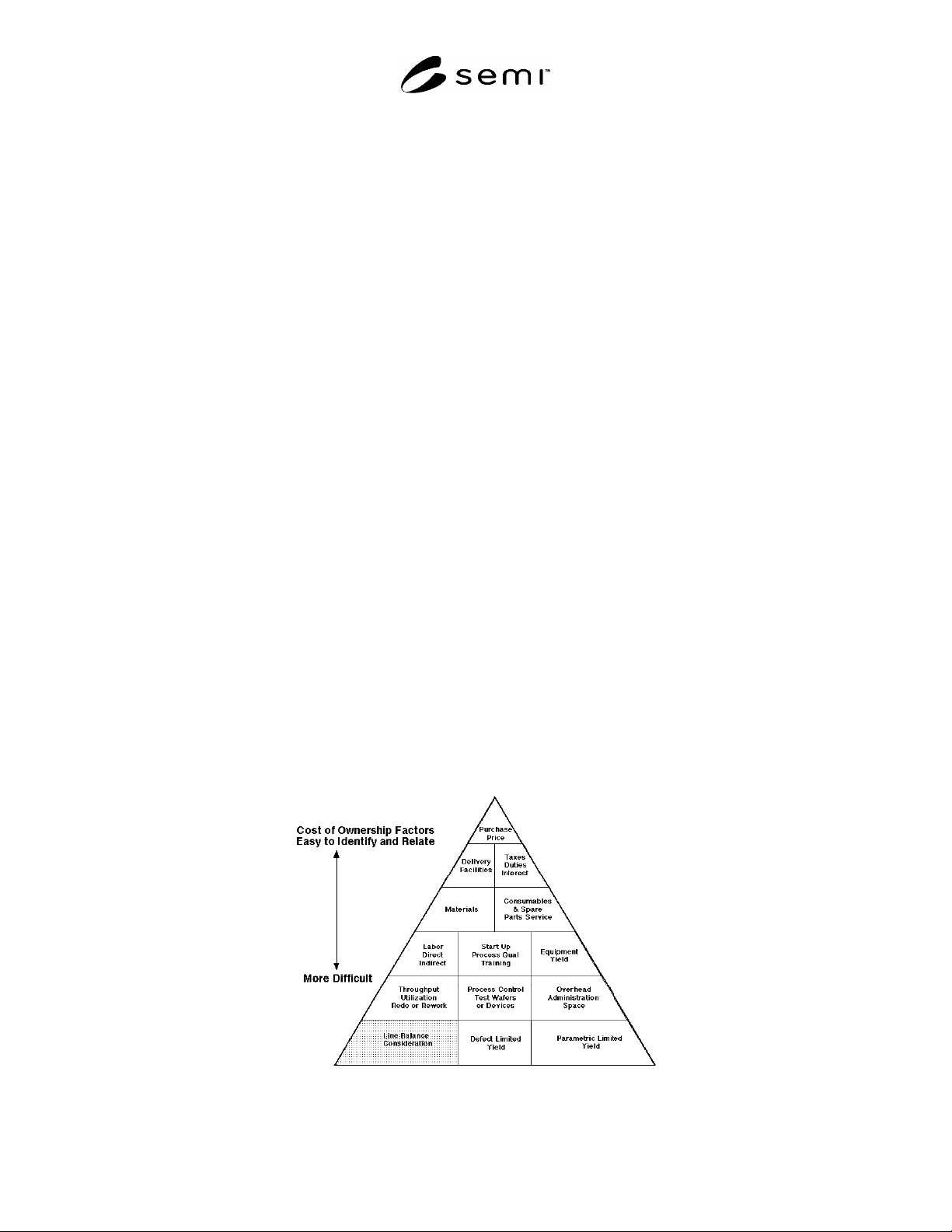
3.2 Certain factors are more difficult than others to accurately determine. Figure 1 depicts the relationship of some
of the COO factors to ability to collect and validate information. The accuracy of a COO calculation may be prone
to a variety of errors or omissions.
Figure 1
Relationship of Cost Factors to Difficulty of Collection and Validation