semi合集-English.pdf - 第1083页
SEMI E5-1104 © SEMI 1982, 2004 25 Name Format Description Values Where Used MMODE 10 Matrix mode select, 1 byte 1 = Host source mode Use S7F7 and F8 to define the process program to be used. 2 = Local source mode Use the…
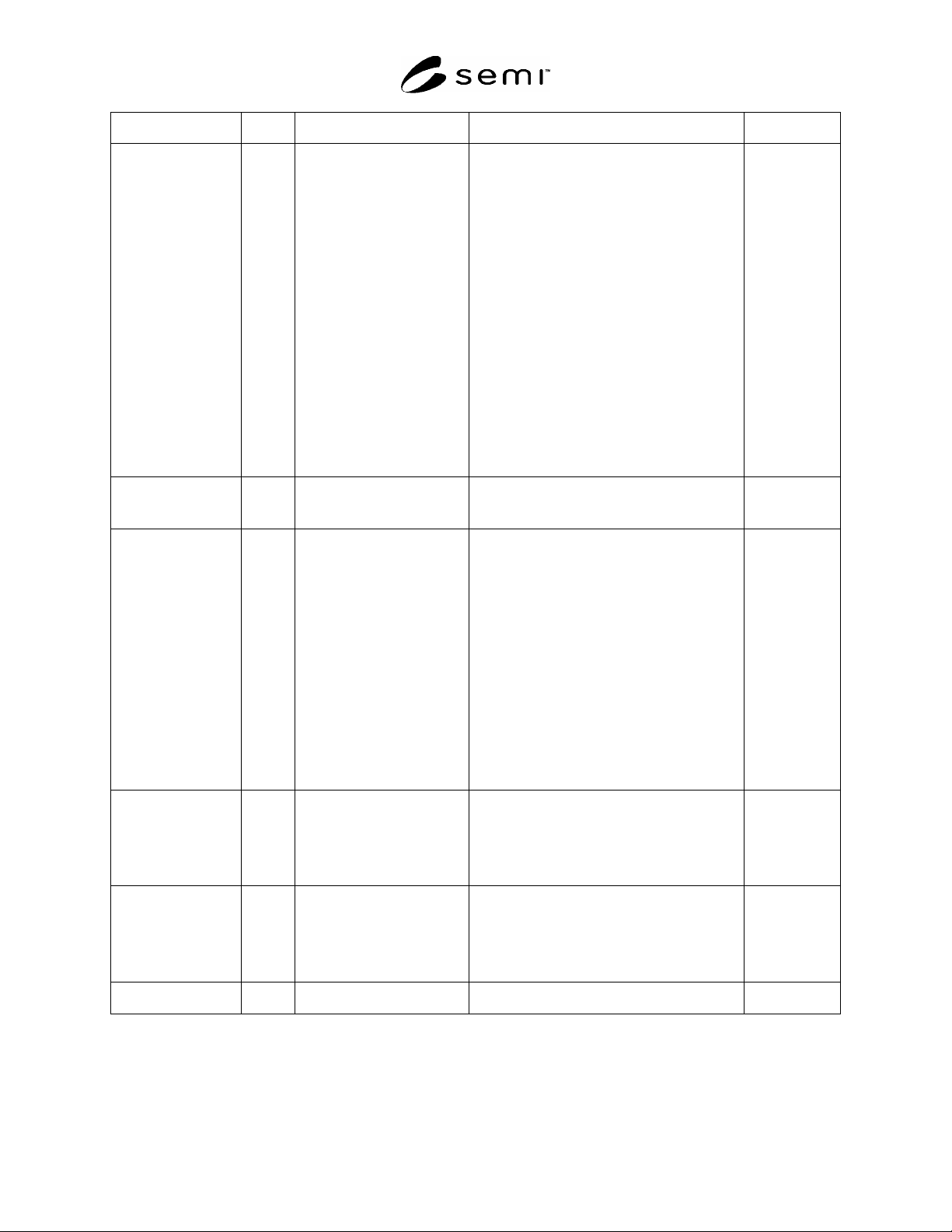
SEMI E5-1104 © SEMI 1982, 2004 24
Name Format Description Values Where Used
MF 10, 20 Material format code 1 byte
by Format 10
Items with format 10 will be
encoded as follows:
1 = Quantities in wafers
2 = Quantities in cassette
3 = Quantities in die or chips
4 = Quantities in boats
5 = Quantities in ingots
6 = Quantities in leadframes
7 = Quantities in lots
8 = Quantities in magazines
9 = Quantities in packages
10 = Quantities in plates
11 = Quantities in tubes
12 = Quantities in waterframes
13 = Quantities in carriers
14 = Quantities in substrates
15-63 Reserved
Items with format 20 will be a
unit identifier for one of the
special SECS generic units, as
specified in Section 12.
S3F2, F4, F5,
F7;
S16F11, F13,
F15
MHEAD 10 SECS message block header
associated with message
block in error
S9F1, F3, F5,
F7, F11
MID 10, 20 Material ID
80 Characters maximum
S2F27;
S3F2, F4, F7,
F9, F12, F13;
S4F1, F3, F5,
F7, F9, F11,
F13, F15, F17;
S7F7, F8, F10,
F11, F13, F35,
F36;
S12F1, F3, F4,
F5, F7, F9, F11,
F13, F14, F15,
F16, F17, F18;
S16F11, F13,
F15;
S18F10, F11
MIDAC 10 Material ID Acknowledge
Code, 1 byte
0 = Accepted
1 = Invalid port number
2 = Material is not present at
identified port
>2 = Error
3-63 Reserved
S3F14
MIDRA 10 Material ID Acknowledge
Code, 1 byte
0 = Acknowledge, MID follows
1 = Acknowledge, will not send
MID
2 = Acknowledge, will send MID
later in S3F13
3-63 Reserved
S3F12
MLCL 5() Message length
Defined by message size in
(bytes)
S12F4, F5
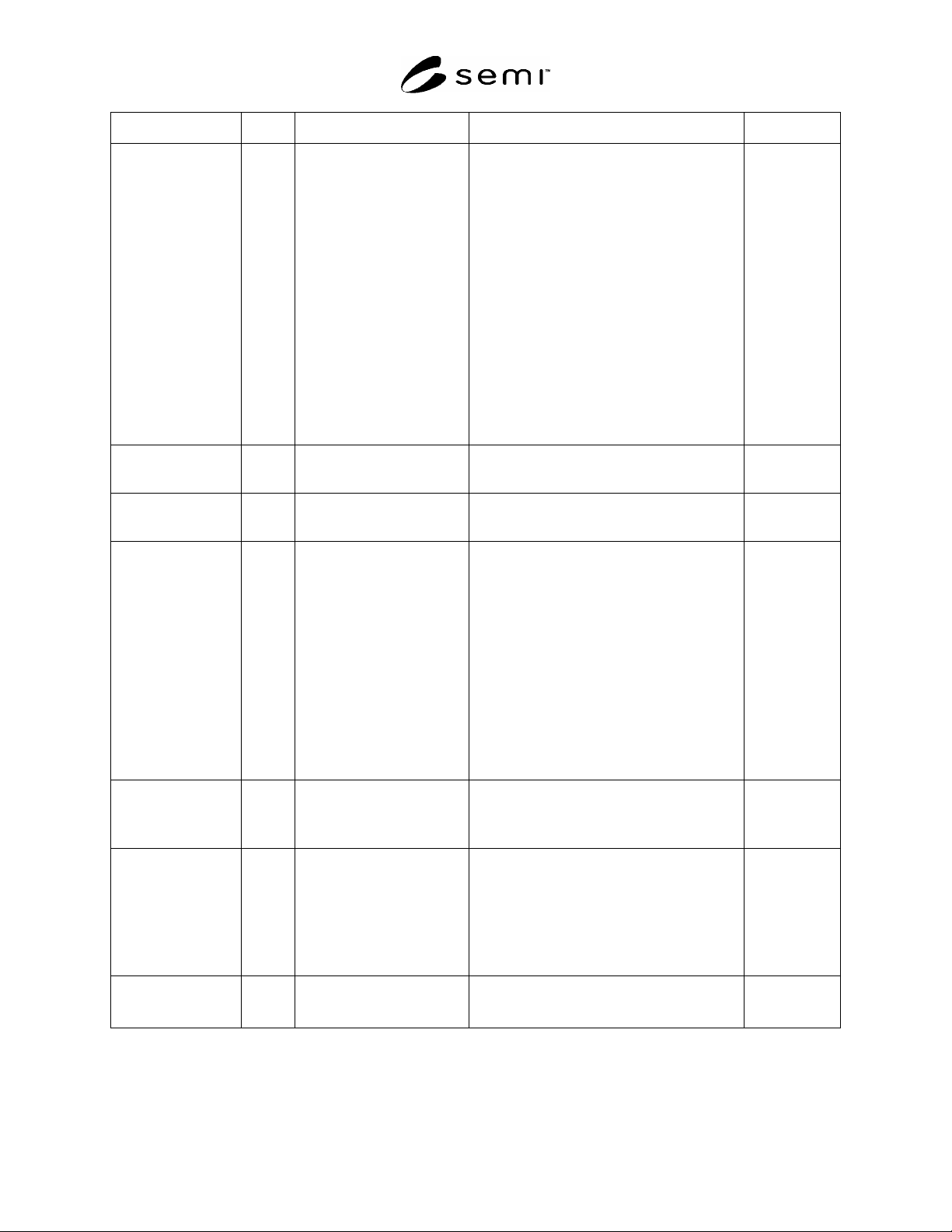
SEMI E5-1104 © SEMI 1982, 2004 25
Name Format Description Values Where Used
MMODE 10 Matrix mode select, 1 byte
1 = Host source mode
Use S7F7 and F8 to define the
process program to be used.
2 = Local source mode
Use the matrix defined by S7F9,
F10, F11 and F13 to define the
process program to be used. The
equipment will initialize to
local source mode at power up.
The equipment will default to
local source mode from host
source mode in the event of loss
of communication with the host.
3 = Host immediate mode
Use the current process program
for all material unless changed
by S7F1-F4. The timing of the
mode change is equipment-
specific.
S7F15
NACDS 32, 52 Not After Command Codes
Vector of all command codes
which defined command may not
succeed within the same block.
S7F22
NBCDS 32, 52 Not Before Command Codes
Vector of all command codes
which defined command may not
precede within the same block.
S7F22
NULBC 20, 51 Null bin code value
This value is the bin code value
that is used for no die at a
location. (For X/Y coordinate
format the ASCII value is a
value with "n" length. For
other map formats, ASCII is a
single byte per bin with "n"
length per item; thus, the total
number of bins is the length,
i.e., length "n" = 10 for ASCII
format is 10 single byte bin
codes.) The format used must be
the same as the one used for
BINLT and BCEQU. Zero length
indicates not used.
S12F1, F3, F4
OBJACK 51 Acknowledge code:
0 = Successful completion of
requested data
1 = Error
>1 Reserved
S14F2, F4, F6,
F8, F10, F12,
F14, F16, F18,
F26, F28
OBJCMD 51 Specifies an action to be
performed by an object:
0 = Reserved
1 = Attach to requestor
2 = Detach from requestor
(requires authorization token)
3 = Reattach to requestor
4 = Set attributes (requires
authorization token)
>4 Reserved
OBJID 20, 5() Identifier for an object
S1F19;
S14F1, F2, F3,
F4
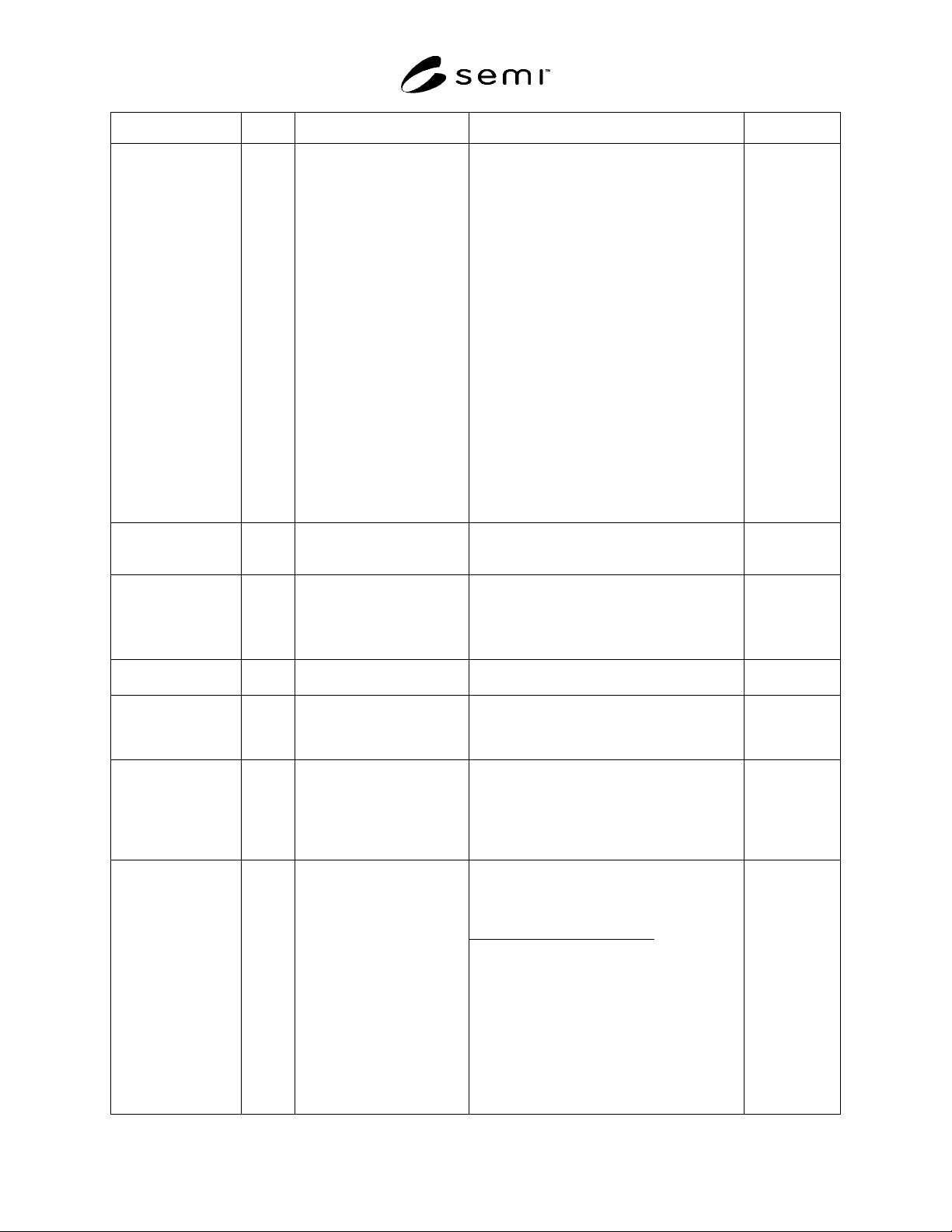
SEMI E5-1104 © SEMI 1982, 2004 26
Name Format Description Values Where Used
OBJSPEC 20 A text string that has an
internal format and that is
used to point to a specific
object instance. The string is
formed out of a sequence of
formatted substrings, each
specifying an object’s type
and identifier. The substring
format has the following four
fields:
object type,
colon character “:”,
object identifier,
greater-than symbol “>“
where the colon character “:”
is used to terminate an object
type and the “greater than”
symbol “>“ is used to
terminate an identifier field.
The object type field may be
omitted where it may be
otherwise determined. The
final “>“ is optional.
S2F49;
S13F11, F13,
F15;
S14F1, F3, F5,
F7, F9, F10,
F11, F13, F15,
F16, F17, F19,
F25, F27;
S15F43, F47
OBJTOKEN 54 Token used for authorization
S14F14, F15;
S15F37, F39,
F41, F43
OBJTYPE 20, 5() Identifier for a group or class
of objects. All objects of the
same type must have the
same set of attributes
available.
S1F19;
S14F1, F3, F6,
F7, F8, F25,
F26, F27
OFLACK 10 Acknowledge code for OFF-
LINE request
0 = OFF-LINE Acknowledge
1-63 Reserved
S1F16
ONLACK 10 Acknowledge code for ON-
LINE request
0 = ON-LINE Accepted
1 = ON-LINE Not Allowed
2 = Equipment Already ON-LINE
3-63 Reserved
S1F18
OPID 5() Operation ID. A unique
integer generated by the
requestor of an operation,
used where multiple
completion confirmations
may occur.
S6F25;
S14F19, F21;
S15F21, F29,
F30, F37, F41,
F44, F46
ORLOC 10 Origin Location
implicit value of (0,0)
0 = Center die of wafer
(Determined by:
row or column count +1
2
truncated)
1 = Upper right
2 = Upper left
3 = Lower left
4 = Lower right
>4 = Error
5-63 Reserved
Zero length indicates not
available
S12F1, F3, F4