semi合集-English.pdf - 第1329页
SEMI E30-1103 © SEMI 1992, 2003 3 SEMI E30-1103 GENERIC MODEL FOR COMMUNICATIONS AND CONTROL OF MANUFACTURING EQUIPMENT (GEM) This standard was technically approved by the Globa l Information & Control Committee and …

SEMI E30-1103 © SEMI 1992, 2003
2
8 GEM Compliance
8.1 Fundamental GEM Requirements
Figure 8.1, GEM Requirements and Capabilities
Table 8.1, Fundamental GEM Requirements
8.2 GEM Capabilities
Table 8.2, Section References for GEM Capabilities
8.3 Definition of GEM Compliance
8.4 Documentation
Figure 8.2, Host View of GEM
Table 8.3, GEM Compliance Statement
Table 8.4, SML Notation
A. Application Notes
A.1 Factory Operational Script
A.1.1 Anytime Capabilities
A.1.2 System Initialization and Synchronization
A.1.3 Production Set-Up
A.1.4 Processing
A.1.5 Post-Processing
A.2 Equipment Front Panel
A.2.1 Displays and Indicators
A.2.2 Switches/Buttons
A.3 Examples of Equipment Alarms
Table A.3, Alarm Examples Per Equipment Configura-
tion
A.4 Trace Data Collection Example
A.5 Harel Notation
Figure A.5.1, Harel Statechart Symbols
Figure A.5.2, Example of OR Substates
Figure A.5.3, Example of AND Substates
A.5.1 State Definitions
A.5.2 Transition Table
Table A.5, Transition Table for Motor Example
A.6 Example Control Model Application
A.7 Examples of Limits Monitoring
A.7.1 Introduction
A.7.2 Examples
Figure A.7.1, Valve Monitoring Example
Figure A.7.2, Environment Monitoring Example
Figure A.7.3, Calibration Counter Example
A.8 Recipe Parameter Modification for Process and
Equipment Control
A.8.1 Introduction
A.8.2 Equipment Constants
A.8.3 Example
Figure A.8.1, CMP Single Wafer “Polishing” System
with Host Recipe Parameter Modification Capability
Index
SEMI E30-1103 © SEMI 1992, 2003
3
SEMI E30-1103
GENERIC MODEL FOR COMMUNICATIONS AND CONTROL OF
MANUFACTURING EQUIPMENT (GEM)
This standard was technically approved by the Global Information & Control Committee and is the direct
responsibility of the Japanese Information & Control Committee. Current edition approved by the Japanese
Regional Standards Committee on August 8, 2003. Initially available at www.semi.org October 2003; to be
published November 2003. Originally published in 1992; previously published July 2003.
1 Introduction
1.1 Revision History — This is the first release of the
GEM standard.
1.2 Scope — The scope of the GEM standard is limited
to defining the behavior of semiconductor equipment as
viewed through a communications link. The SEMI E5
(SECS-II) standard provides the definition of messages
and related data items exchanged between host and
equipment. The GEM standard defines which SECS-II
messages should be used, in what situations, and what
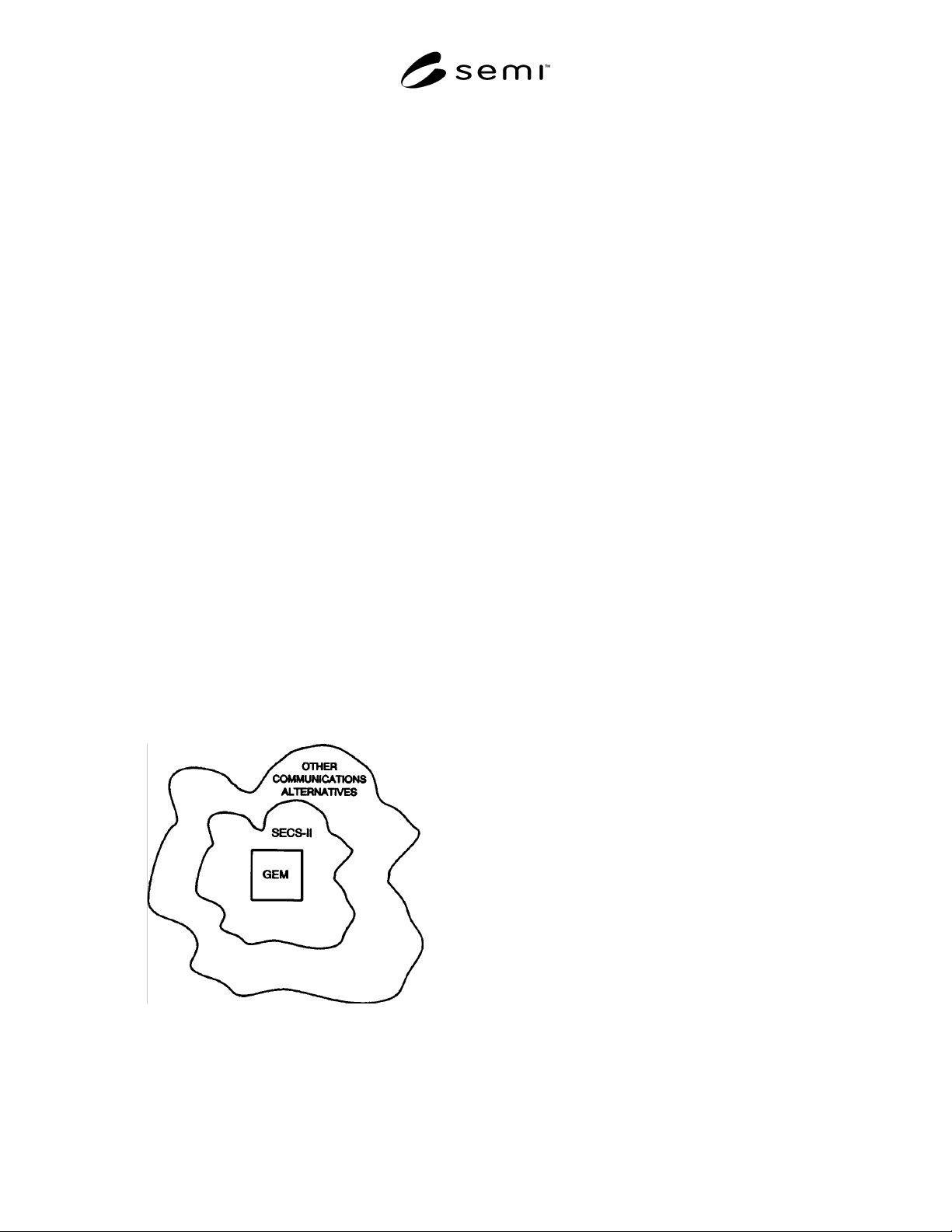
the resulting activity should be. Figure 1.1 illustrates
the relationship of GEM, SECS-II and other
communications alternatives.
The GEM standard does NOT attempt to define the
behavior of the host computer in the communications
link. The host computer may initiate any GEM message
scenario at any time and the equipment shall respond as
described in the GEM standard. When a GEM message
scenario is initiated by either the host or equipment, the
equipment shall behave in the manner described in the
GEM standard when the host uses the appropriate GEM
messages.
Figure 1.1
GEM Scope
The capabilities described in this standard are
specifically designed to be independent of lower-level
communications protocols and connection schemes
(e.g., SECS-I, SMS, point-to-point, connection-oriented
or connectionless). Use of those types of standards is
not required or precluded by this standard.
NOTICE: This standard does not purport to address
safety issues, if any, associated with its use. It is the
responsibility of the users of this standard to establish
appropriate safety and health practices and determine
the applicability of regulatory or other limitations prior
to use.
1.3 Intent — GEM defines a standard implementation
of SECS-II for all semiconductor manufacturing
equipment. The GEM standard defines a common set of
equipment behavior and communications capabilities
that provide the functionality and flexibility to support
the manufacturing automation programs of
semiconductor device manufacturers. Equipment
suppliers may provide additional SECS-II functionality
not included in GEM as long as the additional
functionality does not conflict with any of the behavior
or capabilities defined in GEM. Such additions may
include SECS-II messages, collection events, alarms,
remote command codes, processing states, variable data
items (data values, status values or equipment
constants), or other functionality that is unique to a
class (etchers, steppers, etc.) or specific instance of
equipment.
GEM is intended to produce economic benefits for both
device manufacturers and equipment suppliers.
Equipment suppliers benefit from the ability to develop
and market a single SECS-II interface that satisfies
most customers. Device manufacturers benefit from the
increased functionality and standardization of the
SECS-II interface across all manufacturing equipment.
This standardization reduces the cost of software
development for both equipment suppliers and device
manufacturers. By reducing costs and increasing
functionality, device manufacturers can automate
semiconductor factories more quickly and effectively.
The flexibility provided by the GEM standard also
enables device manufacturers to implement unique
automation solutions within a common industry
framework.
SEMI E30-1103 © SEMI 1992, 2003
4
The GEM standard is intended to specify the following:
— A model of the behavior to be exhibited by
semiconductor manufacturing equipment in a
SECS-II communication environment,
— A description of information and control functions
needed in a semiconductor manufacturing
environment,
— A definition of the basic SECS-II communications
capabilities of semiconductor manufacturing
equipment,
— A single consistent means of accomplishing an
action when SECS-II provides multiple possible
methods, and
— Standard message dialogues necessary to achieve
useful communications capabilities.
The GEM standard contains two types of requirements:
— fundamental GEM requirements and
— requirements of additional GEM capabilities.
The fundamental GEM requirements form the
foundation of the GEM standard. The additional GEM
capabilities provide functionality required for some
types of factory automation or functionality applicable
to specific types of equipment. A detailed list of the
fundamental GEM requirements and additional GEM
capabilities can be found in Chapter 8, GEM
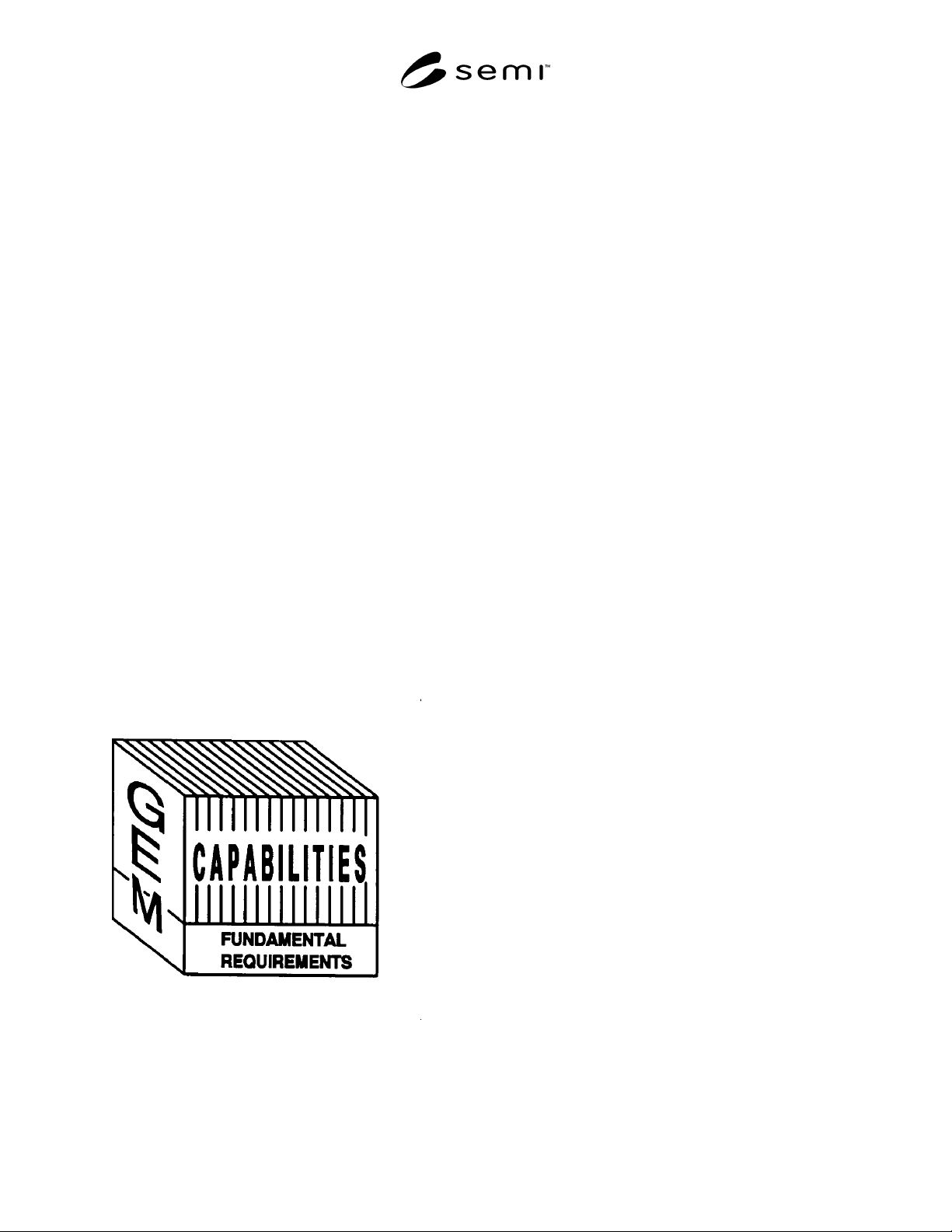
Compliance. Figure 1.2 illustrates the components of
the GEM standard.
Figure 1.2
GEM Components
Equipment suppliers should work with their customers
to determine which additional GEM capabilities should
be implemented for a specific type of equipment.
Because the capabilities defined in the GEM standard
were specifically developed to meet the factory
automation requirements of semiconductor
manufacturers, it is anticipated that most device
manufacturers will require most of the GEM
capabilities that apply to a particular type of equipment.
Some device manufacturers may not require all the
GEM capabilities due to differences in their factory
automation strategies.
1.4 Overview — The GEM standard is divided into
sections as described below.
Section 1 — Introduction
This section provides the revision history, scope and
intent of the GEM standard. It also provides an
overview of the structure of the document and a list of
related documents.
Section 2 — Definitions
This section provides definitions of terms used
throughout the document.
Section 3 — State Models
This section describes the conventions used throughout
this document to depict state models. It also describes
the basic state models that apply to all semiconductor
manufacturing equipment and that pertain to more than
a single capability. State models describe the behavior
of the equipment from a host perspective.
Section 4 — Capabilities and Scenarios
This section provides a detailed description of the
communications capabilities defined for semiconductor
manufacturing equipment. The description of each
capability includes the purpose, definitions,
requirements, and scenarios that shall be supported.
Section 5 — Data Definitions
This section provides a reference to the Data Item
Dictionary and Variable Item Dictionary found in
SEMI Standard E5. The first subsection shows those
data items from SECS-II which have been restricted in
their use (i.e., allowed formats). The second subsection
lists variable data items that are available to the host for
data collection and shows any restrictions on their
SECS-II definitions.
Section 6 — Collection Events
This section provides a list of required collection events
and their associated data.