semi合集-English.pdf - 第1606页
SEMI E37.1-0702 © SEMI 1995, 2002 7 R1-2 Multiple HSMS Connections R1-2.1 Typically, an Equipment w ill accept only one Ho st Connection. R1-2.2 A Hos t may connect to several units of Equi pment, so the Host may have se…
SEMI E37.1-0702 © SEMI 1995, 2002 6
RELATED INFORMATION 1
APPLICATION NOTES
NOTE: This related information is not an official part of SEMI E37.1 and is not intended to modify or supercede the
official standard. Publication was authorized by full letter ballot. Determination of the suitability of the material is
solely the responsiblity of the user.
R1-1
R1-1.1 An entity may have more than one session. If a unit of equipment can be divided into two or more logical
sub-equipments, such as process chambers, or process resources, each of these may have separated session ID. If
two or more physical sub-equipments are controlled by an equipment controller or communicated to through a
TCP/IP network device, each sub-equipment may have a separate session ID. Such a session can be established
once HSMS is selected. Each session ID corresponds to a device ID.
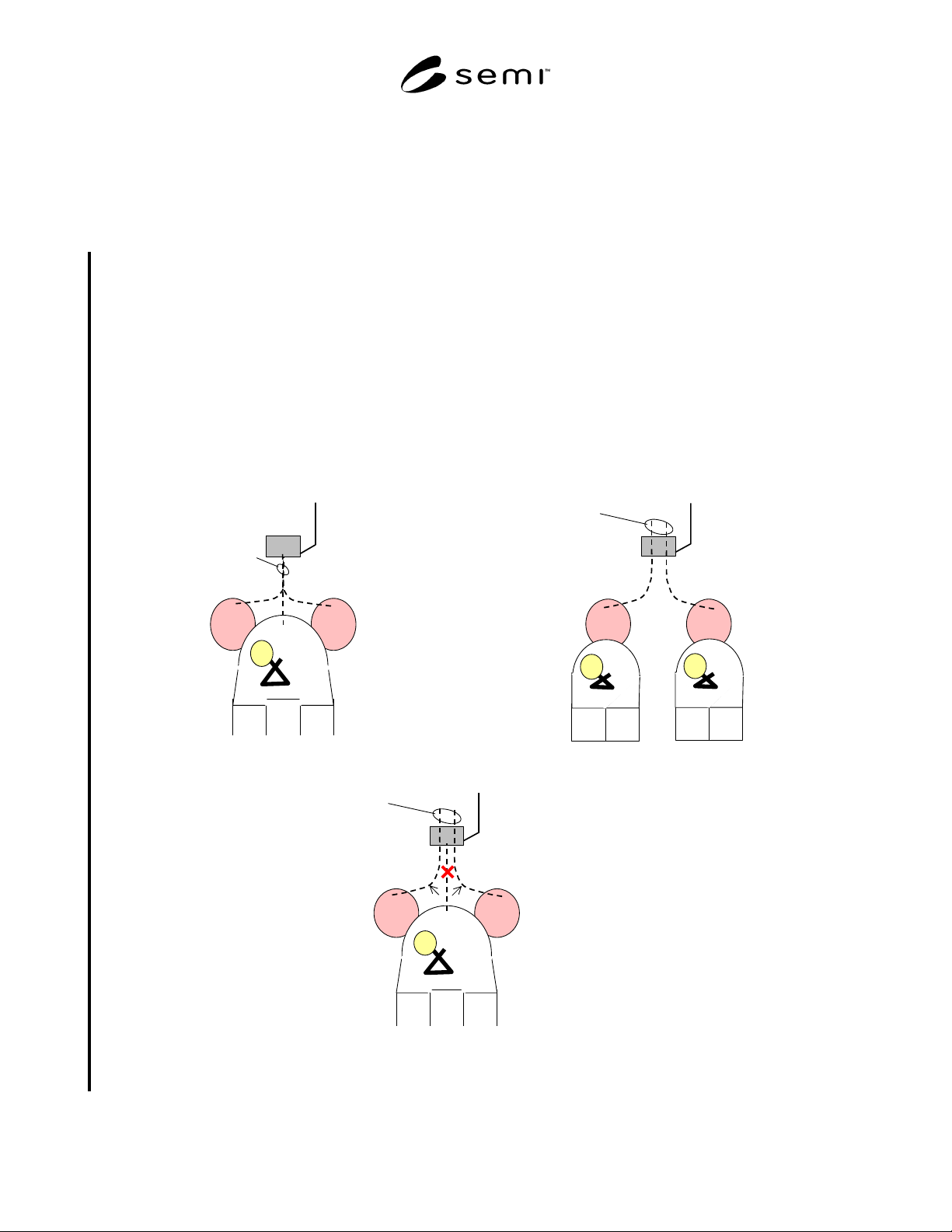
R1-1.2 If a unit of equipment has more than one sub-equipment or process resource (e.g. process modules) but the
sub-equipment share a common resource (e.g. transfer subsystem), it is not recommended that each sub-equipment
have an independent session to communicate with host. Even if the host requests an action to the shared subsystem
with a session identifier specific for a sub-equipment, the shared subsystem may not always serve for the sub-
equipment. Since the host expects the shared subsystem to perform the service for the sub-equipment, an error will
occur if it is not possible to perform the service for the designated sub-equipment. See following figure.
(Resource-C)
Transfer Subsystem
(Resource-B)
Process Module B
(Resource-A)
Process Module A
HSMS-SS
HOST
common 1 session
(one device ID)
(Resource-C)
Transfer Subs
y
stem
(Resource-B)
Process Module B
(Resource-A)
Process Module
A
HSMS-SS
HOST
2 sessions
(2 device Ids)
T
yp
ical Case
Problematic Case:
Equipment may not know for which module a cassette is
sent. Because subsystem doesn’t have its own device ID,
arrival event may be reported with wrong device ID.
(Resource-D)
Transfer Subsystem D
(Resource-B)
Process Module B
(Resource-A)
Process Module A
HSMS-SS
HOST
2 sessions
(2 device Ids)
(Resource-C)
Transfer Subsystem C
Possible Case,
not intended
Equipment Controller
Equipment Controller
Equipment Controller
Device ID -A
Device ID -A
Device ID -B
Device ID -B
Figure R1-1

SEMI E37.1-0702 © SEMI 1995, 2002 7
R1-2 Multiple HSMS Connections
R1-2.1 Typically, an Equipment will accept only one Host Connection.
R1-2.2 A Host may connect to several units of Equipment, so the Host may have several simultaneously active
Connections (each to one Equipment).
R1-2.3 A Cell Controller (or similar entity) might have one Connection by which the Cell Controller appears as
“Equipment” to the Factory Host Computer, as well as several Connections by which the Cell Controller appears as
“Host” to Equipment.
R1-3 Equipment Support for Multiple Hosts
R1-3.1 HSMS requires Equipment to accept at least one active Connection, and does not require the equipment to
support access by multiple concurrent Hosts. That is, if the Equipment has already accepted a Host Connection, but
a Host (the same or a different Host) attempts a second Connection, the Equipment will immediately terminate that
second Connection attempt.
R1-3.2 For specialized applications, an equipment could accept more than one Host Connection. Coordination of
activity by multiple hosts is equipment-defined.
NOTICE: SEMI makes no warranties or representations as to the suitability of the standards set forth herein for any
particular application. The determination of the suitability of the standard is solely the responsibility of the user.
Users are cautioned to refer to manufacturer’s instructions, product labels, product data sheets, and other relevant
literature respecting any materials mentioned herein. These standards are subject to change without notice.
The user’s attention is called to the possibility that compliance with this standard may require use of copyrighted
material or of an invention covered by patent rights. By publication of this standard, SEMI takes no position
respecting the validity of any patent rights or copyrights asserted in connection with any item mentioned in this
standard. Users of this standard are expressly advised that determination of any such patent rights or copyrights, and
the risk of infringement of such rights, are entirely their own responsibility.
Copyright by SEMI® (Semiconductor Equipment and Materials
International), 3081 Zanker Road, San Jose, CA 95134. Reproduction o
f
the contents in whole or in part is forbidden without express written
consent of SEMI.
SEMI E37.2-95 © SEMI 1995, 2003 1
SEMI E37.2-95 (Reapproved 0303)
HIGH-SPEED SECS MESSAGE SERVICES GENERAL SESSION
(HSMS-GS)
This standard was technically approved by the Global Information and Control Committee and is the direct
responsibility of the North American Information and Control Committee. Current edition approved by the
North American Regional Standards Committee on October 25, 2002. Initially available at www.semi.org
December 2002; to be published March 2003. Originally published in 1995.
1 Purpose
1.1 HSMS-GS is intended to support the needs of
complex systems containing multiple independently
accessible subsystems such as cluster tools or track
systems. Specifically, procedures are defined to permit
access to any individual subsystem or set of subsystems
within any complex system.
2 Scope
2.1 High-Speed SECS Message Services General
Session (HSMS-GS) is a subsidiary standard to High-
Speed SECS Message Services (HSMS) Generic
Services.
NOTICE: This standard does not purport to address
safety issues, if any, associated with its use. It is the
responsibility of the users of this standard to establish
appropriate safety and health practices and determine
the applicability of regulatory or other limitations prior
to use.
3 Referenced Standards
3.1 SEMI Standards
SEMI E4 — SEMI Equipment Communications
Standard 1 Message Transfer (SECS-I)
SEMI E5 — SEMI Equipment Communications
Standard 2 Message Content (SECS-II)
SEMI E37 — High-Speed SECS Message Services
(HSMS) Generic Services
NOTICE: Unless otherwise indicated, all documents
cited shall be the latest published versions.
4 Terminology
4.1 Definitions
4.1.1 Selected Entity List — a list of session entities
currently selected for communication on a given
TCP/IP connection.
4.1.2 Selection Count — the number of sessions
opened by an HSMS Select procedure and not yet
ended by an HSMS Deselect or Separate procedure.
4.1.3 Session Entity — an individually selectable entity
within an HSMS-GS system.
4.1.4 Session Entity ID — a 16-bit identifier for a
Session-Entity.
4.1.5 SessionEntityList — a list of all available session
entities within an HSMS-GS system and associated
with a particular IP address and port number.
4.2 In addition, all definitions for HSMS Generic
Services apply.
4.3 Note that the terms HSMS and HSMS Generic
Services both refer to the HSMS Generic Services
standard definition (SEMI E37).
5 HSMS-GS Overview and State Machine
5.1 HSMS-GS provides a set of definitions which
permit the individual subentities (e.g., subsystems) of
complex entities (e.g., systems) to be separately
accessible during HSMS procedures. HSMS-GS
defines no new procedures or message types beyond
HSMS Generic Services to provide these services. It
does, however, require extensions to the HSMS State
machine, in the form of additional state transition
definitions and additional state information, which are
used by the extended state machine which must be
maintained by an HSMS-GS implementation to support
the extended state machine. The additional information
consists of the following:
1. The Session Entity List
2. The Selected Entity List
3. The Selection Count
5.2 The Session Entity List consists of the set of all
Session Entities having individual accessibility within
the HSMS-GS entity. The scope of this list is normally
the entire HSMS-GS entity. HSMS-GS, however, does
not require this scope: the supplier may provide access
to HSMS-GS entity through more than one well known
port and provide a different Session Entity List for
each.
5.3 A Session Entity is any individually addressable
subentity within the HSMS-GS entity: for example, a
Session Entity may be an individual sub-device in a
track system or cluster tool, or may be an individual
service provider, such as a data server, within an entity.