semi合集-English.pdf - 第1609页
SEMI E37.2-95 © SEMI 1995, 2003 3 6 HSMS-GS Use of TCP/IP 6.1 There is no additional HSMS-GS specification for the use of TCP/IP b eyond the above mentioned creation of the empty “Selected Entity List” upon entry into th…
SEMI E37.2-95 © SEMI 1995, 2003 2
HSMS-GS only provides the conventions for
identifying Session Entities. It places no restrictions on
the individual supplier as to what constitues a
SessionEntity: the supplier must determine what is the
most appropriate for the particular implementation.
5.4 The Selected Entity List is the list of Session
Entities actually selected for access on a given TCP/IP
connection. When the TCP/IP connection is established
(CONNECTED state entered), an empty Selected
Entity List is created. Each time, the Select Procedure
is used to select a Session Entity, its Session Entity ID
is added to the Selected Entity List created for that
TCP/IP connection. Each time the Session Entity is
deselected via the Deselect or Separate procedures, its
Session Entity ID is removed from the Selected Entity
List. At any given time on any given TCP/IP
connection endpoint, HSMS Data Messages will only
be accepted by an entity if the SessionID of the Data
Message is equal to any Session Entity ID in the
Selected Entity List.
5.5 The Selection Count is simply the number of
Session Entity IDs in the Selected Entity List. Its value
affects the behavior of the state machine: the transition
to NOT SELECTED from SELECT can only take place
when the SELECTION COUNT is zero.
5.6 Note that the above lists and count are defined for
the purpose of explaining state machine operation only.
There is no requirement that any of the above lists and
count be explicitly implemented.
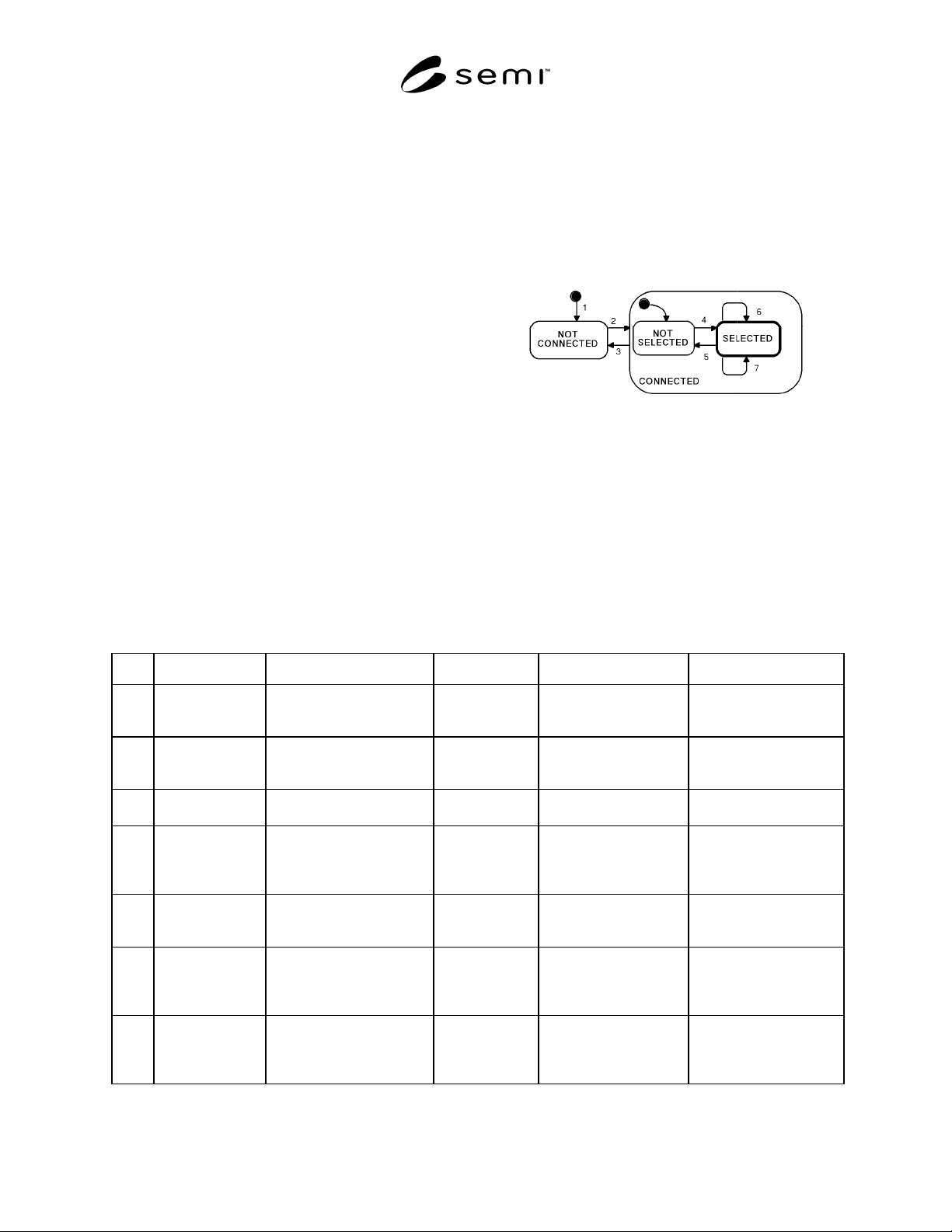
5.7 HSMS-GS State Machine — The HSMS-GS state
machine is the same as the HSMS Generic Services
state machine with the addition of the two new state
transitions (#6 and #7) and the use of the Selection
Count in the other transitions as described in the state
transition table below.
Figure 1
5.8 State Descriptions — The state descriptions are the
same as HSMS Generic Services.
5.9 State Transition Table — The state transition table
is almost identical with the state transition table for
HSMS Generic Services. For convenience, however,
the entire table is reproduced and extended here, not
just those areas which differ from it.
Table 1
# Current State Trigger New State Actions Comment
1 ... Local entity specific
preparation for TCP/IP
communication.
NOT
CONNECTED
Local entity-specific. Action depends on
connection procedure to be
used: active or passive.
2 NOT
CONNECTED
A TCP/IP connection is
established for HSMS
communication.
CONNECTED -
NOT
SELECTED
Set Selection Count = 0
and create empty Selecte
d
Entity List.
none
3 CONNECTED Breaking of TCP
Connection.
NOT
CONNECTED
Local entity-specific. none
4 NOT SELECTED Successful completion of
HSMS Select Procedure.
SELECTED Set Selection Count = 1
and add selected Session
Entity to Selected Entity
List.
none
5 SELECTED Deselect or Separate
procedure resulting in
Selection Count = 0.
NOT
SELECTED
Local entity-specific. See transition 7 below.
6 SELECTED Successful completion of
HSMS Select Procedure
when Selection Count > 0.
SELECTED Increment Selection
Count and add selected
Session Entity to Selected
Entity List.
none
7 SELECTED Successful completion of
HSMS Deselect or Separate
when Selection Count > 1.
SELECTED Decrement Selection
Count and remove
selected Session Entity
from Selected Entity List.
If this transition results in
Selection Count = 0,
immediately trigger state
transition 5.
SEMI E37.2-95 © SEMI 1995, 2003 3
6 HSMS-GS Use of TCP/IP
6.1 There is no additional HSMS-GS specification for
the use of TCP/IP beyond the above mentioned creation
of the empty “Selected Entity List” upon entry into the
CONNECTED state, NOT SELECTED substate.
7 HSMS-GS Specific Procedures
HSMS-GS provides further specification of the
following procedures.
7.1 Select Procedure — The select procedure is
permitted in both the NOT SELECTED state and the
SELECTED state. The procedure for both the initiator
and the responding entity is the same as HSMS Generic
Services, with the following additional conditions:
1. If the responding entity contains no Session Entity
in its Session Entity List whose ID matches the
SessionID in the Select.req, a Select Status of No
Such Entity is used in the Select.rsp.
2. If the responding entity is unable to provide access
to the selected entity because it is usable on only a
single TCP/IP connection at any one time and it is
already in use on a different TCP/IP connection, a
response code of Entity In Use is used in the Sel-
ect.rsp.
3. If the responding entity finds the SessionID already
in its Selected Entity List, a response code of
Entity Selected is used in the Select.rsp.
7.1.1 The Select Status values referenced above are all
defined in Section 8.
7.1.2 If none of the above is true, the Select completes
successfully, and a Select Status of 0 is provided in the
Select.rsp. Both entities will add the SessionID from
the Select.req to the Selected Entity List.
7.2 Data Procedure — The Data Procedure is as
defined in HSMS Generic Services. Note that the
SessionID of any Data Message must match a
SessionID in the SelectedEntityList. If a Data Message
is received with a SessionID other than one from the
Selected Entity List, a Reject.req message is sent in
response by the receiving entity. The reason code will
be Entity Not Selected.
7.3 Deselect Procedure — The Deselect procedure is
restricted by the following conditions:
1. The SessionID must be in the Selected Entity List.
2. The corresponding SessionEntity is in a state which
permits Deselect. This decision is local entity
specific and not subject to the HSMS-GS.
7.3.1 If both of the above are true, then the Deselect
can proceed. Assuming that the Deselect completes
successfully, the SessionID is removed from the
Selected Entity List, and the Selection Count is
decremented. The transition to the NOT SELECTED
state transpires only if the resulting Selection Count is
equal to zero (i.e., an empty Selected Entity List).
7.4 Linktest Procedure — As defined by HSMS.
7.5 Reject Procedure — As defined by HSMS. Note,
in particular, the use of Reject in response to certain
data messages (above).
7.6 Separate Procedure — The Separate procedures
and state transitions are subject to the same restrictions
and conditions as the Deselect.
7.7 Communications Failures — As defined by HSMS.
Note that any abrupt termination has the effect of
deselecting all entities in the Selected Entity List.
8 HSMS-GS Message Format Issues
8.1 Session ID — In HSMS-GS Select, Data, Deselect,
Reject, and Separate messages, the SessionID will
equal the Session Entity ID of the target Session Entity
which must equal the Session ID of a Session Entity
contained in the Session Entity List. In the Linktest, it
is 0xFFFF, as in HSMS.
8.2 PType — HSMS-GS messages are generally PType
= 0 (SECS-II-encoded) as defined in HSMS. Although
other PTypes are permitted, specific application
domains may restrict the use of HSMS-GS to Ptype = 0.
8.3 SType — Only HSMS-defined STypes are
permitted in HSMS-GS.
8.4 Select/Deselect Status — The following additional
enumeration applies to the Select/Deselect status in
HSMS-GS:
Table 2 SelectStatus
Value Description
4 No Such Entity — Session ID does not correspond to
any Session Entity ID available at this connection.
5 Entity In Use (by another connection) — Session
Entity corresponding to session ID is not sharable
connections and is already selected by another
connection.
6 Entity Selected (by current connection) — Session
entity corresponding to Session ID is already selected
on current connection.
9 Special Considerations
9.1 There are no special considerations above and
beyond those described in HSMS Generic Services.
SEMI E37.2-95 © SEMI 1995, 2003 4
10 HSMS-GS Documentation
10.1 An HSMS-GS implementation is required to
document the following information in addition to the
information required by HSMS.
1. The Session Entity List — specifically the number
of Session Entities available for HSMS-GS
communication and the value of their particular
Session Entity ID’s.
NOTICE: SEMI makes no warranties or
representations as to the suitability of the standards set
forth herein for any particular application. The
determination of the suitability of the standard is solely
the responsibility of the user. Users are cautioned to
refer to manufacturer' s instructions, product labels,
product data sheets, and other relevant literature,
respecting any materials or equipment mentioned
herein. These standards are subject to change without
notice.
By publication of this standard, Semiconductor
Equipment and Materials International (SEMI) takes no
position respecting the validity of any patent rights or
copyrights asserted in connection with any items
mentioned in this standard. Users of this standard are
expressly advised that determination of any such patent
rights or copyrights, and the risk of infringement of
such rights are entirely their own responsibility.