semi合集-English.pdf - 第1683页
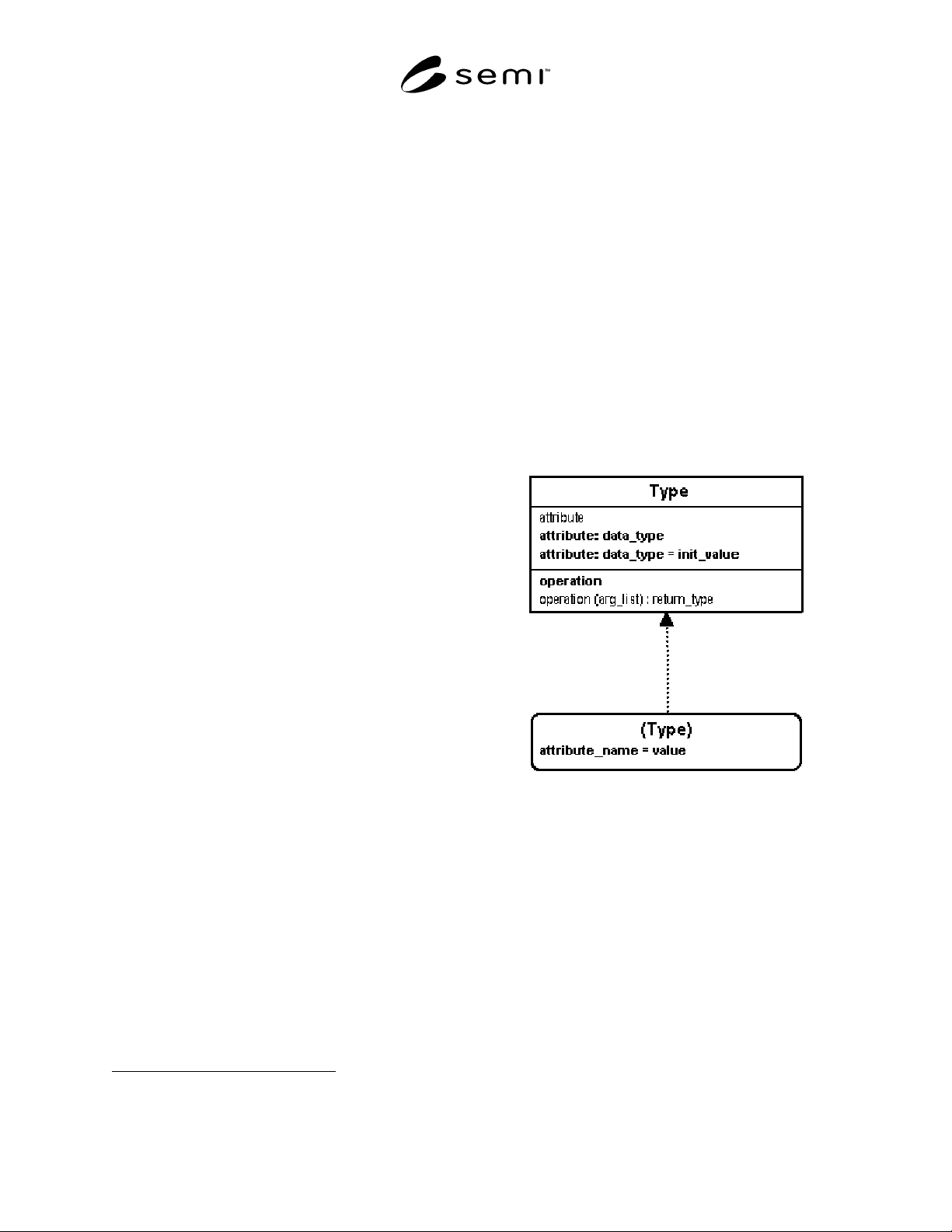
SEMI E39-0703 © SEMI 1995, 2003 25 Figure A1-2 Example of Object Type and Inst ance A1-2 Object Modeling Technique (OMT) Notation A1-2.1 The material con tained in this section is provided as a reference for auxiliary in…
SEMI E39-0703 © SEMI 1995, 2003 24
APPENDIX 1
NOTICE: The material in this appendix is an official part of SEMI E39 and was approved by full letter ballot procedures on
March 16 and April 21, 2000 by the Japanese Regional Standards Committee.
A1-1 Overview of Object Terminology
A1-1.1 This section provides an introduction to the
basic terminology for object models.
A1-1.2 A model is an abstraction of a problem, a real-
world phenomena, things, etc. for the purpose of
understanding it. A model typically is a simplification
that omits nonessential details. Examples: architectural
scale models, behavioral state models.
A1-1.3 An object is an entity (concept, abstraction, or
“real world” thing) with a particular behavior and with
associated properties (information, or attributes). An
object type (class) refers to a group of objects that have
common (1) properties (but not specific values), (2)
behavior, (3) relationships with other objects, and (4)
semantics (public interfaces). The term “object” may be
used either to refer to a type of object or to a particular
instance of an object type.
8
The notation used for
diagrams of objects used in this document is described
in Section A1-2.
A1-1.4 An object model is a static graphic model of
objects to show structure — the identity of objects, their
attributes and operations, and their relationships with
one another.
A1-1.5 An instance of an object is an instantiation of
an object type. For example, a specific installation of
equipment is an instance of the object type
“Equipment.”
A1-1.6 Objects have items of associated information
called attributes. For example, for an object
“Equipment,” attributes of interest include the
manufacturer, model, serial number, and a logical user-
assigned name (nickname). Attributes used to uniquely
identify a particular instance of an object type is called
an identifier. An object may have more than one
identifier. Also, a set of more than one attribute may be
used as an identifier. In the example of “Equipment,”
name could be used as an identifier, and the
combination of manufacturer and serial number also
could be an identifier.
A1-1.7 Objects have operations that may be applied to
or by an object type. Operations are functions or
transformations that are either performed by, or on, an
object. Operations of interest to Object Services are
“get (read) attributes,” “set (write) attributes,” and “get
8 The term “object” is used by some authors to only refer to
instances and by other authors as a synonym for object type.
type.” A service provides a service user with an
interface to the functionality of the operation.
A1-1.8 A high-level model may show a particular type
of object with certain operations, while a more detailed
model shows that a second type of object actually
performs one or more of the operations on the first
object. As an example, a model might show a process
program object with the operation “delete,” to show
that the “delete” operation is inherently associated with
the process program. A more detailed model might
show that a “process program manager” actually
performs the operation of deleting a process program.
A1-1.9 A method is an implementation of an operation
(e.g., the software code that performs the operation).
Figure A1-1
Object Type and Instance
SEMI E39-0703 © SEMI 1995, 2003 25
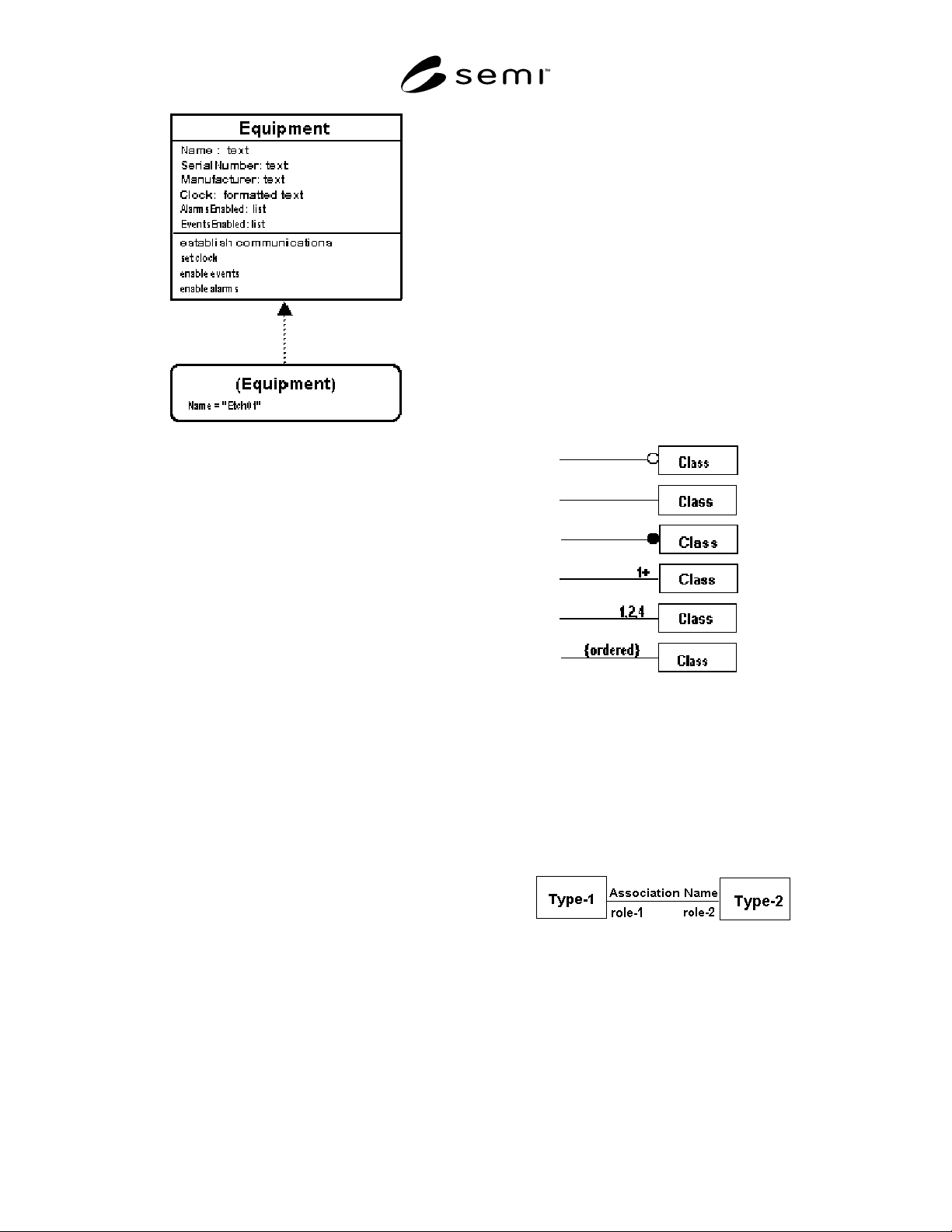
Figure A1-2
Example of Object Type and Instance
A1-2 Object Modeling Technique (OMT)
Notation
A1-2.1 The material contained in this section is
provided as a reference for auxiliary information.
A1-2.1.1 Object Modeling Technique (OMT) is a
graphical notation for models of objects that is useful
for analyzing a wide variety of problems, in all phases
of software design and development, and in preparing
documentation. OMT was developed by Rumbaugh,
Blaha, et al., in Object Modeling and Design, Prentice
Hall, Englewood Cliffs, NJ, ©1991. OMT has been
adopted by different standards to describe requirements
in terms of objects and relationships between objects.
The purpose of this document is to provide a
description of OMT notation as a reference for such
SEMI standards and other SEMI documents.
A1-2.2 Basic Notation — Figure A1-1 illustrates
notation for object type, showing object type, object
attributes, object operations, object instance, and the
relationship between an object type and instance. Figure
A1-2 provides an example.
A1-2.2.1 Object types in OMT are shown as rectangles.
The rectangle may be further subdivided into two or
three parts. The object type always appears at the top.
Object attributes are shown in a second part of the
rectangle. Operations are shown in a third part of the
rectangle. High-level models often omit the operations
section and sometimes omit the attributes section.
A1-2.2.2 The name of an attribute may be followed by
additional details, such as data type and initial value.
A1-2.2.3 Instances of objects are shown as rounded
rectangles. The instantiation relationship is shown by a
dotted arrow from an instance of an object type to the
type.
A1-2-2.4 The example for an object type “Equipment”
is shown in Figure A1-2; here “Etch01” is a specific
real-world installation of type “Equipment.”
A1-2.3 Associations — An association describes a set
of potential bi-directional relationships between
instances of objects. An association uses a formal
structure and semantics.
A1-2.3.1 An association shows a specific multiplicity
at both ends of the relationship. For example, a single
factory manufacturing system may be associated with
many equipment (one-to-many). Possible multiplicities
of association types are shown in Figure A1-3.
Figure A1-3
Multiplicities of Associations
A1-2.3.2 Figure A1-4 shows an example of a one-to-
one relationship. The name of the association (using a
verb) appears above the line connecting a pair of
objects and describes the relationship that the object to
the left (or above) has to the object to the right (or
below).
Figure A1-4
Association of Objects
A1-2.3.3 The name of the role of each object within
the relationship may be placed beneath the line and near
that object. Role names are nouns. In the example
above, the roles might be “supervisor” and
“subordinate.” Role names are optional.
SEMI E39-0703 © SEMI 1995, 2003 26
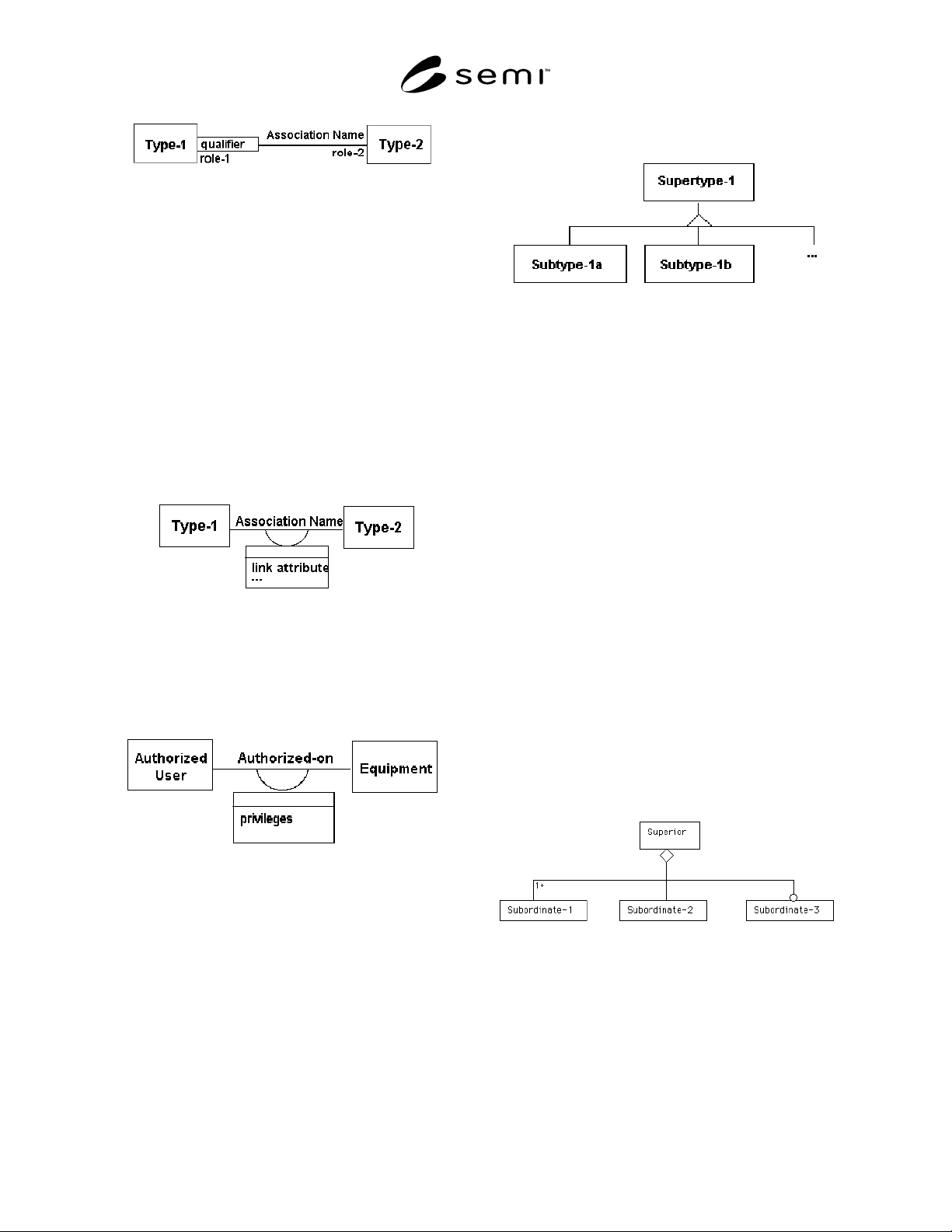
Figure A1-5
Qualified Association
A1-2.3.4 A qualified association, shown in Figure A1-
5, uses a qualifier to reference an object. Qualifiers
may be shown to specify the identifier used by one
object to associate with instances of the other object. If
Type-1 object is “Factory Host” and Type-2 object is
“Equipment,” a user-assigned “name” attribute may be
used as a qualifier for the equipment.
A1-2.3.5 Figure A1-6 illustrates a link object, where
link attributes are placed in an object box that is
attached to the association with a loop. A link object
may be used to show attributes that are dependent on
the association between instances of one object type to
instances of another type.
Figure A1-6
Link Object
A1-2.3.6 Figure A1-7 gives an example of a link object
for the association “Authorized On” between an
“Authorized User” and “Equipment.”
Figure A1-7
Example of a Link Object
A1-3 Generalization and Inheritance
A1-3.1 Figure A1-8 shows the concept of
generalization. Generalization categorizes a set of
object types and allows the abstraction of their common
features into a supertype, with refinements of the
supertype shown as subtypes. The subtype may be
thought of as a specialization of the supertype. For
example, “vehicle” is a supertype with many subtypes,
including “aircraft,” “automobile, “cart,” and “robot.”
Figure A1-8
Non-Overlapping Subtypes
A1-3.1.1 An instance of a subtype is also an instance
of its supertype. Attributes and operations of the
supertype are inherited by all the subtypes. That is, the
subtype has all of the same attributes and operations of
the supertype, and in addition it adds attributes and
operations of its own.
A1-3.1.2 The OMT notation for the generalization
(supertype/subtype) relationship is shown by a solid
triangle. White triangles indicate that the subtypes are
non-overlapping; an instance of one subtype may not be
an instance of another subtype.
A1-3.1.3 The method for a subtype of an object might
be different from that of the supertype or from a
different subtype, perhaps due to more specialized
knowledge that allowed a more efficient
implementation for the subtype. As an example, a
Geometrical Figure object type might have the
operation “draw.” The methods for subtypes of “circle”
and “rectangle” would differ, however.
A1-3.1.4 Figure A1-10 gives an example of an “agent”
as a generalization of various types of active entities
that might be found in a factory, and “equipment” as a
generalization of specific kinds of equipment.
Figure A1-9
Aggregation with Two Component Types
A1-3.2 Object Composition and Containment —
Figures A1-9 and A1-10 illustrate the diamond notation
used to show aggregation. An aggregation object is also
referred to as an assembly in object-oriented literature.