semi合集-English.pdf - 第1684页
SEMI E39-0703 © SEMI 1995, 2003 26 Figure A1-5 Qualified Association A1-2.3.4 A qualified association , shown in Figu re A1- 5, uses a qualifier to reference an object. Qualifiers may be shown to sp ecify the identifier …
SEMI E39-0703 © SEMI 1995, 2003 25
Figure A1-2
Example of Object Type and Instance
A1-2 Object Modeling Technique (OMT)
Notation
A1-2.1 The material contained in this section is
provided as a reference for auxiliary information.
A1-2.1.1 Object Modeling Technique (OMT) is a
graphical notation for models of objects that is useful
for analyzing a wide variety of problems, in all phases
of software design and development, and in preparing
documentation. OMT was developed by Rumbaugh,
Blaha, et al., in Object Modeling and Design, Prentice
Hall, Englewood Cliffs, NJ, ©1991. OMT has been
adopted by different standards to describe requirements
in terms of objects and relationships between objects.
The purpose of this document is to provide a
description of OMT notation as a reference for such
SEMI standards and other SEMI documents.
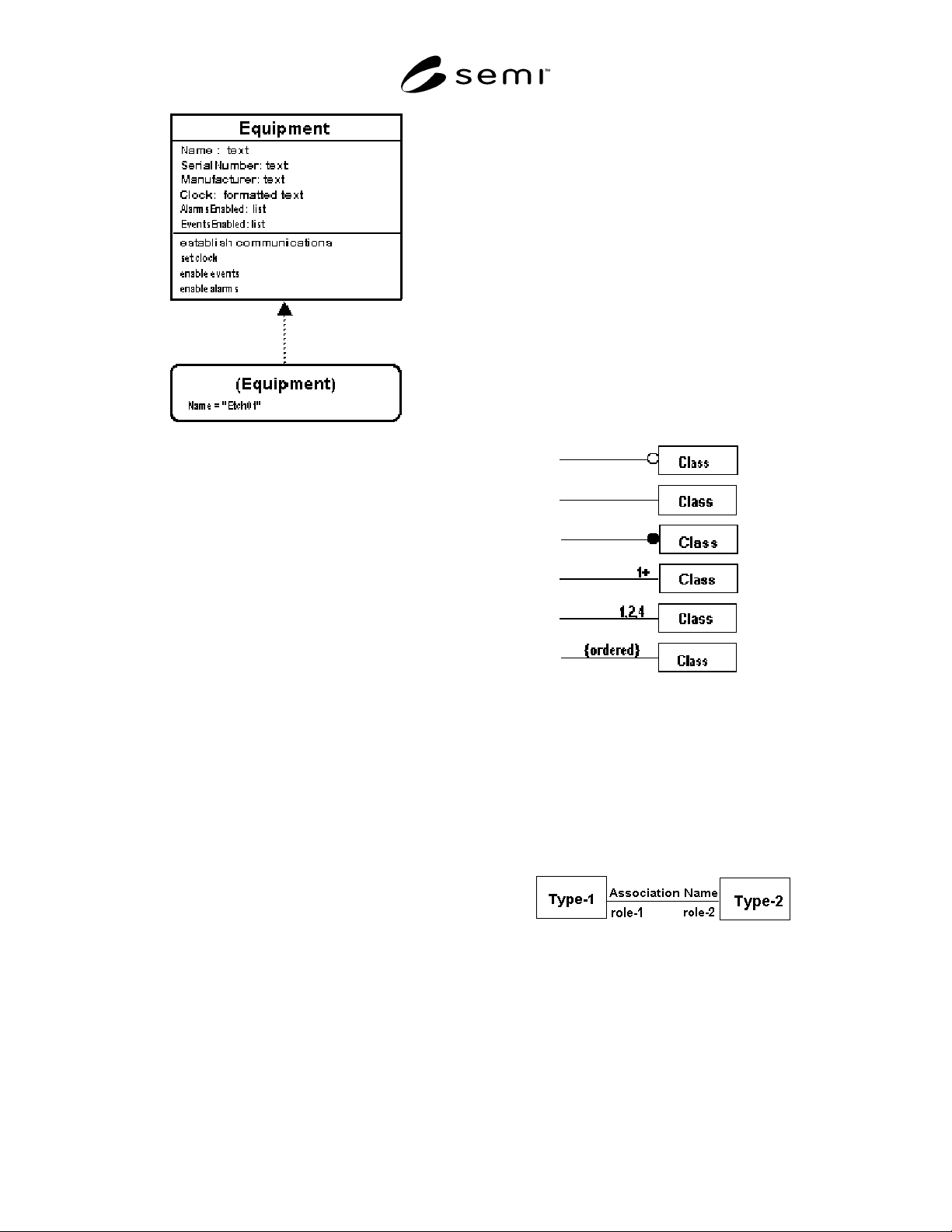
A1-2.2 Basic Notation — Figure A1-1 illustrates
notation for object type, showing object type, object
attributes, object operations, object instance, and the
relationship between an object type and instance. Figure
A1-2 provides an example.
A1-2.2.1 Object types in OMT are shown as rectangles.
The rectangle may be further subdivided into two or
three parts. The object type always appears at the top.
Object attributes are shown in a second part of the
rectangle. Operations are shown in a third part of the
rectangle. High-level models often omit the operations
section and sometimes omit the attributes section.
A1-2.2.2 The name of an attribute may be followed by
additional details, such as data type and initial value.
A1-2.2.3 Instances of objects are shown as rounded
rectangles. The instantiation relationship is shown by a
dotted arrow from an instance of an object type to the
type.
A1-2-2.4 The example for an object type “Equipment”
is shown in Figure A1-2; here “Etch01” is a specific
real-world installation of type “Equipment.”
A1-2.3 Associations — An association describes a set
of potential bi-directional relationships between
instances of objects. An association uses a formal
structure and semantics.
A1-2.3.1 An association shows a specific multiplicity
at both ends of the relationship. For example, a single
factory manufacturing system may be associated with
many equipment (one-to-many). Possible multiplicities
of association types are shown in Figure A1-3.
Figure A1-3
Multiplicities of Associations
A1-2.3.2 Figure A1-4 shows an example of a one-to-
one relationship. The name of the association (using a
verb) appears above the line connecting a pair of
objects and describes the relationship that the object to
the left (or above) has to the object to the right (or
below).
Figure A1-4
Association of Objects
A1-2.3.3 The name of the role of each object within
the relationship may be placed beneath the line and near
that object. Role names are nouns. In the example
above, the roles might be “supervisor” and
“subordinate.” Role names are optional.
SEMI E39-0703 © SEMI 1995, 2003 26
Figure A1-5
Qualified Association
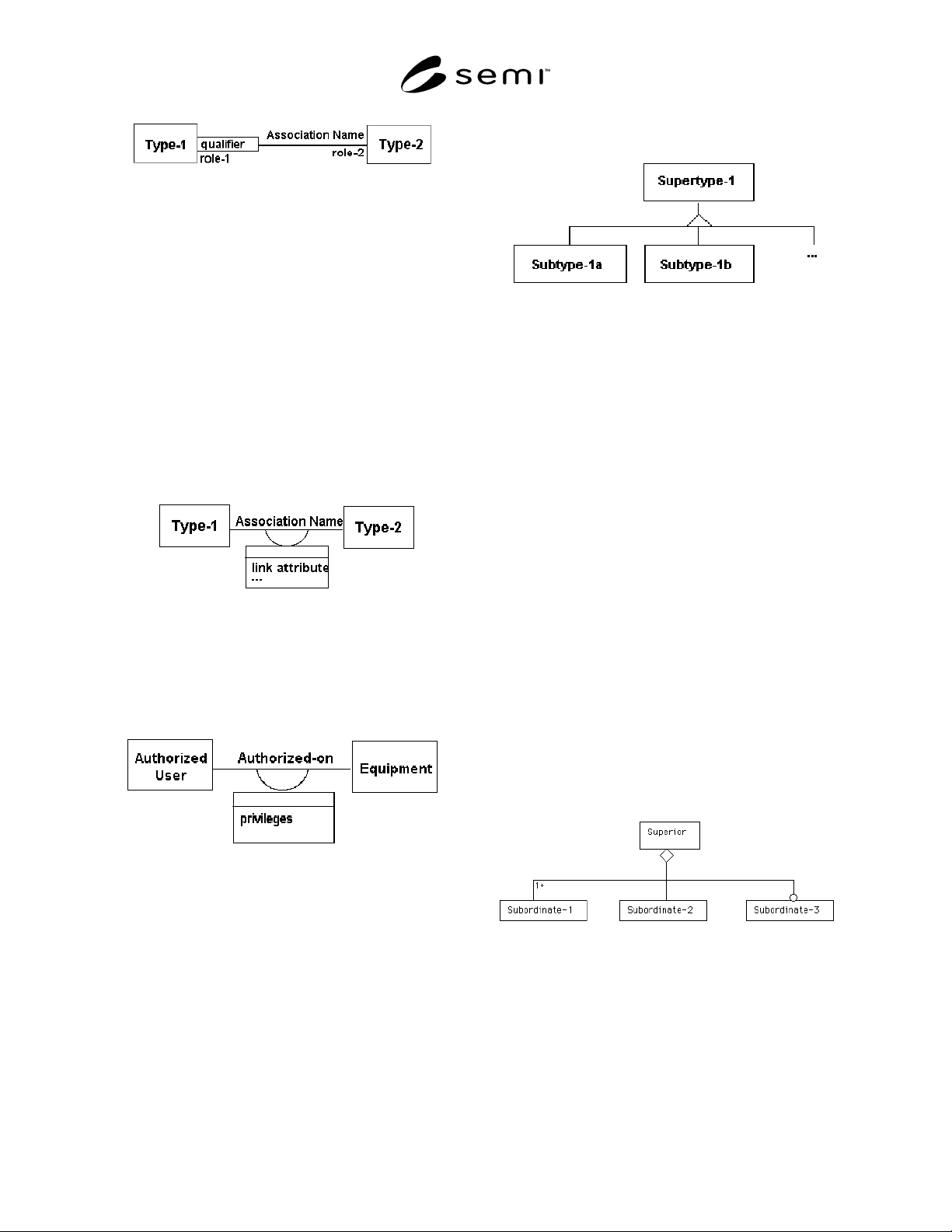
A1-2.3.4 A qualified association, shown in Figure A1-
5, uses a qualifier to reference an object. Qualifiers
may be shown to specify the identifier used by one
object to associate with instances of the other object. If
Type-1 object is “Factory Host” and Type-2 object is
“Equipment,” a user-assigned “name” attribute may be
used as a qualifier for the equipment.
A1-2.3.5 Figure A1-6 illustrates a link object, where
link attributes are placed in an object box that is
attached to the association with a loop. A link object
may be used to show attributes that are dependent on
the association between instances of one object type to
instances of another type.
Figure A1-6
Link Object
A1-2.3.6 Figure A1-7 gives an example of a link object
for the association “Authorized On” between an
“Authorized User” and “Equipment.”
Figure A1-7
Example of a Link Object
A1-3 Generalization and Inheritance
A1-3.1 Figure A1-8 shows the concept of
generalization. Generalization categorizes a set of
object types and allows the abstraction of their common
features into a supertype, with refinements of the
supertype shown as subtypes. The subtype may be
thought of as a specialization of the supertype. For
example, “vehicle” is a supertype with many subtypes,
including “aircraft,” “automobile, “cart,” and “robot.”
Figure A1-8
Non-Overlapping Subtypes
A1-3.1.1 An instance of a subtype is also an instance
of its supertype. Attributes and operations of the
supertype are inherited by all the subtypes. That is, the
subtype has all of the same attributes and operations of
the supertype, and in addition it adds attributes and
operations of its own.
A1-3.1.2 The OMT notation for the generalization
(supertype/subtype) relationship is shown by a solid
triangle. White triangles indicate that the subtypes are
non-overlapping; an instance of one subtype may not be
an instance of another subtype.
A1-3.1.3 The method for a subtype of an object might
be different from that of the supertype or from a
different subtype, perhaps due to more specialized
knowledge that allowed a more efficient
implementation for the subtype. As an example, a
Geometrical Figure object type might have the
operation “draw.” The methods for subtypes of “circle”
and “rectangle” would differ, however.
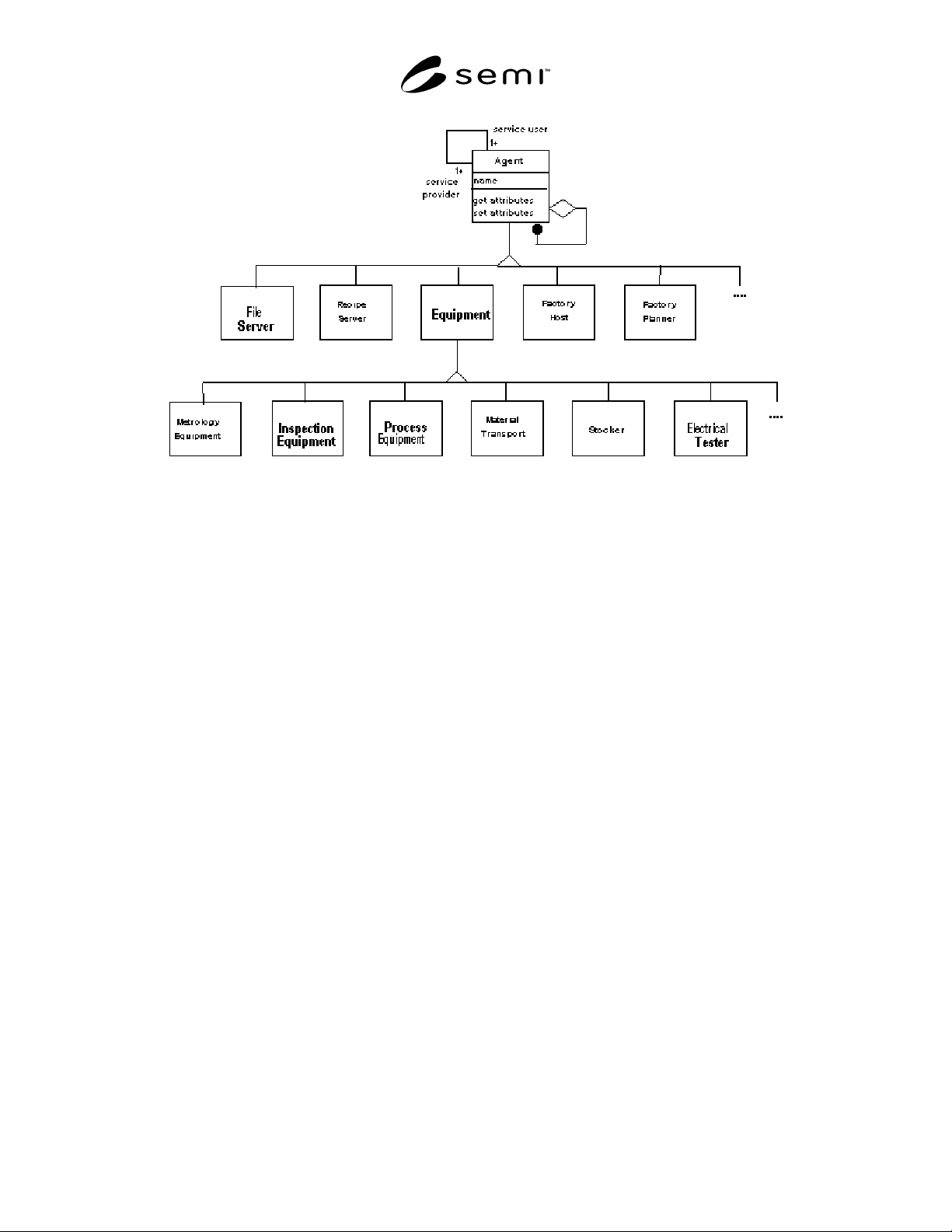
A1-3.1.4 Figure A1-10 gives an example of an “agent”
as a generalization of various types of active entities
that might be found in a factory, and “equipment” as a
generalization of specific kinds of equipment.
Figure A1-9
Aggregation with Two Component Types
A1-3.2 Object Composition and Containment —
Figures A1-9 and A1-10 illustrate the diamond notation
used to show aggregation. An aggregation object is also
referred to as an assembly in object-oriented literature.
SEMI E39-0703 © SEMI 1995, 2003 27
Figure A1-10
An Example of Generalization
A1-3.2.1 An aggregation object is composed of other objects called the components of the aggregation.
Components may be of the same type as the aggregation (illustrated in Figure A1-10), or they may be of one or
more different types.
A1-3.2.2 In Figure A1-9, the “Superior” object type is composed of one or more objects of type “Subordinate-1,” of
exactly one component of object type “Subordinate-2,” and of zero or one objects of type “Subordinate-3.”
A1-3.2.3 In addition, an aggregate also may be optionally composed of other objects of the same type, as Figure
A1-10 illustrates. The “agent” in this figure is a very general supertype of a factory system. Additional subtypes of
agents, not shown in the figure, could include cells, clusters, and cluster modules. Cells, with equipment as
components, and clusters, with modules as components, are examples of types of agents that are aggregates
composed of other subtypes of agent.
NOTICE: SEMI makes no warranties or representations as to the suitability of the standard set forth herein for any
particular application. The determination of the suitability of the standard is solely the responsibility of the user.
Users are cautioned to refer to manufacturer’s instructions, product labels, product data sheets, and other relevant
literature respecting any materials mentioned herein. These standards are subject to change without notice.
The user’s attention is called to the possibility that compliance with this standard may require use of copyrighted
material or of an invention covered by patent rights. By publication of this standard, SEMI takes no position
respecting the validity of any patent rights or copyrights asserted in connection with any item mentioned in this
standard. Users of this standard are expressly advised that determination of any such patent rights or copyrights, and
the risk of infringement of such rights, are entirely their own responsibility.
Copyright by SEMI® (Semiconductor Equipment and Materials
International), 3081 Zanker Road, San Jose, CA 95134. Reproduction o
f
the contents in whole or in part is forbidden without express written
consent of SEMI.