semi合集-English.pdf - 第1755页
SEMI E42-0704 © SEMI 1995, 2004 24 3.4 Manage d Recipes — This section def ines the managed r ecipe and its attributes. 3.4.1 Ge neric Attributes — For clarity, the attributes of the managed recipe are sometimes called g…
SEMI E42-0704 © SEMI 1995, 2004 23
3.2.5.1 Descriptors — Two types of mandatory
attributes of particular importance are the timestamp
and length attributes. These are provided for the body,
for each agent-specific dataset, and for the set of
attributes of the recipe object itself, including the
timestamp and length attributes of the body.
A descriptor contains the length and timestamp
attributes (in that order) of one or more of the aspects of
a recipe: its attributes, its body, or an agent-specific
dataset. Descriptors are used to compare two recipes
stored in different namespaces or in a namespace and in
the recipe execution area of a recipe executor.
NOTE: Provision of a real-time clock or other device
capable of counting time in centiseconds greatly
improves the value of the timestamps for this
comparison.
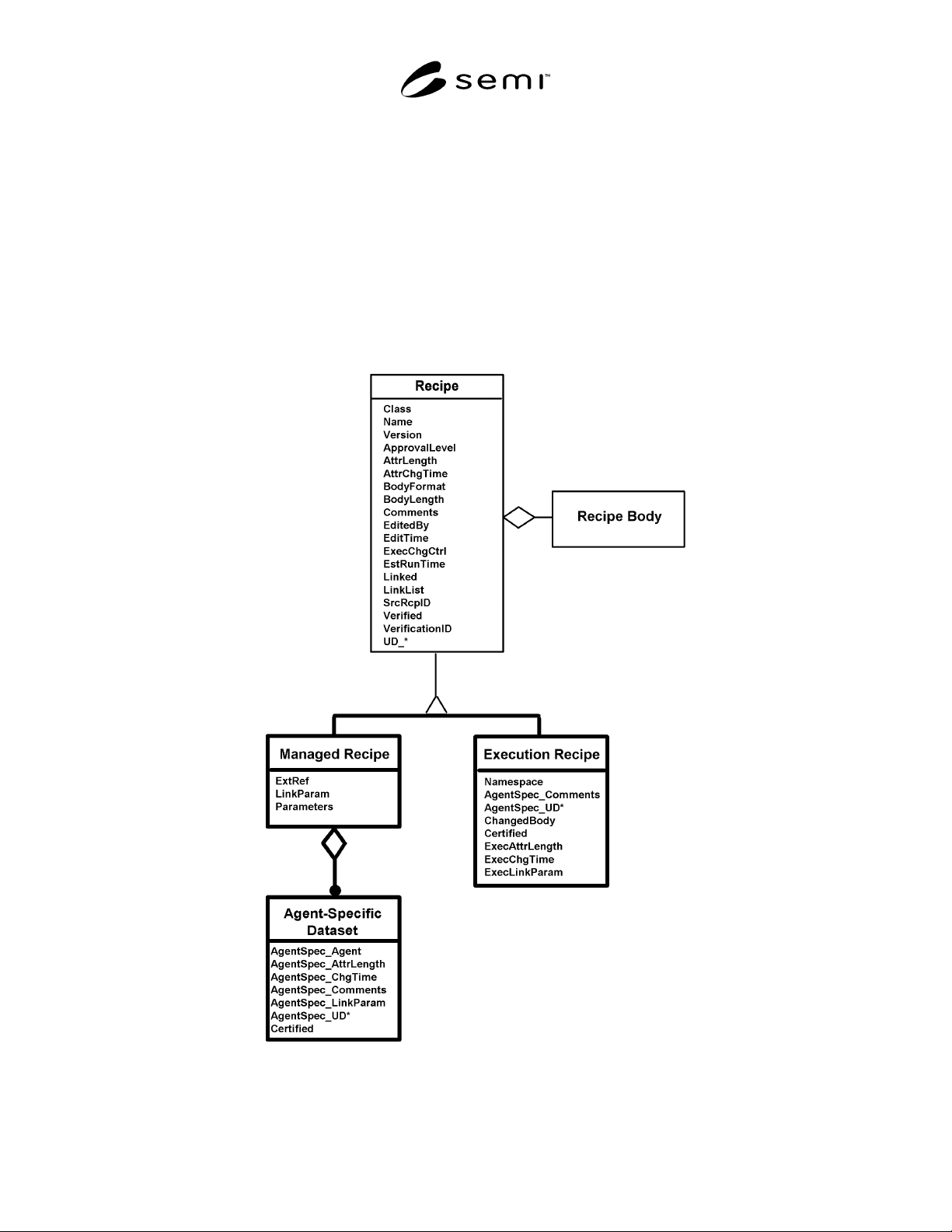
3.3 Full and Minimal Recipe Models — Figure 3.5
contains an object model for the managed and
execution recipes supporting all of the standard
attributes defined in RMS. Non-identifier attributes are
shown in alphabetical order. Many of these attributes
are not required for minimal applications. Minimal
models for the managed and execution recipes are
shown in Sections 3.4.2.3 and 3.5.2, respectively.
Figure 3.5
Full Recipe Object Model

SEMI E42-0704 © SEMI 1995, 2004 24
3.4 Managed Recipes — This section defines the
managed recipe and its attributes.
3.4.1 Generic Attributes — For clarity, the attributes of
the managed recipe are sometimes called generic
attributes to distinguish them from agent-specific
attributes or attributes of the execution recipe.
Attributes that are not specifically defined in this
standard may be defined by an application or by the
user. Attributes that are defined by a namespace or by a
recipe executor for its own use shall be changed only
by rules specified and documented by the originator of
the attribute.
To prevent conflict between non-standard attribute
names and names which may become standard in the
future, non-standard attribute names shall start with the
prefix "UD_" (the two characters "U" and "D" followed
by the underline character). It is the responsibility of the
originator to provide unique attribute names. When
using other RMS services, non-standard attributes shall
follow all standard attributes.
It is desirable that a method be provided for the user to
define new attributes.
3.4.1.1 Timestamp Attributes — Timestamp
information (date and time of the last change) is
important to recipe management. Timestamp attributes
are maintained by the recipe namespace and may not be
changed otherwise.
A timestamp attribute shall always contain the date and
time that the particular aspect of the recipe was last
changed. This attribute is a text string of the form
"yyyymmddhhmmsscc" for the year yyyy, the month
mm, the day dd, the hour hh, the minutes mm, the
seconds ss, and the centiseconds cc.
The timestamp of the body is called EditTime
and is set
when a recipe is first created and updated whenever the
body is modified in any way.
Because a recipe's attributes may be changed without
changing the body, both the recipe's generic attributes
and each set of agent-specific attributes themselves
each have a timestamp attribute. For the generic
attributes, the timestamp attribute is called
AttrChgTime
. The set of agent-specific attributes (of an
agent-specific dataset) has its own timestamp attribute,
called AgentSpec_ChgTime
.
3.4.1.2 Length Attributes — There are three length
attributes, one which contains the length of body, one
that contains the length of the generic attributes, and
one that contains the length of the agent-specific
attributes. Length attributes are calculated without
regard to either protocol overhead or storage overhead,
such as proprietary formats used for internal storage
that may change from one implementation to another.
This preserves the length across different conventions
used for recipe storage and different communications
protocol.
The length attribute of the body, BodyLength
, contains
the length of the body in bytes. The length of the body
is calculated as the number of bytes it will require when
transferred, excluding any overhead, such as that which
might be required for protocol format information.
The length of an individual
attribute is calculated as the
sum of the lengths of the attribute name and the
attribute value.
The length of a set
of attributes shall be calculated as
the sum of the lengths of the individual attributes that
are set to a non-default value at the time the calculation
is performed, including the length attribute itself. All
attributes set to their default value, at the time the
length is calculated, are excluded from the calculation.
This is because only the attributes with a non-default
value are transferred when a recipe is moved into or out
of a namespace. It also results in a more significant
change to value of the length attribute when an attribute
is set to a non-default value.
3.4.1.3 Descriptors — The descriptors of the managed
recipe are the body descriptor (BodyLength
and
EditTime
), the generic attribute descriptor
(AttrLength
and AttrChgTime), and the agent-specific
descriptor (AgentSpec
_AttrLength and
AgentSpec
_ChgTime). The recipe descriptor for a
managed recipe consists of the attribute descriptor, the
body descriptor (in that order), followed by descriptors
of any existing agent-specific datasets.
3.4.2 Managed Recipe Object Attribute Definitions —
This section provides the formal definitions for the
recipe's generic attributes. For Object Services, a recipe
is considered as the owner of its components, any
agent-specific datasets. The body may not be accessed
through Object Services.
Attributes in Tables 3.1 and 3.2 are presented in the
following order:
• identification attributes, including object type and
identifier, appearing above the heavy line in Tables
3.1 and 3.2,
• mandatory attributes and the other required
attributes, in the order in which they are to appear
when a recipe is transferred,
• optional attributes in alphabetical order, and
• non-standard attributes, which are transferred last.
SEMI E42-0704 © SEMI 1995, 2004 25
When transferring a recipe with RMS services, identification attributes are not included in the list of attributes, and
required attributes are sent, in order, before optional attributes. Non-mandatory attributes having their default value
are not transferred, since their absence indicates their value, but they are always available through Object Services.
Order of optional attributes is not dictated.
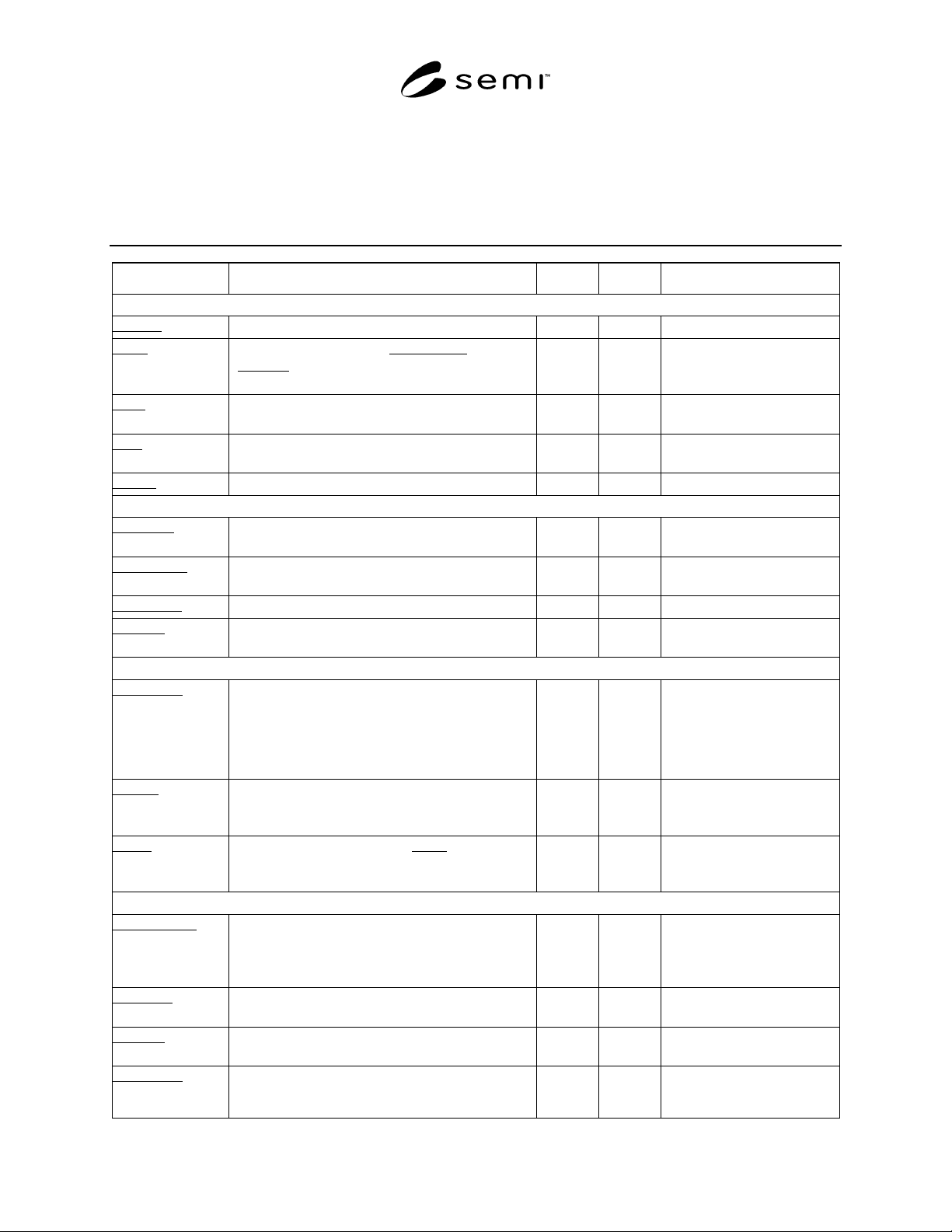
3.4.2.1 Generic Attribute Definitions — Table 3.1 provides the formal definition of the generic attributes of the
managed recipe.
Table 3.1 Managed Recipe Attribute Definition
Attribute Name Definition Access Rqmt Form
I
dentification Attributes
ObjType The object type. RO Y Text: "MRcp"
ObjID An identifier derived from Class, Name, and
Version.
No part of a recipe's identifier shall be
changed except through renaming.
RO Y Formatted text.
N
ame A logical name assigned by the user when the recipe
is created or renamed.
RO Y Text.
Class The recipe's class (e.g., "/PROCESS/" or
"/PROCESS/LOADER/").
RO Y Formatted text:
"CLASS/CLASS/../CLASS/"
Version The version of the recipe. RO Y Text.
M
andatory Attributes
AttrLength The total length of the generic attributes, in bytes.
Mandatory.
RO Y Unsigned integer.
AttrChgTime Timestamp of the last change to a generic attribute.
Mandatory.
RO Y Formatted text.
BodyLength Length of the recipe's body, in bytes. Mandatory. RO Y Unsigned integer.
EditTime Timestamp of when the body was created or last
updated. Mandatory.
RO Y Formatted text. Timestamp
format.
R
equired Attributes
BodyFormat Indicates the form and format of the recipe's body.
Default is zero.
RO Y Enumerated unsigned
integer:
0 = source,
1 = object,
> 1 reserved.
Verified Indicates whether the recipe's body is syntactically
correct. Reset when the recipe is created or updated.
Default is FALSE.
RO Y Boolean.
Linked Indicates whether the recipe is linked. Reset when
the recipe is originated, verified, or unlinked.
Default is FALSE.
RO Y Boolean.
Optional Attributes
ApprovalLevel Indicates the level of approval assigned by an
authorized user. Default is zero. Reset when the
recipe is originated or linked. For a linked recipe,
may not be higher than any of its subrecipes.
RW N Unsigned integer.
Comments User comments. RW N Text. Maximum length is 80
characters.
EditedBy The name of the person who last edited the recipe. RO N Text. Maximum length is 40
characters.
EstRunTime The nominal or estimated execution (run) time of the
recipe, in seconds. Reset when the recipe is created
or updated. Set when the recipe is verified. May be
RW N Unsigned integer.