semi合集-English.pdf - 第1928页
SEMI E54.1-1000 © SEMI 1996, 2000 34 7.4.3.1.2 SafeState — Specif ies the state i n which the actuator will be placed for ABORT and INITIALIZING states. U nless otherwise specif ied, t his attribute is a Boolean t ype co…
SEMI E54.1-1000 © SEMI 1996, 200033
7.4.2.1 Sensor Class Attributes — All required and “common optional” S class attributes are listed in Table 35 and
described below. For an explanation of the table format, see Section 7.3.1. Note that the S class also inherits all AE
class attributes.
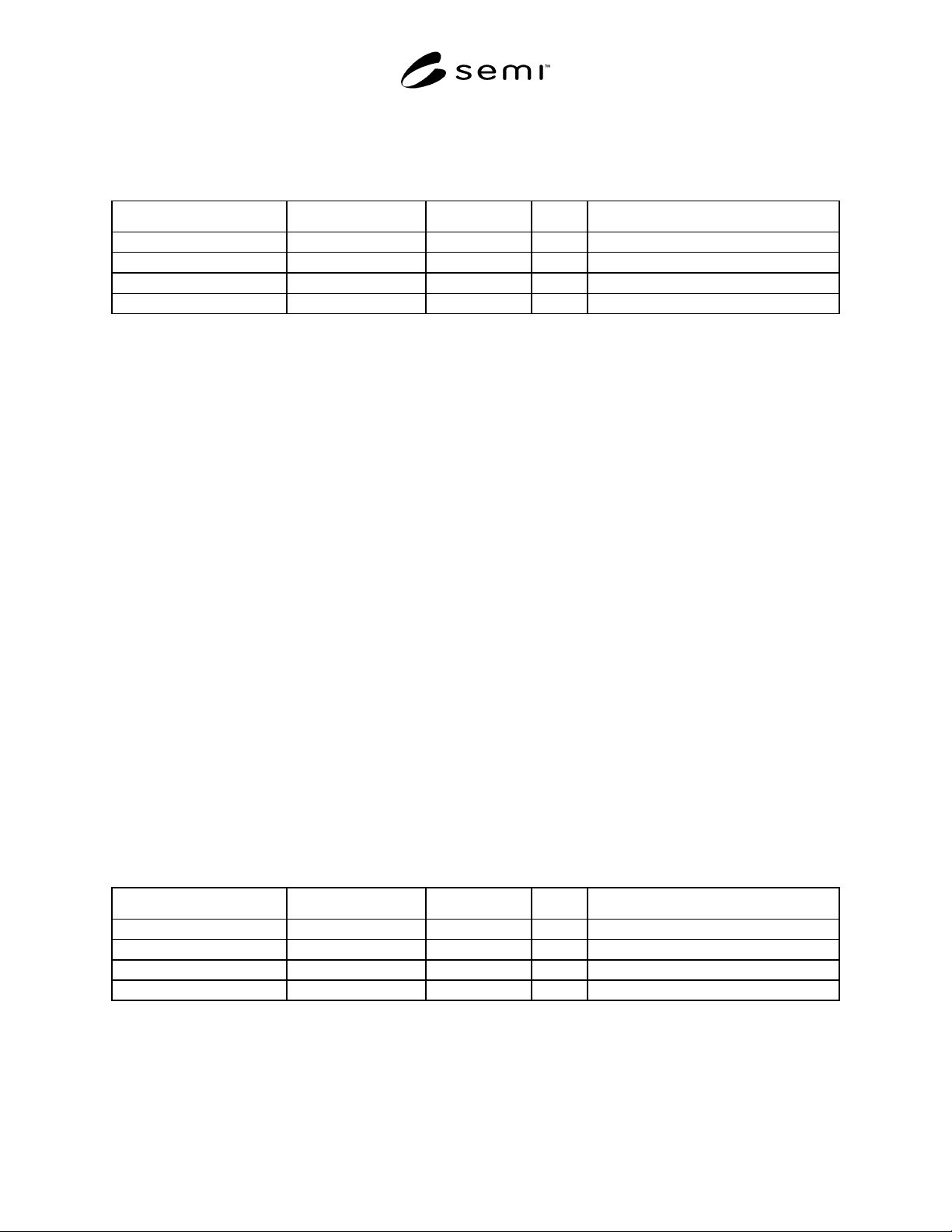
Table 35 S Class Attributes*
Attribute Name Attribute Identifier Access (Network) Rqmt Form
Value nA16** RO Y Context-Specific
ReportInhibitTimer nA17 RW N Context-Specific
EnableReportRate nA18 RW N Boolean
ReportRate nA19*** RW N Context-Specific
* A “Definition” column is not included. For attribute definitions, see text.
** Where ‘n’ is the type of the object instance to which the particular attribute is associated (e.g., Sai or Sbi), see Sections 7.4.4 through 7.4.8.
*** ID’s nA20 through nA63 are reserved for future S class attribute definition.
7.4.2.1.1 Value — The value of the sensor (associated with the object instance) that is to be conveyed. The form
and content of this attribute is context-specific.
7.4.2.1.2 ReportInhibitTimer — An attribute which is used to identify the absolute minimal time interval (i.e.,
maximum rate) for reporting the attribute “Value”; expressed in seconds. A value of zero indicates that there is no
minimal time interval.
7.4.2.1.3 EnableReportRate — An attribute which enables the reporting of the attribute “Value” based on the
“ReportingRate” attribute value; a value of TRUE signifies that the reporting at the “ReportingRate” is enabled.
7.4.2.1.4 ReportRate — An attribute which defines the time interval at which the attribute “Value” will be
reported; expressed in seconds.
7.4.2.2 Sensor Class Services — No S class common services are defined. Note that the S class inherits all AE
class services.
7.4.2.3 Sensor Class Behavior — The following applies to S class behavior:
Some form of measurement or other sensory activity is made by the active sensory element. This measurement is
converted into the appropriate data and becomes the value of the “Value” attribute. The method of conversion is
beyond the scope of this document.
No other S class common behavior is defined. Note that the S class inherits all AE class-defined behavior.
7.4.3 Actuator (A) Class — The A class at the second level of the active element generalization hierarchy contains
structure and behavior common to all actuator element instances in a device.
7.4.3.1 Actuator Class Attributes — All required and “common optional” A class attributes are listed in Table 36
and described below. For an explanation of the table format, see Section 7.3.1. Note that the A class also inherits all
AE class attributes.
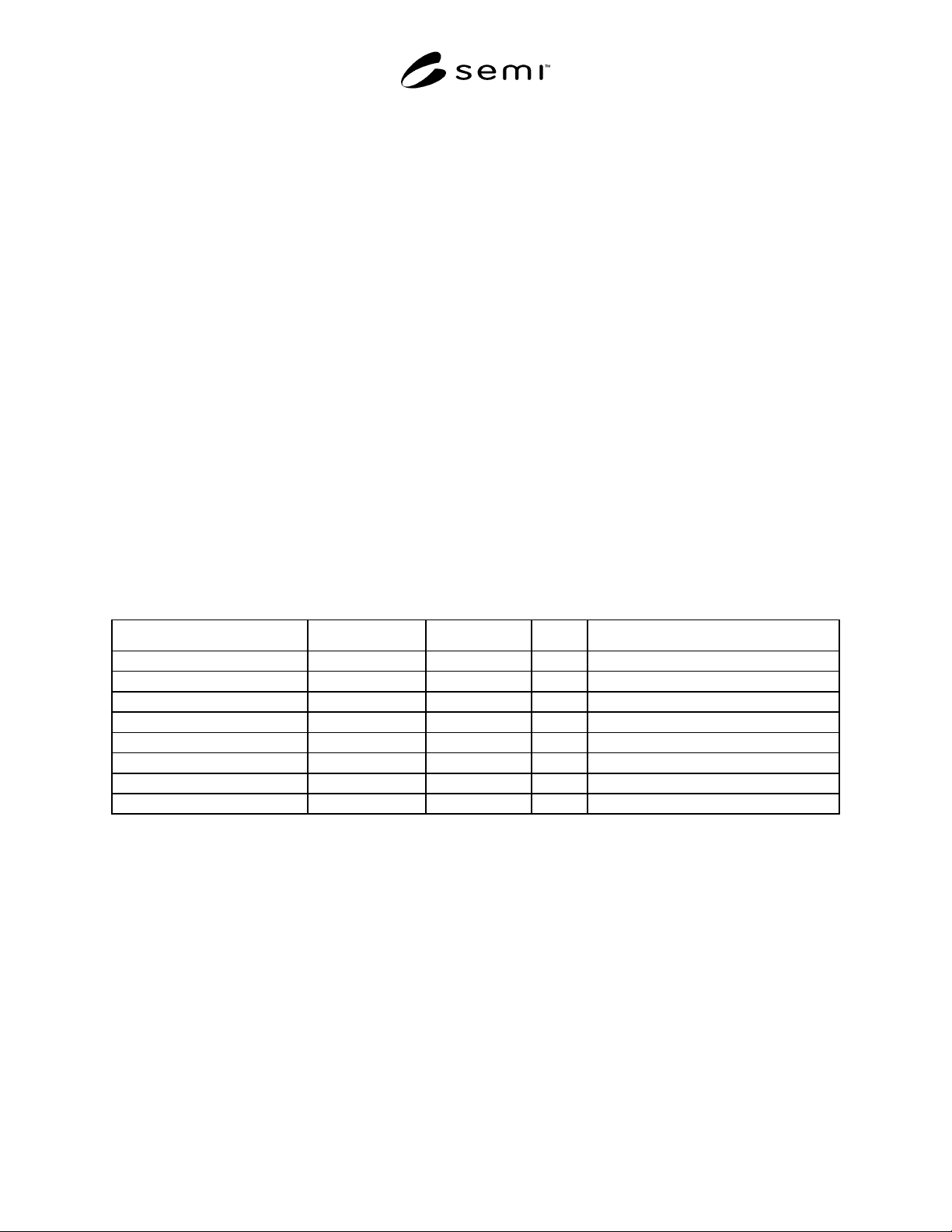
Table 36 A Class Attributes*
Attribute Name Attribute Identifier Access (Network) Rqmt Form
Setting nA16** RW Y Context-Specific
SafeState nA17 RW N Context-Specific
WatchRate nA18 RW N Unsigned Integer < 65,536
WatchDog nA19*** RW N Boolean
* A “Definition” column is not included. For attribute definitions, see text.
** Where ‘n’ is the type of the object instance to which the particular attribute is associated (e.g., Aao or Ado), see Sections 7.4.4 through 7.4.8.
*** ID’s nA20 through nA63 are reserved for future A class attribute definition.
7.4.3.1.1 Setting — Specifies the value that is to be actuated by the actuator associated with the object instance.
The form and content of this attribute is context-specific.
SEMI E54.1-1000 © SEMI 1996, 2000 34
7.4.3.1.2 SafeState — Specifies the state in which the actuator will be placed for ABORT and INITIALIZING
states. Unless otherwise specified, this attribute is a Boolean type corresponding to Zero (or “no output”) or One (or
“full output”).
7.4.3.1.3 WatchRate — Specifies the rate at which the “Setting” attribute is to be refreshed (i.e., set externally). If
the “Setting” attribute is not refreshed at this rate, it reverts to its default value; expressed in (integer/100) hertz.
7.4.3.1.4 WatchDog — Enables or disables the capability of setting the “Setting” attribute to its default value due
to a refresh rate lower than specified by the “WatchRate” attribute value; a value of TRUE signifies that the
WatchRate functionality is enabled.
7.4.3.2 Actuator Class Services — No A class common services are defined. Note that the A class inherits all AE
class services.
7.4.3.3 Actuator Class Behavior — The following applies to A class behavior:
Some form of actuation activity is made by the active actuation element. The value of the “Setting” attribute is
converted into the appropriate signal to cause the desired actuation.
A class-defined behavior associated with the “WatchRate” and “WatchDog” attributes is defined in Section 7.4.3.1
(above). No other A class common behavior is defined. Note that the A class inherits all AE class-defined behavior.
7.4.4 Controller (C) Class — The C class at the second level of the active element generalization hierarchy
contains structure and behavior common to all controller element instances in a device. Note that, as discussed in
Section 7.4, since this is the lowest level of class description in the generalization hierarchy for this device type (see
Figure 7), object instances can be created as instances of this class type.
7.4.4.1 Controller Class Attributes — All required and “common optional” C class attributes are listed in Table 37
and described below. For an explanation of the table format, see Section 7.3.1. Note that the C class also inherits all
AE class attributes.
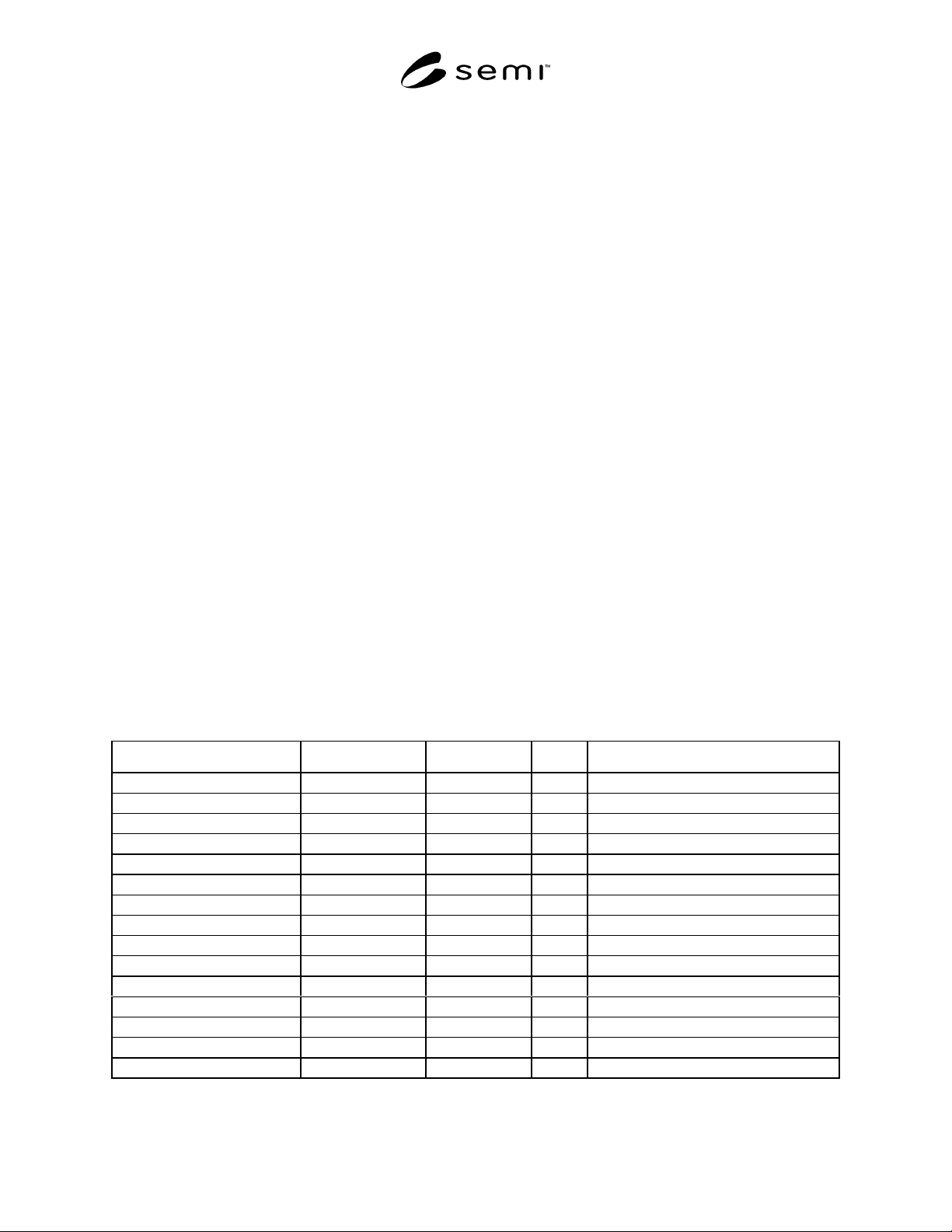
Table 37 C Class Attributes*
Attribute Name Attribute Identifier Access (Network) Rqmt Form
Setpoint CA16 RW Y Context-Specific
ProcessVariable CA17 RW N Context-Specific
ControlVariable CA18 RW N Context-Specific
DataType CA19 RW N Context-Specific
AlarmSettleTime CA21 RW N Context-Specific
AlarmErrorBand CA22 RW N Context-Specific
WarningSettleTime CA24 RW N Context-Specific
WarningErrorBand CA25 RW N Context-Specific
* A “Definition” column is not included. For attribute definitions, see text.
** ID’s CA27 through CA63 are reserved for future C class attribute definition.
7.4.4.1.1 Setpoint — This attribute specifies the value to which the Process Variable will be controlled via the
Control Variable. This is one of the inputs of a classic single-stage closed-loop controller. The setpoint attribute
value is expressed in units identified by the “DataUnits” attribute.
7.4.4.1.2 ProcessVariable — This attribute value is the measurement of the process being controlled. This is one of
the inputs of a classic single-stage closed-loop controller.
7.4.4.1.3 ControlVariable — This attribute value is the control signal being sent to the process controlling element.
This is the output of a classic single-stage closed-loop controller.
7.4.4.1.4 DataType — An attribute which defines the format of the data associated with “Value” attribute
(inherited) of the object instance.
SEMI E54.1-1000 © SEMI 1996, 200035
7.4.4.1.5 DataUnits — An attribute which defines the
current units associated with “Value” attribute
(inherited) of the object instance.
7.4.4.1.6 AlarmSettleTime — An attribute which
specifies a time used in the determination of a
Controller object instance alarm exception condition.
This value is expressed in units of seconds. The
minimum allowable value for this attribute is specified
by the manufacturer. An out-of-range error will result
from an attempt to set this attribute to a value lower
than that specified as the minimum allowable.
7.4.4.1.7 AlarmErrorBand — An attribute which
specifies an amount by which the process variable may
not equal the setpoint used in the determination of a
Controller object instance alarm exception condition.
This value is expressed in units identified by the
“DataUnits” attribute and in a format specified by the
“DataType” attribute.
7.4.4.1.8 WarningSettleTime — An attribute which
specifies a time used in the determination of a
Controller object instance warning exception condition.
This value is expressed in units of seconds. The
minimum allowable value for this attribute is specified
by the manufacturer. An out-of-range error will result
from an attempt to set this attribute to a value lower
than that specified as the minimum allowable.
7.4.4.1.9 WarningErrorBand — An attribute which
specifies an amount by which the process variable may
not equal the setpoint used in the determination of a
Controller object instance warning exception condition.
This value is expressed in units identified by the
“DataUnits” attribute and in a format specified by the
“DataType” attribute.
7.4.4.2 Controller Class Services — No C class
common services are defined. Note that the C class
inherits all AE class services.
7.4.4.3 Controller Class Behavior — The following
applies to C class behavior:
The controller element uses the value of the Process-
Variable and Setpoint attributes and determines the
error signal. It then adjusts the ControlVariable attribute
value as necessary and appropriate to minimize this
error signal. The method of, and conditions for,
adjustment are beyond the scope of this document.
Note that the C class inherits all AE class-defined
behavior.
7.4.5 Sensor-Analog Input (SAI) Class — The SAI
class at the third level of the active element
generalization hierarchy contains structure and behavior
common to all analog input sensor element instances in
a device. Note that, as discussed in Section 7.4, since
this is the lowest level of class description in the
generalization hierarchy for this device element type
(see Figure 7), object instances can be created as
instances of this class type.
7.4.5.1 Sensor-Analog Input Class Attributes — All
required and “common optional” SAI class attributes
are listed in Table 38 and described below. For an
explanation of the table format, see Section 7.3.1. Note
that the SAI class also inherits all AE and S class
attributes.
Table 38 SAI Class Attributes*
Attribute Name Attribute Identifier Access (Network) Rqmt Form
Offset SaiA64 RW N Context-Specific
Gain SaiA65 RW N Context-Specific
DataType SaiA66 RW N Context-Specific
DataUnits SaiA67 RW N Context-Specific
SafeState SaiA68 RW N Enumerated Byte
EnableReportDelta SaiA69 RW N Boolean
ReportDelta SaiA70 RW N Context-Specific
EnableReportROC SaiA71 RW N Boolean
ReportROC SaiA72 RW N Context-Specific
AlarmTripPointHigh SaiA73 RW N Context-Specific
AlarmTripPointLow SaiA74 RW N Context-Specific
AlarmHystersis SaiA75 RW N Context-Specific
WarningTripPointHigh SaiA76 RW N Context-Specific
WarningTripPointLow SaiA77 RW N Context-Specific
WarningHystersis SaiA78** RW N Context-Specific
* A “Definition” column is not included. For attribute definitions, see text.
** ID’s SaiA78 through SaiA127 are reserved for future Sai class attribute definition.