semi合集-English.pdf - 第1933页
SEMI E54.1-1000 © SEMI 1996, 2000 39 7.4.9.1 Act uator-Enumerate d Output C l a ss Attributes — No A E O class common attributes are defi ned. Note that the AEO class inherits all AE and A class attributes. 7.4.9.2 Act u…
SEMI E54.1-1000 © SEMI 1996, 2000 38
7.4.6.5.2 AlarmState — The value of the Value attribute that will cause an alarm condition.
7.4.6.5.3 WarningState — The value of the Value attribute that will cause a warning condition.
7.4.7 Actuator-Analog Output (AAO) Class — The AAO class at the third level of the active element generalization
hierarchy contains structure and behavior common to all analog output actuator element instances in a device. Note
that, as discussed in Section 7.4, since this is the lowest level of class description in the generalization hierarchy for
this device element type (see Figure 7), object instances can be created as instances of this class type.
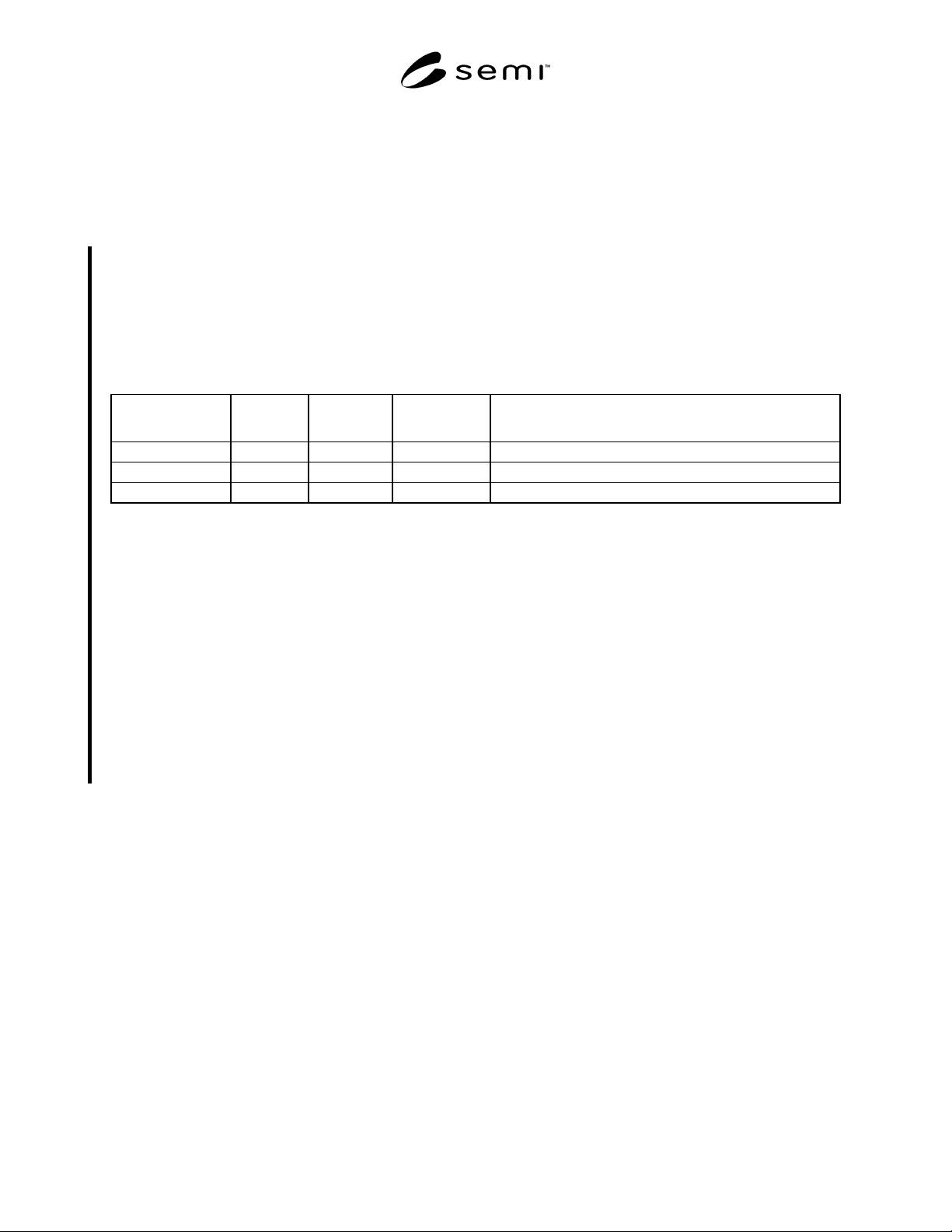
7.4.7.1 Actuator-Analog Output Class Attributes — All required and “common optional” AAO class attributes are
listed in Table 42 and described below. For an explanation of the table format, see Section 7.3.1. Note that the AAO
class also inherits all AE and A class attributes.
Table 42 AAO Class Attributes*
Attribute Name Attribute Identifier Access (Network) Rqmt Form
Offset AaoA64 RW N Context-specific
Gain AaoA65 RW N Context-specific
DataType AaoA66 RW N Context-specific
DataUnits AaoA67** RW N Context-specific
* A “Definition” column is not included. For attribute definitions, see text.
** ID’s AaoA68 through AaoA127 are reserved for future Aao class attribute definition.
7.4.7.1.1 Offset — An attribute which specifies the amount of offset correction being applied to derive the value of
the “Value” attribute (inherited) of the object instance. It is expressed in terms of the units specified by the
“DataUnits” attribute.
7.4.7.1.2 Gain — An attribute which is used to define the range of the “Value” attribute (inherited) of the object
instance. The method of conveying this range with this attribute is beyond the scope of this document.
7.4.7.1.3 DataType — An attribute which defines the format of the data associated with “Value” attribute
(inherited) of the object instance.
7.4.7.1.4 DataUnits — An attribute which defines the current units associated with “Value” attribute (inherited) of
the object instance.
7.4.7.2 Actuator-Analog Output Class Services — No AAO class common services are defined. Note that the AAO
class inherits all AE and A class services.
7.4.7.3 Actuator-Analog Output Class Behavior — No AAO class common behavior is defined. Note that the AAO
class inherits all AE and A class-defined behavior.
7.4.8 Actuator-Binary Output (ABO) Class — The ABO class at the third level of the active element generalization
hierarchy contains structure and behavior common to all binary output actuator element instances in a device. Note
that, as discussed in Section 7.4, since this is the lowest level of class description in the generalization hierarchy for
this device element type (see Figure 7), object instances can be created as instances of this class type.
7.4.8.1 Actuator-Binary Output Class Attributes — No ABO class common attributes are defined. Note that the
ABO class inherits all AE and A class attributes.
7.4.8.2 Actuator-Binary Output Class Services — No ABO class common services are defined. Note that the ABO
class inherits all AE and A class services.
7.4.8.3 Actuator-Binary Output Class Behavior — No ABO class common behavior is defined. Note that the ABO
class inherits all AE and A class-defined behavior.
7.4.9 Actuator-Enumerated Output (AEO) Class — The AEO class at the third level of the active element
generalization hierarchy contains structure and behavior common to all Enumerated output actuator element
instances in a device. Note that, as discussed in Section 7.4, since this is the lowest level of class description in the
generalization hierarchy for this device element type (see Figure 7), object instances can be created as instances of
this class type.
SEMI E54.1-1000 © SEMI 1996, 200039
7.4.9.1 Actuator-Enumerated Output Class Attributes — No AEO class common attributes are defined. Note that
the AEO class inherits all AE and A class attributes.
7.4.9.2 Actuator-Enumerated Output Class Services — No AEO class common services are defined. Note that the
AEO class inherits all AE and A class services.
7.4.9.3 Actuator-Enumerated Output Class Behavior — No AEO class common behavior is defined. Note that the
AEO class inherits all AE and A class-defined behavior.
7.4.10 Sensor-Binary Input-Threshold (SBITH) Class — The SBITH class at the fourth level of the active element
generalization hierarchy contains structure and behavior common to all binary input threshold sensor element
instances in a device.
7.4.10.1 Sensor-Binary Input Threshold Class Attributes — All required and “common optional” SBITH class
attributes are listed in Table 43 and described below. For an explanation of the table format see Section 7.3.1. Note
that the SBITH class also inherits all AE, S, an SBI class attributes.
Table 43 SBITH Class Attributes*
Attribute Name Attribute
Identifier
Access
(Network)
Rqmt Form
Reading Valid SbithA64 R N Enumerated, Byte
State SbithA65 R N Enumerated, Byte
Status SbithA66 R N Enumerated, Byte
* A “Definition” column is not included. For attribute definitions, see text.
** ID’s Sbith67 through Sbith127 are reserved for future Sbith class attribute definition.
7.4.10.1.1 Reading Valid — This attribute is used to specify the validity of the “Value” attribute of the SBITH
object. The method of utilization of this attribute is application specific.
7.4.10.1.2 State — This attribute is used to record the current state of the SBITH object. The method of utilization
of this attribute is application specific.
7.4.10.1.3 Status — This attribute is used to record the current active reporting status of the SBITH object. The
method of utilization of this attribute is application specific.
7.4.10.2 Sensor-Binary Input-Threshold Class Services — No SBITH class common services are defined. Note that
the SBITH class inherits all AE, S, and SBI class services.
7.4.10.3 Sensor-Binary Input-Threshold Class Behavior — No SBITH class common behavior is defined. Note
that the SBITH class inherits all AE, S, and SBI class behavior.
SEMI E54.1-1000 © SEMI 1996, 2000 40
APPENDIX 1
DATA UNIT ENUMERATION
NOTE: This appendix was approved as an official part of SEMI E54.1 by full letter ballot procedure.
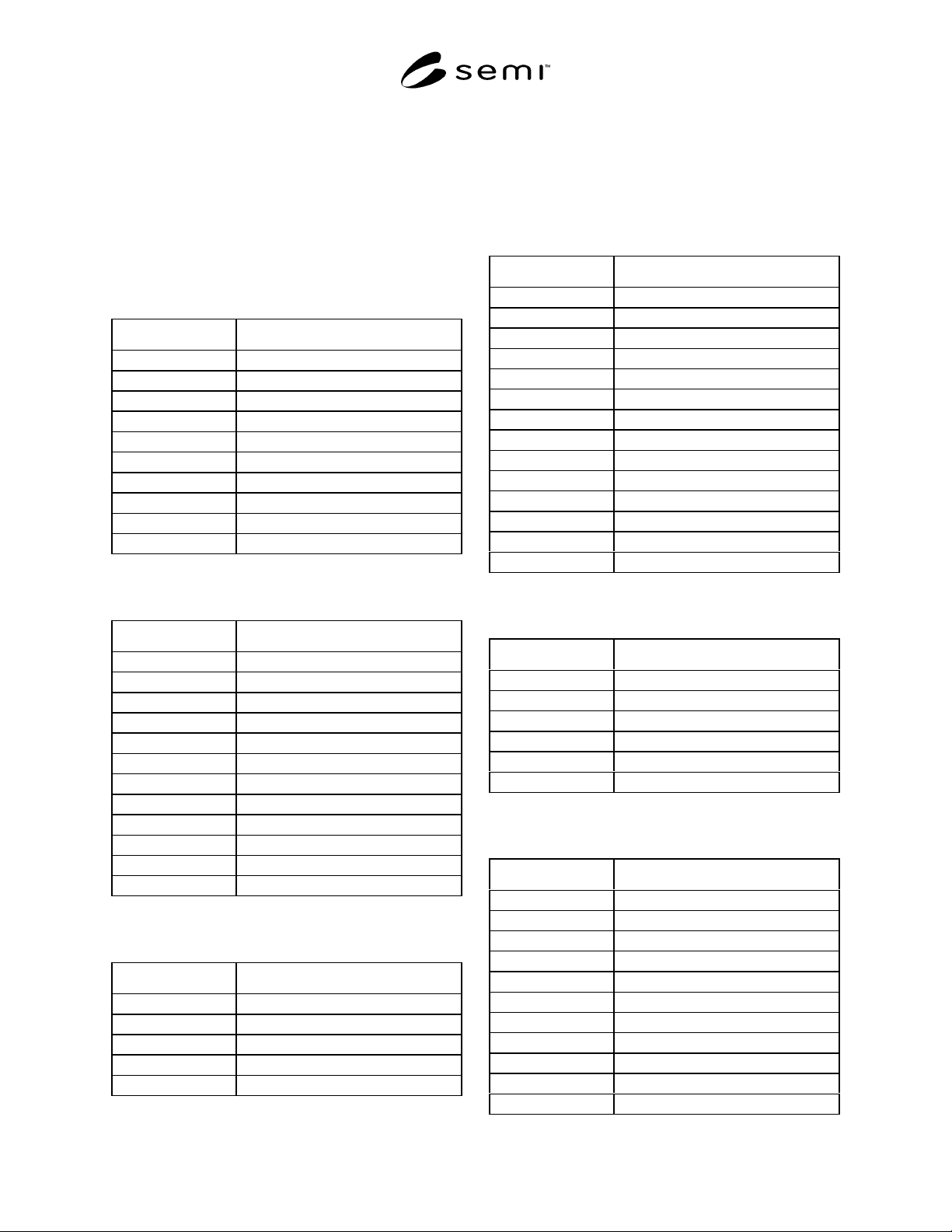
The Data Units data type term is defined in Section 5.2.
The following is a partial enumeration of that data type;
further enumeration may be provided in an application-
specific context.
Table A1-1 General
Data Units Description
0 Counts
1 Counts per Second
2 Counts per Millisecond
3 Counts per Microsecond
4 Counts per Minute
5 Counts per Hour
6 Counts per Day
7 Percent
8–191 Reserved
192–255 Open
Group 1 — Time and Frequency (256–511)
Table A1-2 Time and Frequency
Data Units Description
256 Seconds
257 Milliseconds
258 Microseconds
259 Minutes
260 Hours
261 Days
262 Hertz
263 KiloHertz
264 MegaHertz
265 GigaHertz
266–447 Reserved
448–511 Open
Group 2 — Temperature (512–767)
Table A1-3 Temperature
Data Units Description
512 Centigrade/Celsius
513 Fahrenheit
514 Kelvin
515–703 Reserved
704–767 Open
Group 3 — Pressure (768–1023)
Table A1-4 Pressure
Data Units Description
768 PSI
769 Torr
770 MilliTorr
771 mm Hg (0°C)
772 inches Hg (0°C)
773 cm H
2
O (25°C)
774 inches H
2
O (25°C)
775 Bar
776 MilliBar
777 Pascal
778 KiloPascal
779 Atmosphere
780–959 Reserved
960–1023 Open
Group 4 — Flow (1024–1279)
Table A1-5 Flow
Data Units Description
1024 SCCM
1025 SLM
1026 CFM
1027 Pa-m
3
/s
1028–1215 Reserved
1216–1279 Open
Group 5 — Electrical (1280–1535)
Table A1-6 Electrical
Data Units Description
1280 Volts
1281 MilliVolts
1282 MicroVolts
1283 NanoVolts
1284 PicoVolts
1285 FemtoVolts
1286 KiloVolts
1287 MegaVolts
1288 GigaVolts
1290 Amps
1291 MilliAmps