semi合集-English.pdf - 第2006页
SEMI E54.6-0997 © SEMI 1997, 2004 12 9 Specific Device Type Information 9.1 This section prov ides for the mapp ing of network- visible specific device struct ure and behavior, specified in a SEMI standard SDM specificat…
SEMI E54.6-0997 © SEMI 1997, 2004 11
The type SNVT_exc_detail(*) is a sequence of three
structures containing arrays. The LonWorks Network
Communication Standard limits the size of each of
these arrays to 9 bytes, so that the type fits within the
network variable size limit of 31 bytes. For example, in
Neuron C, the declaration of SNVT_exc_detail is as
follows:
typedef struct {
u_char comn_exc_size;
int resvd1 : 1;
int real_time : 1;
int communic : 1;
int RAM : 1;
int EEPROM : 1;
int EPROM : 1;
int microproc : 1;
int diagnostic : 1;
/*--------------------------*/
int resvd2 : 1;
int reset : 1;
int notify_mfr : 1;
int maintenance : 1;
int power_inputV : 1;
int power_outptV : 1;
int power_resvd : 1;
int power_overC : 1;
u_char comn_exc_dtl[7];
/*--------------------------*/
u_char dev_exc_size;
u_char dev_exc_dtl[9];
/*--------------------------*/
u_char mfr_exc_size;
u_char mfr_exc_dtl[9];
} SNVT_exc_detail;
7.5 Sensor, Actuator, and Controller Objects — These
objects are necessarily specific to the Specific Device
Models. The LonMark Application Layer
Interoperability Guidelines provide a framework for
defining LonMark objects, together with specifications
of generic sensor and actuator objects. Specific Device
Models may employ these objects, and/or may define
their own objects and Standard Network Variable
Types for device-specific requirements. As long as the
LonMark object definition guidelines are followed,
these device-specific objects may be proposed to the
LonMark Interoperability Association for incorporation
within the LonMark guidelines.
8 Protocol Compliance
A method of testing protocol compliance is required to
verify implementation conformance to the standard. By
virtue of the fact that the intermediate layers of the
LonTalk protocol are implemented in commercially
available silicon, compliance verification is needed
only at the physical and application layers. The
LonMark Interoperability Association provides a
compliance verification service to its members. When
the SEMI Sensor/Actuator Network standard is
incorporated into the LonMark guidelines, this service
may be used to verify compliance with the SEMI
guidelines.
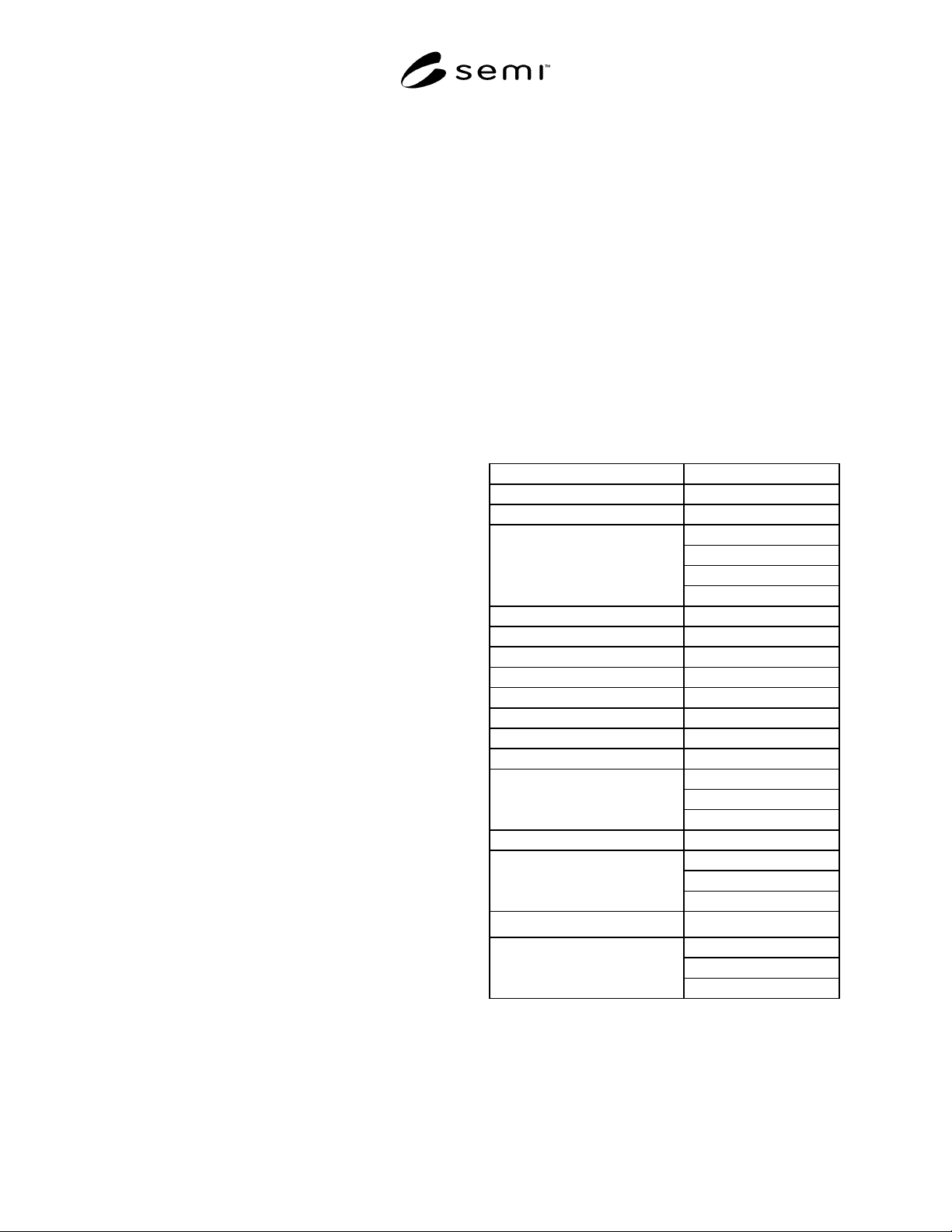
8.1 Interoperability Guidelines Checklist
Applicant Name
Product Name
Standard Program ID
Manufacturer ID
Device Class
Device Subclass
Model Number
Comm. Transceiver
Standard Xcvr Type
Network Connector
Neuron Chip Clock Rate
Oscillator Accuracy
Network Buffer Size
Receive Transactions
SAC Object
Mandatory NVs
Optional NVs
Configuration Properties
Device Manager Object
Mandatory NVs
Optional NVs
Configuration Properties
Functional Profiles
Mandatory NVs
Optional NVs
Configuration Properties

SEMI E54.6-0997 © SEMI 1997, 2004 12
9 Specific Device Type Information
9.1 This section provides for the mapping of network-
visible specific device structure and behavior, specified
in a SEMI standard SDM specification, to the
LonWorks network. Each subsection is devoted to a
single SDM specification (e.g., Section 9.1: Mass Flow
Controller). Additional SDM mappings are added as
subsections to this NCS specification according to
SEMI guidelines and the guidelines of the SEMI SAN
Interoperability standard. Device-type-specific items,
such as overrides to the standard connector, may also be
noted in these subsections.
NOTICE: These standards do not purport to address
safety issues, if any, associated with their use. It is the
responsibility of the user of these standards to establish
appropriate safety and health practices and determine
the applicability of regulatory limitations prior to use.
SEMI makes no warranties or representations as to the
suitability of the standards set forth herein for any
particular application. The determination of the
suitability of the standard is solely the responsibility of
the user. Users are cautioned to refer to manufacturer’s
instructions, product labels, product data sheets, and
other relevant literature respecting any materials
mentioned herein. These standards are subject to
change without notice.
The user’s attention is called to the possibility that
compliance with this standard may require use of
copyrighted material or of an invention covered by
patent rights. By publication of this standard, SEMI
takes no position respecting the validity of any patent
rights or copyrights asserted in connection with any
item mentioned in this standard. Users of this standard
are expressly advised that determination of any such
patent rights or copyrights, and the risk of infringement
of such rights, are entirely their own responsibility.
Copyright by SEMI® (Semiconductor Equipment and Materials
International), 3081 Zanker Road, San Jose, CA 95134. Reproduction o
f
the contents in whole or in part is forbidden without express written
consent of SEMI.

SEMI E54.7-0999 © SEMI 19991
SEMI E54.7-0999
STANDARD FOR SENSOR/ACTUATOR NETWORK COMMUNICATION
FOR SERIPLEX
This standard was technically approved by the Global Information & Control Committee and is the direct
responsibility of the North American Information & Control Committee. Current edition approved by the
North American Regional Standards Committee on July 15, 1999. Initially available at www.semi.org
August 1999; to be published September 1999.
1 Purpose
1.1 This standard defines a communication
specification based on the Seriplex protocol to enable
communications between intelligent devices on a
sensor/actuator network (SAN) that operate according
to SEMI specified device models (common and device
specific) in a semiconductor manufacturing tool.
1.2 Background and Motivation
1.2.1 Seriplex is a component level network which
provides a simple, inexpensive, fast, and deterministic
means of exchanging data among control level
industrial devices (e.g., sensors and actuators) and
higher level devices such as controllers. Seriplex
provides:
• A solution to low-level device networking
• Access to intelligence present in low-level devices
• Networking between higher level controllers
• Master/Slave and Peer-to-Peer capabilities
1.2.2 Seriplex specifies a communication model and
protocol as well as a complete Physical Layer
definition.
1.2.3 This document enables commu nications between
intelligent devices on a SEMI compliant SAN by
providing a presentation mapping of common and
specific device network visible structure and behavior
to a Seriplex network.
2 Scope
2.1 This document specifies the protocol and services
that compliant intelligent devices must support to
exchange information over this semiconductor
equipment sensor/actuator network.
2.2 This document specifies the utilization of the
Seriplex protocol to present externally visible device
structure and behavior, specified in the Common
Device Model (CDM) and appropriate Specific Device
Models (SDMs), on a Seriplex network.
2.3 This document is used in conjunction with a SEMI
standard SAN Common Device Model specification,
one or more SEMI standard Specific Device Model
(SDM) specifications (e.g. for a mass flow controller)
and the Seriplex Standard Specification. Together, they
describe the Seriplex protocol, the externally visible
data structures and behaviors of devices utilizing the
Seriplex networking capability in a SEMI compliant
SAN system.
2.4 This standard does not purport to address all of the
safety issues associated with its use. It is the
responsibility of the users of this standard to establish
appropriate safety and health practices and determine
the applicablity of regulatory limitations prior to use.
3 Limitations
3.1 This document specifies a semiconductor
equipment SAN based solely on Seriplex and is a
companion document to the Seriplex standard
specification; thus a complete specification of this
standard necessarily includes the Seriplex standard
specifications. There are other semiconductor
equipment SAN communications options. The
specifications for these options are not included here.
3.2 This standard specifies enhancements that provide
additional capabilities over and above those currently
required by Seriplex. In order to avoid document
consistency problems, information in the Seriplex
standard specification that relates to this standard is not
repeated in this document. This document is limited to
describing enhancements or limitations to the Seriplex
standard specification that are imposed by this standard.
4 Referenced Standards
4.1 SEMI Standards
SEMI E54.1 — Standard for Sensor/Actuator Network
Common Device Model
SEMI E54.3 — Specification for Sensor/Actuator
Network Specific Device Model for Mass Flow Device