semi合集-English.pdf - 第2263页
SEMI E58.1-0697 © SEMI 1997, 2003 3 NOTICE: SEMI makes no warranties or representatio ns as to the suitability of th e standards set forth herein for any particular application. Th e determination of the suitability of t…
SEMI E58.1-0697 © SEMI 1997, 2003 2
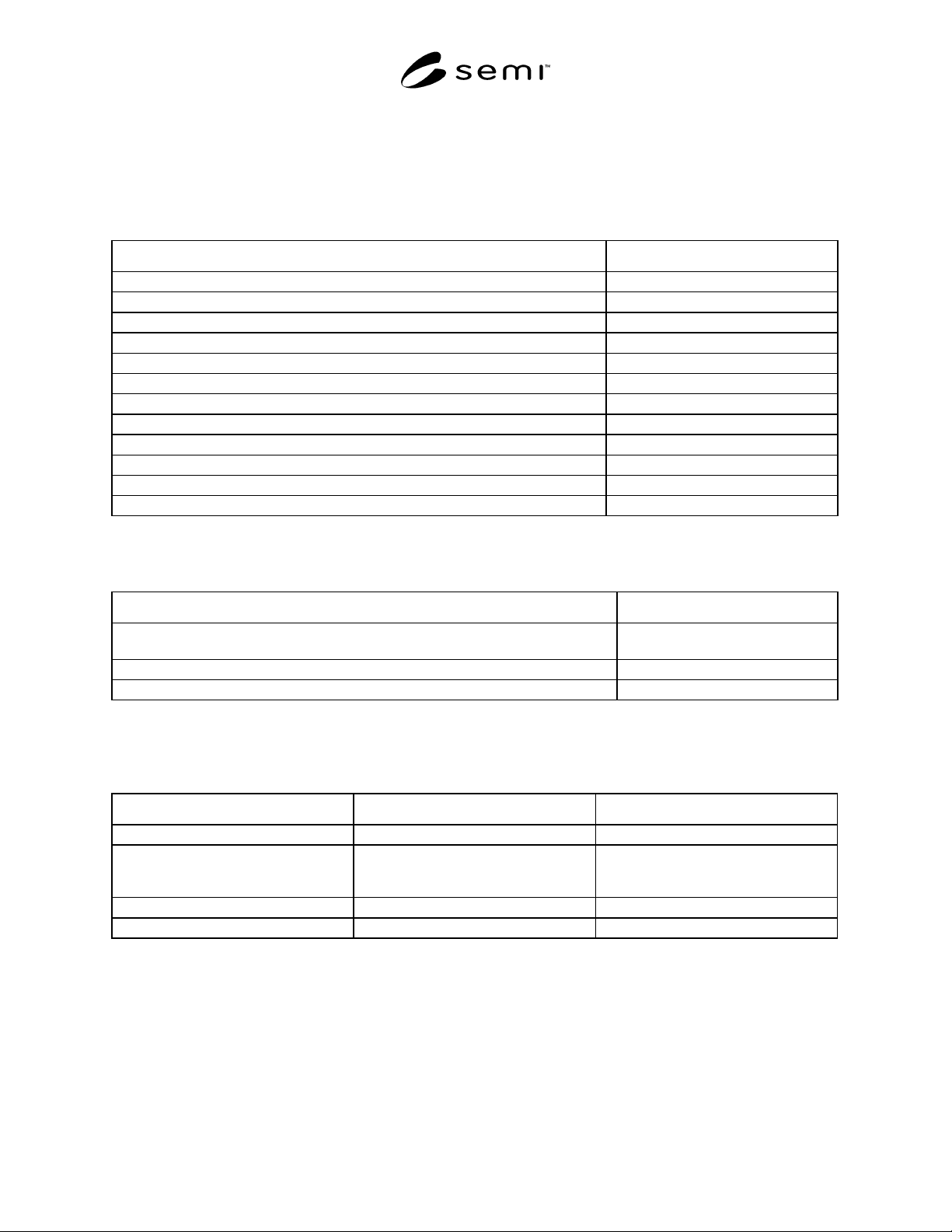
5 Service Parameter Mapping
5.1 Table 2 shows the mapping between service parameters defined by ARAMS and the data items defined by
SEMI E5. An additional mapping for the ARAMSStateChange and ResetAccumulators services is shown in Table 4
below.
Table 2 Service Parameter Mapping Table
Parameter Name SECS-II Data Item
AttrData ATTRDATA
AttrName ATTRID
ColHdr COLHDR
ErrorCode ERRCODE
ErrorText ERRTEXT
ObjSpec OBJSPEC
RequestStatus HCACK
TableAck TBLACK
TableCmd TBLCMD
TableElem TBLELT
TableID TBLID
TableType TBLTYP
5.2 Table 3 shows the data items in SECS-II messages that do not have a corresponding service parameter.
Table 3 Additional Data Item Requirement Table
Function SECS-II Data Item
Used to satisfy SECS-II conventions for linking a multi block inquiry with subsequent
multilock message.
DATAID
Used by S2F41 and S2F49 to indicate the ARAMSStateChange Service. RCMD=“ARAMSStateChange”
Used by S2F41 and S2F49 to indicate the ResetAccumulators Service. RCMD=“ResetAccumulators”
NOTE: The text strings specified in Table 3 for RCMD shall be recognized by the equipment, whether the equipment is or is not case-sensitive.
5.3 Table 4 provides the parameter mapping for the ARAMSStateChange and the S2,F41 and S2,F49 messages.
Table 4 Service Parameter Mapping (S2F41 and S2F49)
Parameter Name CPNAME CPVAL/CEPVAL (Form)
ARAMSCode “ARAMSCode” Text, 4 characters
ObjSpec “ObjSpec” Text. Conforms to data item OBJSPEC.
NOTE: in S2,F49, ObjSpec maps directly
to the data item OBJSPEC.
SymptomID “SympID” Unsigned integer
SymptomText “SympText” Text, 0–80 characters
NOTE: The text strings specified in Table 4 for CPNAME shall be recognized by the equipment, whether the equipment is or is not case-
sensitive.

SEMI E58.1-0697 © SEMI 1997, 2003 3
NOTICE: SEMI makes no warranties or representations as to the suitability of the standards set forth herein for any
particular application. The determination of the suitability of the standard is solely the responsibility of the user.
Users are cautioned to refer to manufacturer’s instructions, product labels, product data sheets, and other relevant
literature respecting any materials mentioned herein. These standards are subject to change without notice.
The user’s attention is called to the possibility that compliance with this standard may require use of copyrighted
material or of an invention covered by patent rights. By publication of this standard, SEMI takes no position
respecting the validity of any patent rights or copyrights asserted in connection with any item mentioned in this
standard. Users of this standard are expressly advised that determination of any such patent rights or copyrights, and
the risk of infringement of such rights, are entirely their own responsibility.
Copyright by SEMI® (Semiconductor Equipment and Materials
International), 3081 Zanker Road, San Jose, CA 95134. Reproduction o
f
the contents in whole or in part is forbidden without express written
consent of SEMI.
SEMI E81-0600 © 1999, 20001
SEMI E81-0600
PROVISIONAL SPECIFICATION FOR CIM FRAMEWORK DOMAIN
ARCHITECTURE
This provisional specification was technically approved by the Global Information & Control Committee and
is the direct responsibility of the North American Information & Control Committee. Current edition
approved by the North American Regional Standards Committee on March 2, 2000. Initially available at
www.semi.org April 1999; to be published June 2000. Originally published June 1999.
1 Purpose
1.1 This document is an overview of the structure and
contents of a suite of documents representing an
application framework for the Computer Integrated
Manufacturing (CIM) systems as used in semiconductor
factories. A framework is a software infrastructure that
creates a common environment for integrating appli-
cations and sharing information in a given domain. The
purpose of this framework is to establish an industry
standard architecture for complex manufacturing
systems, leading to an open, multisupplier CIM system
environment. The framework described in this
specification is called the CIM Framework.
2 Scope
2.1 The intent of this document is to describe the
Manufacturing Execution Systems (MES) domain that
is the subject of the CIM Framework and to provide a
reference for concepts that are common to the set of
documents that specify the CIM Framework. The
Provisional Specification for CIM Framework Domain
Architecture defines the structure, relationships and
interworkings of the components that together comprise
the CIM Framework. This architecture defines the
partitioning of the CIM Framework components and the
responsibilities of each of those components. It also
specifies the common abstractions for manufacturing
jobs, material, and factory resources that are used
consistently throughout the CIM Framework as
unifying themes.
2.2 The CIM Framework Domain Architecture does
not address the dependencies on computing tech-
nologies needed to implement these components. These
aspects apply more to the realization of the components
as software artifacts than to their functionality in terms
of semiconductor manufacturing concepts. The
technical aspects of the CIM Framework architecture
are captured in a separate document, SEMI E96, Guide
for CIM Framework Technical Architecture.
2.3 This specification does not purport to address
safety issues, if any, associated with its use. It is the
responsibility of the users of this specification to
establish appropriate safety and health practices and
determine the applicability of regulatory limitations
prior to use.
3 Limitations
3.1 The CIM Framework Specification must continue
to evolve to meet the needs of a competitive and vital
industry. The content of this framework represents a
significant amount of real development experience from
a number of commercial software suppliers and their
customers. These specifications reflect the product
architectures of those companies, as well as the
requirements of their customers.
3.2 As a SEMI Provisional Standard, the Specification
for CIM Framework Domain Architecture has specific
deficiencies that must be addressed before it may be
upgraded to full SEMI Standard status. These
deficiencies are:
• Ensuring consistency with the details of subsequent
related specifications that are based on this domain
architecture.
• Evolving from coarse-grained component partitions
to fine-grained components that provide
substitutability of smaller components.
• Expanding interfaces to include build-time
configuration functions.
• Providing fully validated models using the standard
Unified Modeling Language (UML) notation.
• Aligning the CIM Framework representation of
equipment and interfaces for interactions with
equipment automation software with emerging
standards in areas such as Object-Based Equipment
Model (OBEM) and Automated Material Handling
Systems (AMHS).
• Modifying the CIM Framework use of the “in”
parameter mode and operation return value to
include also the “out” and “inout” modes to better
accommodate implementations based on Microsoft
DCOM and IDL enhancements for pass-by-value
of objects.