semi合集-English.pdf - 第2271页
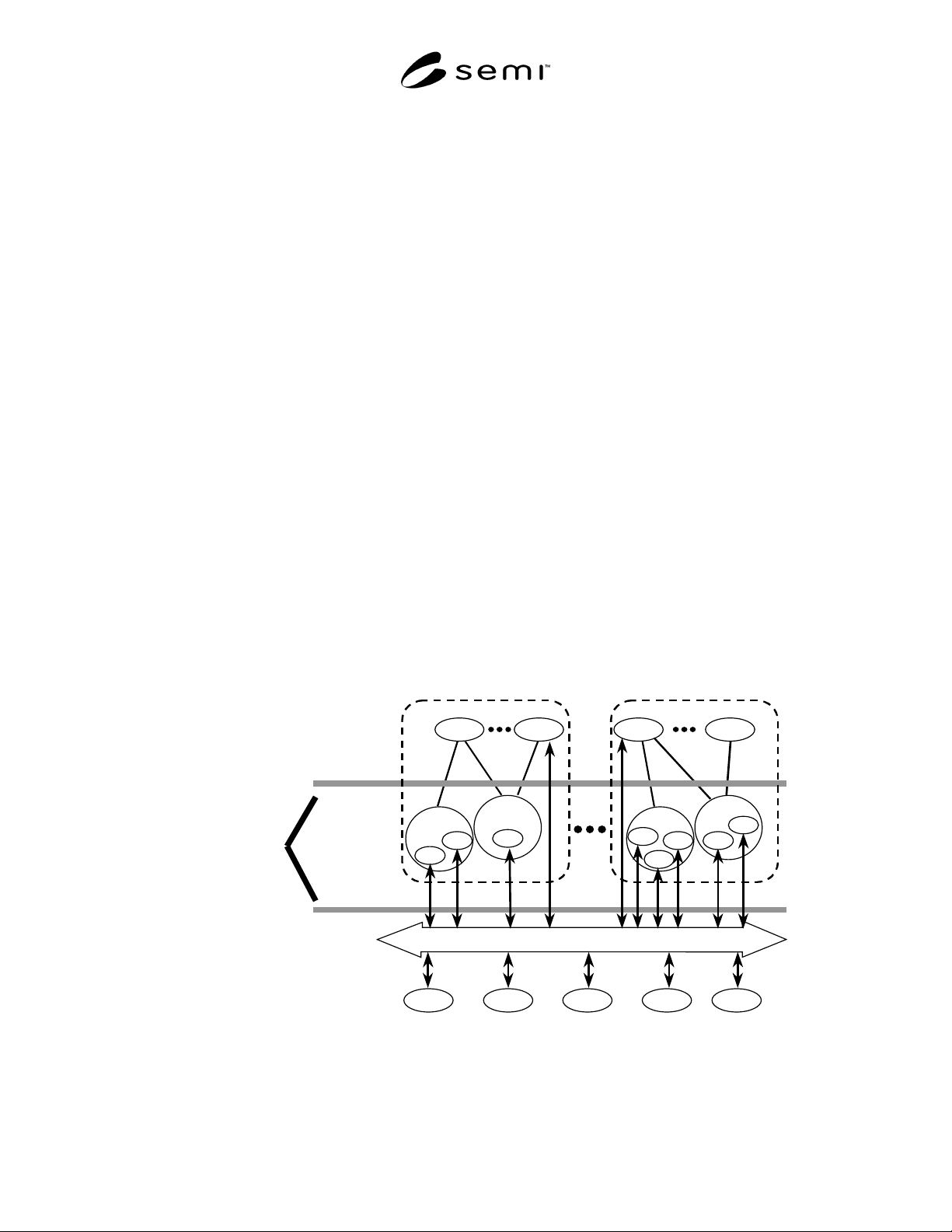
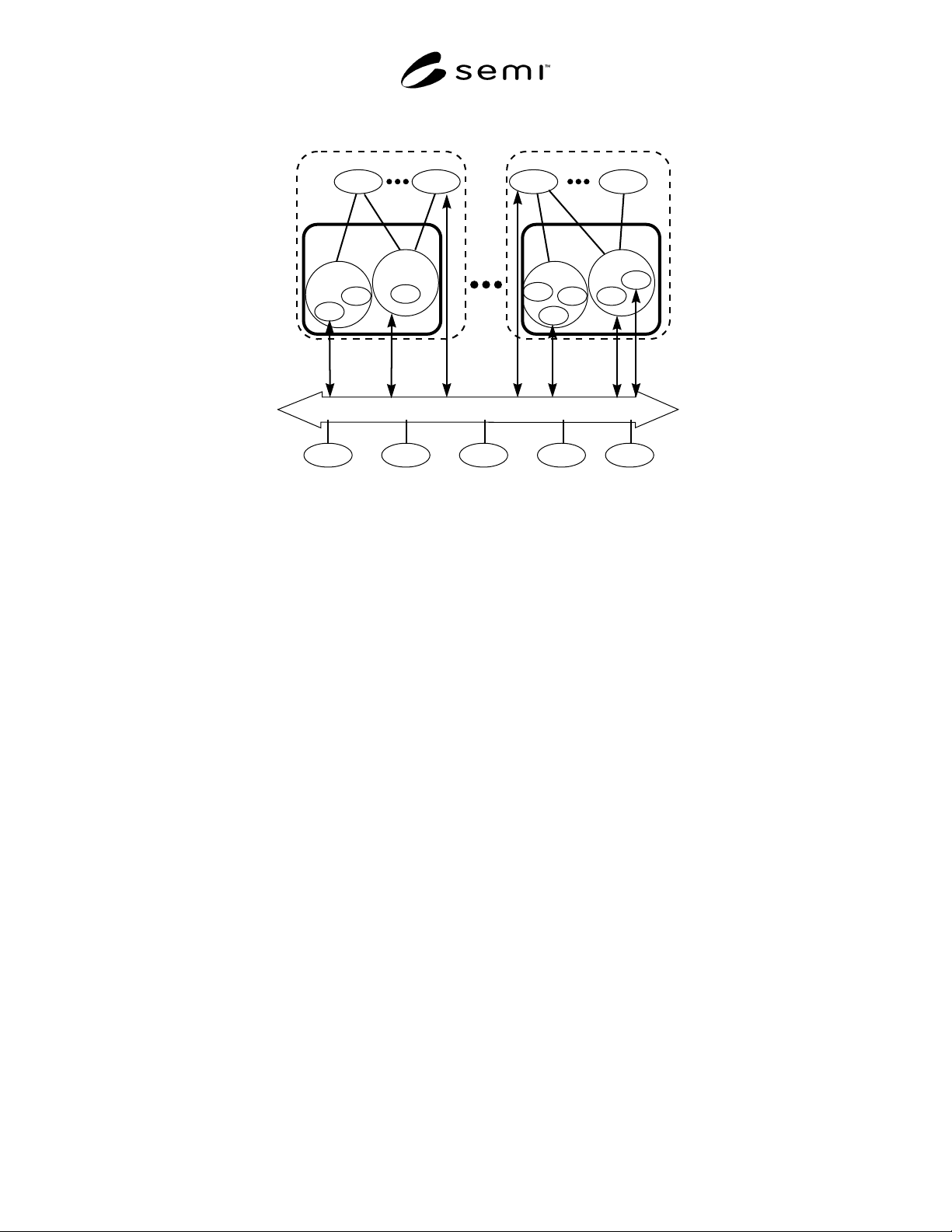
SEMI E81-0600 © 1999, 2 000 8 Object Communica tions (CO RBA or DCOM ) Object Object Obj ect Sub- Comp onent Object Object Object Object Object Object Ob ject O bject Object App lication 1 Applicat ion N Component Compon…
SEMI E81-0600 © 1999, 20007
define the business process workflows, business logic
and user interfaces for the applications. They provide
functionality that is often product- or site-specific. This
functionality should not be included in an industry-wide
standard for common components. Rather, it should be
accommodated through the extendibility and reuse
mechanisms of the common components.
6.3.3.6 Component Granularity and Incremental
Standard Conformance
6.3.3.6.1 The CIM Framework components are the
smallest elements of standardization of functional
interface and behavior. The CIM Framework specifies
relatively fine-grained components (in terms of their
functional scope) as in the SEMATECH CIM
Framework Specification Version 2.0 [CIMFW]. These
components are larger than objects (their specification
is in terms of an object model with typically three to
five objects) but more fine-grained than traditional
MES applications. However, the initial SEMI CIM
Framework standards also identify components that are
more coarse-grained, aligning with current MES
product boundaries. These coarse-grained components
contain fine-grained sub-components in their
specifications, as in Figure 3 (typically two to four sub-
components per coarse-grained component).
6.3.3.6.2 The coarse-grained components encapsulate
the detail of the internal objects, relationships and sub-
components by selectively exposing, hiding or
abstracting some object methods and relationships. The
coarse-grained components are specified with the detail
of the sub-component and object interfaces and
behavior, but standard conformance is in two levels;
first-level conformance is to the interfaces of the
coarse-grained components (not requiring exposure of
the encapsulated detail), and second-level conformance
is to the detail of the sub-components.
6.4 CIM Framework Functional Scope
6.4.1 The term Manufacturing Execution System
(MES) represents an abstraction for a collection of
software implementations. While there are examples of
implementations that provide significant coverage of
MES functionality, the industry trend is toward supplier
focus on areas of core competency. In many cases this
will result in a supplier offering for a subset of the MES
domain, or a partitioned offering of separable products
by a single source. Large, more monolithic
implementations are gradually evolving toward this
model of component packaging for smaller
implementations. Ideally, MES scoping should
correspond to natural boundaries that have emerged in
representative products that border the “In
MES”/“Outside MES” dividing line. It is that capability
within MES scope that will be provided by the CIM
Framework.
6.4.2 The following list identifies so me criteria that
may be used to help scope MES within the larger
context of manufacturing enterprise systems often
called Computer Integrated Manufacturing.
Object Communications (CORBA, DCOM, etc.)
Object
Object
Events
Common Services and Facilities
(CORBAservices and CORBAfacilities or COM+ or other)
Names Persist
Transact
Distributed
Computing
Infrastructure
Common
Components
Object
Component
Component
Object
Object
Object
Object
Component
Component
Object Object Object Object
Standard Component Interfaces
Standard Component Interfaces
Application
Objects
Conformant Extensions
Conformant Extensions
Object
Application 1 Application N
CIM
Framework
Components
. . .
• Interoperable
• Substitutable
• Extendible
•Flexible
• Reusable
Figure 2
CIM Framework Component Architecture
SEMI E81-0600 © 1999, 2000 8
Object Communications (CORBA or DCOM)
Object
Object
Object
Sub-
Component
Object
Object
Object
Object
Object Object Object Object
Object
Application 1 Application N
Component
Component
Component
Events Names Persist
Transact
. . .
Component
Component
Component
Sub-
Component
Sub-
Component
Sub-
Component
Figure 3
Components and Sub-Components
6.4.3 Thus, a component is “In MES” scope and
within the CIM Framework scope, if
• it provides a job abstraction to manage work
currently in progress across the manufacturing
facility,
• it represents the convergence of product and
process specifications, material, and manufacturing
resources through execution of production jobs,
• it provides facility level planning and scheduling of
manufacturing production activities,
• it provides access to historical data and reporting of
occurrences that changed the state of the products,
the production facility or its resources,
• it allows coordinated actions to control factory
resources,
• it allows abstraction representations of production
facilities and their resources,
• it enables automated update of manufacturing
parameters (settings) through data collection and
analysis of manufacturing processes, and
• it supports quality management through capture of
key metrics (e.g., yield, throughput, cycle-time and
utilization).
6.4.4 A component is “Outside MES” scope, thus
outside CIM Framework scope, if
• it controls or manipulates the internal state or
operation of a piece of manufacturing equipment,
• it deals with the business interactions between the
manufacturing enterprise and external enterprises
such as customers or suppliers,
• it manipulates the product or process definition
with a focus on product design rather than
execution of the manufacturing process,
• it focuses on the creation and manipulation of
what-if models of factory or product state,
• it isn’t directly concerned with transforming
material from an initial (raw or partially
completed) state to a more valuable product, and
• it is primarily used in support of laboratory analysis
that is not directly integrated into the
manufacturing process (e.g., off-line metrology).
6.4.5 Examples applying the MES definition and
scoping criteria might be derived from the following
high-level interactions.
6.4.5.1 “In MES” Scope
• A product request for production of goods (partial
or finished) is offered to one facility which
responds with a delivery commitment.

SEMI E81-0600 © 1999, 20009
• A production job is created, along with a grouping
structure for the target product.
• A production job is split into subjobs and maybe
merged again.
• A production job is rerouted to a different resource
due to specific circumstances.
• A production job is assigned to a set of resources,
allocated required material, and dispatched for
execution.
• A change in state of product, resources or material
resulting in a change to delivery commitments is
reported.
• A change to a manufacturing process results in
alteration of the execution of a production job.
• A production job is assigned to specific set of
manufacturing machines due to their machine
resource capabilities.
• A value for a process specification is changed due
to gathered values of a influencing quality control
process.
• Material is made available for use or is moved to a
new physical location within the facility.
• Material is exchanged between different positional
containers due to e.g., contamination control
(cleaning of a positional container).
• A manufacturing machine is taken down for main-
tenance and becomes unavailable for job execution.
• A resource of a multiple resource machine is taken
down and becomes unavailable, but not the whole
machine.
6.4.5.2 “Outside MES” Scope
• A product is defined and engineered for production
Product and Process Engineering.
• A facility is qualified to produce a given product
Release for Production.
• An order is released for production represented
as a demand from Order Management System.
• A consumable is running out of stock an order is
released for delivery to the facility Enterprise
Resource Tracking.
• The facilities (or series of facilities) capable of
producing the needed product are analyzed and the
demand is matched with available supply
(including capacity for future production)
Enterprise Planning System.
• A piece of manufacturing equipment obtains a
recipe and enacts a manufacturing process on
material Equipment Automation.
• Material movement equipment controls the
transport of material to a specified destination
Equipment Automation.
• Modeling data representing a hypothetical change
in factory state is manipulated and analyzed to
determine the effects of the changes Modeling
and Simulation.
• Material is packed for transport from the front-end
facility to the back-end facility and a carrier is noti-
fied of shipping order Transportation Logistics.
• A customer order is divided into two product
requests involving two facilities to meet the
requested delivery date Release for Production.
• The layout of equipment locations within the
factory is modified to accommodate a new tool
Factory Design.
6.4.6 Multiple levels of packaging framework
functionality are supported by the specification so that a
variety of applications from multiple suppliers with
potentially intersecting capabilities can be
accommodated. This means that, given a specific
framework binding to a set of computer and software
system technologies, an application can be instantiated
and executed in this environment and will register itself
as a set of well-known objects that provide a core set of
framework specified services.
6.4.7 The CIM Framework specification defines a set
of functional components designed to work together to
form an integrated manufacturing system. The CIM
Framework components cover the functionality of
Manufacturing Execution Systems (MES). MES is a
factory-wide function that drives material processing on
equipment to produce products, and it manages all the
resources to accomplish this.
6.4.8 Figure 4 shows the functional scope of the CIM
Framework. The left-hand side represents engineering
aspects of manufacturing systems, such as configura-
tion, while the right-hand side indicates where MES
falls within manufacturing operations. The CIM Frame-
work covers operations of manufacturing execution to a
larger degree and configuration to a lesser degree.