semi合集-English.pdf - 第2289页
SEMI E81-0600 © 1999, 2 000 26 Documen tRevision (from Document Mgt) Maintena n c eSpeci f ica tion Facto rySup ervi sor (from Factory Opera tions Comp) Resou rceTrac kingSuperviso r JobS uper visor (from Job Supervisor …

SEMI E81-0600 © 1999, 200025
extends resource composition to provide machine
resources as composites of machine (sub)resources and
specialized process resources with associated process
capabilities. The Machine Resource interface also
extends the resource state model to include the states
and substates of SEMI E10 and SEMI E58. Specific
subtypes of Machine Resource and Machine are
possible. The CIM Framework defines the subtypes for
Production Machine and Process Resource. Additional
subtypes to support Transport Machine and Storage
Machine interfaces are also possible if there are
additional attributes or behaviors required that Machine
and Machine Resource interfaces do not already
provide.
7.3.3.3.8 Port, Sensor, Durable, Consumable, Person,
etc.
7.3.3.3.8.1 The other support resource subtypes
provide additional, resource-specific, attributes and
behavior. Note that durables are also subtypes of
Material so they can be moved and tracked as material.
Consumables are not currently considered as resources,
but a given implementation of the CIM Framework
could have consumables be support resources to track
their consumption and replenish them as regular
maintenance. Persons are considered support resources
to schedule them and associate them with machines and
other resources and to have associated “maintenance”
schedules for training and certification.
7.3.3.4 Resource Capabilities
7.3.3.4.1 Resources have associated capabilities, as
Figure 9 shows. Factory operations and scheduling use
capabilities to identify resources with the capability to
perform a specific task. A CIM Framework capability is
represented as a text string, providing flexibility to
define types of capabilities appropriate for a variety of
resources. For example, an MESFactory resource may
have capabilities defined in terms of its capacity and the
product families it can produce, and a Process Resource
may have capabilities that define its C
pk
process
capability and its throughput.
7.3.3.4.2 The Capability interface maintains a list of
Resources which have that specific capability, and the
associated Resource interface maintains a list of its
overall possible capabilities and the subset of possible
capabilities that resource is assigned to perform.
7.3.3.4.3 The Capability interface is specialized for
Process Capabilities associated with Process Resources.
This provides an association to the Process Operation
Specifications a Process Resource can perform and the
Process Durables and the person Skills needed to
support the Process Capability. Other Resources can
specialize the Capability interface.
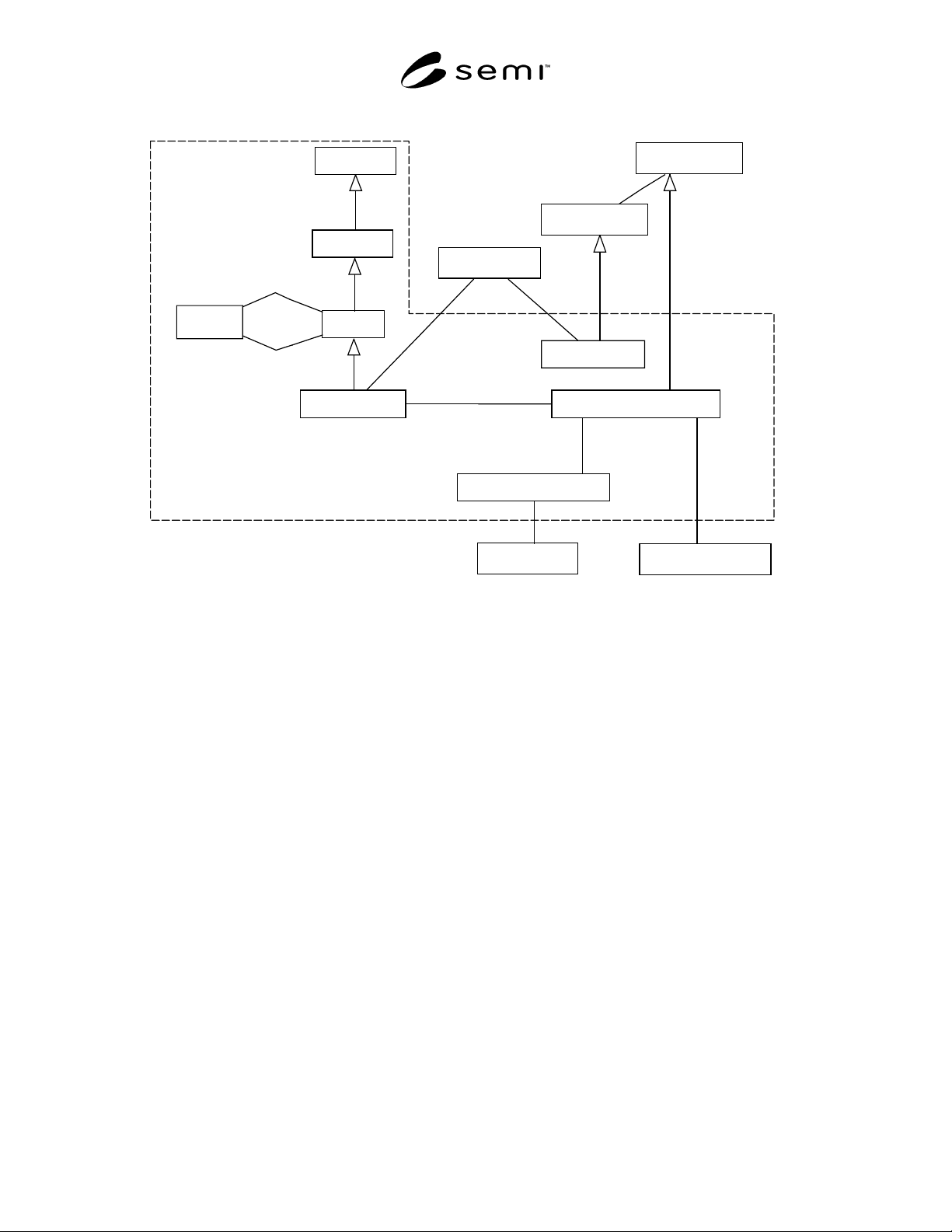
7.3.3.5 Resource Tracking and Maintenance
7.3.3.5.1 Support Resources have an associated
resource tracking and maintenance management
function, as Figure 10 shows. A Resource Tracking
Supervisor for a Resource monitors and records
resource usage and status and creates Maintenance Jobs
according to Maintenance Specifications. Factory
Operations, with the aid of a scheduler or dispatcher,
assigns Persons and other support resources defined in
the Maintenance Specification and initiates
Maintenance Job execution. The Resource Tracking
Supervisor then supervises Maintenance Job execution.
The Maintenance Job and Resource Tracking
Supervisor specialize the Job/Job Supervisor pair as
Section 7.3.4.6 describes. The Resource Tracking
Supervisor also records appropriate history, such as
maintenance logs and resource utilization and state, in
the Named History Collection for the Resource
(inherited from Named Entity). Resource type-specific
specializations of the resource tracking and
maintenance interfaces are possible.
7.3.4 Job Architecture
7.3.4.1 This section describes the job management and
control architecture of the CIM Framework. It defines a
hierarchical job supervision and control structure that
manages factory-level jobs (create product material to
fill enterprise product requests) and implements these
factory-level jobs by creating and managing machine-
level process jobs and transport jobs, coordinated with
maintenance jobs and other support jobs. The job
control architecture defines and manages relationships
between manufacturing resources (process equipment,
transport equipment, people), material groups (lots,
product groups, process groups, transport groups) and
specifications (product specifications, process flows
and recipes). This is the central functional architecture
which integrates the CIM Framework components into
a coherent manufacturing execution system
architecture. The concepts are derived from existing
standards and related standards efforts [ANSI],
[ALBUS], [OMA], [WfMC].
SEMI E81-0600 © 1999, 2000 26
DocumentRevision
(from Document Mgt)
MaintenanceSpecification
FactorySupervisor
(from Factory Operations Comp)
ResourceTrackingSupervisor
JobSupervisor
(from Job Supervisor AIG)
SupportResource
Person
(from Person Mgt Comp)
Job
(from Job Supervisor AIG)
1
1
1
1
stored
in
0..*
1
0..*
1
compares with
maintenance interval
1
1
1
informs
maintenance
activity due
0..*
0..*
0..*
0..*
defines
0..*0..*
0..*
assigned to
0..*0..*
supervises
NamedEntity
OwnedEntity
Capability
Resource
0..*
0..*
0..*
0..*
possible
0..*
0..*
assigned
0..*
0..*
MaintenanceJob
0..*
0..*
0..*
0..*
assigned to
Resource Abstract
Interface Group
(part)
Figure 10
Resource Tracking and Maintenance Architecture
7.3.4.2 Job Architecture Concepts
7.3.4.2.1 A job represents a unit of work requested of
and performed (or facilitated) by a factory entity that
results in some change to the overall factory state.
There are several important aspects of a job within the
CIM Framework:
• A job typically takes a non-zero time to perform
and has a non-zero chance of refusal or failure.
• A job may encapsulate a decomposition into a
combination of jobs/tasks/activities.
• There is a notion of higher-level jobs and lower-
level jobs. Coordination of lower-level jobs are
delegated to other job supervisors to ensure that the
higher-level job is completed.
• There is a job requestor.
7.3.4.2.2 The CIM Framework specifies a number of
structures for job control. The complexity and
variability of the factory requires some organizational
structure and separation of manufacturing tasks.
Breaking up a complex task into a coordinated
interoperation of simpler tasks enables practical
solutions to complex problems (the principle of “divide
and conquer”). This results in a key organizational
structure based on the factory resource hierarchy of
Figure 7 and Figure 8 , with the separation of tasks
summarized in Section 7.3.3.3. The job control
architecture defines how tasks are assigned and
coordinated across the hierarchy of factory resources.
7.3.4.2.3 Another key job structure is the relationship
between manufacturing tasks and the material and
resources used to carry out the task. For example,
Factory Operations is responsible for efficiently
allocating machine resources with the required
processing capability to the material work-in-progress
to drive the material through its process flow. A job is a
combination of a requested task and the material and
resources needed to execute that task (see Figure 13).
The relationship between task, material and resource,
combined with a hierarchical job structure (based on a
hierarchical resource structure) results in complex
relationships between tasks, material, and resources at
multiple levels.
7.3.4.2.4 Given the complexity, scope and variability
(chance of failure or partial success) of jobs, the CIM
Framework separates job control into explicit functions.
SEMI E81-0600 © 1999, 200027
It does not bury job control into material management
functions for driving process flows, nor does it bury job
control into machine management functions for driving
process operations. The CIM Framework makes job
control explicit, providing an architectural structure to
attach decision support logic (such as scheduling
utilities), business processes (workflow) and business
rules that enforce operational policy. Further, the CIM
Framework distributes and coordinates job control
among factory jobs, production machine jobs, transport
jobs, and maintenance jobs. This allows job control to
manage “local” complexity while coordinating factory-
wide operations toward “global” objectives.
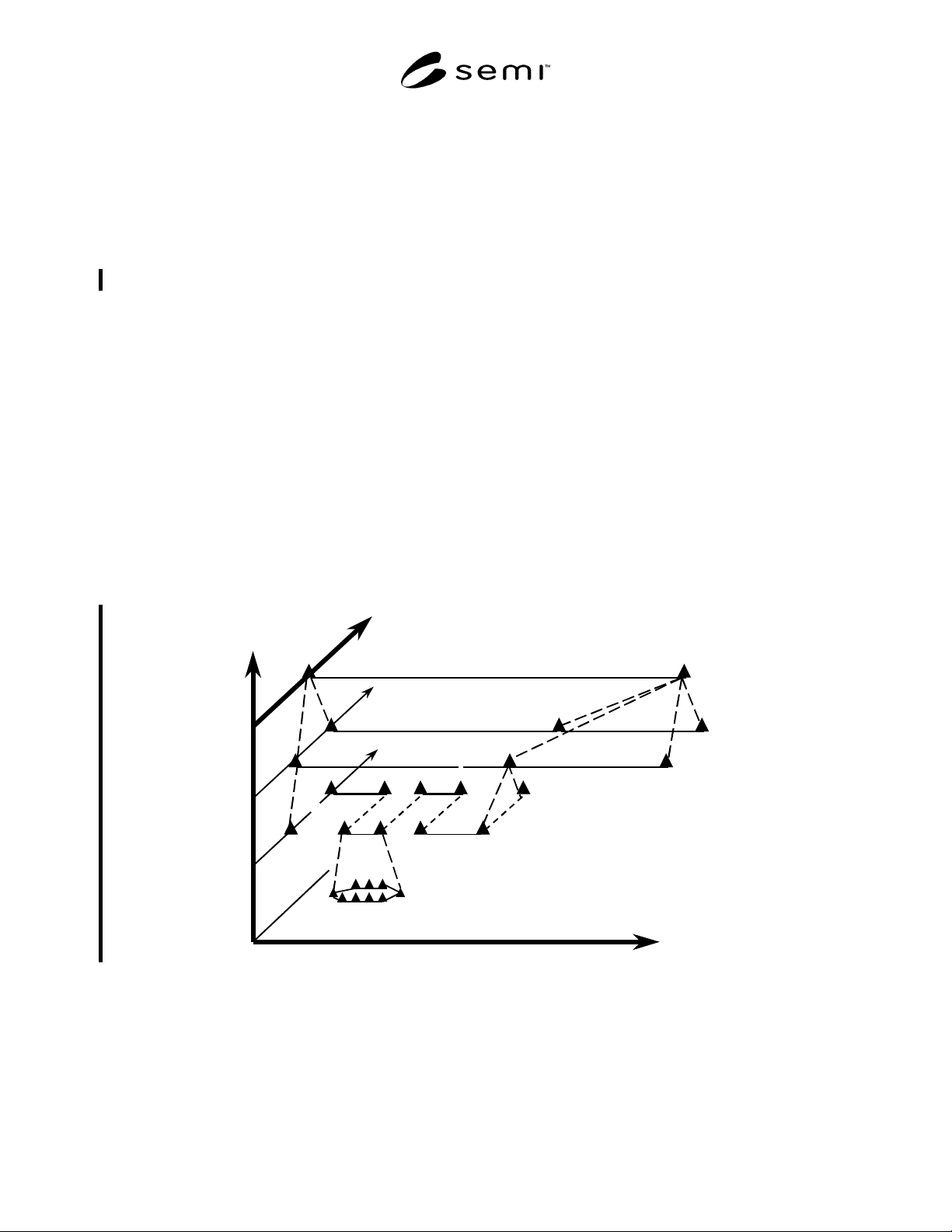
7.3.4.3 Hierarchical Task Structure
7.3.4.3.1 At the lowest level of the factory hierarchy
(the resource level in Figure 7), the tasks are single
process or metrology operations or material
movements. Through a complex, context-dependent
combination of single tasks, products are manufactured
and delivered to customers. This complex combination
of single tasks is a task structure as shown in Figure 11.
In manufacturing operations, these structures are pre-
defined as task procedures, work flows, process
specifications, etc. To accommodate manufacturing
variability and exceptions, though, the structures must
also be adjusted and modified as they are executed. For
example, as factory operations selects specific machine
resources to perform process steps, it may insert
machine-dependent setup tasks and operation
sequences, it may modify step specifications (recipes)
with machine-dependents settings, or it may insert
transport steps to get the material to the machine.
7.3.4.3.2 Notice in Figure 11 that tasks of a higher
level are decomposed into combinations of tasks for
lower level resources. Each manufacturing resource has
a thread of tasks that must be coordinated with the tasks
of other resources. The higher level task is completed
when the combination of lower level tasks is completed.
Figure 11 illustrates this with the coordination of
material movement and processing operations and with
the coordination of operations within the processing
equipment. Resource maintenance, advanced process
control calculations and other tasks must also be
coordinated with material processing, inspection and
movement tasks. The role of job control is to
decompose, coordinate, monitor, adjust, and report on
this hierarchical structure of tasks.
M
a
c
h
i
n
e
R
e
s
o
u
r
c
e
Task: Fill Order
Task: Produce Lot 1
Task: Produce Lot 2 Task: Produce Lot 4
Task: Produce Lot 3
Process
. . .
Move Move
Process
Operations
M
a
c
h
i
n
e
R
e
s
o
u
r
c
e
E
n
t
e
r
p
r
i
s
e
F
a
c
t
o
r
y
Time
Level
T
r
a
n
s
p
o
r
t
. . .
. . .
Resource
Process
Transport Machine
activity thread
Production Machine
activity thread
Machine Resource
activity thread
Figure 11
Hierarchical Task Structure