semi合集-English.pdf - 第239页
SEMI E35-0305 © SEMI 1995, 2005 8 For CEO calculations, ER is a whole number. Thus, a frac tional result from Equation 5 is increased to the next larger whole number to represent whole pieces of equipm en t. 7 Reporting …

SEMI E35-0305 © SEMI 1995, 2005 7
6.3.2 Tax lifetime for depreciation allocation purposes is another measure of the piece of equipment’s lifetime that
is customarily used in evaluating COO. Tax lifetime is based upon local tax or standard accounting practices.
6.3.3 The piece of equipment usually remains in production much longer than the tax lifetime, so it is useful to
consider both lifetimes in evaluating COO.
6.4 CEO: Fixed and Recurring Costs
6.4.1 Determining CEO requires enumerating all of the fixed and recurring costs that are incurred in the life cycle
of the piece of equipment. The calculation is shown in §8.
6.4.2 Fixed costs are those incurred once and are usually associated with the acquisition and incorporation of a
piece of equipment into the factory. End-of-life costs, such as decontamination and removal costs, are also part of
fixed costs.
6.4.3 Recurring costs are those that arise on a regular basis from the operation and maintenance of the piece of
equipment. Some infrequent recurring costs, including the costs of upgrading a piece of equipment to new
technologies may be included in fixed costs if the CEO is being calculated to compare an upgraded existing piece of
equipment with a new acquisition.
6.4.3.1 Costs that are depreciated should be included as fixed costs.
6.5 Yield
6.5.1 Yield is a metric of the percentage of the unit volume that results in good product. Yield affects the COO in a
number of ways.
Volume of units that must be processed for the required product requirements.
Cost of units that do not produce good product.
6.5.2 Product yield (PRY) is the percentage of units that pass through the factory and result in good product.
Product yield for units is the composite yield from all sources of yield loss, as shown in Equation 4. The
components are defined in §5.
ReworkPLYDLYEYPRY
111
(4)
6.5.2.1 Since DLY is generally a wafer-level phenomena, Equation 4 may be simplified for other types of units by
setting DLY = 1. Particle additions are a predictor of defect yield loss at a future step, but not a complete predictor
of all the possible loss since there may be other defects or parametric problems.
6.5.2.2 The P/T ratio of test and measurement equipment also affects PRY. P/T ratio is reflected in Equation 4 by
the inclusion of α and β. The formulas for calculating α and β are provided in Appendix 1.
6.6 Cost of Yields
6.6.1 A unit lost at the end of a given step represents the loss of the starting unit cost and all costs of manufacturing
a unit prior to that step. In addition, units leaving a step with undetected defects may be lost at a later step.
Calculating CYL therefore requires knowing the accumulated costs of manufacturing before the unit is lost.
Therefore, although CYL is a recurring cost, it should be tracked separately. CYL is given in Equation 7 in ¶8.2.
6.7 Volume Requirement
6.7.1 The volume requirement is the number of units to be processed and can be derived from specification of the
product units needed corrected for yield and the number of other units required to be processed by the equipment in
a specific time period such as rework or monitor units. One complication in accurately estimating the volume
requirement is that the volume of units actually reaching the equipment will depend on the equipment yields from all
prior steps.
6.8 Equipment Required
6.8.1 Once the volume of units is specified, the number of pieces of equipment required (ER) is obtained from the
TP and the OU.
ER = Volume Requirement / (TP × OU) (5)
SEMI E35-0305 © SEMI 1995, 2005 8
For CEO calculations, ER is a whole number. Thus, a fractional result from Equation 5 is increased to the next
larger whole number to represent whole pieces of equipment.
7 Reporting Results
7.1 Reports on COO should always show the following items. Other data items should be reported as required by
clarity.
7.1.1 Input Items
7.1.1.1 Identification of standard conformance
7.1.1.2 Identification of constraint conditions
7.1.1.3 Declarations
7.1.1.3.1 Summed categories: all or enumerate
7.1.1.3.2 Volume requirement
7.1.1.3.3 Operational uptime
7.1.1.3.4 Equipment throughput
7.1.1.3.5 Number of pieces of equipment and chambers
7.1.2 Output Items
7.1.2.1 Cost per unit
7.1.2.2 Cost distribution
7.1.2.3 Related statistics
8 Procedures
8.1 COO Calculation
8.1.1 The COO algorithm requires the specification or calculation of the volume level, the determination of the
number of pieces of equipment required to process the volume, the enumeration of all fixed and recurring costs
associated with processing the volume by the equipment, and the yield-related costs. The COO metric is a function
defined by Equation 6 to be:
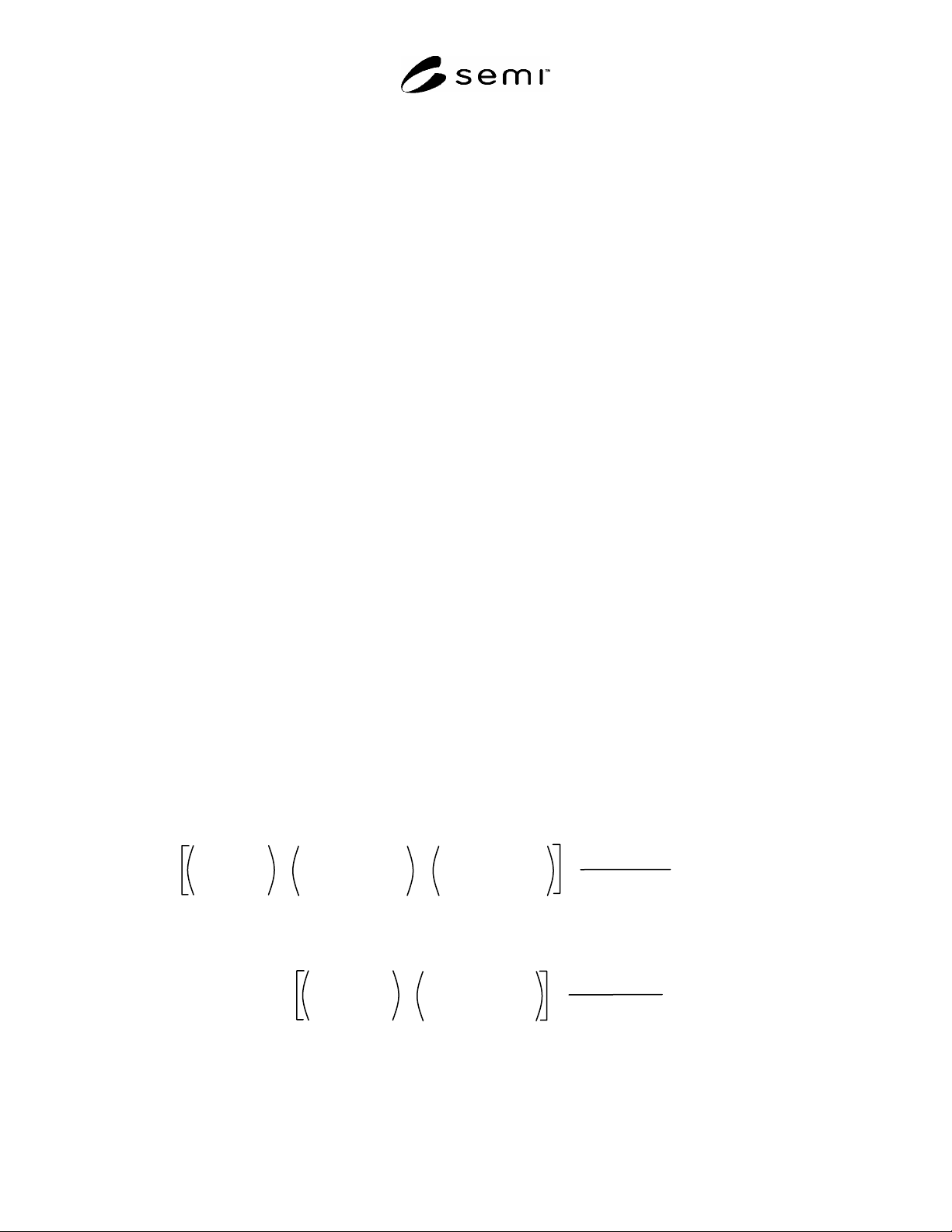
COO = CEO + CYL (6)
The CYL is given by Equation 7. The CEO component is described in Equation 8 and is expressed in Equation 9 as
the sum of a number of cost categories. Constrained versions of COO exclude certain cost categories from the
calculation.
8.2 Cost of Yield Loss
where the recurring scrap cost elements are given in Table 3.
8.3 Cost of Equipment Ownership
annualized annualized ER
CEO = fixed cost per + recurring cost per × (8)
e
q
ui
p
ment units lost to DYL GUE
p
er
y
ear
annualized annualized annualized 1
CYL = cost of units + attributed cost of + attributed cost of × (7)
lost to EY units lost to DYL units lost to PYL GUE
p
er
y
ear
SEMI E35-0305 © SEMI 1995, 2005 9
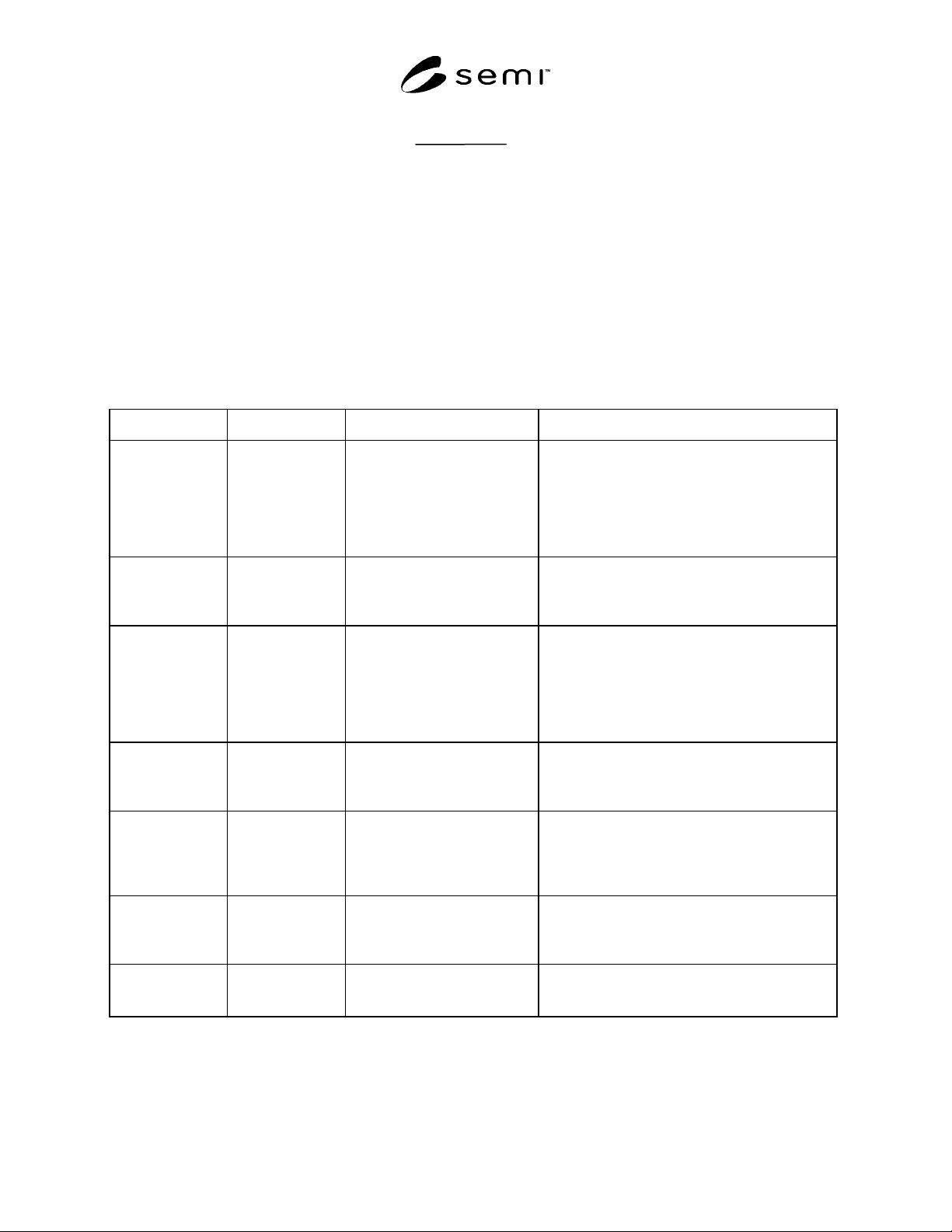
where i and k are the number of primary categories and cost elements, respectively, in Tables 1 and 2. F
ij
and R
km
are the detailed elements, each of which is defined in Tables 1 and 2.
9 Cost Elements
9.1 Cost elements are expanded into further items and then summed.
9.2 Constrained versions of the COO calculation are created by defining a modification of the calculation such as
the way yield is included or in restricting the items in a cost element that are used. This set is similar to the original
Sematech COO model.
NOTE 6: Default values for some cost elements are given in Related Information 2.
Table 1 Elements of Fixed Cost by Category
Category (i) Cost Element (j) Description Method
Equipment Acquisition Costs of acquiring the piece of
equipment.
Expressed in terms of equipment cost (i.e., purchase
price), transportation, taxes, duties, actual burdened
costs for labor-hours of effort multiplied by the
number of hours for each equipment user’s
personnel type, etc. May be allocated to annual
costs using any accepted depreciation schedule
(e.g., straight-line, double declining balance).
Equipment Installation Costs of installing the piece of
equipment for production.
Expressed in terms of actual burdened costs for
labor-hours of effort multiplied by the number of
hours for each equipment user’s personnel type and
cost of materials.
Equipment Training Costs of the initial training
requirements for the new piece of
equipment for operators,
supervision, engineers, and
maintenance personnel.
Expressed in terms of actual burdened costs for
labor-hours of training multiplied by the number of
training hours and training course costs, if
applicable, for each equipment user’s personnel
type. Note that depending on accounting rules,
some training may be included as part of the
equipment acquisition cost.
Equipment Qualification Costs of qualifying the piece of
equipment for production
including acceptance testing
Expressed in terms of actual burdened costs for
labor-hours of effort multiplied by the number of
hours for each equipment user’s personnel type and
cost of materials.
Equipment Decommissioning Costs of removing the piece of
equipment from production.
Expressed in terms of actual burdened costs for
labor-hours of effort multiplied by the number of
hours for each equipment user’s personnel type and
costs of transportation and materials. May deduct
the salvage value from the fixed costs.
Facilities Moves and
Rearrangements
Costs of displacing an existing
piece of equipment in order to
install the new piece of
equipment.
Expressed in terms of actual burdened costs for
labor-hours of effort multiplied by the number of
hours for each equipment user’s personnel type and
costs of transportation and materials.
Facilities Floor Space Costs of the cleanroom overhead
allocated to the piece of
equipment.
Multiply the cost footprint of the piece of
equipment by the cost of cleanroom space for each
class of cleanroom space used.
#1
#1
The cost of cleanroom space per unit area of effective usable production space includes both the fixed and recurring operations costs as
determined by a separate COO analysis outside the scope of this document.
ER
= F + R × (9)
GUE
p
er
y
ear
ij
ij
km
km