semi合集-English.pdf - 第2625页
SEMI E94-0705 © SEMI 2000, 2005 8 Data Identifier Description Form SubstrateLocation A substrate position at a source and a destination . A carrier is an example of a multi- location destinat ion. For a wafer carrier the…

SEMI E94-0705 © SEMI 2000, 2005 7
Name Definition Rqmt Access Form
PauseEvent Identifier of a list of events on which the Control Job
shall PAUSE.
N RW (list of)
EventID
PRJobStatusList A list of all process jobs managed by this Control
Job and their associated status.
Y RO (list of)
PRJobID
PRJobState
(see SEMI E40)
ProcessingCtrlSpec A list of structures that defines the process jobs and
rules for running each that will be run within this
ControlJob.
Y RW (list of)
Structure:
PRJobID
ControlRule
OutputRule
ProcessOrderMgmt Define the method for the order in which process
jobs are initiated.
Y RW Enumeration:
LIST
ARRIVAL
OPTIMIZE
StartMethod A logical flag that determines if the ControlJob can
start automatically. A user start may come through
either the host connection or the operator console.
Y RO Boolean:
TRUE – Auto
FALSE – UserStart
State The current state of the ControlJob. Y RO Enumerated:
per State Model
8.4.2 A number of the ControlJob attributes are composite data types. The constituent data is defined in Table 2.
Table 2 Attribute Data Definitions
Data Identifier Description Form
CarrierID The identifier of a carrier that is the source or destination for substrates. Text
ControlRule Provides additional job control functionality. It is equipment type dependent. It may
be used to modify processing based on processing results. Use of this attribute is not
required for equipment, which does not support it. Suppliers shall document the use
of this attribute when supported.
(list of)
Structure:
RuleName
RuleValue
Destination The identifier of a substrate location at which material can be placed. (Identifier
should conform to standards for substrate tracking.)
Text
DestinationMap Describes carrier positions into which finished material will be placed. If the list of
carrier positions is empty, then follow sequential order of source.
Structure:
CarrierID
List of
SubstrateLocation
MaterialStatus ControlJob processing assigns this value to finished material. The association of
MaterialStatus to Destination enables ControlJob processing to put material at the
desired destination.
Equipment
dependent
enumeration
OutputRule Defines the MaterialStatus (such as Good, Reject, Aborted, Monitor, etc.) based on
results of the process job.
Equipment
dependent
PRJobID A process job identifier as defined by SEMI E40. Host must supply same name in the
ProcessingCtrlSpec as when it requested creation of process job. NOTE: SEMI E40
process jobs link material to a recipe.
See SEMI E40.
Rule Value The value used by the equipment for execution of a control rule. Equipment
dependent
RuleName Identifier of a control rule. Text
SourceMap Describes the locations from which material is taken for processing. If the list of
location is empty, then assume the default of ascending order.
Structure:
CarrierID
List of
SubstrateLocation

SEMI E94-0705 © SEMI 2000, 2005 8
Data Identifier Description Form
SubstrateLocation A substrate position at a source and a destination. A carrier is an example of a multi-
location destination. For a wafer carrier the SubstrateLocation is a slot number.
Numeric
8.4.3 ControlRule
8.4.3.1 For equipment that supports this attribute (field), the host sets this in order to achieve better host processing
control capabilities. For example, the host may have previously measured characteristics of the material to be
processed. A standard recipe is used based on the product and process step, but based on the measured
characteristics, the application of the recipe is biased by the specified rule and the value that is passed to the rule
(RuleValue). However, use of ControlRule should not be considered to be limited to only this type of application.
8.4.4 DataCollectionPlan
8.4.4.1 The DataCollectionPlan is a name given by the host to associate data collection activities to a specific
control job. In general, it provides a way for the equip-ment to then inform and coordinate with the host to receive
data collection requests. A DataCollectionPlan is generic and will be applied to many control jobs. The variable
itself, DataCollectionPlan, will hold no significance for the equipment. It is simply a label the equipment reports
back when requested by the host. Normally, the host upon receiving the ControlJob START event would include
DataCollectionPlan as a data variable to be reported. The host then knows that the time is appropriate to set up
various trace reports and event reports on the equipment. Potentially, all jobs that specify the same product type and
process capability could specify the same DataCollectionPlan.
8.4.5 OutputRule
8.4.5.1 This attribute can only be supported by equipment that has some means to determine the status of material
that it has processed. For equipment with that ability, the rule will usually take the form of a list of name value
pairs. The names will be material status and the values will be measurement thresholds that correspond to the status
category (such as, Good, Reject, Rework, etc.). Substrate (material) status changes should be recorded in substrate
histories created by the equipment.
8.4.5.2 Equipment which also supports the MtrlOutbyStatus shall use the status determined by the OutputRule to
place substrates at the Destination associated with MaterialStatus.
8.4.6 PauseEvent
8.4.6.1 For equipment which can support it, this attribute contains a list of equipment events, specified by the host,
at which the host expects the equipment to PAUSE the ControlJob. Equipment suppliers shall document any events
that can be used for the pausing of control jobs. Pausing a control job causes it to stop initiating process jobs. The
host might use this to stop processing after one or more process jobs has started in order to await results before
processing the rest of the material in the control job.
8.4.7 ProcessOrderMgmt
8.4.7.1 This is an enumerated attribute that defines the order in which processing will occur. This standard defines
three enumerations. For some equipment other enumerations may be possible. If they are the supplier shall
document them.
8.4.7.2 LIST
8.4.7.2.1 When ProcessOrderMgmt is set to this value, process jobs shall be initiated in the order of the list in
ProcessingCtrlSpec.
8.4.7.3 ARRIVAL
8.4.7.3.1 When ProcessOrderMgmt is set to this value, process jobs shall be initiated as the material for the job
arrives. Any jobs that do not require material will be initiated first.
8.4.7.4
OPTIMIZE
8.4.7.4.1 When ProcessOrderMgmt is set to this value, process jobs shall be initiated in an order to be determined
by internal equipment algorithms, that optimize the throughput of material in the equipment.
SEMI E94-0705 © SEMI 2000, 2005 9
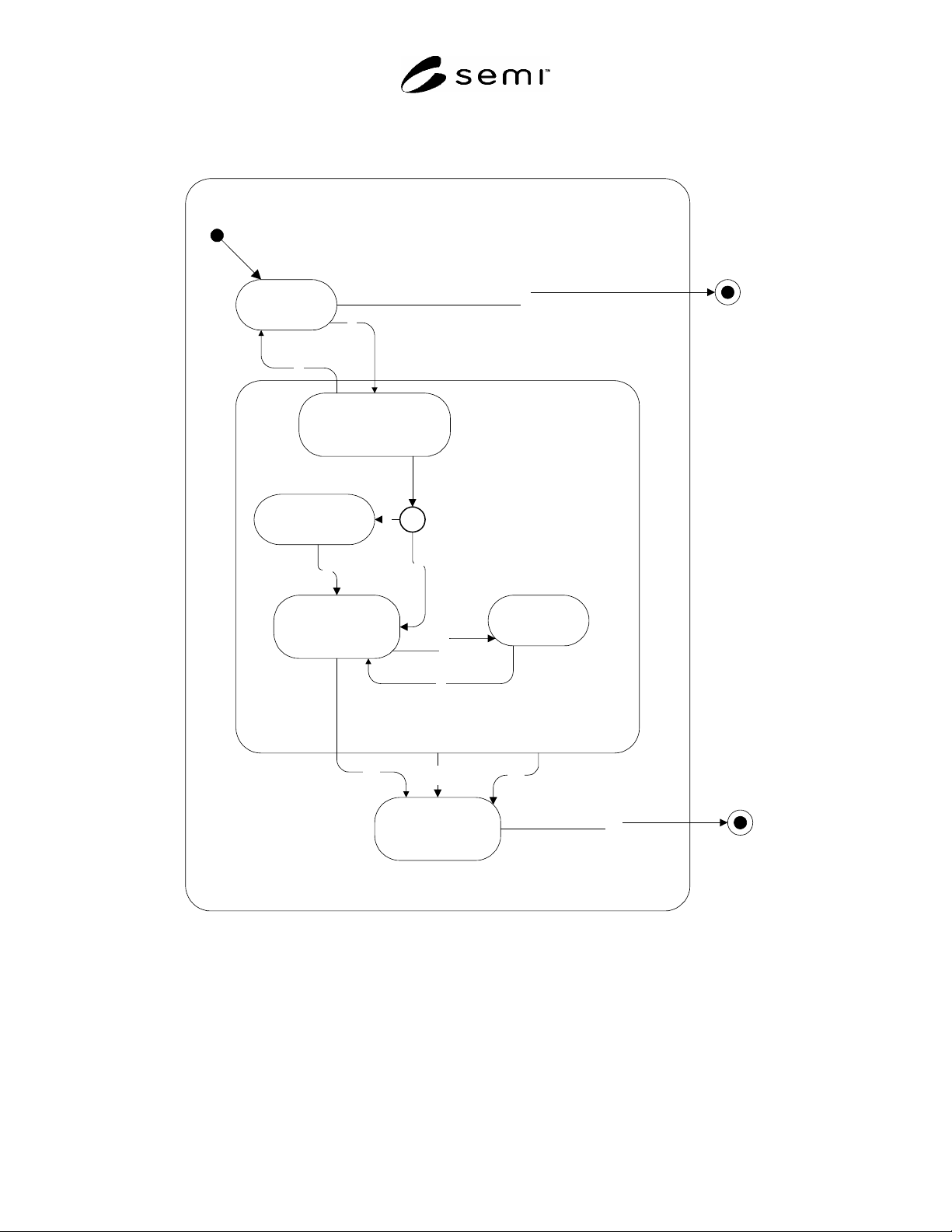
9 Control Job State Model – Behavior
9.1 The following state chart defines the behavior of the ControlJob.
CONTROLJOB
QUEUED
SELECTED
WAITINGFOR
START
ACTIVE
EXECUTING
PAUSED
COMPLETED
C
6
5
8
9
10
11 12
13
7
1
2
4
3
Figure 2
Control Job State Model
9.2 State Definitions
9.2.1 QUEUED — A ControlJob is queued after its creation or de-selection. A newly created ControlJob is placed
at the tail of the queue.
9.2.2 SELECTED — In this state, the ControlJob does not initiate process jobs specified in it and therefore pre-
defined (based on recipe variable parameters) process conditions can be modified. The processing resource is
reserved (not available for any other jobs) by the ControlJob in the SELECTED state. If materials, required by the