semi合集-English.pdf - 第2690页
SEMI E97-0200A © SEMI 2000 10 Description: Resource is an abstract inherited interf ace for any entity in th e factory that takes an active role in advancing a produ ct along its manufacturing life cycle (adds value). T …

SEMI E97-0200A © SEMI 20009
/* Set and get the name. The NamedEntity interface does not specify scoping of names or enforce uniqueness of
names. This could allow distinct instances of a NamedEntity to use the same string as a name. */
void setName (in string name)
raises (Global::FrameworkErrorSignal);
string getName ()
raises (Global::FrameworkErrorSignal);
/* Tests the equality of the name with the name provided as an argument. */
boolean isNamed (in string testName)
raises (Global::FrameworkErrorSignal);
}; // NamedEntity
Contracted Services: None.
Dynamic Model: None.
6.4.3 Owned Entity Interface
6.4.3.1 The concept of ownership in the CIM Framework relates to the hierarchical structure that may be defined
where one object “owns” another object. This should not be confused with the business concept of ownership
relating to an item’s value as an asset.
Module: AbstractIF
Interface: OwnedEntity
Inherited Interface: NamedEntity
Description: The abstract interface OwnedEntity provides for the concept of an “owned” entity. There
may be only one “owner” for each instance of an OwnedEntity. The OwnedEntity is able
to communicate with the owner to request services, or forward information of interest. To
build a “parts of” hierarchy, a series of ownerships can be established.
Exceptions: None.
Published Events: None.
Provided Services:
interface OwnedEntity : NamedEntity {
/* Set and get owner. */
void setOwner (in NamedEntity owner)
raises (Global::FrameworkErrorSignal);
NamedEntity getOwner ()
raises (Global::FrameworkErrorSignal);
}; // OwnedEntity
Contracted Services: None.
Dynamic Model: None.
6.4.4 Resource Interface
Module: AbstractIF
Interface: Resource
Inherited Interface: OwnedEntity
SEMI E97-0200A © SEMI 2000 10
Description: Resource is an abstract inherited interface for any entity in the factory that takes an active
role in advancing a product along its manufacturing life cycle (adds value). This includes
the factory itself, personnel, production, planning and scheduling resources, and all of the
machines used for processing, transporting, and storing materials. Resource provides a
common set of services for monitoring and control. Resource uses the NamedEntity and
OwnedEntity characteristics together to allow for the building of resource hierarchies.
There must be a clear division between the state of the Resource and the condition of the
physical entity which the Resource represents. For instance, a Machine is a resource, but
the fact that it is “Out of Service” may not mean the physical equipment is shutdown on
the shop floor. In fact, the equipment may be operating in manual mode. The Resource
state represents the availability of the Resource object to accept work for the factory
system.
Exceptions: None.
Published Events: None.
Provided Services:
interface Resource : OwnedEntity {
/* Perform the startup activities for this Resource. Should be implemented by Resource specializations. */
void startUp ()
raises (Global::FrameworkErrorSignal);
/* Perform normal shutdown activities for this Resource. Normal is defined as allowing the Resource to complete
any current activities and “gracefully” shutdown. */
void shutdownNormal ()
raises (Global::FrameworkErrorSignal);
/* Perform immediate shutdown activities for this Resource. Immediate is defined as aborting or terminating any
current activities and stopping activity as soon as possible. This should be implemented by Resource specializations.
*/
void shutdownImmediate ()
raises (Global::FrameworkErrorSignal);
/* Respond with the receiver’s level in the Resource hierarchy. Resource specifies that each different type of
Resource provide a “resourceLevel” identifier.
string resourceLevel ()
raises (Global::FrameworkErrorSignal);
/* The following service provides name scoping for Resources. Resource name scoping makes use of the notion of
“Resource level” and the ownership hierarchy. For example, unique identification of MachineResources within a
Machine is possible, but to identify them outside the Machine additional information about their ownership will be
required.
Thus: nameQualifiedTo (“Machine”) sent to the ProcessResource named “Chamber” answers
“TestMachine>Chamber”.
If the Machine was owned by a Factory named “TestFactory”, then:
nameQualifiedTo (“Factory”) sent to the ProcessResource answers
“TestFactory>TestMachine>Chamber”
where the ProcessResource has now been uniquely identified for the given Factory.
SEMI E97-0200A © SEMI 200011
There is no limit to the number of levels that may be addressed this way. Based on the implementations of
nameQualifiedTo (string); a name need not always be concatenated, if a particular Resource level is not applicable
to identification. */
string nameQualifiedTo (in string resourceLevel)
raises (Global::FrameworkErrorSignal);
/* Returns the set of subordinate Resources for a given Resource. */
ResourceSequence subResources ()
raises (Global::FrameworkErrorSignal);
/* Answer if the resource is in service. In service means the resource is functional and ready to accept and perform
its normal tasks. Derivatives of Resource are expected to expand this state (e.g., add sub-interfaces) that explicitly
deal with such additional issues as capacity, “normal” work versus maintenance, etc. */
boolean isInService ();
/* Answer if the resource is out of service. Out of service means the resource is unable to accept or begin new tasks.
Previously begun tasks may continue in some cases. */
boolean isOutOfService ();
}; // Resource
Contracted Services: None.
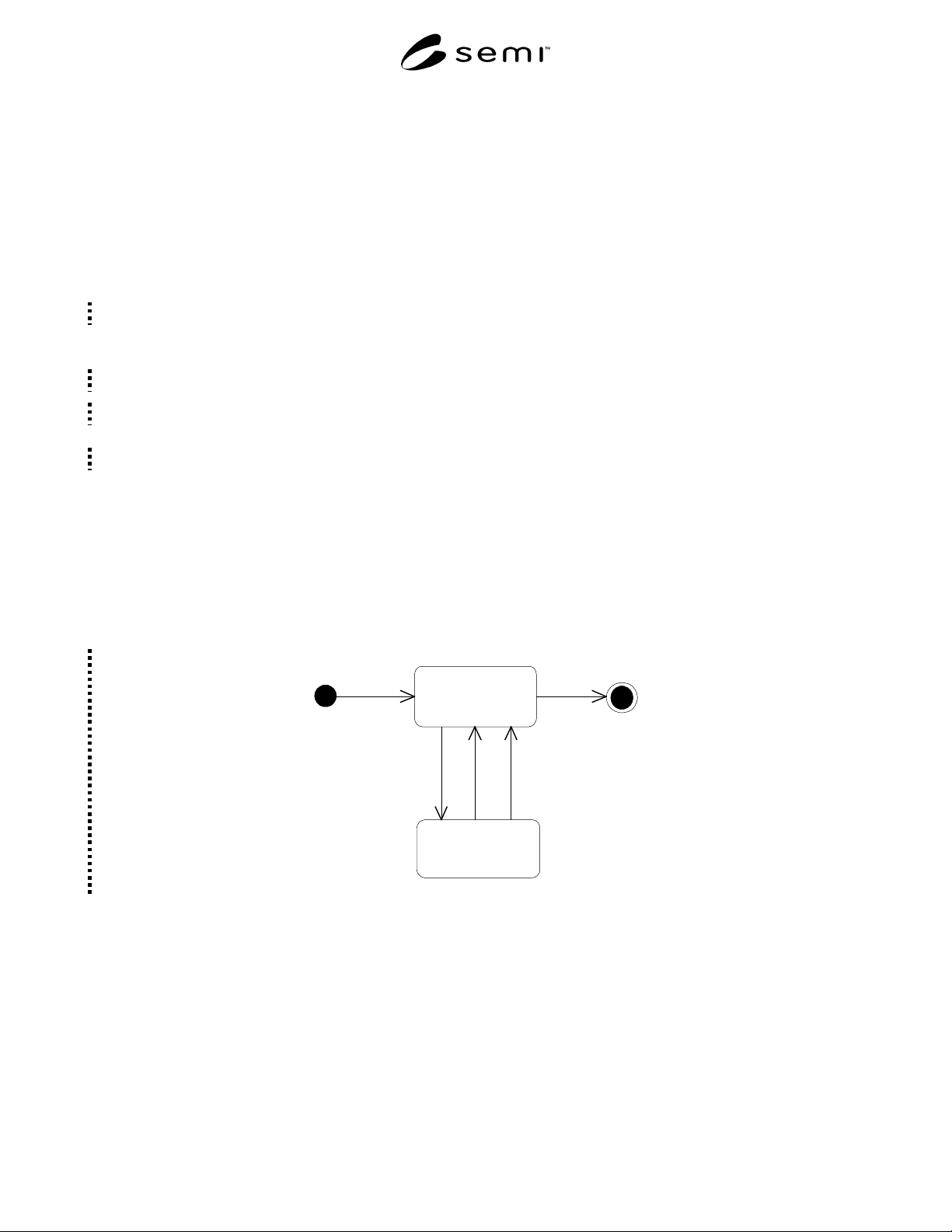
Dynamic Model:
Implementations of Resource may extend the state model by providing additional sub-states that are wholly
contained within a state defined here. Extending the state model by the addition of state transitions is also an option
for subtypes of Resource.
IN SERVICE
OUT OF SERVICE
3 4
2
51
Figure 2
Resource Dynamic Model