semi合集-English.pdf - 第2745页
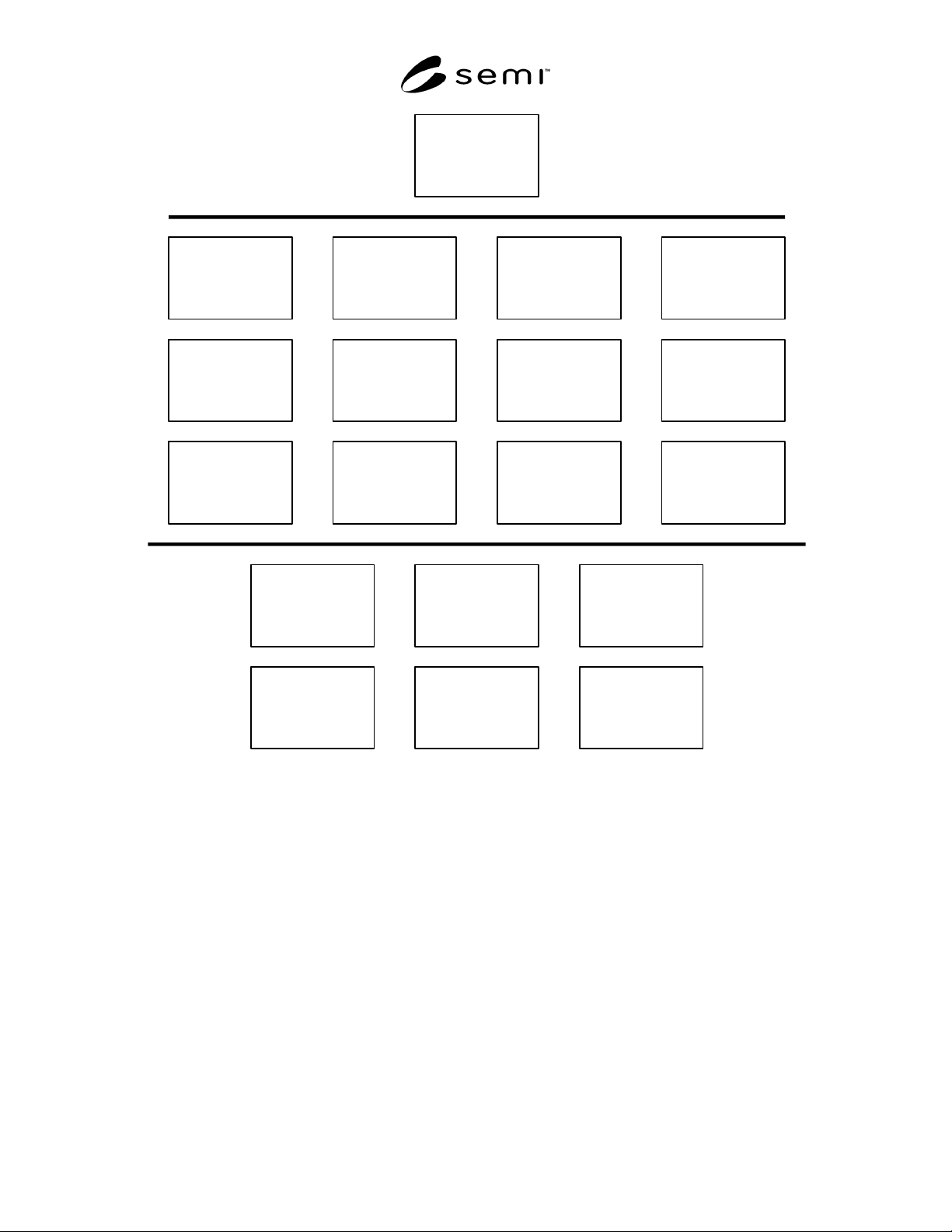
SEMI E98-1102 © SEMI 2000, 2002 10 Equipment Control Facilities Interface Ma te ri al I/O Manageme nt Recipe Management Operatio ns Management Recipe Execu tion Excep tion Management Mat eri al Management Process Execu t…

SEMI E98-1102 © SEMI 2000, 2002 9
• stand-alone (with no connection to the factory
systems),
• fully on-line and operated locally (by the operator),
• fully on-line and operated remotely (by the factory
systems), and
• fully on-line and able to support and coordinate
interactions from multiple factory users and
systems at the same time.
8 Equipment Overview
8.1 The Object-Based Equipment Model defines the
objects that are generic components of equipment as
well as the object representing the equipment itself.
OBEM does not dictate the makeup of equipment.
Through support of OBEM, the equipment is able to
describe its own makeup to the factory. However,
OBEM does require certain visibility and access to
those parts of the equipment that control and/or monitor
the environment or the location of the product.
8.2 Two view areas are of importance: the functional
view of the equipment and the internal composition
view of the equipment.
8.3 Functional View of Equipment — From a
functional view, equipment is internally composed of
logical subsystems with different areas of responsibility
that are at different levels within a control hierarchy, as
illustrated in Figure 1. There are three general levels.
Equipment Control is at the highest level, both respon-
sible for, and representing, the equipment as an inte-
grated whole. The middle level provides management
of specific areas, while the lowest level of functionality
has specific time-critical responsibilities and handles all
direct interaction with the equipment’s I/O (sensors and
actuators). The third level is below the factory level of
visibility and is discussed here for completeness.
NOTE 3: This is not intended to represent the design of an
actual implementation.
8.3.1 The functional areas are discussed below in
alphabetical order.
8.3.2 Access Management — Access Management is
responsible for communications with the factory,
including factory computers, local and remote oper-
ators, third party systems, and alternate users (desktop
access by process engineers, maintenance personnel,
supplier remote diagnostics, etc.) Communications
with the local operator include input devices (such as
keyboards, wands, buttons, and optical character read-
ers) and display devices (console, light pole, and LCD
panel) as well as interpretation of operator requests.
8.3.3 Communications Link — Communications Link
is responsible for low-level communications, including
establishing a connection with a communications
partner, sending messages, and receiving messages.
8.3.4 Date/Time Management — Date/Time Manage-
ment is responsible for maintaining an accurate date
and time-of-day, and for providing current date/time
information to the rest of the system. This may include
maintenance of regular time-based scheduling.
8.3.5 Environment Control — Environment Control is
responsible for maintaining the internal environment
according to the equipment’s specifications. While
Process Control is specific to a process and recipe,
other monitoring activities may be required regardless
of whether the equipment is processing or idle. Such
activities include monitoring for particles, humidity, or
temperature.
8.3.6 Equipment Control — Equipment Control is the
supervisory level with overall high-level control.
Equipment Control represents the entire equipment as
an integrated whole to the factory and represents the
decision-making authority within the equipment.
8.3.7 Event Management — Events continually occur
in all equipment states. A variety of these events are of
interest to the factory, including those events that
generate a change of state in any standardized object.
The factory requires notification when selected events
occur, and in many cases, requires reports of the values
of specified information at the time that the event
occurred. Event Management is responsible for
tracking those events and the reports associated with
those events.
8.3.8 Exception Management — Exception Manage-
ment is responsible for determining the proper response
to an action or operation that the equipment was unable
to perform which raised an exception condition. It
prompts notification to all affected components,
including internal components and currently connected
users. In some cases, the proper action may have to be
resolved by the user. Exception Management is a high
level activity that is in addition to underlying hardware
and software interlocks.
SEMI E98-1102 © SEMI 2000, 2002 10
Equipment
Control
Facilities
Interface
Material
I/O
Management
Recipe
Management
Operations
Management
Recipe
Execution
Exception
Management
Material
Management
Process
Execution
Performance
Management
Access
Management
Event
Management
Object
Management
Date/Time
Management
Environment
Control
Communications
Link
Job
Management
Information
Management
Material
Movement
Control
Figure 1
Functional View of Equipment
8.3.9 Facilities Interface — The Facilities Interface is
responsible for managing the physical interfaces
(hookups) to the factory. This includes bulk fill,
continuous chemical services, factory vacuum, factory
exhaust, and the electrical environment of the
equipment.
8.3.10 Information Management — Information
Management is responsible for the information and data
stored by the equipment, including information required
for the user as well as various internal event and data
logs.
8.3.11 Job Management — Job Management is
responsible for all jobs, including process jobs, job
queues, and job execution.
8.3.12 Material I/O Management — The Material
Input/Output (I/O) Management is responsible for
loading and unloading material to and from the factory.
This includes the AMHS interface (parallel I/O), pod
interface, carrier management, and carrier-related
services such as reading, writing, and slot mapping
(identifying unoccupied, correctly occupied, and
incorrectly occupied slots in a carrier).
8.3.13 Material Management — Material Management
is responsible for tracking all material, including
carriers, product, and consumables, within or used by
the equipment. This includes providing historical
information required for product history.
8.3.14 Material Movement Control — Material
Movement Control consists of low-level control of

SEMI E98-1102 © SEMI 2000, 2002 11
internal subsystems, subassemblies, and i/o devices
used in moving material within the equipment, such as
robots, location sensors, proximity sensors, motors,
centering and alignment systems, and material identifier
readers.
8.3.15 Object Management
8.3.15.1 Object Management consists of management
of OBEM objects, their attributes, and internal
communications. It includes all elements of
configuration definition, both fixed and user-
configurable, that pertain to the equipment.
Configuration settings consist of those attributes that
affect the global behavior of the equipment and are
generally static and change only on request. They are
in effect at all times regardless of the current recipe(s)
and/or processing states. They control activities that
maintain the environment when “not processing”.
8.3.15.2 Configuration settings shall be retained in
non-volatile storage. Some elements of configuration
may be distributed. For example, individual process
chambers may have their own configuration elements.
8.3.15.3 Elements of configuration management
include:
• configuration of individual physical chambers, and
• configuration of individual logical objects.
8.3.16 Operations Management — Operations
Management is responsible for the overall operation of
the equipment in all operational modes: automatic,
semi-automatic, and manual.
8.3.17 Performance Management — Performance
Management is responsible for managing information
and operations related to the performance of the
equipment and equipment modules. This includes
oversight for manual mode operations performed when
the equipment and equipment modules are out of
service. For implementations of ARAMS, this also
includes ARAMS state changes and data as well as
oversight for manual mode operations performed during
downtime and non-scheduled time.
8.3.18 Process Execution — Process Execution covers
those fixed algorithms and procedures that are not
reachable or changeable by the user. This includes any
embedded control and sequence algorithms not
contained in recipes. It consists of low-level control of
subsystems, sensors, and actuators not covered by
Material Management Control, such as, chemical
control (valves, exhaust), motion control (rotational,
acceleration, positional) and the control of the
environment during processing of the product
(temperature, etc.). It also includes product
environment control and any fixed embedded fault
detection classification, and/or fixed low-level in-situ
run-to-run control for advanced process control.
8.3.19 Recipe Execution
8.3.19.1 A recipe represents the pre-planned and
reusable set of instructions, algorithms, and settings that
are used by process execution to control process,
including variable in situ process control algorithms.
Recipes are created by the user, and in some cases by
the equipment as well. Recipes may be of a variety of
types, such as flow sequence, metrology, models, abort,
and load maps, as well as etch, clean, etc.
8.3.19.2 Recipe Execution is responsible for the proper
and safe execution of recipes, including loading the
recipe into the execution area, verification of the recipe,
validation of recipes (ensuring the recipe does not
conflict with the current equipment configuration), and
initiation of process execution based on recipe
instructions (SEMI E42).
8.3.20 Recipe Management — Recipe Management
consists of the management of stored recipes. This is
differentiated from short-term storage of recipes and the
selection and execution of recipes performed by Recipe
Execution (SEMI E42). Recipes are classified
(organized) according to their primary application
function: process, environment, service (maintenance),
etc.
8.4 Relationships with Other Standards
8.4.1 Only those functional areas in the middle in
Figure 1 are of interest to the host. The top level of
Equipment Control represents all of the functionality
below it, while the functional areas at the bottom are
considered to be low level and proprietary to the
equipment supplier.
8.4.2 Table 1 shows those functional areas that are
defined by OBEM and those that are defined by other
SEMI standards. In some cases, OBEM may extend or
limit the functionality defined elsewhere.