semi合集-English.pdf - 第2751页
SEMI E98-1102 © SEMI 2000, 2002 16 A b stract Equipment Element Equipment IODevice Abstract Equipment Subsystem Figure 6 AbstractEquipmentElement Object Type s 10.2.3 AbstractEquipmentElement State Model 10.2.3.1 The Abs…
SEMI E98-1102 © SEMI 2000, 2002 15
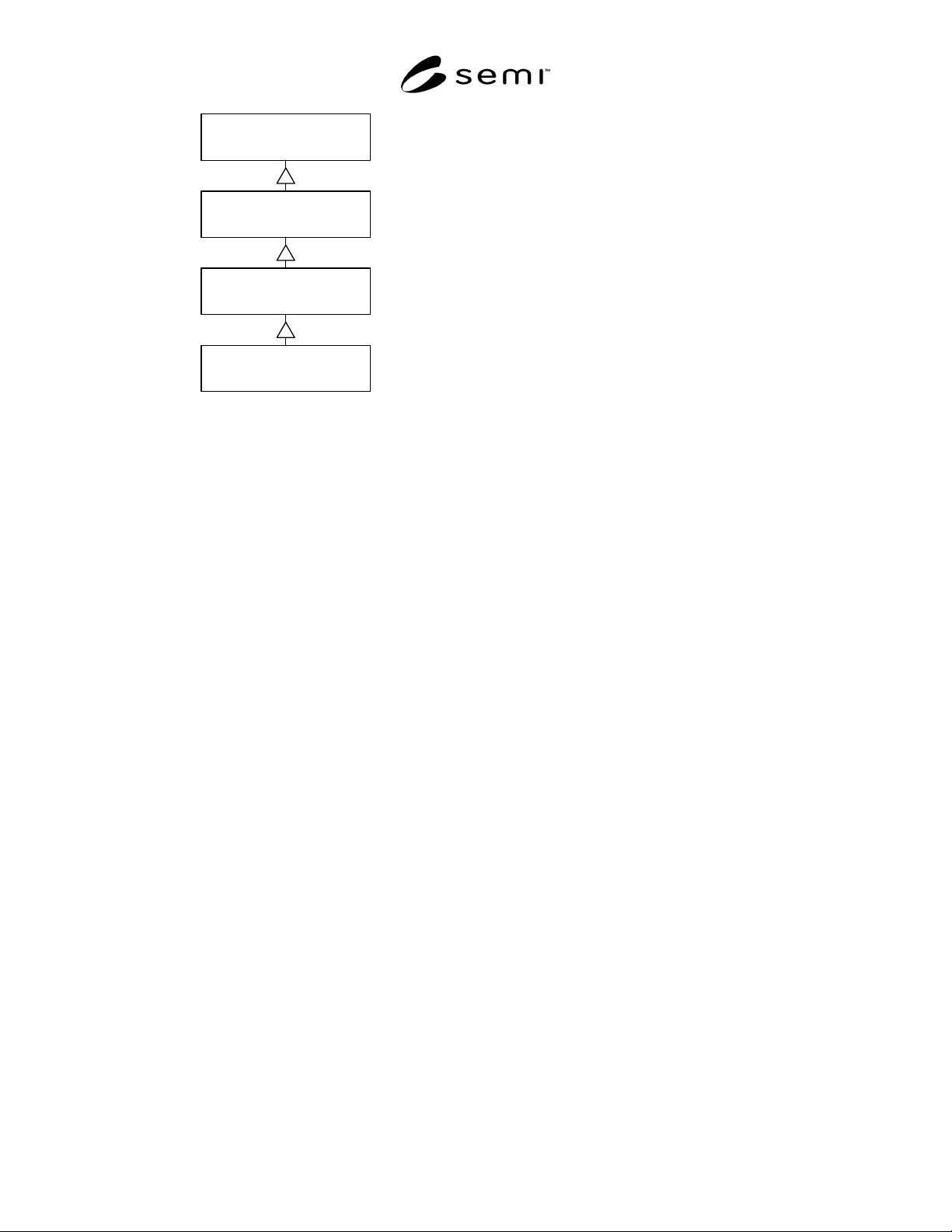
AbstractEquipment
Element
Equipment
AbstractEquipmentModule
AbstractEquipment-
Subsystem
Figure 5
Object Interface Hierarchy Concept
9.6.1.1 The physical view shown in Figure 2 is
concerned with the relationships between different
objects. In that view, the equipment is at the highest
level and owns (is responsible for) the lower level
objects of which it is made up. A process chamber is
considered to be at a higher level than subsystems such
as substrate handlers.
9.6.1.2 From the view of the object interface hierarchy,
this order is reversed, with AbstractEquipmentElement
appearing at the top level as shown in Figure 5. From
the view of an object interface — the interface to an
object — the higher the level, the more simple the
interface. This is because of inheritance, where the
“child” object inherits all of the attributes, behavior,
and services of the “parent” object and at the same time
adds some degree of specialization that will be reflected
in either additional attributes, behavior, or services, or
in restrictions on the more general object.
9.6.1.3 All objects represent the view as seen by the
factory, not the internal view of equipment control.
From this view, the information and services required
for an equipment part such as a pod door opener is
relatively simple. The view of a module such as a
process chamber is more complex but contains all the
elements of the view provided for the simpler part
(functional description, immutable id, etc.). The view
of the equipment is the most complex and includes all
of the attributes and services of the equipment element,
equipment subsystem, equipment module, and the
equipment itself.
9.6.1.4 The object model of equipment presented to the
factory is based on SEMI E39 (OSS). OSS services
allow the factory to “discover” the actual physical
makeup and aggregation hierarchy of the physical view
of equipment illustrated in Figures 2 and 3.
9.6.1.5 Each object is defined in terms of its
requirements, attributes, behavior (state models), and
the services that it is required to support. The
equipment owns all of the objects that it is made of and
is responsible for providing the required behavior.
9.6.1.6 All objects in OBEM inherit the attributes and
services defined for the Top Object as specified in the
Object Service Standard (OSS). This allows the factory
to use object services to request the equipment to
describe its physical view by reporting which objects
that it owns.
9.6.1.7 Note that equipment support for an OBEM
interface to the factory does not imply or require direct
access from the factory to any equipment element.
10 OBEM Object Definitions
10.1 OBEM objects are defined in this section.
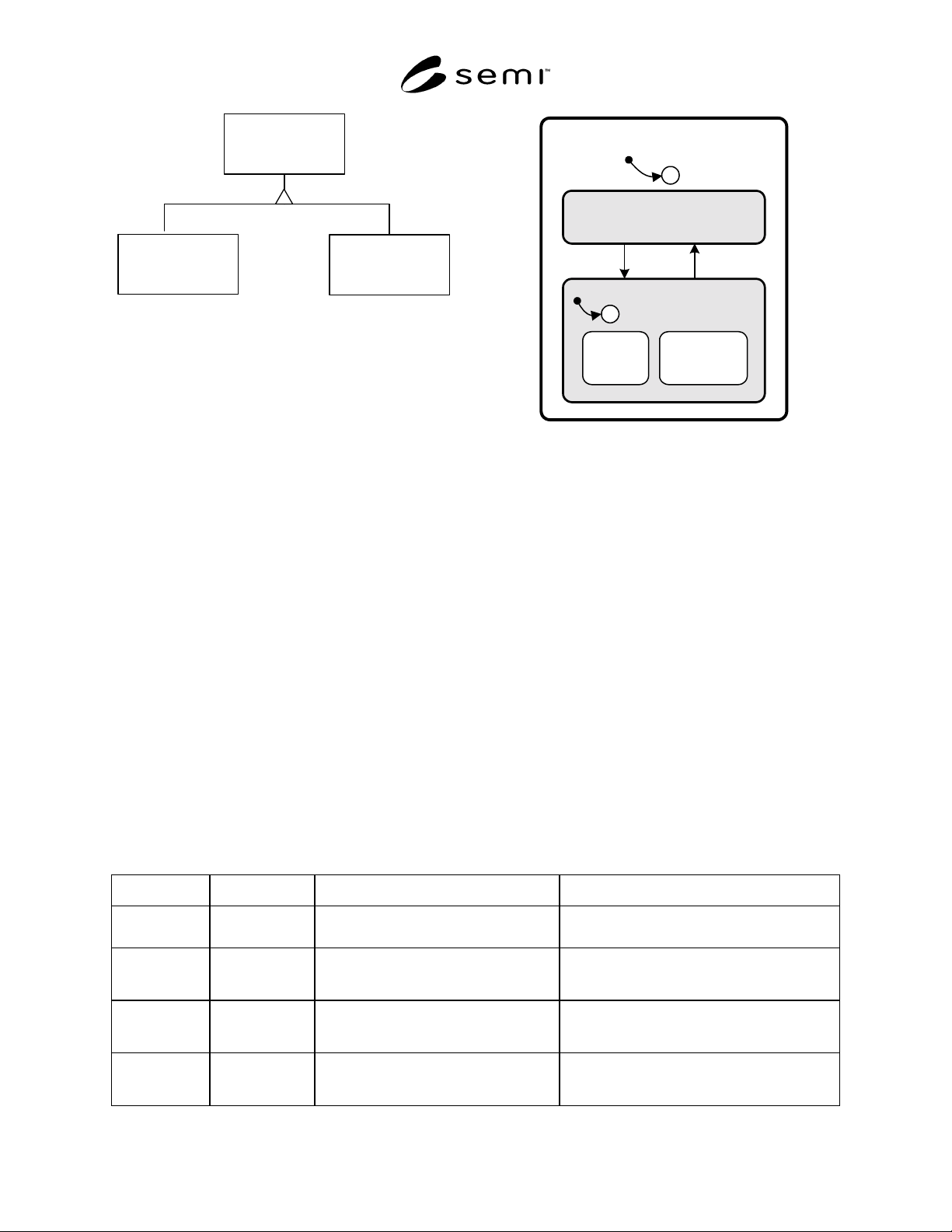
10.2 AbstractEquipmentElement Object — The
supertype object of the interface hierarchy is
AbstractEquipmentElement, which is an abstraction of
any equipment component that can perform work.
AbstractEquipmentElement is an abstract type that is
not implemented directly. There are two subtypes of
AbstractEquipmentElement: AbstractEquipmentSub-
system, and EquipmentIODevice. AbstractEquipment-
Element is an abstract type, so that implementations are
of one of the subtypes.
10.2.1 AbstractEquipmentElement Requirements
10.2.1.1 Object Exception Management
10.2.1.1.1 SEMI E41 defines a model for Exception
Conditions. An Exception Condition may be either an
Alarm Condition or an Error Condition. Error
Conditions may, in some cases, have a set of associated
Recovery Actions that can be performed by the
AbstractEquipmentElement to attempt to recover from
the abnormal situation.
10.2.1.1.2 An OBEM object shall comply with the
fundamental requirements of SEMI E41, Section 10.4.
Exception Condition objects shall be provided in
conformance with SEMI E41 and shall be accessible
through services defined in SEMI E39. The
AbstractEquipmentElement owns all exceptions that it
generates. Therefore, it shall report all of its Exception
Condition objects through OSS services.
10.2.2 AbstractEquipmentElement Subtypes — The
AbstractEquipmentElement has two subtypes, the
EquipmentIODevice and the AbstractEquipment-
Subsystem.
SEMI E98-1102 © SEMI 2000, 2002 16
Abstract
Equipment
Element
Equipment
IODevice
Abstract
Equipment
Subsystem
Figure 6
AbstractEquipmentElement Object Types
10.2.3 AbstractEquipmentElement State Model
10.2.3.1 The AbstractEquipmentElement is either IN
SERVICE (available for work) or OUT OF SERVICE
(unavailable for work). In some cases, the user may be
able to set the AbstractEquipmentElement’s operational
state.
10.2.3.2 The state diagram for the
AbstractEquipmentElement state model is shown in
Figure 7.
10.2.3.3 The AbstractEquipmentElement shall be fault-
free whenever it is in the IN SERVICE state.
10.2.3.4 An AbstractEquipmentElement in the OUT
OF SERVICE state shall not be used by the equipment
or the user for normal manufacturing purposes (while
the Equipment or containing EquipmentModule is in
the ARAMS superstate of MANUFACTURING).
OPERATIONAL
C
1
IN SERVICE
3
USER
SELECT
EQUIPMENT
SELECT
2
C
4
OUT OF
SERVICE
Figure 7
AbstractEquipmentElement State Model
10.2.3.5 The user may or may not be allowed to put a
certain subtype of AbstractEquipmentElement out of
service, depending upon the equipment design. This is
optional for the equipment. In general, the user
requires the ability to put major components into and
out of service but does not require this for lower level
components. In many cases, a component can not
operate without some or all of its component elements.
10.2.3.6 Substates of OUT OF SERVICE are not
required unless the user is able to put the
AbstractEquipmentElement out of service. However, if
a user places an AbstractEquipmentElement out of
service, only a user shall be able to return it back in
service. The substates are then required to retain the
source of the out of service selection through the
substates USER SELECT and EQUIPMENT SELECT.
10.2.3.7 State Model Definitions — Table 2 defines the states of the AbstractEquipmentElement object.
Table 2 AbstractEquipmentElement State Definitions
State Name Superstate Definition Comment
IN SERVICE OPERATIONAL The AbstractEquipmentElement is error-
free and may be used for work.
None
OUT OF
SERVICE
OPERATIONAL The AbstractEquipmentElement has one
or more exceptions and/or has been made
unavailable by the equipment or User.
None
USER SELECT OUT OF
SERVICE
The user requested the Abstract-
Equipment-Element be put out of service.
Stays out of service until the user returns it to
service. This substate may be omitted for low
level elements.
EQUIPMENT
SELECT
OUT OF
SERVICE
The equipment determined that the
AbstractEquipmentElement should be
placed out of service.
Stays out of service until the equipment
determines it is able to operate properly. This
substate may be omitted for low level elements.
SEMI E98-1102 © SEMI 2000, 2002 17
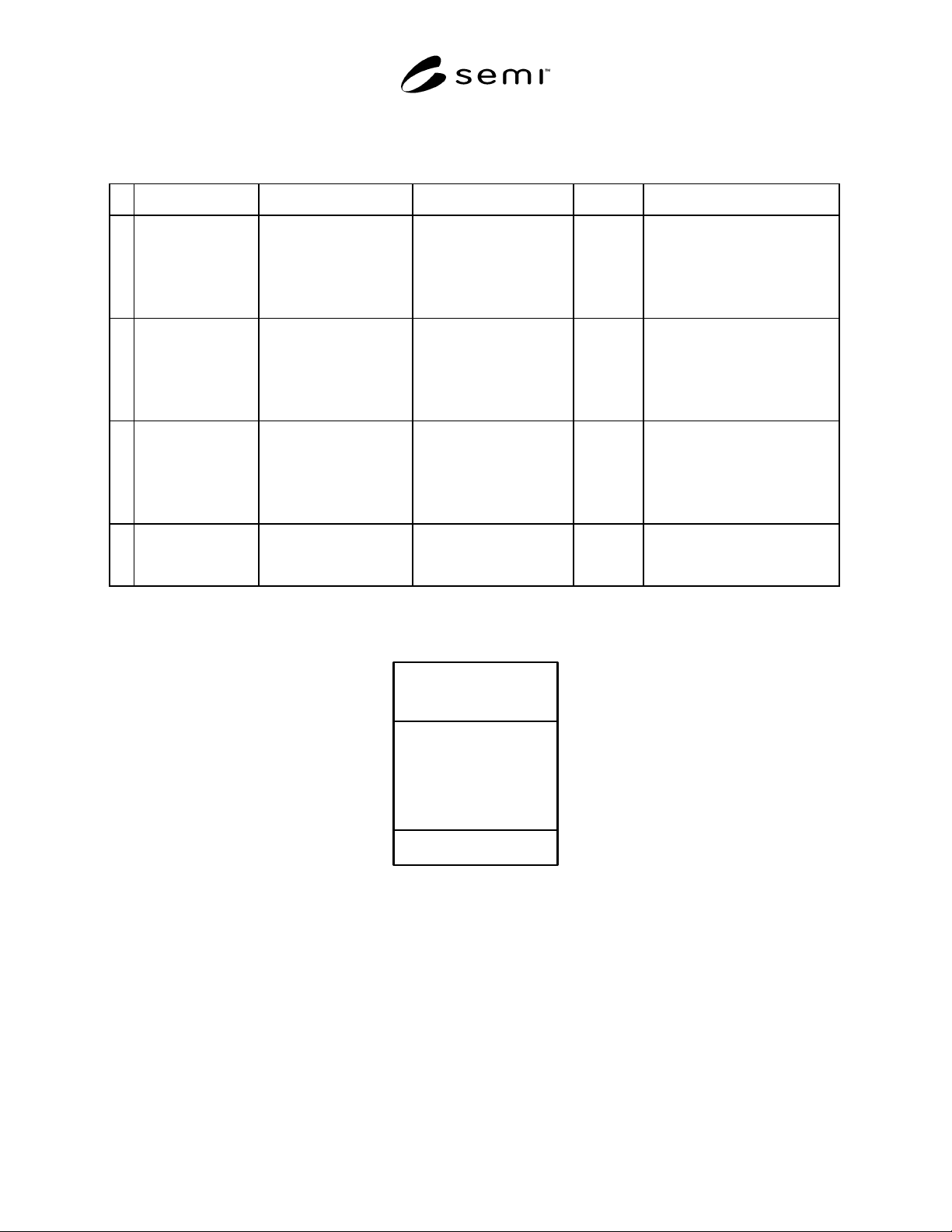
10.2.3.8 State Transition Table — Table 3 defines the state transitions of the AbstractEquipmentElement object.
Table 3 AbstractEquipmentElement State Transitions
# Previous State Trigger New State Action(s) Comment
1 INITIALIZATION Initialization is complete. Depends upon previous
state and current condition
None If the user made the element
unavailable, it shall remain
unavailable. If the element has a
fault, it shall be made unavailable
by the equipment.
2 IN SERVICE The user has placed the
element OUT OF
SERVICE by the user or
the equipment.
OUT OF SERVICE None The equipment should put the
element out of service whenever
a fault condition exists at the
element.
3 OUT OF SERVICE The element has been
returned to service by the
entity that placed it out of
service. All exceptions
and any user restriction
have cleared.
IN SERVICE None The original out of service
condition has cleared. The
element may be used for work.
4 IN SERVICE or
INITIALIZING
Default entry into
OUT OF SERVICE
USER SELECT or
EQUIPMENT SELECT
None
10.2.4 AbstractEquipmentElement Object — Figure 8 represents the AbstractEquipmentElement object.
Abstract Equipment
Element
ChangeService
Cycles
ResetDate
Description
Function
InService
ImmutableID
Supplier
Figure 8
AbstractEquipmentElement Object Type