semi合集-English.pdf - 第2853页
SEMI E105-0701 © SEMI 2000, 2001 4 6.1.4 Sched uling Component Declar a t ions /* The ActivityType enum erated value will determine w hich kind of activity i s represented an d the appropriate properties present in t he …
SEMI E105-0701 © SEMI 2000, 20013
SEMI E97 — Provisional Specification for CIM
Framework Global Declarations and Abstract Interfaces
SEMI E102 — Provisional Specification for CIM
Framework Material Transport and Storage Component
4.2 Other Documents
UML Notation Guide, Version 1.1, document number
ad/97-08-05, Object Management Group.
1
ISO/IEC International Standard 14750 (also ITU-T
Recommendation X.920): Information Technology –
Open Distributed Processing – Interface Definition
Language
2
5 Terminology
5.1 Definitions
5.1.1 activity — work performed as part of the
manufacturing operations of a factory. Activities may
be specified formally by a predefined type of job
specification (for example, Production Job, Transport
Job or PM Job), or they may be represented by
identifying the minimal set of resources and material
needed to allow subsequent completion of the job
specification. An activity is the result of dispatching or
scheduling.
5.1.2 dispatching — generation of a decision or option
for the next activity involving a particular factory
resource or material. The dispatch result is determined
by evaluating the current state of the factory, the
priorities and requirements for the activities, and the
relationship of the activities to one another. Dispatching
returns only the immediately applicable part of a
schedule.
5.1.3 factory planning — recommendation of lot starts
for a particular production facility over an extended
period of time. The factory plan is determined by
predicting future changes in factory state and available
capacity as lots progress through production. This
prediction is used to determine the optimum sequence
of lot starts to best achieve the production goals of the
facility. Factory planning is typically the responsibility
of enterprise systems.
5.1.4 scheduling — generation of a forecast of future
time sequenced activities involving factory resources or
material. The schedule is based on the current state of
the factory, the priorities and requirements for the
activities, the relationship of the activities to one
1 UML Notation Guide v1.1 is available to the general public at
http://www.omg.org/cgi-bin/doclist.pl, +1-508-820 4300, Object
Management Group, Inc. , Framingham Corporate Center, 492 Old
Connecticut Path, Framingham, MA 01701.
2 ISO Central Secretariat, 1, rue de Varembé, Case postale 56, CH-
1211 Genève 20, Switzerland
another and knowledge of factory level goals and
capacity. Scheduling covers activities projected to
occur over a longer future time interval than
dispatching.
6 Requirements
6.1 Scheduling Component — The Scheduling
Component provides a single interface called the
SchedulingManager with operations for both
dispatching and scheduling.
6.1.1 Any resource or material within the factory may
have a next activity defined for it. The
SchedulingManager interface is responsible for
identifying activities that answer questions such as:
• What’s next for this Machine?
• Where next for this Lot?
• What’s next for this Operator?
6.1.2 The SchedulingManager interface is also
responsible for generating a time-sequenced forecast of
future activities for a resource or for material within the
factory. This forecast is based on projections from the
current factory state and may be updated as actual
activities are dispatched and executed.
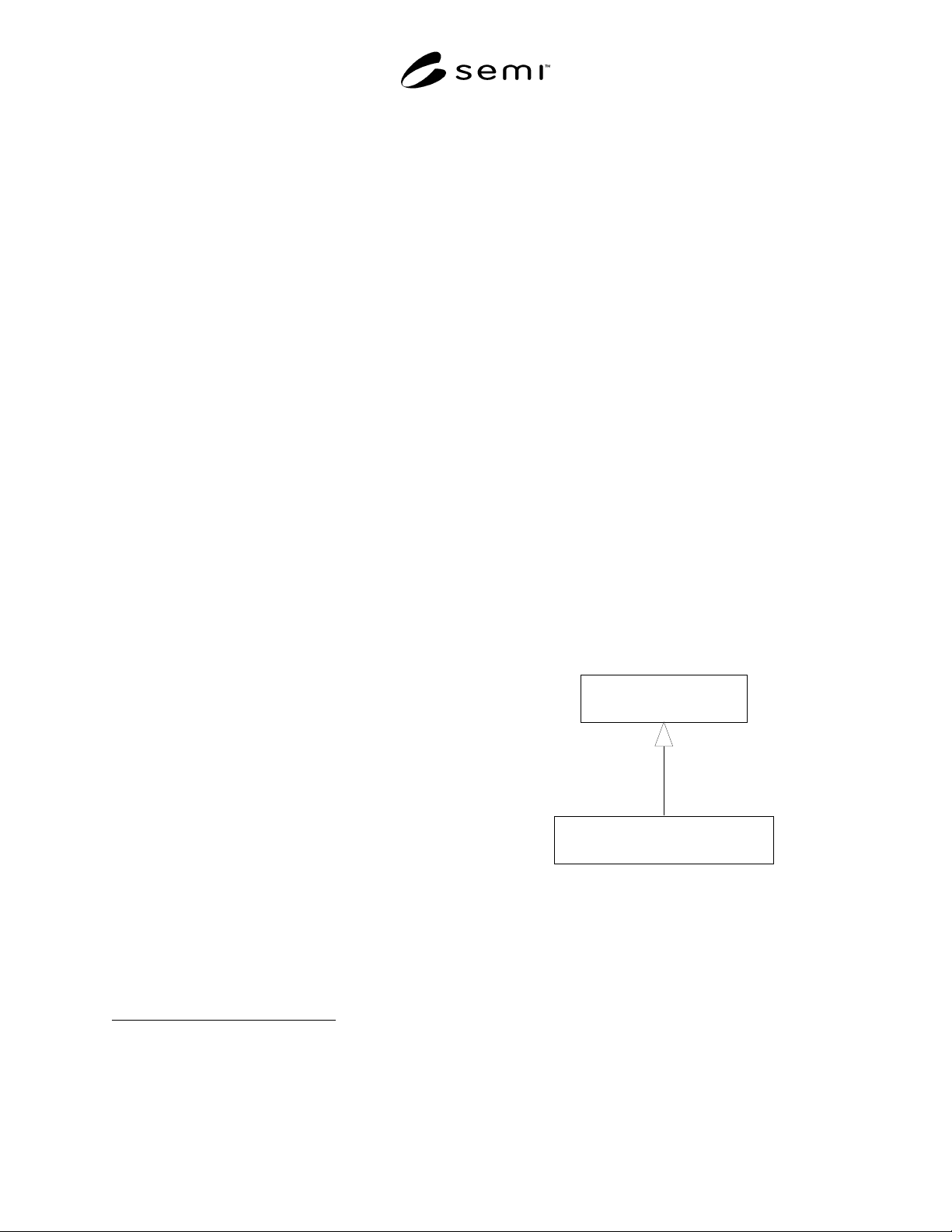
6.1.3 The Scheduling Component Information Model
is shown in Figure 2.
ComponentManager
(from Factory Component)
SchedulingManager
Figure 2
Dispatching Component Information Model

SEMI E105-0701 © SEMI 2000, 2001 4
6.1.4 Scheduling Component Declarations
/* The ActivityType enumerated value will determine which kind of activity is represented and the appropriate
properties present in the activitySpec. */
enum ActivityType {
ProductionActivity,
TransportActivity,
MaintenanceActivity,
DoNothing };
/* ActivityOption represents a single activity that is eligible to be dispatched for execution. The
prioritySequenceNumber represents the priority ordering of a list of ActivityOptions in the case where a manual
process includes selection of one ActivityOption from the list. The deadline is a timestamp that is used to convey
start time constraints for activities. It may also be used in a DoNothing activity to specify the timeout for a retry of
the dispatch request. */
struct ActivityOption {
ActivityType activityType;
short prioritySequenceNumber;
Global::TimeStamp deadline;
AbstractIF::ResourceSequence resources;
AbstractIF::MaterialGroupSequence materialGroups;
DurablesManagement::DurableSequence durables;
Global::Properties activitySpec;
}; // ActivityOption
/* ActivityForecast represents a single Activity that may be dispatched and executed in the future. An
ActivityForecast includes information that is equivalent to an ActivityOption, but with added start and finish time
projections. The timeSequenceNumber represents the time ordering of activities consistent with the projectedStart
and projectedFinish. */
struct ActivityForecast {
ActivityType activityType;
short timeSequenceNumber;
AbstractIF::ResourceSequence resources;
AbstractIF::MaterialGroupSequence materialGroups;
DurablesManagement::DurableSequence durables;
Global::TimeStamp projectedStart;
Global::TimeStamp projectedFinish;
Global::Properties activitySpec;
}; // ActivityForecast
/* An ActivityList contains one or more ActivityOptions for a Resource, MaterialGroup or Durable which are all
eligible for immediate execution. A list of one ActivityOption represents a decision from the SchedulingComponent.
A list of more than one ActivityOption represents recommendations from the SchedulingComponent which require
some external interaction for a decision to be reached. */
typedef sequence <ActivityOption> ActivityList;
/* A ForecastList contains one or more ActivityForecasts for a Resource or MaterialGroup which are not yet
dispatched for execution. */
typedef sequence <ActivityForecast> ForecastList;
6.1.5 Use of ActivitySpec Properties— The ActivitySpec part of the ActivityOption and ActivityForecast are
provided to allow implementations to extend the specifications of activities for specific implementations. The names
and value types of properties included in these ActivitySpec structure are not part of the standard.

SEMI E105-0701 © SEMI 2000, 20015
6.1.6 SchedulingManager Interface
Module: Scheduling
Interface: SchedulingManager
Inherited Interface: ComponentManager
interface SchedulingManager : FactoryOperations::ComponentManager {
Description: The SchedulingManager provides the concrete interfaces that support the registration and
control of the Scheduling Component and enable access to the Dispatcher and Scheduler
interfaces.
Exceptions:
/* An attempt was made to request an activity for a resource that is not found within the factory data available to this
SchedulingManager. */
exception ResourceNotFound {
AbstractIF::Resource requestedObject;};
/* An attempt was made to request an activity for a material group that is not found within the factory data available
to this SchedulingManager. */
exception MaterialGroupNotFound {
AbstractIF::MaterialGroup requestedObject;};
/* An attempt was made to request an activity for a durable that is not found within the factory data available to this
SchedulingManager. */
exception DurableNotFound {
DurablesManagement::Durable requestedObject;};
Published Events:.
/* The ActivityListAvailable event is published by the Scheduling Component to notify event subscribers that a new
ActivityList containing changes is available. The generation of ActivityListAvailable events is controlled as an
implementation specific configuration choice. */
ActivityListAvailable
/* The ForecastListAvailable event is published by the Scheduling Component to notify event subscribers that a new
Forecast is available. ForecastList generation is potentially a compute-intensive operation which may benefit from
event notification when an updated forecast is available. The generation of ForecastListAvailable events is
controlled as an implementation specific configuration choice. */
ForecastListAvailable
Provided Services:
/* Return an activity list for this resource. The activity list will contain the number of existing activities requested in
listCount in maximum. If “listCount” is blank, the activity list shall contain all existing activities. A decision will
be represented by an activity list with only one activity option. The ActivityOptions returned by this operation may
be ProductionActivity, MaintenanceActivity or DoNothing ActivityTypes. Although Resources are typically
immobile (such a Equipment), some Resources may also be subject to TransportActivities. */
ActivityList whatNextForResourceByCount (
in AbstractIF::Resource aResource)
in short listCount)
raises (Global::FrameworkErrorSignal,
ResourceNotFound);