semi合集-English.pdf - 第2970页
SEMI E120-0705 © SEMI 2003, 2005 6 Mod ul e Equi pme nt IODevice Subsystem +elementType:string +supplier :string +mak e:string +model:s tring +modelR evision:st ring +functi on:stri ng +imm utableId:strin g Equi pmentE l…

SEMI E120-0705 © SEMI 2003, 2005 5
factory software to match the documentation. Unfortunately, manuals are too often incomplete or out of date. If the
equipment can provide its instance model (and the extended class model on which it is based) to the host, it is more
likely to be complete and accurate. If it can construct that model in real-time, based on its current hardware
configuration it will be more accurate. This self-descriptive data is also known as “metadata”.
7.3.3 Relation Of Data To The Equipment — Data gathered from equipment gains greater meaning if it is clear as to
what part of the equipment it pertains and what related data items provide context information. The instance model
can be a reference in the definition of the data collection plans and reflected by actual data collected.
7.3.4 Relation Of Parameters & Setting To The Equipment — Proper and predictable control of equipment is
possible only if the effects of all available parameters and settings is understood. These must be related to the
equipment and to the measurable values that they affect. This information can be provided by the instance model.
7.3.5 Understanding Equipment Capabilities — The process capabilities of equipment depend on the modules
present and the characteristics and status of those modules. In some situations, the hardware configuration of
equipment can change on a regular basis.
8 Common Equipment Model Definition
8.1 This section documents the Common Equipment Model.
8.2 Overview
8.2.1 Documentation of the Common Equipment Model begins with system views of the model and moves to
detailed descriptions of the classes with their attributes and relationships. No behavior is defined—that is, no state
models and no methods are described for classes.
8.2.2 It is important to note that the two system views presented are of the same model. They are separated to avoid
large, complex diagrams, thus enhancing understandability.
8.2.3 The model shows only classes and their relationships. Actual equipment will have corresponding instance
models that define the detail of the equipment as viewed through an equipment interface. Thus, the Common
Equipment Model in this document provides rules for constructing the instance model of an equipment.
8.2.4 The Common Equipment Model is represented in two system level views. The first is the inheritance
hierarchy that shows which classes inherit characteristics (e.g. attributes and relationships) from which other classes.
The second view represents the relationships among classes to show general equipment structure. These views are
described in general terms to highlight important aspects of the model.
8.2.5 Everything in these two views is repeated in subsequent sections dealing with individual classes in the model.
In the individual class views, class of interest is shown with all relationships to other classes. No other detail is
shown in these views.
8.3 Inheritance Hierarchy
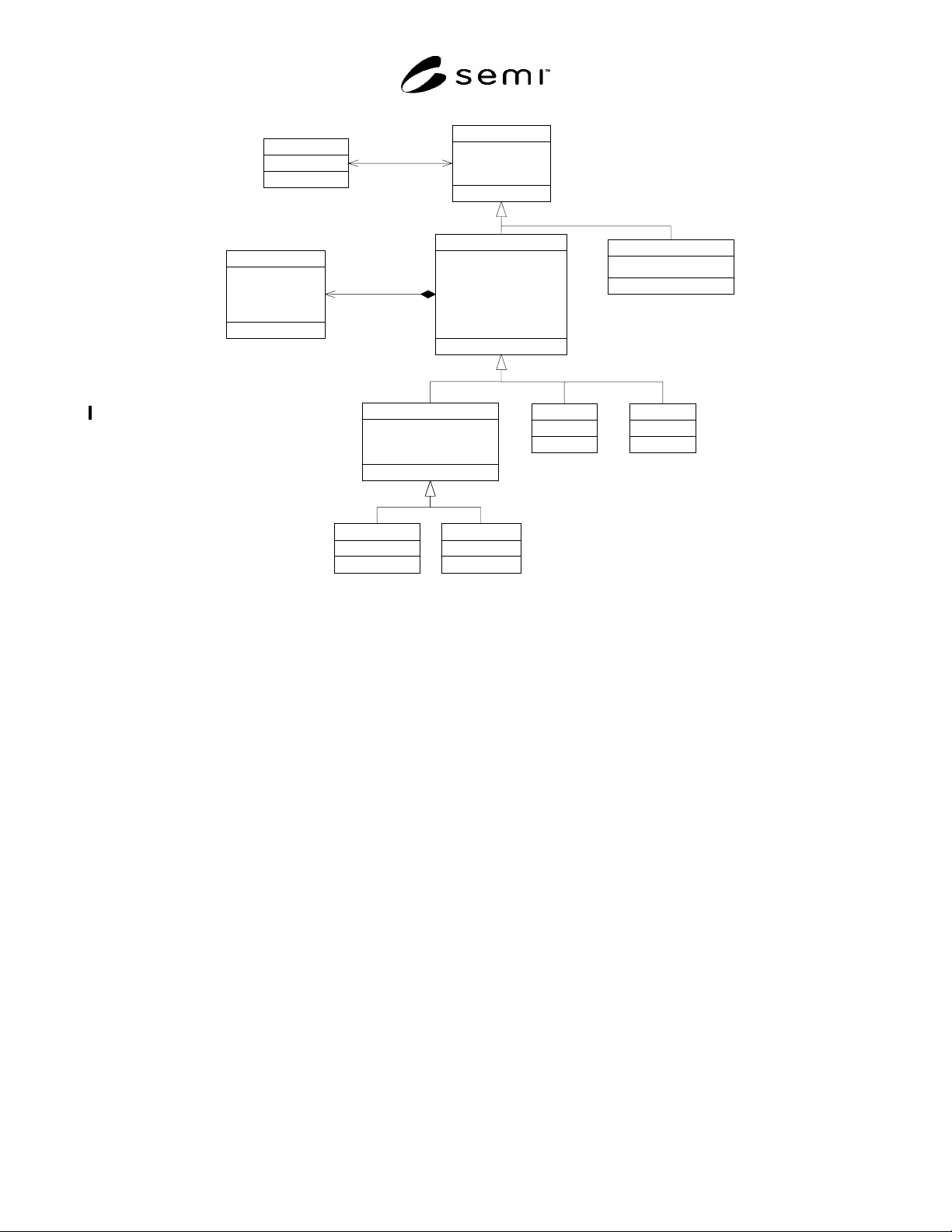
8.3.1 The inheritance hierarchy view, Figure 2, shows the superclass/subclass relationships of the Common
Equipment Model.
SEMI E120-0705 © SEMI 2003, 2005 6
ModuleEquipment
IODevice Subsystem
+elementType:string
+supplier:string
+make:string
+model:string
+modelRevision:string
+function:string
+immutableId:string
EquipmentElement
+uid:string
+name:string
+description:string
Nameable
materialType:enumeration
MaterialLocation
+processName:string
+processType:enumeration
+recipeType:string
ExecutionElement
Extension
extensions
0..*
0..*
softwareModules
1
target
+name:string
+supplier:string
+description:string
+version:string
SoftwareModule
Figure 2
Inheritance Hierarchy
8.3.2 Items to note about the inheritance hierarchy view:
Nameable is at the top of the inheritance hierarchy and provides common accessibility to all classes in the
Common Equipment Model.
Equipment and Modules may be able to process material, but Subsystems cannot.
Note that a subclass inherits the attributes of its superclass. Some subclasses have no additional attributes
defined in this specification. It is anticipated that other standards will extend this model to add attributes,
relationships, state models, etc. as equipment behavior is mapped onto this model.
8.4 Relationship View
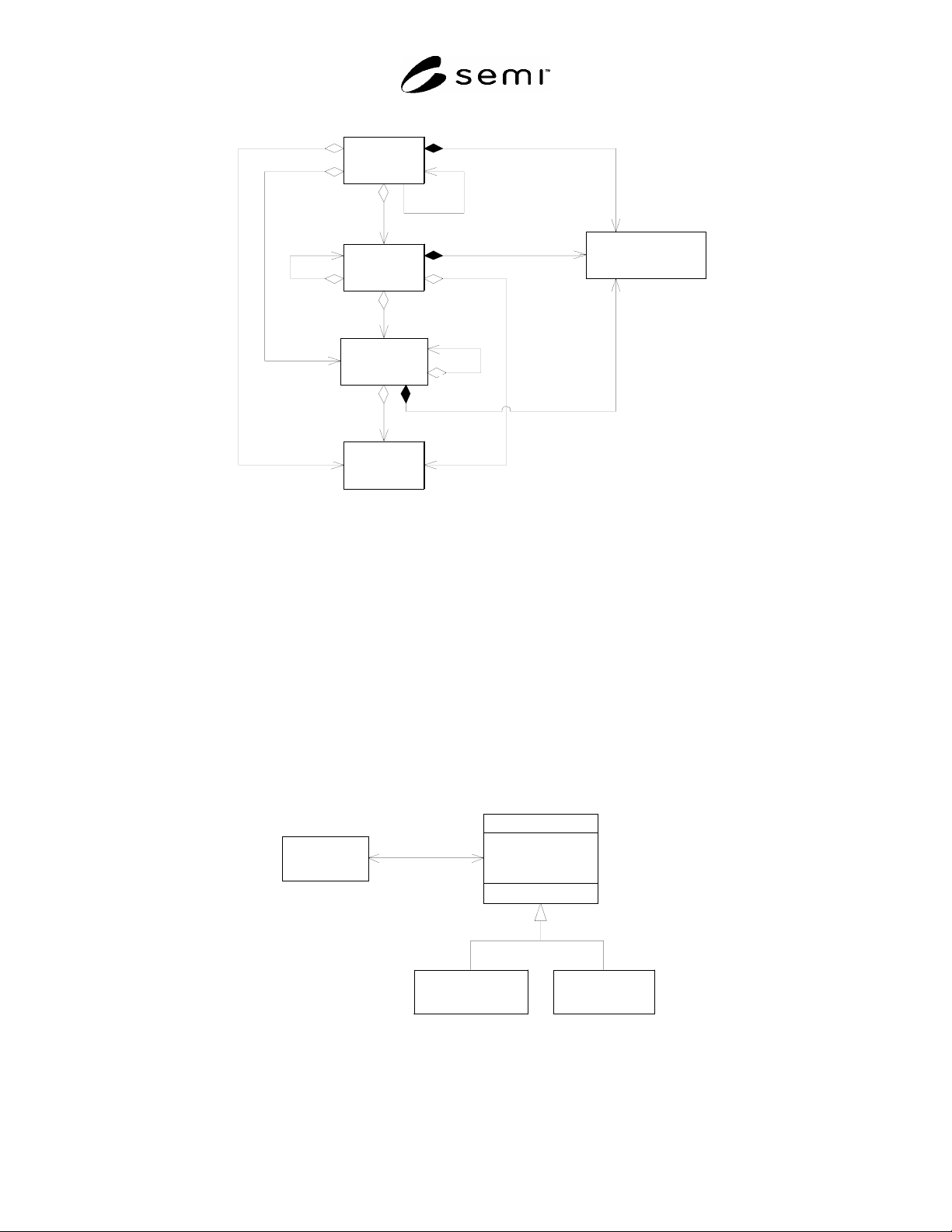
8.4.1 The relationship view is shown in Figure 3. This view illustrates expected equipment. Items to note about the
relationship view:
Flexibility is built into the structure so that, for instance, IODevices may belong directly to almost any level of
the equipment structure.
Subsystems, Modules, and Equipment may have MaterialLocations (i.e. hold material).
Equipment — Equipment aggregation allows Equipment that acts on behalf of other Equipment to describe these
Equipment.
SEMI E120-0705 © SEMI 2003, 2005 7
IODevi ce
Subsystem
Eq uipment
Module
+modules
+subsystems
+ioDevices
0..*
0..*
0..*
0..*
0..*
0..*
0..*
0..*
+ioDevices
+ioDevice s
+subsyst ems
+subsystems
+modules
0..1
0..*
0..*
0..*
0..*
0..*
0..*
0..*
MaterialLocation
0..*
+materialLocations
+materialLocat ions
+materialLocations
0..*
0.. *
0..1
0..1
0..1
0..*
0..1
+equipment
Figure 3
Relationship View
8.5 Class Definitions
8.5.1 Class definitions consist of a brief description of the highlighted class, a class diagram showing the class and
all related classes (both from an inheritance and relationship standpoint), a table defining the attributes, and further
text as necessary to fully define the class.
8.5.2 For clarity, the abstract classes are listed separately from concrete classes.
8.5.3 Abstract Classes
8.5.3.1 Nameable — The root of each class in the CEM class hierarchy. This class provides a means for uniquely
identifying each component of the equipment structure
. Nameable is a superclass of EquipmentElement and
MaterialLocation (see Figure 4). It includes three attributes: uid, name, and description (see Table 2). Nameable is
also associated with the class Extension. See ¶6.3 for more information on the use of Extension.
EquipmentElement MaterialLocation
+uid:string
+name:string
+description:string
Nam eable
Extens ion
extensions
0..*
1
target
Figure 4
Nameable Class