semi合集-English.pdf - 第2973页
SEMI E120-0705 © SEMI 2003, 2005 9 Software M odule 0..* software Modul es +elemen tType:stri ng +suppli er:stri ng +mak e:string +model :string +modelR evision:st ring +function :string +imm utableId:st ring Equi pmentE…
SEMI E120-0705 © SEMI 2003, 2005 8
Table 2 Attributes of Nameable
Attribute Name Description Access Reqd Form
uid Identifier that uniquely and permanently identifies a Nameable. The uid
contains a “uuid” string. See §4, ISO/IEC 11578:1996 for a reference to
uuid definition. A properly formed uuid provides an identifier that is
unique from any other uuid (in the factory and beyond).
RO Y String.
name Human-readable name for Nameable. The name is representative of the
role or function that the Nameable plays in the equipment structure.
RO Y String – See rules for
naming below.
description Human-readable description of Nameable. Contents of this attribute shall
provide enough information for a human to understand the purpose of
this Nameable.
RO Y String.
8.5.3.1.1 uid — The requirements for each uid value are:
The uid value shall conform to the rules for constructing a uuid as defined in standard ISO/IEC 11578:1996.
The uid shall be a fixed value with respect to the physical hardware and shall be unique among all Nameables.
The uid shall remain with the Nameable, even if the Nameable is removed from one equipment and added to
another. For example, if an IODevice fails and is removed from an equipment, its replacement will have a
different uid. If the original IODevice is repaired and installed on a different equipment, it will retain its
original uid. Note that a MaterialLocation is contained within an equipment component and will move with
that component, retaining its own uid.
8.5.3.1.2 name — The naming requirements for each Nameable are:
Names shall consist of alphanumeric characters, spaces, hyphens, and underscores. Names shall start with an
alpha character, and shall not contain leading or trailing spaces.
The value of the name attribute shall be unique among component parts
1
of the same aggregate (object). This
restriction holds for a Nameable instance that is aggregated (shared) by more than one object.
If a Nameable represents a class or variable described in a SEMI standard, the name used shall conform to the
spelling and case style specified in the standard. If the uniqueness rules can’t be met, the name shall include an
appended suffix of the form “-n”, where ‘n’ is a number making the name unique.
The name attribute represents the role or function of the object in the equipment hierarchy. The value of name
shall not change unless the physical equipment configuration changes. Upon a configuration change, if a
Nameable is replaced in its role and function by a different one, the name value representing that role shall be
transferred to the new Nameable. For example, if an IODevice named “TemperatureControlZone5” fails and is
replaced with a new unit, that new unit shall be named “TemperatureControlZone5”.
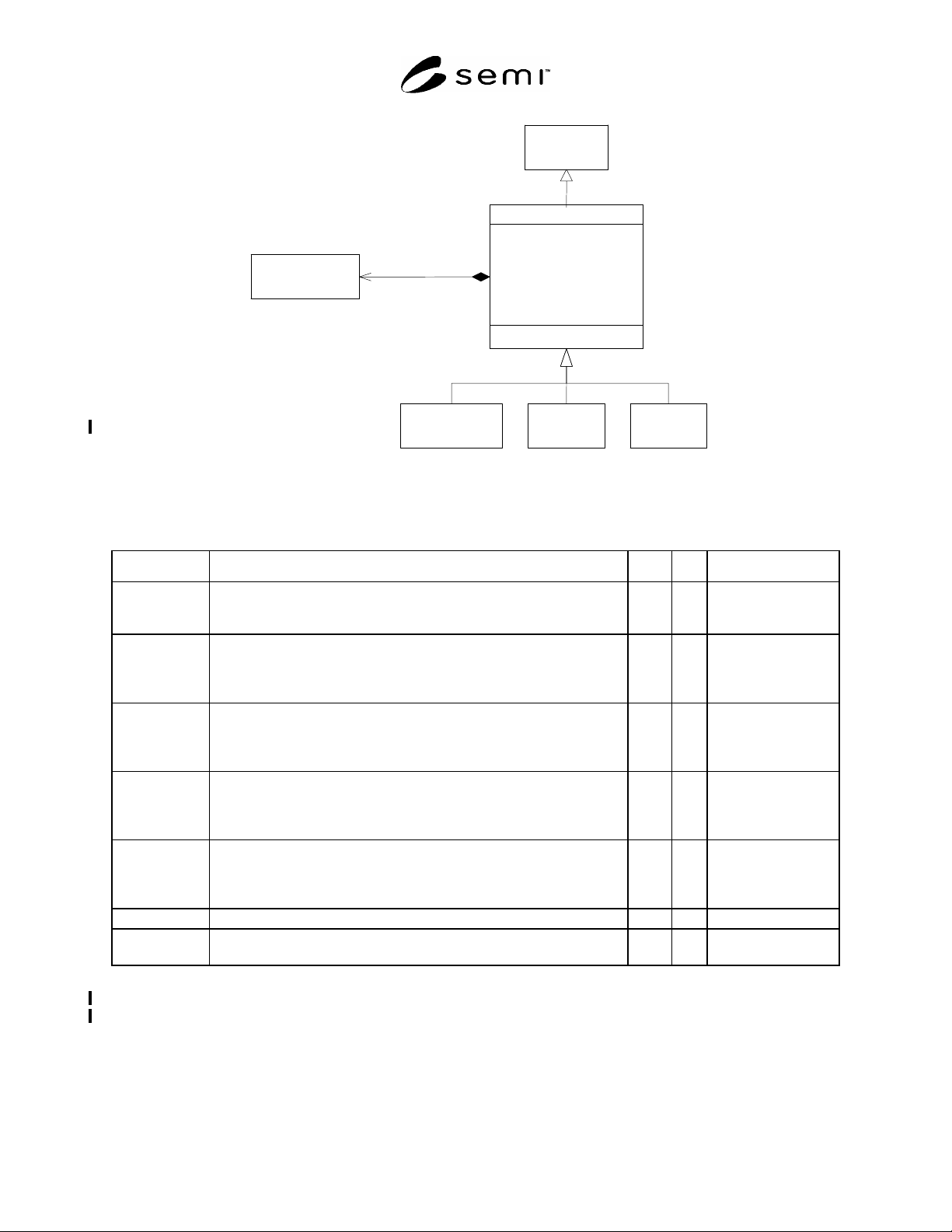
8.5.3.2 EquipmentElement — This abstract class represents the basic information required for each hardware
component in the equipment structure (see Figure 7). EquipmentElement includes the attributes: elementType,
supplier, make, model, modelRevision, function, and immutableId (see Table 3). It also has a composite aggregation
of SoftwareModules.
1 Members of an aggregation (i.e. the classes/objects opposite the diamond) are referred to as “component parts” or “components” of the
aggregation. The “aggregate” is the class/object at the diamond end of the aggregation relationship.
SEMI E120-0705 © SEMI 2003, 2005 9
SoftwareModule
0..*
softwareModules
+elementType:string
+supplier:string
+make:string
+model:string
+modelRevision:string
+function:string
+immutableId:string
EquipmentElement
Nameable
Subsystem IODevice ExecutionElement
Figure 5
EquipmentElement Class
Table 3 Attributes of EquipmentElement
Attribute Name Definition Access Reqd Form
elementType Describes EquipmentElement type. For example, if EquipmentElement is
a valve for controlling Nitrogen gas flow, the value of this attribute might
be “Nitrogen Valve”. If it is a load port, the value might be “Load Port”.
RO Y String
supplier The name of the manufacturer of the EquipmentElement, if known. Not
all EquipmentElement instances of the equipment make it easy to
determine this information automatically. Where this information cannot
be determined or configured, it shall have the value “unknown”.
RO Y String
make The hardware make of the EquipmentElement, if known. Not all
EquipmentElement instances of the equipment make it easy to determine
this information automatically. Where this information cannot be
determined or configured, it shall have the value “unknown”.
RO Y String
model The hardware model of the EquipmentElement, if known. Not all
EquipmentElement instances of the equipment make it easy to determine
this information automatically. Where this information cannot be
determined or configured, it shall have the value “unknown”.
RO Y String
modelRevision The hardware model revision of the EquipmentElement, if known. Not
all EquipmentElement instances of the equipment make it easy to
determine this information automatically. Where this information cannot
be determined or configured, it shall have the value “unknown”.
RO Y String
function The role of this EquipmentElement within the equipment. RO Y String
immutableId An unchanging identifier, such as the serial number of the
EquipmentElement, if known.
RO Y String
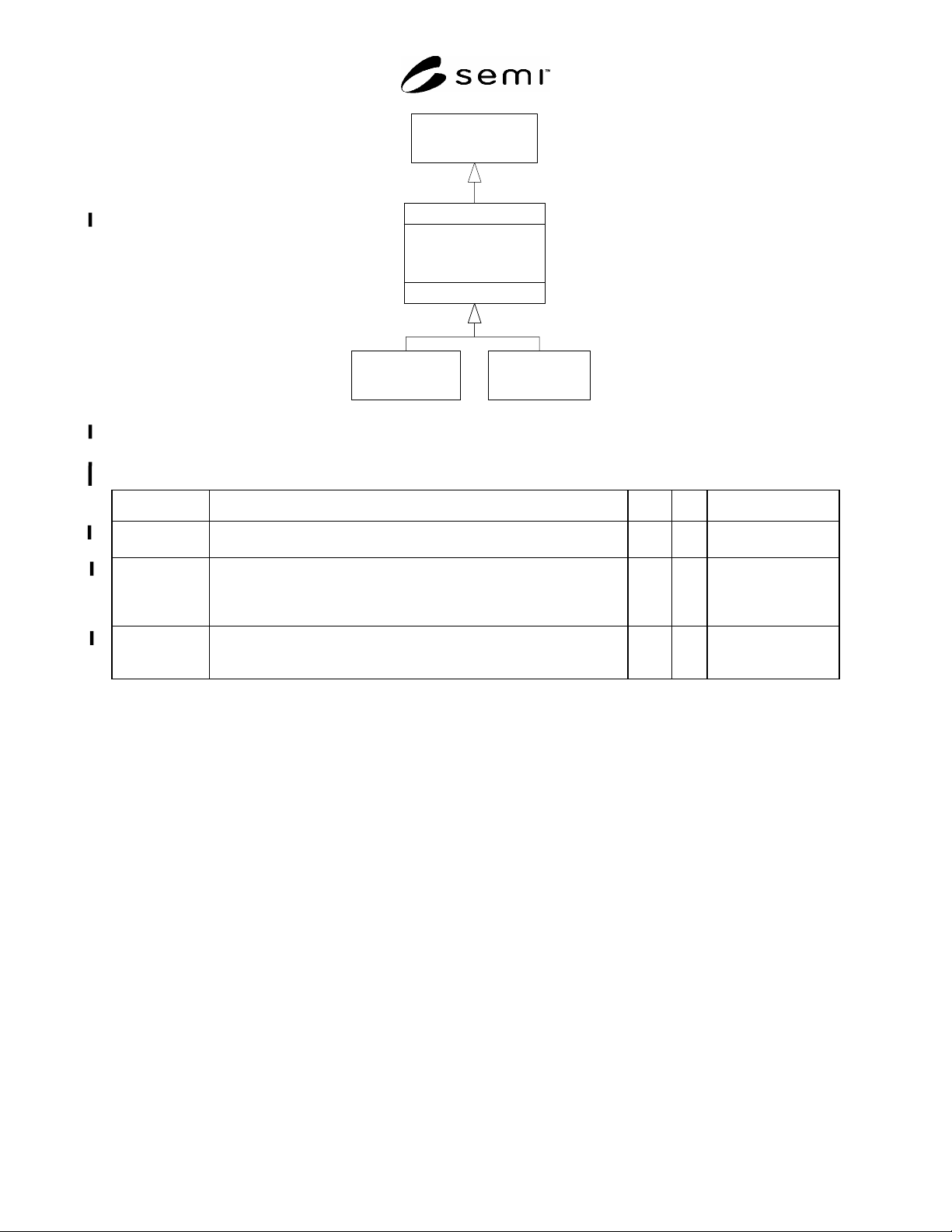
8.5.3.3 ExecutionElement — This abstract class models the parts of the equipment structure capable of processing,
measuring, or testing material — Module and Equipment. It is a subclass of EquipmentElement (see Figure 8).
ExecutionElement has the following attributes: processName, processType, and recipeType (defined in Table 4).
SEMI E120-0705 © SEMI 2003, 2005 10
ModuleEquipment
+processName:string
+processType:string
+recipeType:string
ExecutionElement
EquipmentElement
Figure 6
ExecutionElement Class
Table 4 Attributes of ExecutionElement
Attribute Name Definition Access Reqd Form
processName Describes the processing that occurs at this ExecutionElement (e.g.,
“coat”, “develop”, “bake”, etc.).
RO Y String
processType Categorizes the primary processing function of this ExecutionElement as
an enumerated value chosen from the values: Measurement, Process,
Storage, or Transport. See ¶8.5.3.3.1 for description of processType
values.
RO Y Enumeration
recipeType Instances of ExecutionElement having identical strings for recipeType are
capable of executing the same set of recipes (e.g. processing
instructions). Note that identical results are not guaranteed.
RO Y String
8.5.3.3.1 The definition of processType lists four enumerated values. These are described as follows:
Measurement — Refers to Equipment or Modules whose intended function is to measure or inspect the product
and report results.
Process — Refers to Equipment or Modules whose intended function is to process product by adding value to
the product.
Storage — Refers to Equipment or Modules whose intended function is primarily to provide storage, either
short-term or long-term, for carriers (e.g. stockers).
Transport — Refers to Equipment or Modules whose intended function is primarily to move material from one
location to another. Transport equipment may also provide short-term storage for material.
8.5.3.4 Extension — This abstract class provides the ability for other SEMI standards and implementers to extend
the CEM. Extension has no superclass and no attributes (see Table 5). It is associated with Nameable (see Figure
9). This association is navigable in both directions so that an Extension can identify the class that it modifies and a
Nameable knows its Extensions.
8.5.3.4.1 Extension is modeled to allow extension of any Nameable. However, in practice, only concrete objects
that inherit from Nameable shall have extensions.
8.5.3.4.2 As an abstract class, Extension must have a concrete subclass in order to be useful. The definition of
subclasses of Extension is left to the implementer and/or other standards to define as extensions to the CEM. See
¶6.3 for a discussion of how the Extension class may be used to extend the Common Equipment Model.