semi合集-English.pdf - 第3045页
SEMI E122-0703 © SEMI 2003 26 NOTICE: SEMI makes no warranties or representatio ns as to the suitability of th e standards set forth herein for any particular application . The determinati on of the suitability o f the s…
SEMI E122-0703 © SEMI 2003 25
15.9 Collection Plan Activation — The collection plan is communicated to equipment as parameters to the START
remote command, with one parameter specifying the Dataset, TestTypeData and TestStepData definitions
respectively. An additional parameter is also included to globally enable or disable all test data collection for
process program. The parameters are DATALOG-DATASETS, DATALOG-BY-TESTTYPE, DATALOG-BY-
TESTID, and DATALOG-OPTIONS. Please see START remote command parameters in Table 8 for format
details.
15.10 Test Data Acquisition — This section specifies an interface to allow transfer of data sets from equipment to
host. It defines at a conceptual level the messaging services, and does not define the actual messaging protocol.
Information on structure of the message, how data is represented, or how the message is exchanged will be defined
in a separate document, which maps the services to a specific protocol (such as SECS-II).
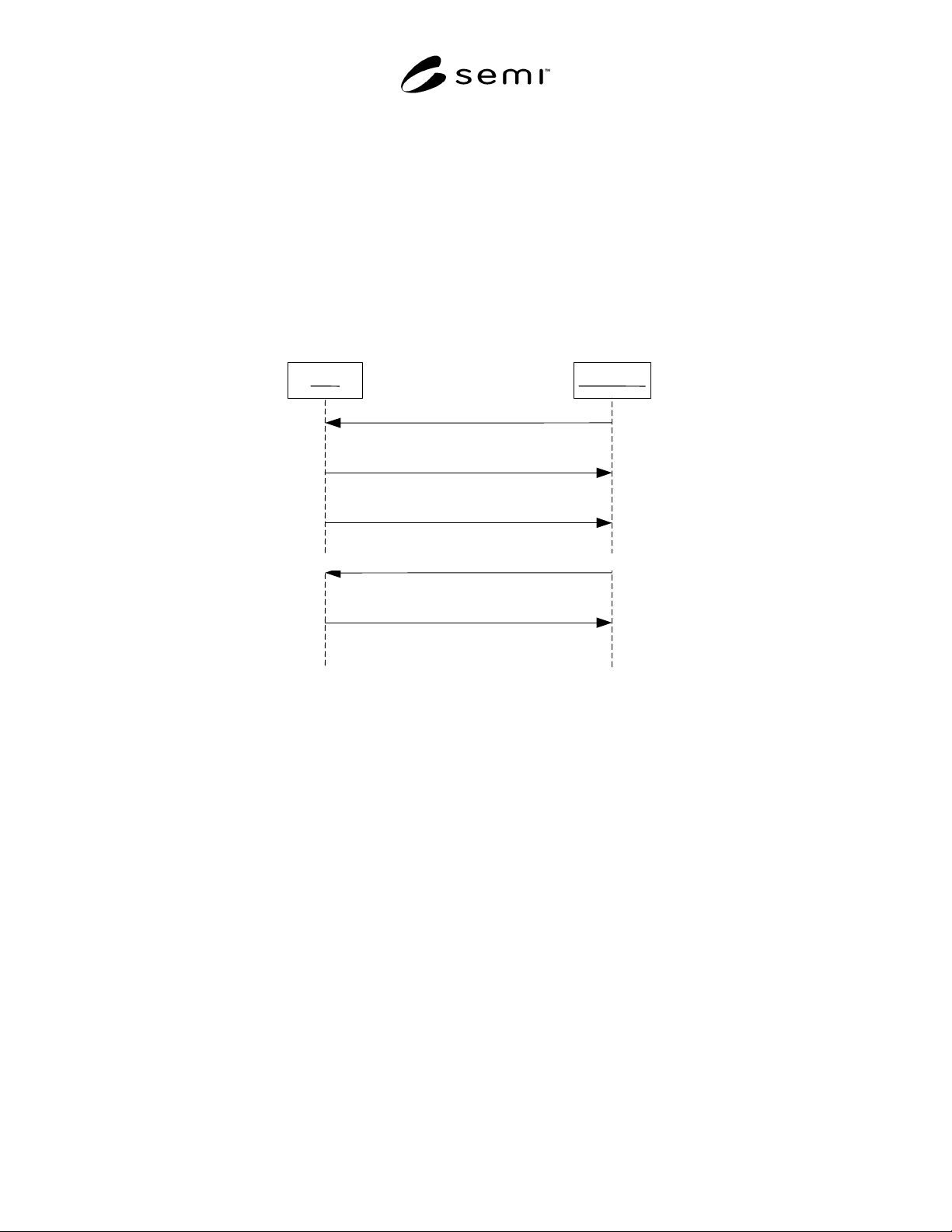
15.10.1 Test Data Transfer Communications — The required messages and the exchange sequence for a normal
transfer of data sets between two systems are presented below in Figure 3.
Host
Equipment
OPEN(DSName:String, Handle:Integer)
READ(Handle:Integer, MaxLen:Integer)
CLOSE(Handle:Integer)
SEND(DSName:String)
READ DATA REPLY(Handle:Integer, Data:<unspecified>)
Data Available
Indication
Open Data Set
for Transfer
Data
Transfer
Close
Data Set
Figure 3
Test Data Transfer Message Flow
15.10.1.1 SEND — Used by equipment to indicate to host that data is available for a data set and request host
system to read it. The data set is identified by its name in the argument.
15.10.1.2 OPEN — Host requests that a certain data set be opened for transfer. A handle is provided unique to this
session to be used in subsequent transfer requests.
15.10.1.3 READ — Host requests data be transferred for an open data set, identified by the handle. A max length is
provided to indicate to equipment the maximum byte length of the data to be sent.
15.10.1.4 READ DATA REPLY — Equipment reply to a READ request. A block of data no bigger than the max
length specified in the READ request is attached to the reply message. Handle identifies the open data set of the
sent data.
15.10.1.5 CLOSE — Closes a data transfer session and frees the handle.
15.10.1.6 RESET — Closes all open data sets.
15.10.2 Synchronization — In order to synchronize the two systems during recovery situations, a RESET message
is defined that can be used by either Host or Equipment to unconditionally close all open data sets.
15.10.3 This specification must be used in conjunction with a protocol mapping specification in order to get a full
definition of the test data acquisition interface.

SEMI E122-0703 © SEMI 2003 26
NOTICE: SEMI makes no warranties or representations as to the suitability of the standards set forth herein for any
particular application. The determination of the suitability of the standard is solely the responsibility of the user.
Users are cautioned to refer to manufacturer’s instructions, product labels, product data sheets, and other relevant
literature, respecting any materials or equipment mentioned herein. These standards are subject to change without
notice.
By publication of this standard, Semiconductor Equipment and Materials International (SEMI) takes no position
respecting the validity of any patent rights or copyrights asserted in connection with any items mentioned in this
standard. Users of this standard are expressly advised that determination of any such patent rights or copyrights, and
the risk of infringement of such rights are entirely their own responsibility.
Copyright by SEMI® (Semiconductor Equipment and Materials
International), 3081 Zanker Road, San Jose, CA 95134. Reproduction o
f
the contents in whole or in part is forbidden without express written
consent of SEMI.
SEMI E122.1-0703 © SEMI 2003 1
SEMI E122.1-0703
SPECIFICATION FOR SECS-II PROTOCOL FOR TESTER SPECIFIC
EQUIPMENT MODEL (TSEM)
This specification was technically approved by the Global Information & Control Committee and is the direct
responsibility of the North American Information & Control Committee. Current edition approved by the
North American Regional Standards Committee on April 11, 2003. Initially available at www.semi.org May
2003; to be published July 2003.
1 Purpose
1.1 This document maps the services and data of SEMI
E122 to SECS-II streams and functions, and data
definitions.
2 Scope
2.1 This is a specification covering equipment
supporting automated control job management.
2.2 This document applies to all implementations of
SEMI E122 that use the SECS-II message protocol
(SEMI E5). Compliance to this standard requires
compliance to both SEMI E122 and SEMI E5.
NOTICE: This standard does not purport to address
safety issues, if any, associated with its use. It is the
responsibility of the users of this standard to establish
appropriate safety and health practices and determine
the applicability of regulatory or other limitations prior
to use.
3 Limitations
3.1 This specification applies to semiconductor
equipment that also use SEMI E30 GEM standard.
4 Referenced Standards
4.1 SEMI Standards
SEMI E5 — SEMI Equipment Communications
Standard 2 Message Content (SECS-II)
SEMI E30 — Generic Model for Communications and
Control of Manufacturing Equipment (GEM)
SEMI E122 — Standard for Tester Equipment Specific
Equipment Model (TSEM)
NOTICE: Unless otherwise indicated, all documents
cited shall be the latest published versions.
5 Services Message Mapping
5.1 This section shows the specific SECS-II streams
and functions that shall be used for SECS-II
implementation of the services defined in SEMI E122,
as well as the parameter mapping for data attached to
services.
5.2 Services Message Mapping
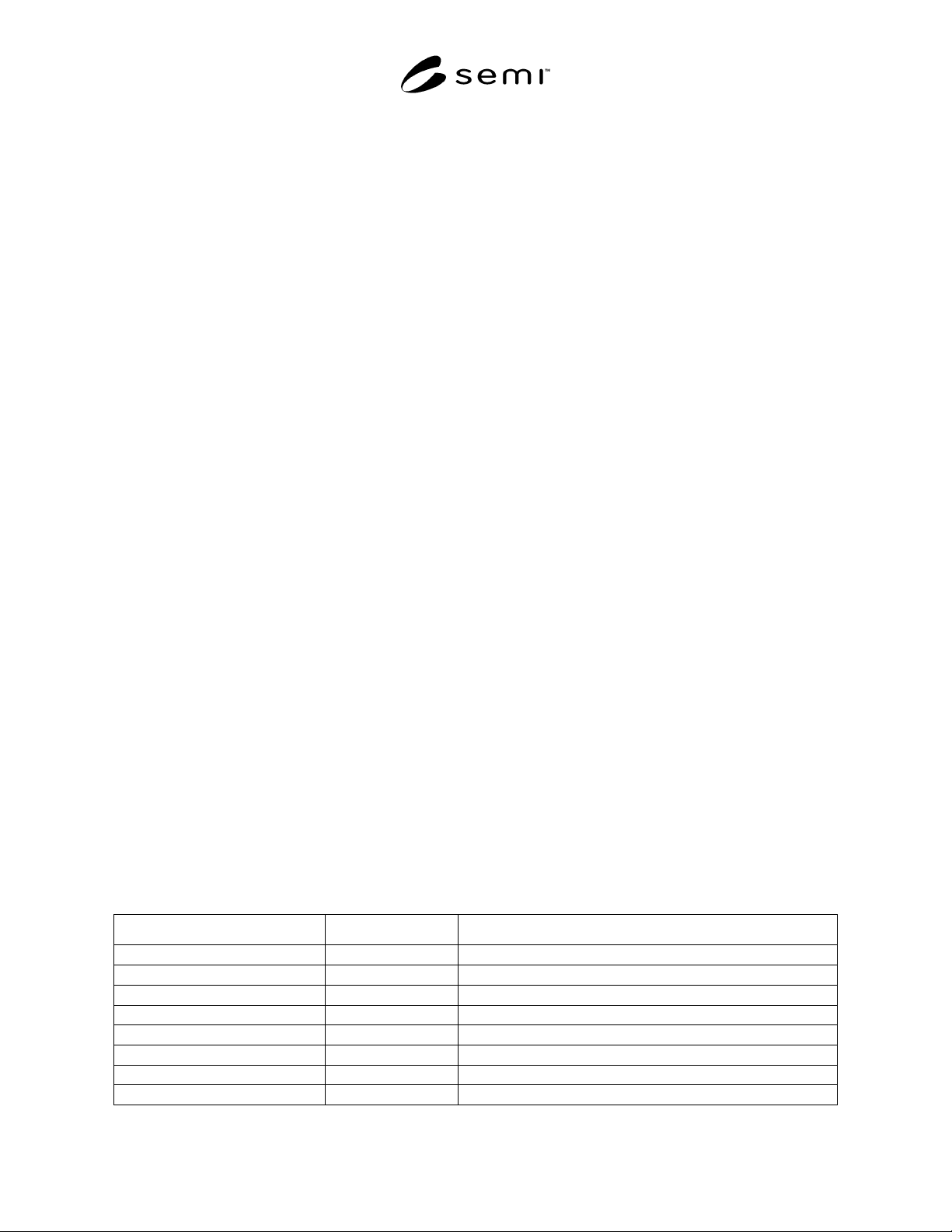
5.2.1 Table 1 defines the relationships between SEMI
E122 services and SECS-II messages. Mapping of
service parameters to the SECS-II data items is
provided in a separate table. Conventions and
definitions of table fields are as described below.
5.2.2 Service Name — Name of the service or remote
command defined in SEMI E122.
5.2.3 Stream, Function — Specifies the SECS-II
stream and function (SxFx) mapped to the service
messages. Following convention of SECS-II, request
and notification messages are mapped to the odd-
numbered functions and response or acknowledgement
messages are mapped to the corresponding even-
numbered functions.
5.2.4 SECS-II Message Name — Name of the SECS-II
message.
Table 1 Services Message Mapping Table
Service Name Stream, Function SECS-II Message Name
ABORT S2,F41/F42 Host Command Send/Acknowledge
DEFINE-DATALOG-PLAN S2,F49/F50 Enhanced Remote Command Send/Acknowledge
DISABLE-SITE S2,F49/F50 Enhanced Remote Command Send/Acknowledge
ENABLE-SITE S2,F49/F50 Enhanced Remote Command Send/Acknowledge
PAUSE S2,F41/F42 Host Command Send/Acknowledge
PP-SELECT S2,F49/F50 Enhanced Remote Command Send/Acknowledge
RESET-SITE-CNT S2,F41/F42 Host Command Send/Acknowledge
RESUME S2,F41/F42 Host Command Send/Acknowledge