semi合集-English.pdf - 第3071页
SEMI E123-0703 © SEMI 2003 12 types, and f ormat of these parameters. HSEM does recommend a minimum list of data items for th e common handler process-sites. These include: 9.2.4.1 Thermal Conditioning Site Parameters • …
SEMI E123-0703 © SEMI 2003 11
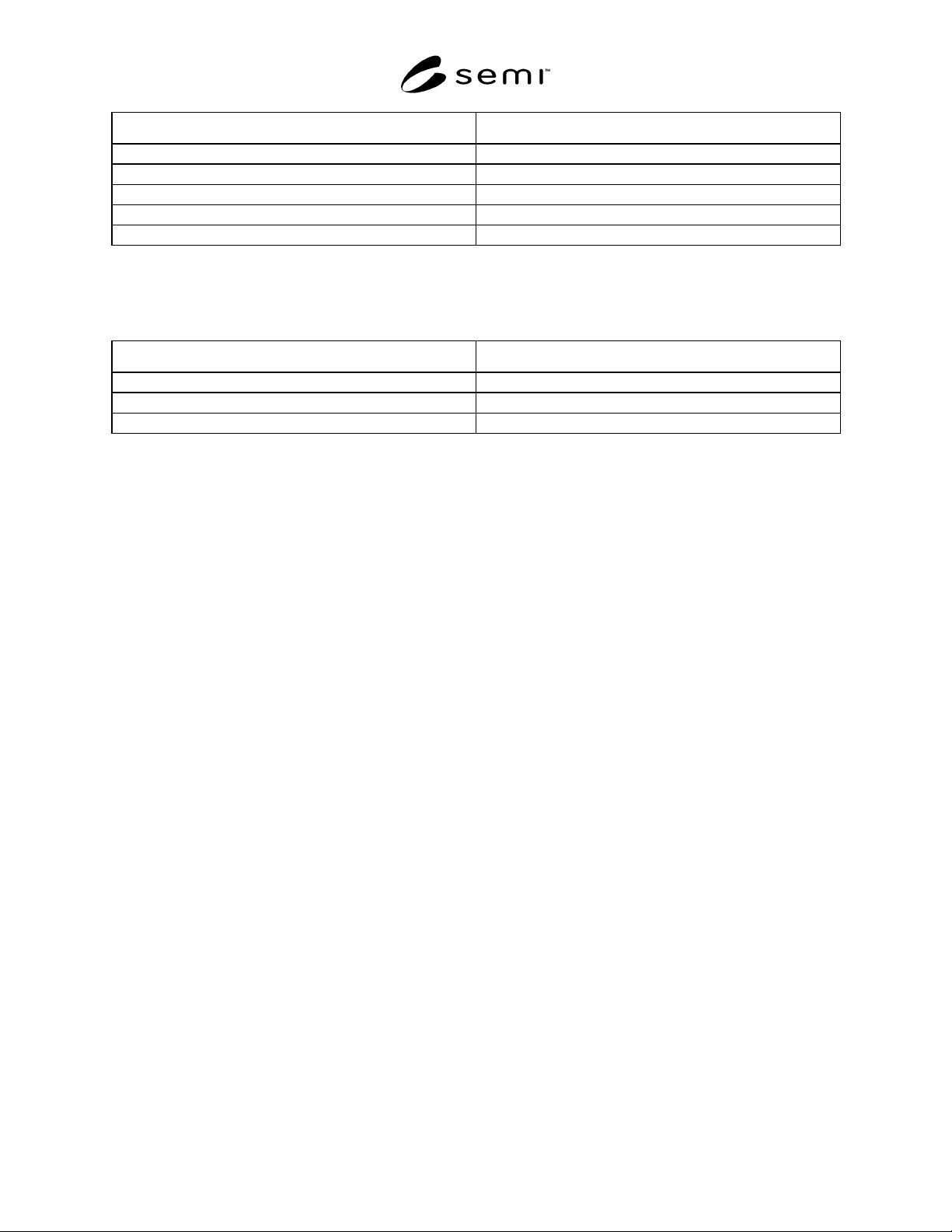
Variable Name Notes
UnitCountInt
MediaCount
MediaCountInterval
MediaID
OperatorID
8.5.4 Units Ready Report — The table below contains variables that must be available and reported when units are
ready to be processed (i.e. at load complete).
Table 9 Required Variables at Load Complete
Variable Name Notes
ProcessSiteLoaded Site loaded status
ProcessSiteStatus List of sites that are available
ProcessSiteCount Total process site count
9 Process Program Management
9.1 Process Program Requirements
9.1.1 The HSEM requires that the capability of process
program management be fully supported for this class
of equipment. The HSEM also requires that the process
program have a structure that enables the user to build
process programs with default conditions that can be
overridden for a run. The concepts of process program
structure and process program variable parameters are
discussed in the following sections. The HSEM also
requires the following:
• Minimum, maximum, and default parameter values
must be defined for all process programs.
• Verification will occur when a process program is
downloaded to the equipment; the program syntax
must be verified by the equipment manufacturer.
• Parameter validation will occur when a process
program is downloaded. Parameters must be type
and range checked.
• Equipment should provide the functionality to
manually or interactively modify the parameters set
in the process program.
• An error message must be generated from the
handler if the process program parameters are
outside the range of the machine calibration.
9.2 Process Program Structure
9.2.1 A handler process program must contain the
following information:
• Machine-specific configuration parameters,
• Process-Site-specific information section,
• Media-Type-specific information section, and
• Unit (Unit/Package) information section.
9.2.2 When combined, this information constitutes a
complete process program. It is emphasized that the
HSEM does not enforce the exact format and data type
of each section. However, it does provide direction as
to what each section should consist of.
9.2.3 Machine-Specific Configuration Parameters —
Each brand or type of handler may have one or more
machine-specific configuration parameters. Examples
of such parameters would be input configuration,
number of process-sites, and output configuration. Even
though they are supplier-specific, these parameters
nevertheless play a vital role in the overall generation
or creation of a process program. Since the machine-
specific parameters can differ from one equipment
manufacturer to another, the HSEM does not specify
the exact number, data types, and format of these
parameters. These details are left to the sole discretion
of the equipment manufacturer.
9.2.3.1 In addition, handler process program must
support user defined mapping of logical test bin
categories that are specific to test recipes and test
equipment to handler sort categories. The mapping
must be easy to define and flexible allowing ranges to
be specified. Logical bin categories can range from 1–
9999.
9.2.4 Process-Site-Specific Information — This
process-site-specific section contains information
necessary for the configuration and execution of the
various process-sites configured on the equipment.
Each equipment may contain different process-site
configurations. Since these configurations will differ,
the HSEM does not specify the exact number, data

SEMI E123-0703 © SEMI 2003 12
types, and format of these parameters. HSEM does
recommend a minimum list of data items for the
common handler process-sites. These include:
9.2.4.1 Thermal Conditioning Site Parameters
• Temperature Set Point
• Upper-Temp Guardband Set Point
• Lower-Temp Guardband Set Point
• Soak Time
• Test-Site Temp
9.2.4.2 Test-Site Parameters
• Device Pick Up/Place
• Speed of Device Pick Up/Place
• Device Insertion/Retraction
• Speed of Device Insertion/Retraction
• Speed of Index Mechanism
• Insertion/Place Force/Stroke
9.2.4.3 Lead Condition Site Parameters
• Device Pick Up/Place
• Speed of Device Pick Up/Place
• Speed of Insertion
• Insertion Force/Stroke
9.2.4.4 Sort Sites Parameters
• Device Pick Up/Place
• Speed of Device Pick Up/Place
• Device Index
• Insertion Force/Stroke
• Sort Category Set
• Sort Category – Full/Empty/Partial
• Sort Media – In place or empty.
9.2.5 Unit/Device-Specific Information — The
unit/device-specific section contains information
necessary for the configuration and execution of the
specific units to be handled by the equipment. HSEM
requires a minimum list of data items be available to
determine package dimensions, terminal dimensions,
package height, and coplanarity.
9.2.6 Media-Type-Specific Information — The media-
type-specific information section contains information
necessary for the configuration and execution of the
specific media type in use on the equipment. HSEM
requires a minimum list of data items be available to
determine row/column count, X/Y distance to a cell,
device height in tray, media height, and X/Y pitch.
9.3 Methods of Process Program Creation — The
method by which an equipment manufacturer creates a
process program may be unique to that manufacturer.
However, it is required that the customer at least be
given both of the following options for the creation of a
process program.
9.3.1 Off-Line Development — Using this method, the
customer is given a set of software tools (process
program compilers, decompilers, and debuggers) that
enables him/her to generate or create a process program
using the above mentioned information (flow,
parameter, functional test, etc.). The newly generated
process program then is downloaded onto a specific
handler, verified, and is now ready to be selected and
executed locally by the operator or remotely by the host
computer. If this process is used, the supplied software
tools should closely mimic or simulate a handler so that
a user can create a complete process program. In many
situations, minor adjustments may be needed to the
process program on the equipment before it is
completely ready for execution.
9.3.2 On-Line Development — The second option is to
enable the user to download the above-mentioned
information (tables or files) onto the equipment and
create the actual process program on the equipment
itself.
10 Remote Commands
10.1 The purpose of this section is to identify remote
commands, command parameters, and valid commands
versus states in the processing state models.
10.2 Requirements
• All the remote commands defined by HSEM are
required.
• The alphanumeric strings defined by HSEM for
remote commands and command parameters are
required.
• If additional remote commands are supported, then
the “Remote Command Versus Valid States”
matrix must be generated for these additional
commands. Place an “X” in the table for each state
in which a given command is valid.
SEMI E123-0703 © SEMI 2003 13
10.3 Remote Command Descriptions
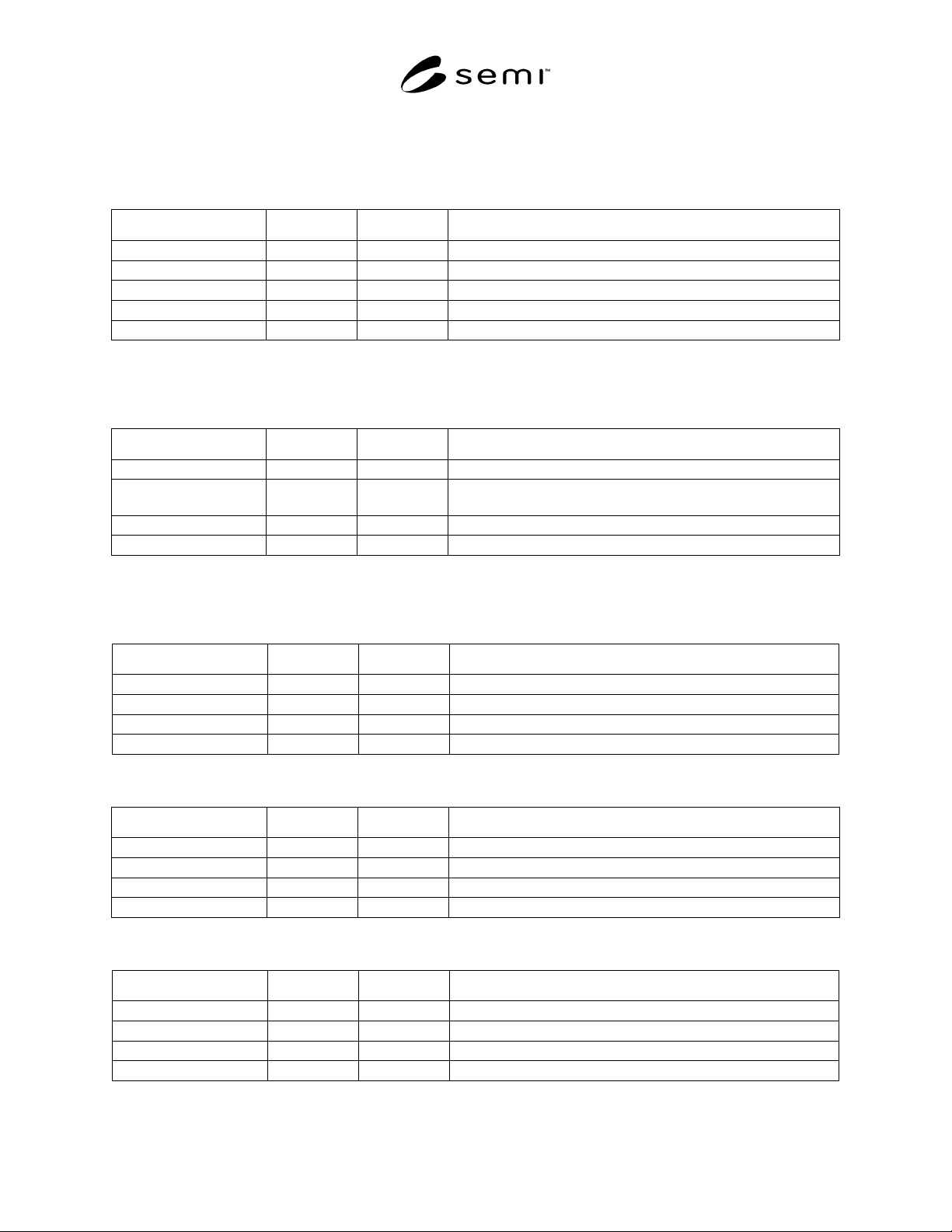
10.3.1 ABORT — This command terminates the current processing. ABORT makes no guarantee about completion
of the current unit. Levels of ABORT may be specified by selecting a particular process site or the equipment itself.
“Cleanup” removes all material that belongs to the lot and then the equipment enters the aborting state.
Parameter Req/Ind Rsp/Cnf Comment
RemoteCommand M “ABORT”
ProcessSiteID C - ID of handler process site.
Cleanup C -
Ack - M Response acknowledge.
Status - C Error code and Error text if any
10.3.2 BIN-UNITS — This command instructs the handler to start unloading the units from process sites and
transfer to output locations. The required bin list parameter combined with the currently loaded mapping of bin
values to output locations will tell handler how to disposition the units.
Parameter Req/Ind Rsp/Cnf Comment
RemoteCommand M - “BIN-UNITS”
Bins M - Bin results of current processed units, one bin value per test site.
Bin values for disabled or empty sites are ignored.
Ack - M Response acknowledge.
Status - C Error code and Error text if any.
10.3.3 BREAK-CONTACT — This command instructs the handler to break contact on the unit(s) at the specified
site(s). This allows user to remove parts from socket(s), replace socket(s) if applicable, perform testhead calibration
etc.
Parameter Req/Ind Rsp/Cnf Comment
RemoteCommand M - “BREAK-CONTACT”
Sites M - List of sites to break contact. Empty list implies all sites.
Ack - M Response acknowledge.
Status - C Error code and Error text if any.
10.3.4 DISABLE-SITE — This command instructs handler to disable sites from been used for processing.
Parameter Req/Ind Rsp/Cnf Comment
RemoteCommand M - “DISABLE_SITE”
Sites M - List of sites to disable. Empty list implies all sites.
Ack - M Response acknowledge.
Status - C Error code and Error text if any.
10.3.5 ENABLE-SITE — This command instructs the handler to enable sites for processing.
Parameter Req/Ind Rsp/Cnf Comment
RemoteCommand M - “ENABLE-SITE”
Sites M - List of sites to enable. Empty list implies all sites.
Ack - M Response acknowledge.
Status - C Error code and Error text if any.