semi合集-English.pdf - 第3108页
SEMI E125-0305 © SEMI 2003, 2005 16 10.4.5 Parameter Association Definition Table Table 24 Parameter Association Definition Association Role Name Definition Comments constraints A description of any restrictions ass ocia…
SEMI E125-0305 © SEMI 2003, 2005 15
10.4 Parameters
10.4.1 Parameters can represent any concept that can be described by any of the primitive or composite types
described in Section 10.5 . A parameter can generally be thought of as a named, typed field that has a specific
meaning, utility or other information value. Examples are process control variables, equipment configuration
settings, measurement results, wafer maps, data variables, etc. Parameters can only be defined by an equipment
node (Section 10.3 ), a SEMI ObjType (Section 10.9 ), or an exception (Section 10.7 ).
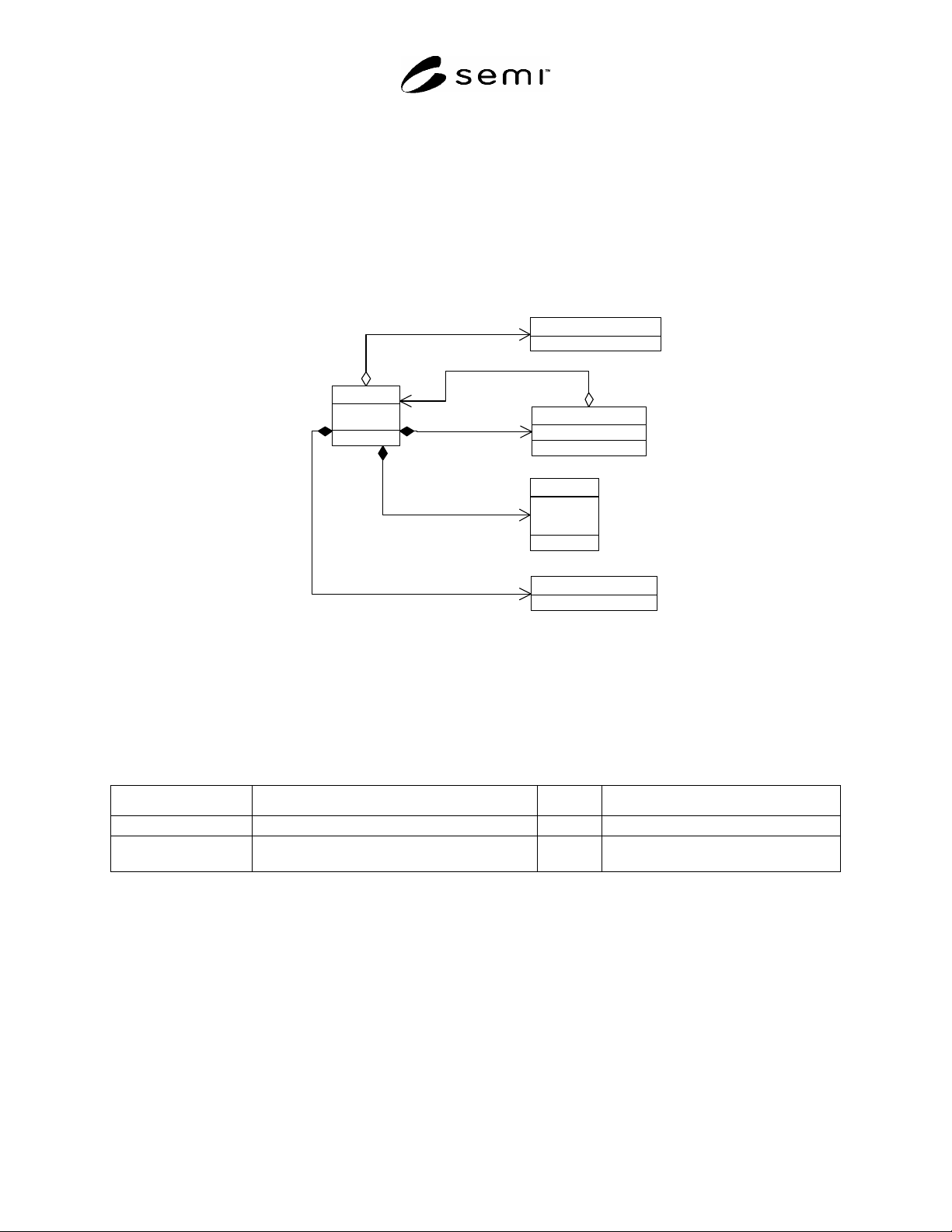
10.4.2 Figure 9 shows how to describe named, typed parameters with units, constraints, and associations with other
parameters. Type and units information is provided through the ParameterTypeDefinition referred to by the
DefinedType class. ParameterTypeDefinition is described in Section 10.5.1 .
description
AssociatedParameter
name
desc ription
defin itio n
Constraint
name
des cription
Parameter
1
ass ociatedParamet ers
0..*
cons traints1
0.. *
typeInformation 0..*
1
ParameterTypeDefini tion
paramet er 0..*
1
ParameterCl assi fication
classification
1
1
Figure 9
Describing Typed Parameters
10.4.3 Suppliers shall provide a model of those Parameters for which it is necessary and practical to facilitate (at
least) utilization tracking, process control, and technical support objectives.
10.4.4 Parameter Attribute Definition Table
Table 23 Parameter Attribute Definition
Attribute Name Definition Required Form
name The name of the parameter. Y Text.
description A human-readable description of the purpose or
usage of the Parameter.
Y Text.
SEMI E125-0305 © SEMI 2003, 2005 16
10.4.5 Parameter Association Definition Table
Table 24 Parameter Association Definition
Association Role Name Definition Comments
constraints A description of any restrictions associated with
this parameter.
List of structured data, of type Constraint,
described in Table 26 . Logical AND semantics
apply between constraints if more than one is
described.
associatedParameters List of other parameters in the system that are
related to this parameter.
List of structured data, of type
AssociatedParameter, described in Section 10.4.7
.
typeInformation Refers to a type definition that describes the type
and units of this parameter.
One and only one element of type
ParameterTypeDefinition.
classification Describes the nature of the Parameter One and only one element of any type derived
from ParameterClassification, described in
Section 10.4.11.2 .
10.4.6 Each parameter can provide a list of zero or more associated parameters, and a human-readable description
of the meaning of the relationship.
10.4.7 AssociatedParameter — This class can be used to describe a generic association with another parameter
anywhere in the equipment hierarchy. If such an association is created, this indicates that the Parameter being
defined is related in some way to the parameter referenced by this class. The meaning of the relationship is
documented in the description attribute of the AssociatedParameter class. More specific meaning can be attributed
to an associated Parameter via the classification types described in Section 10.4.11 .
10.4.7.1 AssociatedParameter Attribute Definition Table
Table 25 AssociatedParameter Attribute Definition
Attribute Name Definition Required Form
description Description of the relationship between the
defined parameter and the parameter identified
by this association.
Y Text.
10.4.7.2 AssociatedParameter Association Definition Table
Table 26 AssociatedParameter Association Definition
Association Role Name Definition Comments
associatedParameters A list of parameters that are associated with this
parameter.
Unordered list of structured data, of type
Parameter.
10.4.8 Constraint — Represents a constraint associated with this parameter. A constraint can be used to describe
limitations on the valid values of a parameter, the rate at which the parameter can be collected for off-tool reporting,
or any other similar restriction on the value or usage of the parameter.
10.4.8.1 Constraint Attribute Definition Table
Table 27 Constraint Attribute Definition
Attribute Name Definition Required Form
name The name of the constraint. Y Text.
description A description of the purpose or meaning of the
constraint.
Y Text.
definition The definition of the constraint. Y Text, formatted according to Section
10.4.9 .

SEMI E125-0305 © SEMI 2003, 2005 17
10.4.9 Constraint Definition
10.4.9.1 Parameter constraints describe restrictions on the valid values of Parameters. A constraint is documented
as a propositional formula, which evaluates TRUE with valid parameter values. Relational algebra defines a rich
syntax for propositional formulas; however, this syntax is not commonly used for commercial applications.
Standard Query Language (SQL) is a well-documented commercial application of relational algebra well suited to
this application. Specifically, the syntax of the WHERE clause (of the SQL SELECT statement) is suitable for
describing constraints on Parameter values. The WHERE clause of the SQL SELECT statement is a propositional-
expression that consists of one or more comparisons of values with constants. It has the following form.
WHERE propositional-expression [nested-propositional-expression];
For the purposes of this specification, a subset of the SQL WHERE syntax (the complete syntax is discussed in
Related Information, Section R2-1) shall be used to define constraints. Specifically, the IN, BETWEEN, and IS
operators are not supported in constraint definitions.
10.4.9.2 For example, a Parameter named “TemperatureSetpoint” that represents a temperature set point that may
not be less than 100 or greater than 200 may be described using the following SQL WHERE clause.
WHERE TemperatureSetpoint > 100 AND TemperatureSetpoint < 200;
10.4.9.3 Describing Reporting Frequency Constraints
10.4.9.3.1 To describe the rates at which a given Parameter can be reported for data acquisition, a specific
convention using the subset of the SQL WHERE clause described in Section 10.4.9.1 shall be used. For Parameters
where this is a consideration, a constraint must be provided named “ReportingPeriod”. The definition of the
ReportingPeriod constraint shall take the following form:
WHERE parameterName.ReportingPeriod comparison;
10.4.9.3.2 Here, parameterName is the name of the Parameter to which the constraint applies, and comparison is
any legal combination of terms, operators, or constants necessary to describe the constraint on valid reporting
periods for the Parameter. The time division for any constants that refer to the reporting period shall be in seconds.
If the constraint definition is used to express an integer multiple of a fundamental reporting period, the variable ‘n’
shall be used to represent the multiplier.
10.4.9.3.3 For example, the constraint definition below specifies that the supported reporting period for
“Temperature” is any continuous value between 0.01 seconds and 60 seconds. Additional examples are provided in
Related Information, Section R4-1.
WHERE Temperature.ReportingPeriod >.01 AND Temperature.ReportingPeriod < 60;
10.4.10 Describing SEMI Standard Variables and/or Attributes
10.4.10.1 If the supplier is using a Parameter to represent variables or attributes that have been defined in a SEMI
standard, the name attribute of the Parameter class shall be equal to the name of the variable or attribute exactly as it
is spelled, using the same case convention as found in the corresponding standard. The type mapping described in
Section 10.5.4 shall determine the type assigned to the Parameter.