semi合集-English.pdf - 第3125页
SEMI E125-0305 © SEMI 2003, 2005 33 10.8.5 Event — This class defines a n event that the equipm ent ge nerates as a resu lt of a transition between any two states contained within the sam e StateMachine, incl uding subst…
SEMI E125-0305 © SEMI 2003, 2005 32
10.8.4 Transition — This class represents a transition between any two states contained within the same
StateMachine, including substates. Each transition references one “source”, or “from” state, and one “target”, or
“to” state, representing the originating and ending states. There must be one Transition defined for all possible state
transitions in the StateMachine instance. History or conditional transitions are described by providing as many
transitions as there are possible conditional or history-based outcomes. True Harel history transitions can be
accommodated by mapping all such transitions to a single event. The ‘description’ attribute can be used to provide a
human-readable description of the condition under which the transition takes place.
10.8.4.1 Transition Attribute Definition Table
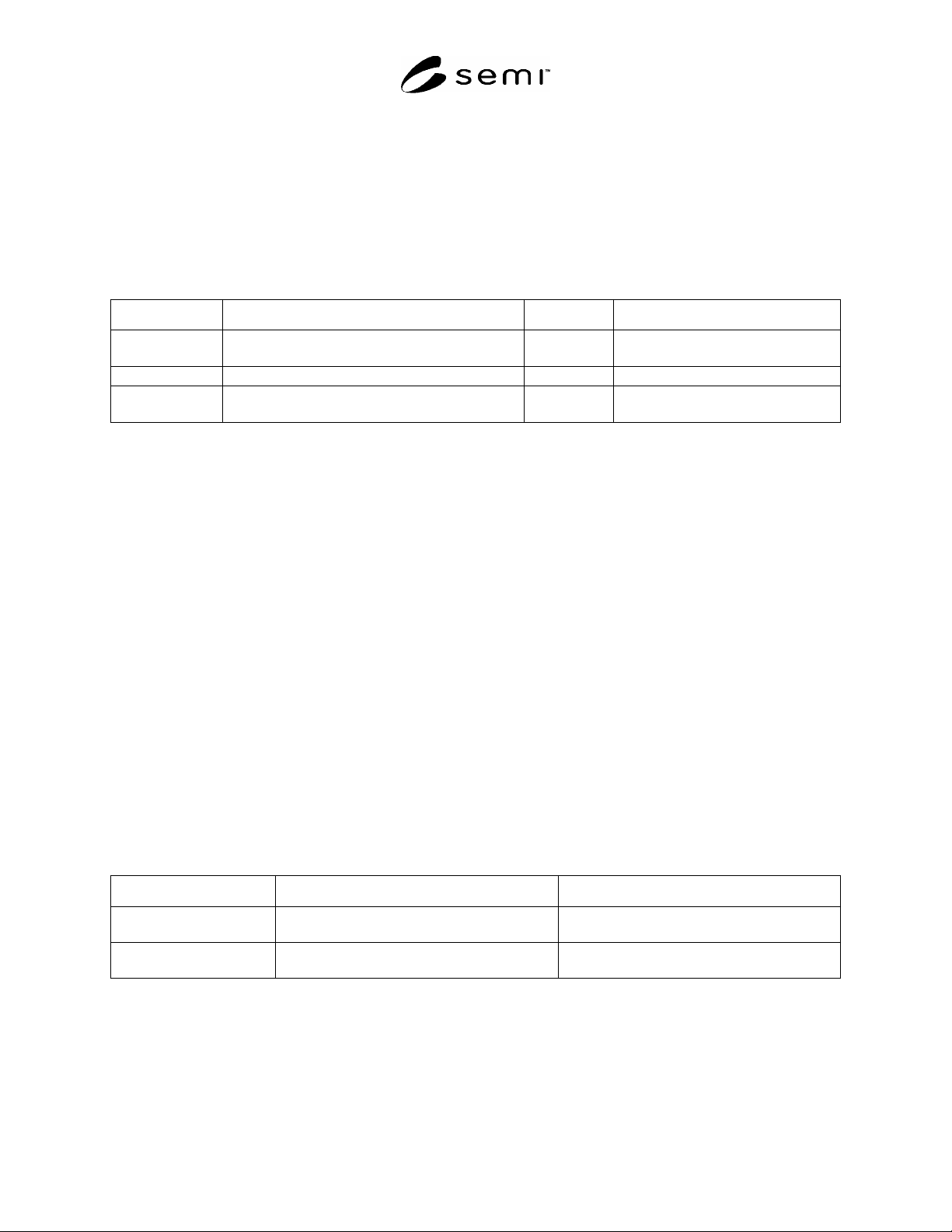
Table 55 Transition Attribute Definition
Attribute Name Definition Required Form
id A unique identifier for this transition. Y Text, unique across all transitions in
this StateMachine.
name A human-readable name for this transition. N Text.
description A description of the meaning or purpose of this
transition.
Y Text.
10.8.4.2 SEMI Standard Transitions
10.8.4.2.1 name — If the Transition represents a SEMI standard transition, the value of this attribute shall be a
URN of the form: “urn:semi-org:transition:<standard id>:<state machine>:<transition number>:<transition name>”.
10.8.4.2.1.1 <standard id> shall be a string formatted according to the SEMI standard form for representing a
specific version of a standard document (for example, “E87-1101”), no spaces, upper-case alphanumeric characters
and hyphens only.
10.8.4.2.1.2 <state machine> shall be the name of the state machine in which the transition is defined. This field
shall be equal to the state machine name as it appears in the standard, with each word in the name concatenated.
The state machine name shall use the camel case capitalization convention (that is, only the first letter of each word
in the state machine name is capitalized). For example, the state machine name for the SEMI E87 LOAD PORT
TRANSFER state machine would be “LoadPortTransfer”.
10.8.4.2.1.3 <transition number> shall be a string representation of the transition number as it appears in the state
machine definition.
10.8.4.2.1.4 <transition name> shall be formed by concatenating the names of the source and target states for the
<transition number>, separated by a hyphen. The state names shall have no spaces, use alphanumeric characters
only, and use camel case capitalization. If either of these states is an “initial” or “final” state, the words “Initial” or
“Final”, respectively, shall be used for the state name. For example, the event name for the E87 load port transfer
history transition from the initial state to “OUT OF SERVICE” would be “Initial-OutOfService”.
10.8.4.3 Transition Association Definition Table
Table 56 Transition Association Definition
Association Role Name Definition Comments
source The state of origin for this transition. References one and only one state within this
StateMachine.
target The transitioned-to state. References one and only one state within this
StateMachine.
SEMI E125-0305 © SEMI 2003, 2005 33
10.8.5 Event — This class defines an event that the equipment generates as a result of a transition between any two
states contained within the same StateMachine, including substates. Each Event can reference one or more
transitions. This is in support of systems or standards that use the same event id to communicate different
transitions. Such implementations typically make additional data available with the event occurrence for
distinguishing between the different transitions. Note that it is not possible for two different events to be defined for
the same transition.
10.8.6 State Machine Instances
10.8.6.1 State machines are intended to be defined once and re-used wherever there is an equipment component or
other entity that can generate the same set of events defined by that state machine. However, each entity that
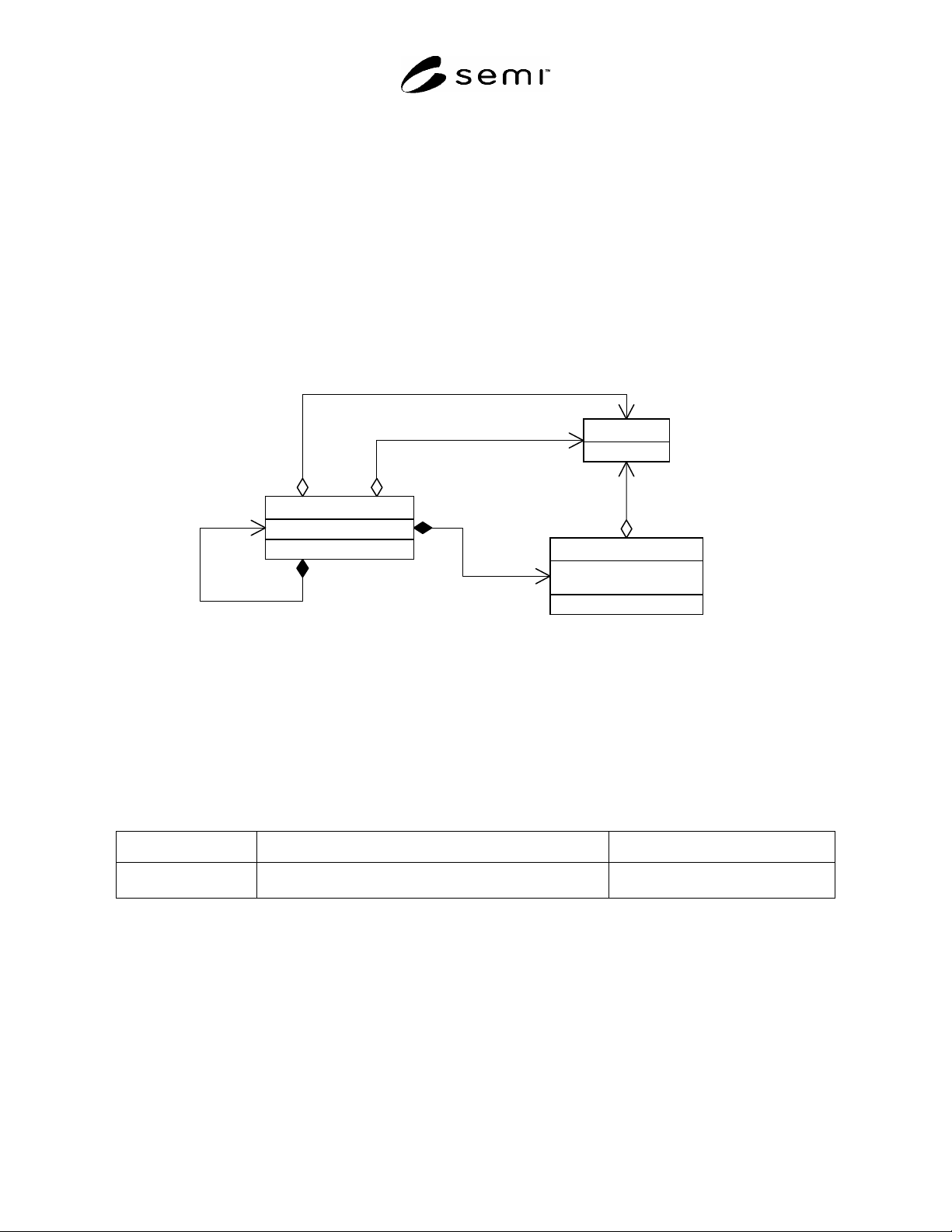
supports a given state machine may report different data for those events. Figure 20 shows the classes that are used
to describe the Parameters available for reporting with the events from a given state machine supported by a given
entity.
Figure 20
Describing State Machine Instances
10.8.6.2 StateMachineInstance — This class is used to declare that an equipment node or other entity supports a
specific state machine described in the metadata. It provides a way to describe the data such entities provide with
the events from that state machine as well as the Parameters used to determine the current state of the entity that
supports the state machine. The class can be used to describe the events and data available from top-level state
machines as well as any nested state machines defined within the top level state machine.
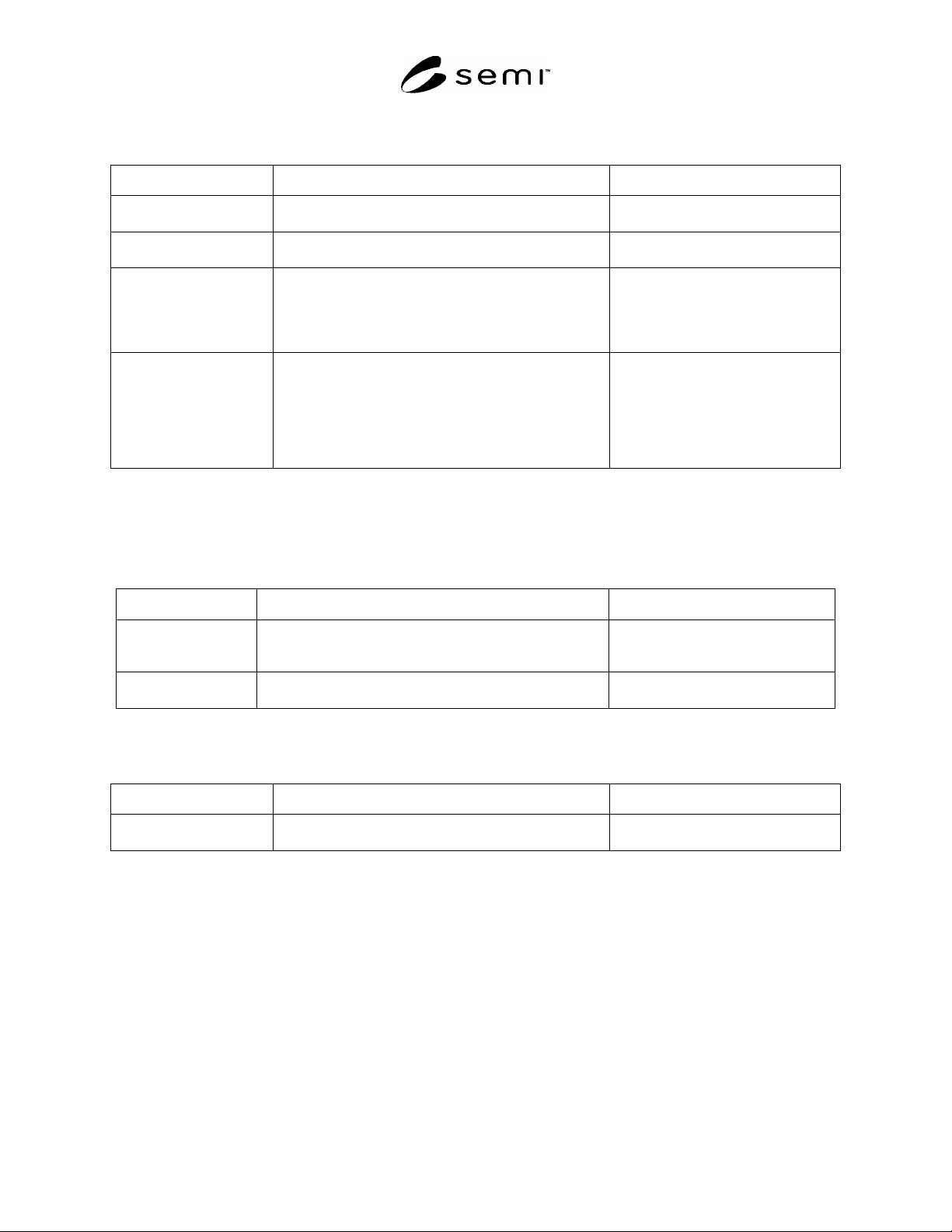
10.8.6.3 StateMachineInstance Attribute Definition Table
Table 57 StateMachineInstance Attribute Definition
Attribute Name Definition Form
stateMachineId Identifies a top level or nested state machine. Text, equal to a valid ‘id’ attribute of
the StateMachine class.
eventId
nestedStateMachines
0..*
1
stateMachineId
StateMachineInstance
1
1
1
eventMaps
1..*
description
EventToParameterMap
0..*
0..*availableParameters
0..1
currentStateName
0..1 previousStateName
Parameter
SEMI E125-0305 © SEMI 2003, 2005 34
10.8.6.4 StateMachineInstance Association Definition Table
Table 58 StateMachineInstance Association Definition
Association Role Name Definition Comments
currentStateName The Parameter, if any, that can be accessed to determine
the current state within the identified StateMachine.
Zero or one element of type Parameter,
described in Section 10.4 .
previousStateName The Parameter, if any, that can be accessed to determine
the previous state within the identified StateMachine.
Zero or one element of type Parameter,
described in Section 10.4 .
eventMaps The events defined by this StateMachine, and the
Parameters that are available for reporting with those
events.
One or more elements of type
EventToParameterMap, described in
Section 10.8.6.5 . There shall be one
such map for each event defined in the
identified StateMachine.
nestedStateMachines Any nested state machines defined within the identified
StateMachine.
One or more elements of type
StateMachineInstance. Although it is
possible to create more, only one level
of nesting of the StateMachineInstance
class is required to describe arbitrary
levels of nesting described by the
referenced top-level StateMachine.
10.8.6.5 EventToParameterMap — This class is used to provide a list of the Parameters available for a specific
event from a given StateMachine.
10.8.6.6 EventToParameterMap Attribute Definition Table
Table 59 EventToParameterMap Attribute Definition
Attribute Name Definition Form
eventId The StateMachine Event for which Parameters are available Text, must be equal to a valid ‘id’
attribute of the Event class within a
StateMachine.
description Provides any description necessary for humans to understand
the parameters that are available for reporting with the event.
Text.
10.8.6.7 EventToParameterMap Association Definition Table
Table 60 EventToParameterMap Association Definition
Association Role Name Definition Comments
availableParameters The Parameters that are available for reporting with this
event.
Structured data of type Parameter,
described in Section 10.4.
10.8.6.7.1 availableParameters — All transient Parameters (see Section 10.4.11) that are available for reporting
with an event generated by the entity providing the EventToParameter map shall be provided in this list. It is not
necessary to list any non-transient Parameters via this association. Non-transient Parameters are implicitly available
for reporting with any event.
10.8.6.8 Events may only be defined within the context of a Transition between two States within a StateMachine.
All events that the equipment can generate must have a StateMachine defined for them. It is not necessary to define
multiple StateMachines for a situation in which the same kind of events are generated by multiple sources.