semi合集-English.pdf - 第3187页
SEMI E125.1-0305 © SEMI 2005 41 Sessions requests revision notification , the equipment shall only enable n otifications for that specific session . The equipment shall not noti f y oth er Sessions tha t have not enabled…
SEMI E125.1-0305 © SEMI 2005 40
7.2.15.4 WSDL Message(s)
7.2.15.4.1 See the message definitions for “E132HeaderMessage”, “GetLatestRevisionRequestMessage”, and
“GetLatestRevisionResponseMessage” in E125-1-V0305-EqpMetadataMgr-PortType.wsdl. Key information is
shown for convenience in the following table.
Table 79 EquipmentMetadataManager Binding
Message Name
Schema
Element Name
E132HeaderMessage auth:E132Header
GetLatestRevisionRequestMessage esd:GetLatestRevisionRequest
GetLatestRevisionResponseMessage esd:GetLatestRevisionResponse
7.2.15.5 XML Schema Types
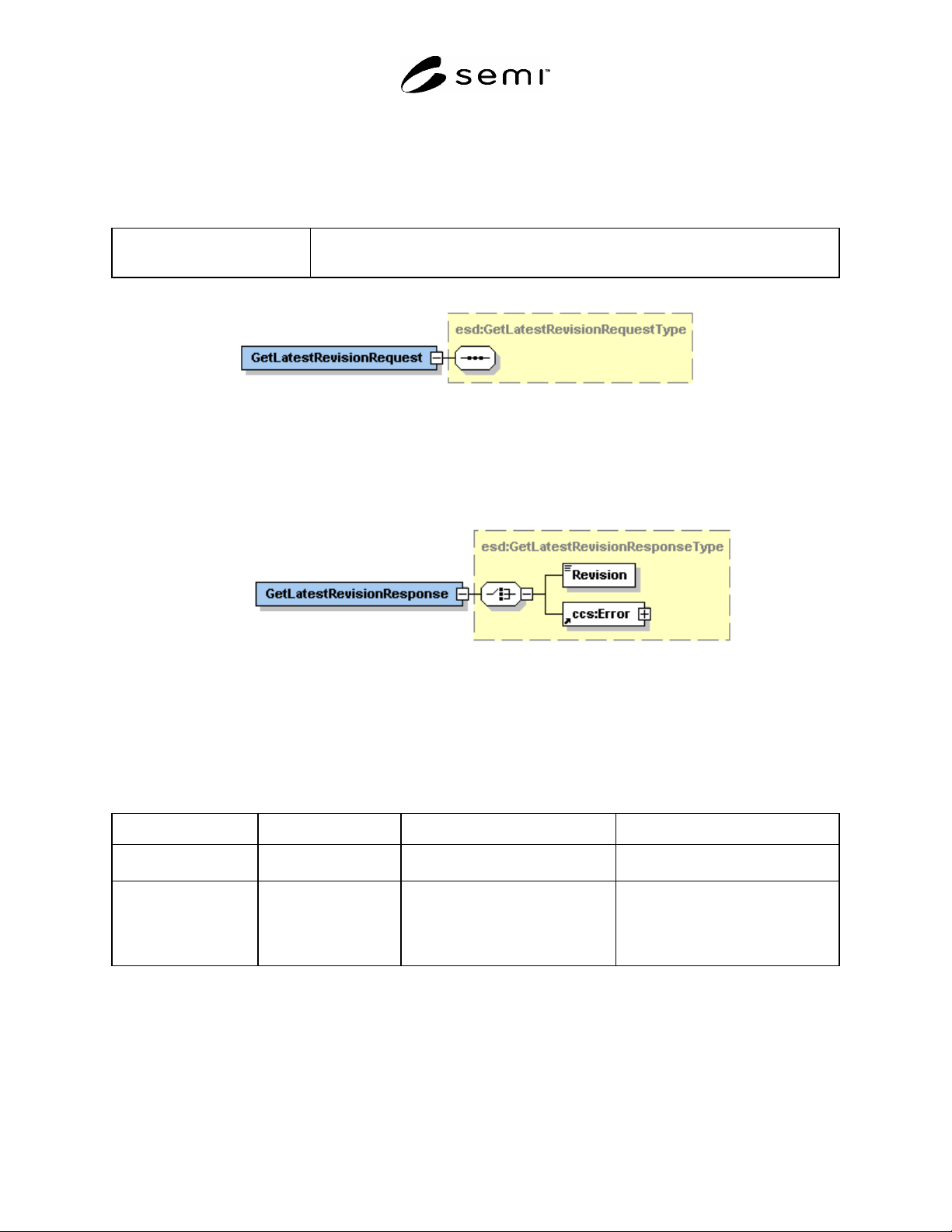
Figure 29
GetLatestRevisionRequest
7.2.15.5.1 GetLatestRevisionRequest — This global element acts as a top-level container entity representing the
SOAP body of a GetLatestRevision request. As defined in SEMI E125, this operation has no input arguments, so
the element has no contents.
Figure 30
GetLatestRevisionResponse Global Element
7.2.15.5.2 GetLatestRevisionResponse — This global element acts as a top-level container entity representing the
SOAP body of the response to an SEMI E125 GetLatestRevision request. It contains either an element named
“Revision” of built-in type “xsd:dateTime” or an element named “Error” of complexType “ErrorType”, defined in
SEMI E138.
Table 80 Translation Table for Output Arguments for the GetLatestRevision Operation
Argument Name Format XML Element or Attribute XML Name/Type
revision Structured data of type
MetadataRevision
element Revision: xsd:dateTime
error Structured data, of type
Error, defined in the
SEMI Specification for
Semicondoctor
Common Components
Element Error: ccs:ErrorType
There are no SEMI E125-defined error
codes for this operation.
7.2.16 NotifyOnRevisions
7.2.16.1 This section is provisional, pending approval of SEMI E132.1 and SEMI E138.
7.2.16.2 Application of SEMI E132 Sessions
7.2.16.3 The equipment shall maintain revision notification settings on a per-Session basis. For example, the same
SEMI E132 Principal may establish one or more SEMI E132 Sessions on the equipment. If only one of those
SEMI E125.1-0305 © SEMI 2005 41
Sessions requests revision notification, the equipment shall only enable notifications for that specific session. The
equipment shall not notify other Sessions that have not enabled notification. As described in ¶7.3.1.2, the equipment
shall use the URL provided with the HTTPEndpoint information provided with the SEMI E132 EstablishSession
request to send all SEMI E125 notifications.
7.2.16.4 SEMI E125 specifies that the equipment shall disable notifications if it detects that a client is no longer
reachable. Because this specification requires clients to establish a SEMI E132 Session in order to honor SEMI
E125 requests. Clients (SEMI E132 Principals) are considered reachable if and only if their SEMI E132 Session has
not been closed (that is, the Session is in either the “Established” or “Frozen” state), as defined by the SEMI E132
Session State Model. If the equipment or the client terminates an SEMI E132 Session for any reason (causes the
Session to close), notifications for that Session shall be automatically disabled by the equipment. That client will be
required to re-establish an SEMI E132 Session and re-send a NotifyOnRevisions request in order to re-establish
revision notifications. If the client’s Session is placed in the “Frozen” state, the equipment shall retain that Session’s
notification settings in non-volatile memory, and resume notifications when the Session returns to the “Established”
state.
7.2.16.5 WSDL Operation Binding
7.2.16.5.1 See the operation binding for “NotifyOnRevisions” in E125-1-V0305-EqpMetadataMgr-Binding.wsdl.
Key information is shown for convenience in the following table.
Table 81 NotifyOnRevisions Operation Binding
SOAPAction
urn:semi-org:ws.E125-1.V0305.esdMetaEqp-
binding:NotifyOnRevisions
Input Headers (WSDL Message, Required) E132HeaderMessage, required
Output Headers (WSDL Message, Required) E132HeaderMessage, required
7.2.16.6 WSDL PortType Operation
7.2.16.6.1 See the portType operation definition for “NotifyOnRevisions” in E125-1-V0305-EqpMetadataMgr-
PortType.wsdl. Key information is shown for convenience in the following table.
Table 82 NotifyOnRevisions PortType Operation
Input Message Name NotifyOnRevisionsRequestMessage
Output Message Name NotifyOnRevisionsResponseMessage
7.2.16.7 WSDL Message(s)
7.2.16.7.1 See the message definitions for “E132HeaderMessage”, “GetLatestRevisionRequestMessage”, and
“GetLatestRevisionResponseMessage” in E125-1-V0305-EqpMetadataMgr-PortType.wsdl. Key information is
shown for convenience in the following table.
Table 83 EquipmentMetadataManager Binding
Message Name
Schema
Element Name
E132HeaderMessage auth:E132Header
NotifyOnRevisionsRequestMessage esd:NotifyOnRevisionsRequest
NotifyOnRevisionsResponseMessage esd:NotifyOnRevisionsResponse
7.2.16.8 XML Schema Types
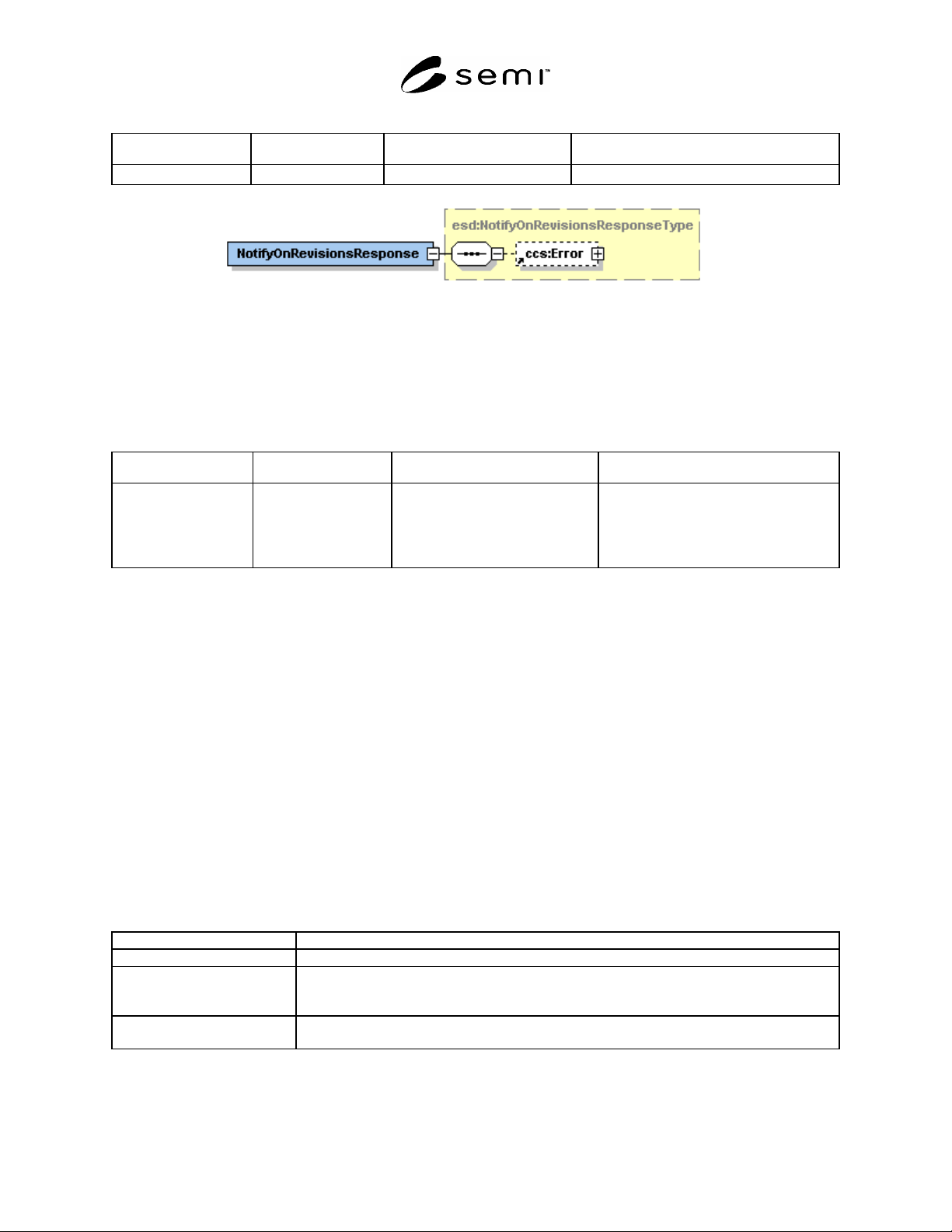
Figure 31
NotifyOnRevisionsRequest Global Element
7.2.16.8.1 NotifyOnRevisionsRequest — This global element acts as a top-level container entity representing the
SOAP body of a GetLatestRevision request. As defined in SEMI E125, this operation has one input argument: a
Boolean indicating the client’s notification preference. This argument is modeled as a single attribute of the
NotifyOnRevisionsRequest element.
SEMI E125.1-0305 © SEMI 2005 42
Table 84 Translation Table for Input Arguments for the NotifyOnRevisions Operation
Argument Name Format XML Element or Attribute XML Name/Type
notification boolean attribute enable: xsd:boolean
Figure 32
NotifyOnRevisionsResponse Global Element
7.2.16.8.2 NotifyOnRevisionsResponse — This global element acts as a top-level container entity representing the
SOAP body of the response to an SEMI E125 NotifyOnRevisions request. It contains an optional element named
“Error” of complexType “ErrorType”, defined in SEMI E138. As defined in SEMI E125, this operation returns no
arguments, so there is no other content defined for this response.
Table 85 Translation Table for Output Arguments for the GetUnits Operation
Argument Name Format XML Element or Attribute XML Name/Type
error Structured data, of type
Error, defined in the
SEMI Specification for
Semicondoctor
Common Components
Element Error: ccs:ErrorType
No SEMI E125-specific error codes are
defined for this operation.
7.3 MetadataClient
7.3.1.1 This section is provisional, pending approval of SEMI E132.1 and SEMI E138.
7.3.1.2 Application of SEMI E132 Sessions
7.3.1.3 Operations defined by the SEMI E125 MetadataClient interface shall be exchanged via HTTP and shall not
be exchanged via HTTPS. The equipment shall include a hash of the client’s SEMI E132 session identifier in the
SOAP envelope header provided with the operation using the E132HashHeader element, as specified by
SEMI E132.1
7.3.1.4 The equipment shall only send SEMI E125 notifications to instances of the MetadataClient interface if the
corresponding SEMI E132 Session(s) for that client are in the “Established” state. The equipment shall use the URL
provided with the HTTPEndpoint information included in the SEMI E132 EstablishSession request to send all
SEMI E125 notifications to the MetadataClient interface.
7.3.2 XML Schema and WSDL Files
7.3.2.1 The XML Schema and WSDL defined by this specification for the MetadataClient interface is contained in
the following documents:
Table 86 XML Schema
File Name E125-1-V0305-Schema.xsd
Target Namespace urn:semi-org:xsd.E125-1.V0305.esd
Imported/Referenced
Namespaces
urn:semi-org:xsd.E120-1.V1104.CommonEquipmentModel
urn:semi-org:xsd.CommonComponents.V0305.ccs
http://www.w3.org/2001/XMLSchema
Description
This file defines all of the E125 data types and elements used by both the
EquipmentMetadataManager and MetadataClient interfaces.