semi合集-English.pdf - 第3218页
SEMI E127-0705 © SEMI 2003, 2005 19 12.2.3 Substrate Tr ansfer Stat es 12.2.3.1 ASSIGNED — A substrate transfer op eration, or normal operations (e.g., measurement) or co nditions (e.g., calibration req uired or bein g p…
SEMI E127-0705 © SEMI 2003, 2005 18
12 Substrate Transfer Path Object
12.1 Description
12.1.1 The Substrate Transfer Path object (STPO) manages the spatial envelope used for loading (receiving) and
unloading (sending) a substrate, along with all mechanisms used in effecting a physical transfer. It has one or more
Equipment Substrate Location objects for holding substrates after they are received and before they are sent. Each
Substrate Location can hold exactly one substrate when it is occupied. Substrate and Substrate Location objects are
defined in SEMI E90.
12.1.2 If substrates can be loaded into, and/or unloaded from, more than one substrate location, then each of these
locations shall be represented by a separate STPO object. This allows the Control Client to specify where it intends
to load or unload.
12.1.3 The STPO object allows the IMM to interact with an external substrate handler to transfer substrates to and
from a Substrate Port (a substrate location together with any necessary mechanisms), and also to exchange
properties of the Substrate Object being transferred.
12.1.4 A Substrate Transfer has two required parts, which may occur in either order: the substrate transfer and the
substrate information transfer. The transfer procedure consists of the messages and physical actions necessary to
effect the loading or unloading of a substrate to or from the Substrate Transfer Location. The exchange is not
complete until both parts have been successfully completed.
12.1.5 The minimum information required for processing is SubstrateID. Additional information is used to store as
context data in the IMM Data Table Objects discussed in §13. The method provided for obtaining the additional
information is the same as the method for providing SubstrateID.
12.1.6 The STPO shall provide two ordered lists of the sequence of text micro commands that are needed for
loading and for unloading a substrate to and from the Substrate Transfer Location. The Control Client may obtain
these lists on demand through the service XfrCmdListRequest. These micro commands are to be returned by the
Control Client in the XfrCommand service, one at a time, in the same order given, to effect a load or unload hand-
off. Micro commands are defined by the IMM supplier except for two that are required. Examples of micro
commands are given in the Load and Unload scenarios in ¶12.11. The two required micro commands are “Confirm
presence” and “Confirm Absence”, as specified in ¶12.11.2.3 and ¶12.11.3.3 respectively.
12.2 Object State Model
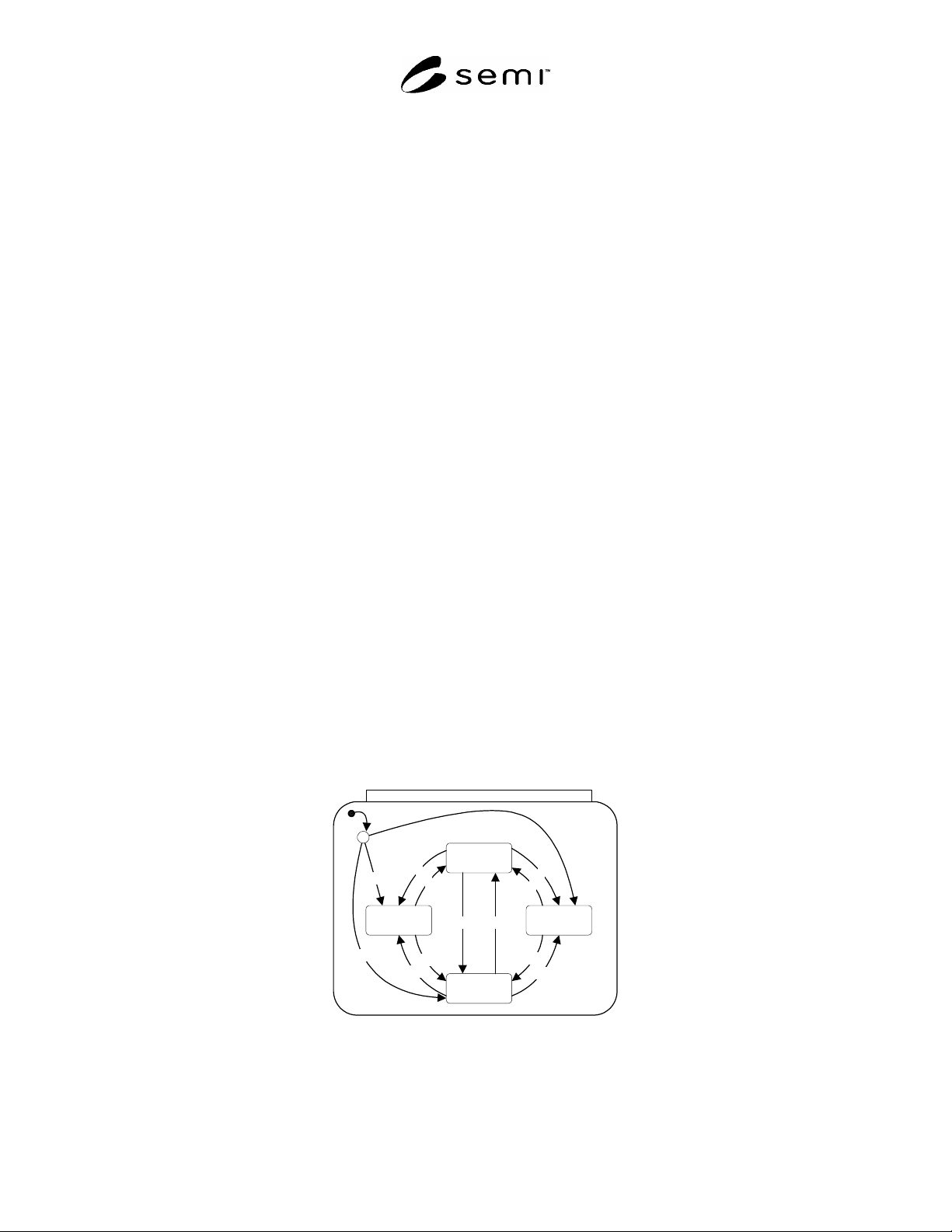
12.2.1 This section defines the Substrate Transfer State Model, which shows the behavior required for coordinating
the loading of a substrate to, and unloading from, the substrate location accessed by an external substrate handling
mechanism.
12.2.2 Figure 4 shows the diagram for the Substrate Transfer Path State Model.
SUBSTRATE TRANSFER PATH
READY TO
LOAD
READY TO
UNLOAD
1
2
ASSIGNED
BLOCKED
10
4
13
6
7
11
5
12
8 9
3
C
Figure 4
Substrate Transfer Path State Model

SEMI E127-0705 © SEMI 2003, 2005 19
12.2.3 Substrate Transfer States
12.2.3.1 ASSIGNED — A substrate transfer operation, or normal operations (e.g., measurement) or conditions (e.g.,
calibration required or being performed) prevent substrate transfers to or from the module.
12.2.3.2 BLOCKED — Abnormal operations (e.g., abort) or conditions (e.g., faults) prevent substrate transfer to or
from the module.
12.2.3.3 READY TO LOAD — A substrate is not present on the Substrate Location, and that location is available to
be loaded with a substrate in this state. This is the only state in which substrate loads may be initiated.
12.2.3.4 READY TO UNLOAD — A substrate is present on the Substrate Location, and the substrate is available to
be unloaded from that location in this state. This is the only state in which substrate unloads may be initiated.
12.2.3.5 SUBSTRATE TRANSFER PATH — The parent state of the Substrate Transfer Path State Model. This state
has four substates, READY TO LOAD, READY TO UNLOAD, ASSIGNED and BLOCKED.
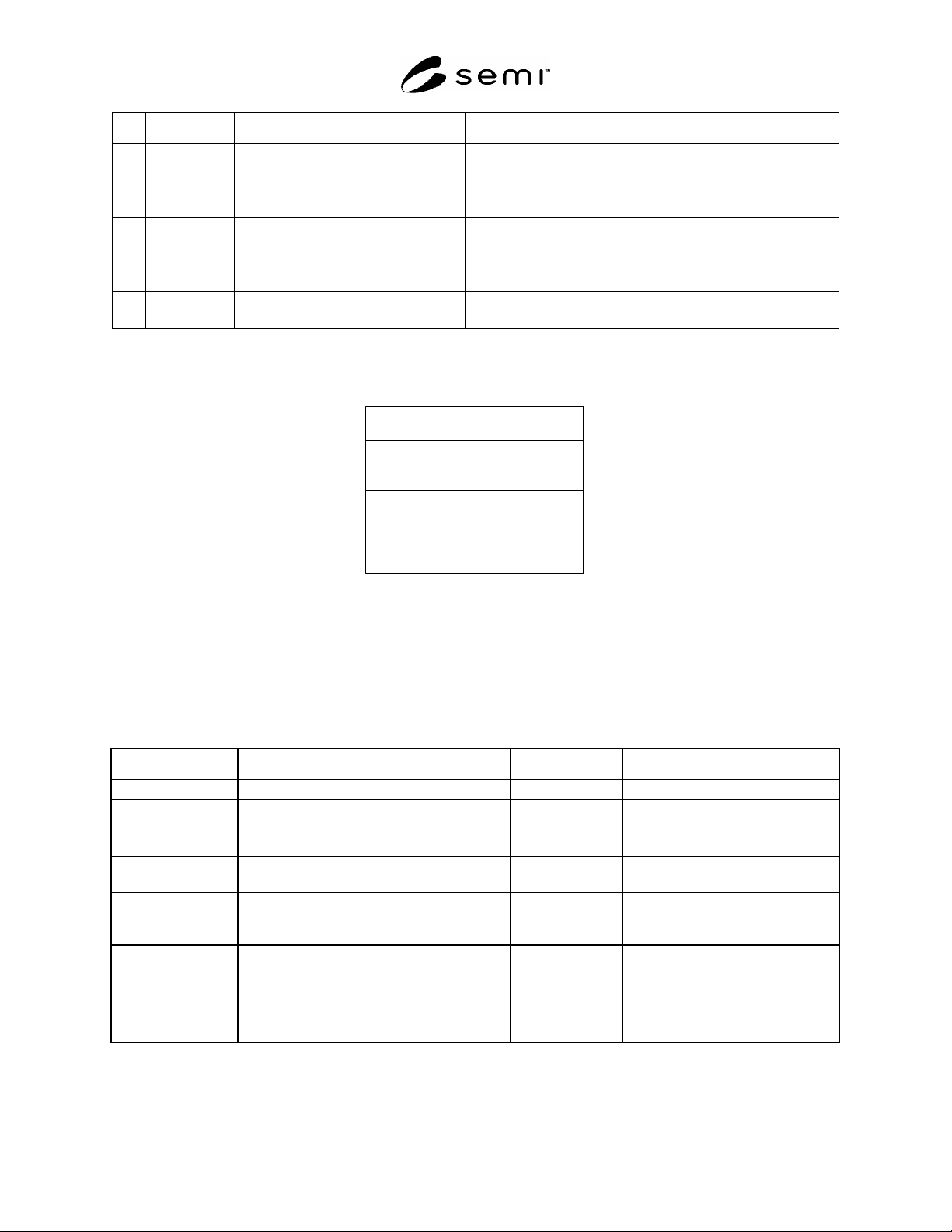
12.2.4 Table 6 defines the transitions of the STPO State Model.
Table 6 Substrate Transfer Path State Model Transitions
# Previous State Trigger New State Comment
1 (no state) IMM initialization complete
AND
All conditions allow a substrate to be
loaded.
READY TO
LOAD
2 (no state) IMM initialization complete
AND
A substrate is present in the Substrate
Location that may be unloaded.
READY TO
UNLOAD
3 (no state) IMM initialization complete
AND
The substrate transfer location is either
configured to be out of service, or a
fault condition exists that does not
allow substrate transfers.
BLOCKED
4 READY TO
LOAD
A substrate transfer is completed
without error.
ASSIGNED The STPO remains ASSIGNED until the
Substrate is either no longer within the STPO
and/or measurements have been completed and
the substrate can be removed.
5 ASSIGNED Conditions make the STPO available
for a substrate unload operation.
READY TO
UNLOAD
The substrate is at an unload location and is
ready for removal.
6 READY TO
UNLOAD
Normal conditions make the STPO
unavailable for substrate unload.
ASSIGNED Conditions that prevent a substrate unload
operation include the termination of an unload
operaton, another substrate transfer operation, or
another measurement of the same substrate is
now required. Note that no direct transition is
provided betwen the READY TO LOAD and
READY TO UNLOAD states.
7 ASSIGNED Conditions make the IMM module
available for a substrate load operation.
READY TO
LOAD
For example, a substrate has moved to a location
outside of the STPO, or a substrate removal has
been successfully completed.
8 ASSIGNED A fault condition occurred that prevents
substrate transfers.
BLOCKED
9 BLOCKED All fault conditions are cleared. ASSIGNED
10 READY TO
LOAD
A fault condition occurred that prevents
substrate transfers.
BLOCKED
SEMI E127-0705 © SEMI 2003, 2005 20
# Previous State Trigger New State Comment
11 BLOCKED 1. All fault conditions are cleared
AND
2. Conditions allow a substrate transfer
into the STPO to occur.
READY TO
LOAD
The substate load location is unoccupied.
12 BLOCKED 1. All fault conditions are cleared
AND
2. Conditions allow a substrate removal
from the STPO to occur.
READY TO
UNLOAD
The substrate unload location is occupied.
13 READY TO
UNLOAD
A fault condition occurred that prevents
substrate transfers.
BLOCKED
12.3 Object Attributes
12.3.1 The diagram for the STPO object is shown in Figure 5.
Substrate Transfer Path
EventList: list of text/integer pairs
SubstrateList: list of text
SubstIDRead: text
TransferState: enumeration
Delete
TransferPathCalibration
UpdateSubstrateObject
XfrCmdListRequest
XfrCommand
XfrVerify
XfrHalt
Figure 5
Substrate Transfer Path Object
12.3.2 Table 7 defines the attributes of the STPO object.
12.3.3 The attribute EventList identifies all of the errors that may be generated by the STPO. Each such event shall
have both a descriptive name and a numeric identifier, each of which shall be unique within the EventList list.
Table 7 Substrate Transfer Path Object Attribute Definitions
Attribute Name Definition Access Reqd Form
ObjType Defines object type. RO Y Text = “SubstrateTransferPath”.
ObjID Identifier of specific module. RO Y Conforms to requirement of ObjID
(SEMI E39).
EventList List of event name/event number pairs. RO Y List of text/integer pairs.
SubstrateList A list of zero or more ObjID for substrates
within the STPO.
RO Y List of 0+ text.
SubstIDRead Substrate identifier last read by the STPO
substrate ID reader.
RO N Required only if substrate ID reader
supported. May be a null string if
reader out of service.
TransferState Current operational status. RO Y Enumerated:
ASSIGNED
BLOCKED
READY TO LOAD
READY TO UNLOAD