semi合集-English.pdf - 第3222页
SEMI E127-0705 © SEMI 2003, 2005 23 state to allow the physical substrate th at it did load to be rem oved or to receive a new UpdateSubstrateObject message. 12.6.7.2 Any request by a client to delete a Su bstrate Object…

SEMI E127-0705 © SEMI 2003, 2005 22
12.5.1.2 If the STPO receives this message with an ObjId (Substrate ID), and a Substrate Object with the same
identifier already exists, the STPO shall assume that a physical substrate with the same identifier has already been
loaded and still exists with the IMM. In this case, the STPO shall deny the request. If the substrate has been loaded,
it must be unloaded.
12.5.1.3 Otherwise, the STPO creates the Substrate Object when it accepts the UpdateSubstrateObject request and
populates its attributes as specified by the service.
12.5.1.4 The UpdateSubstrateObject object may only be sent and accepted by the STPO and not the IMM or other
objects.
12.5.1.5 This message may be sent by the Control Client either immediately before the physical transfer is initiated
or immediately following the successful completion of this transfer. When this message is received, a Substrate
Object is created and its attributes populated with the attributes as specified by the service.
12.5.1.6 If a Subtrate ID reader is available, then the Substrate ID may be read before the UpdateSubstrateObject
message is received.
12.6 Substate Verification
12.6.1 This section only applies to those implementations that provide a Substrate ID reader.
12.6.2 Whenever a Substrate ID is read, the ID as read is saved in the STPO attribute SubstIDRead, and a
SubstrateIDRead event is triggered. No Substrate Object is created by this event. The STPO must wait until the
UpdateSubstrateObject message is received before creating a Substrate Object with the expected ObjID.
12.6.3 Verification Success — If the ID as read is identical to the value sent in the UpdateSubstrateObject message
as the substrate’s ObjID, then the verification is successful.
12.6.3.1 If the ObjID received is a SEMI E90 compliant ID of “CarrierID” + “.” + ”SlotNumber”, the STPO will
consider the verification to be successful.
12.6.4 The value stored in the STPO SubstIDRead attribute is stored in the Substrate Object’s SubstrIDRead
attribute. The substrate is now ready to continue normally and is available for processing.
12.6.5 Verification Failure — If the ID as read is different from the ObjID received, and the ObjID received is not
in the form of the SEMI E90 default Substate ID, the following actions are required:
12.6.5.1 The STPO shall immediately send an Unexpected ID error message to notify the control client that it has
received a substrate with an unexpected identifier.
12.6.5.2 In addition, the STPO shall set an Unexpected ID alarm. This alarm shall remain set until either the
unexpected substrate is unloaded or a SEMI E39 Delete message for the expected substrate object, followed by a
new UpdateSubstrateObject message for the actual substrate, are received.
12.6.5.2.1 The STPO shall go immediately to the Ready to Unload state and wait for the either services for
unloading or a Delete request, followed by a new UpdateSubstrateObject request.
12.6.5.2.2 When the Control Client receives the error message, it has to determine if the substrate that was
transferred should be processed or unloaded. If it is to be processed, then it will need to ask the STPO to delete the
Substrate Object with the original ID and send another UpdateSubstrateObject message with the ID of the substrate
that was just transferred.
12.6.6 When the Substrate ID has been verified (or, in the case where there is no ID reader present, simply
accepted), at some point it may leave the STPO’s management and be passed to the IMM Object for processing.
12.6.7 Substrate Object Deletion
12.6.7.1 The STPO shall only accept requests to delete a Substrate Object when it has no physical substrate that
corresponds to it. See ¶12.6.6. When the STPO has created a substrate object and has no physical substrate to
which that object corresponds, and the STPO is in either the READY TO UNLOAD or the BLOCKED state, the
Control Client may delete the erroneous Substrate Object with a SEMI E39 Delete message. If the STPO is then
cleared of conditions that may have placed it in the BLOCKED state, it shall return to the READY TO UNLOAD
SEMI E127-0705 © SEMI 2003, 2005 23
state to allow the physical substrate that it did load to be removed or to receive a new UpdateSubstrateObject
message.
12.6.7.2 Any request by a client to delete a Substrate Object for a substrate physically located with the IMM in
general shall be denied.
12.7 Substrate Orientation
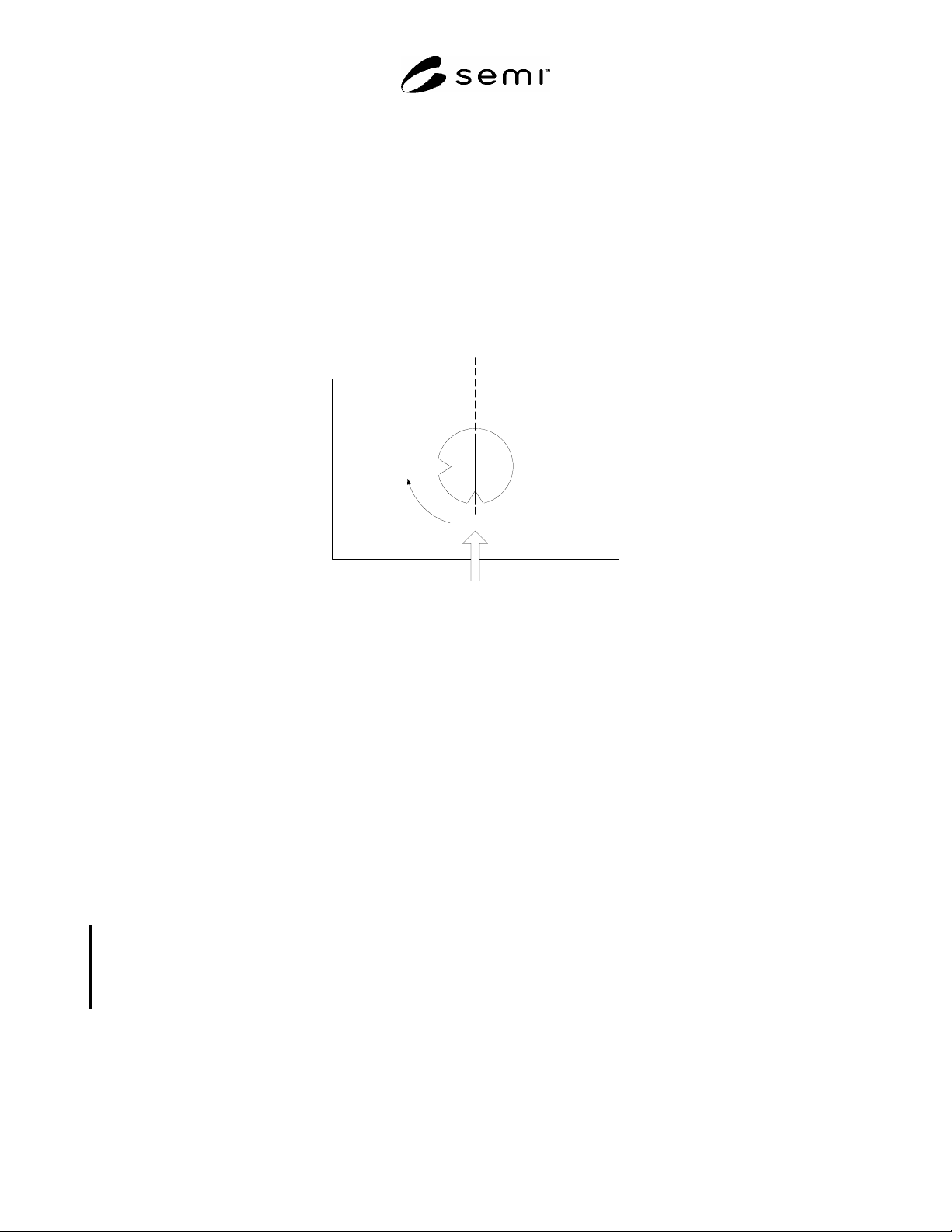
12.7.1 When a substrate is delivered to or picked up from the IMM’s STPO, the substrate has a certain orientation
with respect to the position of the fiducial relative to the entry into the STPO, as illustrated in Figure 6.
12.7.2 The Control Client is able to specify both the incoming orientation of a substrate being loaded into the STPO
and the desired outgoing orientation by passing values for the OrientationIn attribute and/or the OrientationOut
attribute in the UpdateSubstrateObject service.
0 degrees
Substrate Transfer Path
90 degrees
vertical plane
Figure 6
Illustration of Orientation
12.7.3 If the IMM is not capable of determining orientation, either within the STPO or any other of it’s components,
and if a value has been set in OrientationIn, the value in OrientationOut shall be set to the same value that was
provided in OrientationIn.
12.7.4 Otherwise, the following rules shall apply:
If neither OrientationIn nor OrientationOut are provided by the Control Client, then the IMM shall return the
substrate in the same orientation as it was received.
If OrientationIn is provided, and if the actual orientation is determined to be different, then the
“OrientationError” error message shall be sent with the value in the event variable “ActualOrientation” set to
the value as determined.
If OrientationOut is provided, then the substrate shall be oriented in such a way that it is unloaded in the
orientation specified.
12.8 Transfer Path Calibration
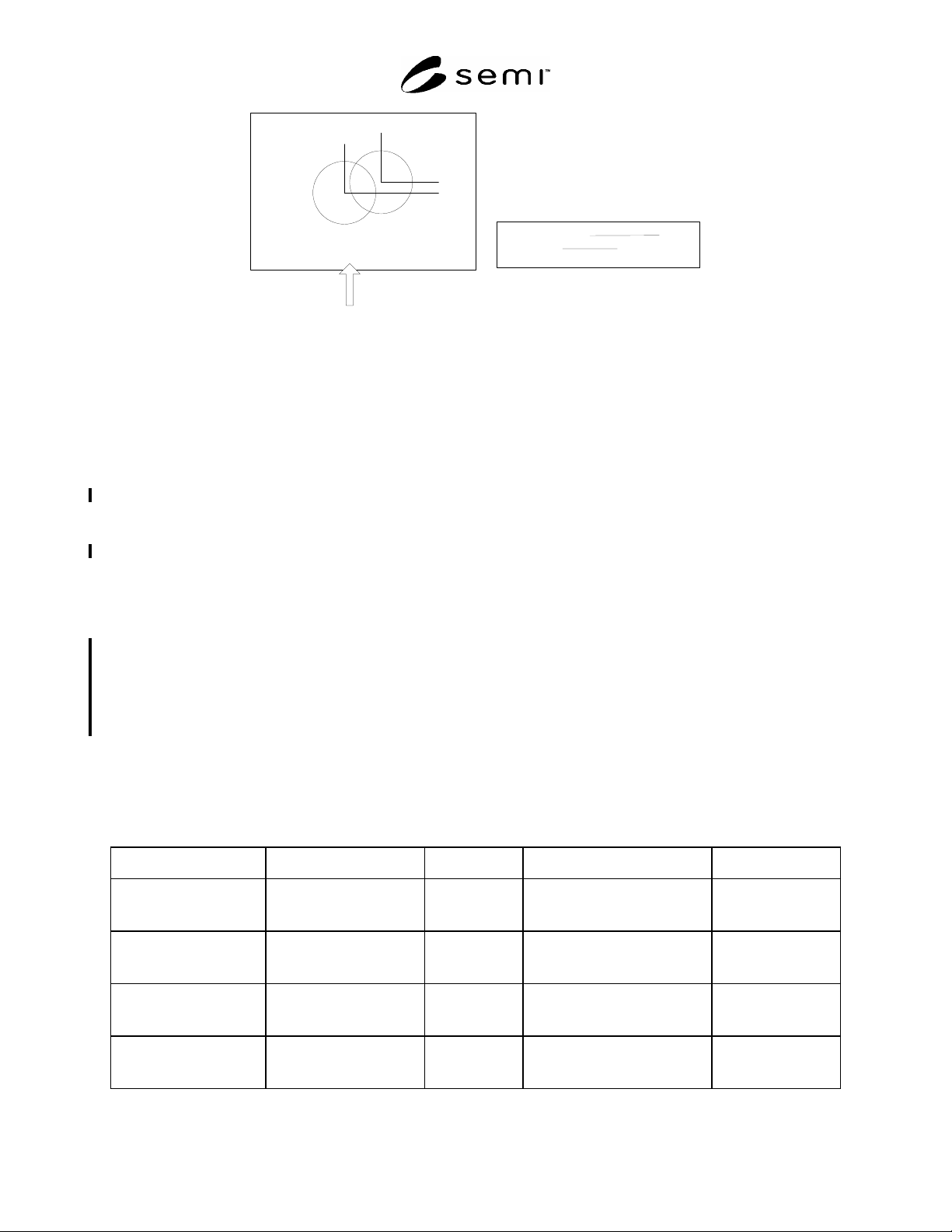
12.8.1 TransferPathCalibration for the STPO is a special service to negotiate adjustments in the arm of the robot of
the Control Client. If the STPO has sensors that can detect the (x,y,z) location of the center of the substrate as it
enters into the STPO, it reports any differences in (x,y,z) in the TransferPathCalibration service response. Through
a series of TransferPathCalibration requests and response, the robot can make adjustments until it is able to place the
substrate into the correct location. Figure 7 illustrates how the differences are calculated.
SEMI E127-0705 © SEMI 2003, 2005 24
original
location
Substrate Transfer Path
Robot
handoff
new
location
y (>0)
x (>0)
Robot handoff (into page)
original location
new location
z (>0)
Figure 7
Illustration of (X,Y,Z) Calculations
12.9 Substrate Transfer Path Events, Errors, and Alarms
12.9.1 Hardware failures shall be reported as alarms.
12.9.2 Each transition of the STPO State Model (STPSM) defined in Table 6 represents a required reportable event.
12.9.3 For implementations with an available Substrate ID Reader, there are 2 additional events and one alarm:
The SubstIDRead event occurs when the ID of an incoming substrate is read, successfully or not.
An Unexpected ID error event and an Unexpected ID alarm occur when substrate verification fails.
12.9.4 For implementations able to determine Substrate Orientation, an OrientationError error message is triggered
whenever the orientation of a substrate being loaded is different from the expected orientation provided in the
OrientationIn attribute of the substrate.
12.9.5 A Missing Substrate alarm occurs whenever a substrate previously present within the STPO can no longer be
detected. This can occur either because the substrate is broken or because of sensor failure In some cases, it may be
possible for a maintenance technician to verify that the substrate is present and undamaged, and the failure is due to
sensor failure to override this alarm. Otherwise, loading and unloading of substrates is prohibited until maintenance
has been performed to remove the broken substrate. The IMM Service state is set to OUT OF SERVICE, and the
IMM EPT state is set to BLOCKED.
12.10 Substrate Transfer Path Event Variables
12.10.1 Table 9 shows the variables that are required for STPO events. These variables are valid only at the time of
the event with which they are associated.
Table 9 Event Variables for Substrate Transfer Path Object
Variable Name Description Type Event Comment
DateTime The date and time that the
event occurred.
Conforms to the
clock format in
SEMI E98.
All.
SubstrXfrPathID Object ID of STPO. Text. All transitions of Substrate
Transfer Path Object State
Model (STPOSM).
Not required if only
one path exists.
SubstrateList Current list of substrate
IDs for substrates in the
transfer path.
List of 0+ text. All transitions of Substrate
Transfer Path Object State
Model (STPOSM).
Empty if no
Substrates are in the
transfer path.
SubstIDRead The value of the substrate
ID as read.
Text. SubstIDRead,
UnexpectedSubstrate.
Required if a
Substrate ID Reader
is available.