semi合集-English.pdf - 第3283页
SEMI E128-0304 © SEMI 2003, 2004 17 Clien t Serve r “getCounter" Request , c Id = 1 “getCounter" Repl y , cId = 1 “setCounter" R equest, cId = 2 “setCounter" Repl y, cI d = 2 counter = 0 counter = 123…
SEMI E128-0304 © SEMI 2003, 2004 16
RELATED INFORMATION 2
MESSAGE TRANSPORT EXAMPLES
NOTICE: This related information is not an official part of SEMI E128 and was derived from the work of the
originating committee. This related information was approved for publication by full letter ballot procedures.
R2-1 Transport Independence
R2-1.1 The aim of these examples is to keep implementation and transport mechanism specifics separated from the
use of the XML Messaging Specification. The example interface consists of five operations:
• start(myName) — starts the messaging send/receive endpoint,
• send(destName, envelope) — sends a message to another endpoint,
• stop()— terminates the messaging endpoint,
• onMessage(envelope) — callback provided by an application to process incoming messages, and
• receive() — waits for next message (needed when onMessage is not supported).
R2-1.2 This kind of interface abstracts the minimum functionality needed to send and receive messages. Any
potential message transport (HTTP, JMS, HSMS, RMI, etc.) could be encapsulated into methods similar to these to
keep the messaging implementation independent of the transport. An application could then be written using HTTP
today and then easily switched to JMS a year later. Also, new applications could be prototyped with lightweight
transports and deployed with robust MOM transports with no change to application code.
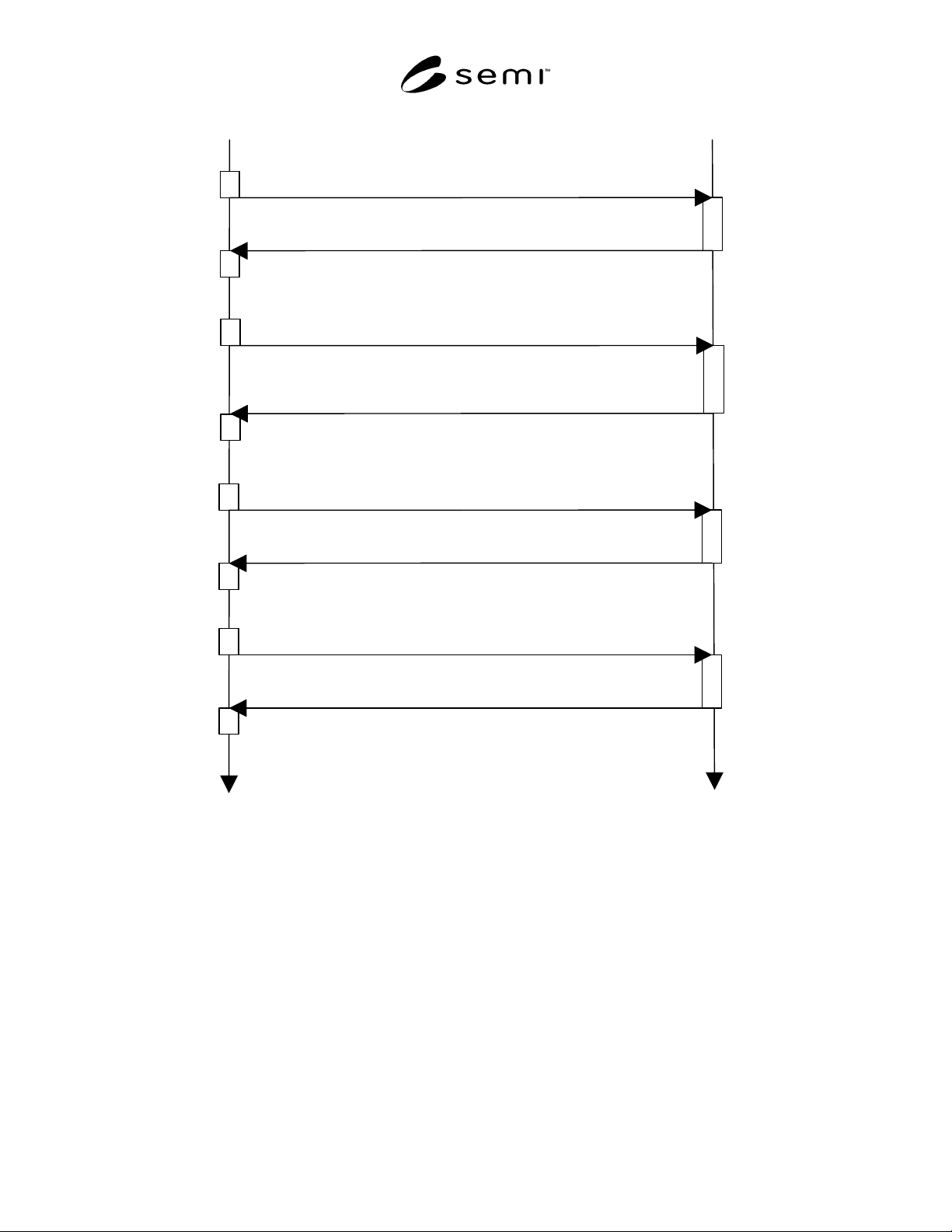
R2-1.3 This Related Information is based on a simple example (illustrated in Figure R2-1) of a typical interaction
between a client application sending requests to a server which provides the service and sends reply messages. The
purpose of this example is to illustrate the way the message header elements proposed in this specification are
realized in an asynchronous messaging implementation over HTTP.
SEMI E128-0304 © SEMI 2003, 2004 17
Clien
t
Serve
r
“getCounter" Request , cId = 1
“getCounter" Reply , cId = 1
“setCounter" Request, cId = 2
“setCounter" Reply, cId = 2
counter = 0
counter = 123
counter = 123
“getCounter" Request , cId = 3
“getCounter" Reply , cId = 3
counter = 123
“bogusAction" Request , cId = 4
“bogusAction" Reply , cId = 4
Fault Value = badrequest
Figure R2-1
Sample Interaction for Messaging Examples
R2-1.4 In order to show this example in an application context, it was implemented in Java for both HTTP and JMS
transports. The examples that follow were extracted from this sample application and the debug output of the
running example.
R2-2 SOAP/HTTP
R2-2.1 Since HTTP is inherently synchronous, a common implementation would support only synchronous
request/reply and would not use any of the MessageHeader elements that support asynchronous messaging. In the
synchronous case, only the To and Action elements would be present in the MessageHeader. The To element would
map to the URL of the target service and Action could also be URL encoded.
R2-2.2 To implement asynchronous messages over HTTP, both client and server endpoints must listen for messages
coming through the selected transport. Each message is interpreted based on both the transport properties and the
XML MessageHeader included in the SOAP header. Unlike more typical HTTP usage, the request and reply are not
SEMI E128-0304 © SEMI 2003, 2004 18
constrained to a single session context, and can be separated in time. There is no “blocking” on pending replies.
This model lends itself better to clients or servers that deal with many messaging partners at a time, while still
needing to act on common data.
R2-2.3 In the HTTP/SOAP transport example, each of the messages in the sample scenario will be sent with an
HTTP Post operation. Every message will include an XML document containing a SOAP envelope and the
MessageHeader specified in this standard. The message body will contain the application specific elements that
communicate the content of each message.
R2-2.4 The elements of the MessageHeader contain data that is used to construct the appropriate HTTP message
and to populate the properties of the SOAP message. Specifically, the destination URL for each message appears in
the To attribute of the MessageHeader. The From attribute contains the URL of the sender of each message. The
SOAPAction HTTP header replicates the Action element in the transport specific header attribute.
R2-2.5 This example (and the ones that follow) include both the HTTP properties and the XML message from the
client perspective. The request message shown in Figure R2-2 illustrates the HTTP transport form of the message.
Sending HTTP POST:
POST getCounter HTTP/1.1
Host: localhost:9001
Content-Type: application/soap+xml; charset="utf-8"
Content-Length: 369
SOAPAction: getCounter
<Envelope>
<Header>
<MessageHeader>
<From>localhost:9001</From>
<To>localhost:9000</To>
<MessageType>REQUEST</MessageType>
<RequestId>1</RequestId>
<Action>getCounter</Action>
</MessageHeader>
</Header>
<Body />
</Envelope>
Figure R2-2
Example HTTP Post Request Message
R2-2.6 The reply message in Figure R2-3 follows the same pattern, with the TO header element reflected in the
HTTP Post and the SOAPAction mapping to the MessageHeader Action element. In this example, the same Action
value is echoed back with the reply message.