semi合集-English.pdf - 第3290页
SEMI E130-1104 © SEMI 2003, 2004 4 equipment events that satisfy the requ irements of those tr ansitions. In certain implem entations, the prober may enter a state and has already satisfied all of the condition s require…
SEMI E130-1104 © SEMI 2003, 2004 3
6 Conventions
6.1 Remote Command Parameter Table Definitions
6.1.1 The table below provides an example of the tables used to list and describe arguments for services or remote
commands defined in this specification.
Parameter Req/Ind Rsp/Cnf Form Comment
(see below) (see below)
6.1.2 Parameter – Specifies the name of the parameter.
6.1.3 Req/Ind – Specifies relationship of the parameter for the command request or indication message. See below
table for codes used.
6.1.4 Rsp/Cnf – Specifies relationship of the parameter for the command response or confirmation message. See
below table for codes used.
6.1.5 Form – Specifies the data type of the parameter. Data types are as defined in the SEMI compilation of terms
or are included in this specification. Specific representation of the data types will depend on and be defined by the
communications protocol and data format adjunct specification.
6.1.6 The following codes appear in the Req/Ind and Rsp/Cnf columns to define how each parameter is used in each
direction:
M Mandatory Parameter – Must be given a valid value.
C Conditional Parameter – May be defined in some circumstances and undefined in others. Whether a
value is given may be completely optional or may depend on the value of the other parameter.
U User-Defined Parameter
- The parameter is not used.
= (for response only) Indicates that the value of this parameter in the response must match that in the
primary (if defined).
7 Requirements
7.1 Following sections in this document, except such supplementary descriptions as Related Information, are
requirements of this specification.
8 State Model
8.1 The purpose is to define the equipment-specific processing state model to portray the expected operational
states of the equipment to enable host tracking and control in place of a local operator. Process Job Management
standard (SEMI E40) is part of the required behavior of this document as described in Section 9. For additional
description of this behavior see Section 10 or See the actual standard, SEMI E40.
8.1.1 The Process State model tracks the state of the equipment with regard to its ability to perform processing on a
substrate. The Process State model is used to inform the host when a substrate is loaded on the main chuck and has
been properly setup for processing.
8.1.2 It is expected that the prober will be preparing a substrate to be loaded on the main chuck while the host is
processing an existing substrate on the main chuck. This concurrent activity does not impact the host’s ability to
process the existing substrate and therefore does not cause a change in the Process State model. The standard for
Substrate Tracking (SEMI E90) is used for tracking substrates between individual substrate locations.
8.1.3 The processing state model in this document is required for implementing a PSEM300-compliant prober, in
addition to the required state models in the related standards. A state model consists of a state model diagram, state
definitions, and a state transition table. A state model represents the host’s view of the prober, but not necessarily
the actual prober operations. All PSEM300 state model transitions shall be mapped sequentially into the actual
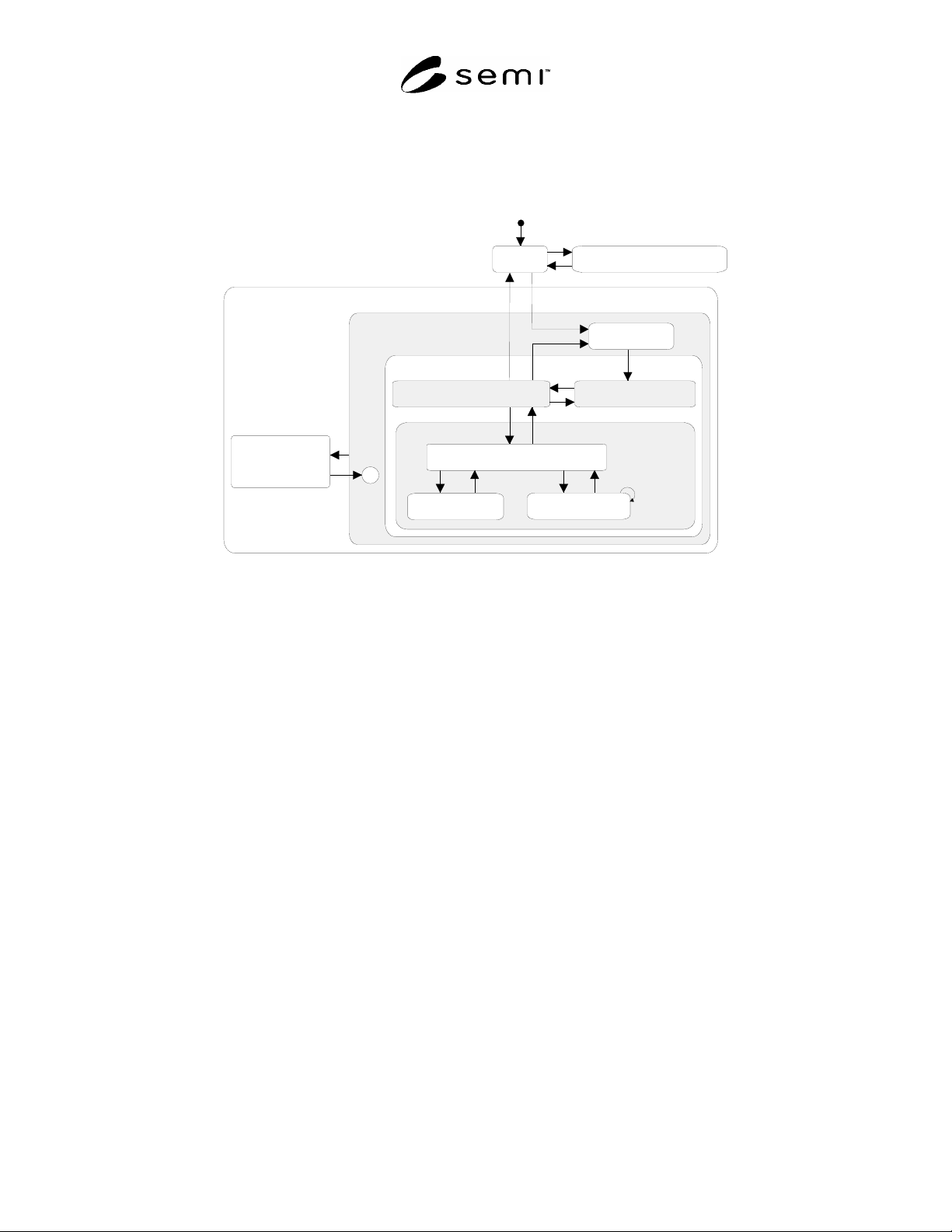
SEMI E130-1104 © SEMI 2003, 2004 4
equipment events that satisfy the requirements of those transitions. In certain implementations, the prober may enter
a state and has already satisfied all of the conditions required by the PSEM300 state model for transition to another
state. In this situation, the prober makes the required transition without any additional actions.
8.1.4 Some equipment may need to include additional states. However, any additional states must not change the
PSEM300-defined state transitions. All expected transitions between PSEM300 states must occur.
PROCESS
EXECUTING
PROCESSING
BLOCKED
3
C
16
15
4
5
SUBSTRATE
LOADED
6
8
10
9
11
12
13
1
2
IDLE
SETTING UP
AWAITING COMMAND
HANDLING MATERIAL
SERVICE TASK
MOVING XYZ
AWAITING LOAD
7
IDLE WITH ALARMS
PROCESSING ACTIVE
17
18
14
Figure 1
PSEM Process State Model Diagram
8.1.5 Description of Prober Processing States
8.1.5.1 AWAITING COMMAND (SUBSTRATE LOADED Sub-state) — A substrate on the main chuck is ready for
processing. The prober is ready to receive an instruction from the host.
8.1.5.2 AWAITING LOAD (EXECUTING Sub-state) — At least one Process Job is in the PROCESSING state. No
substrate is loaded on the main chuck. The prober is waiting for a host command to load a substrate.
8.1.5.3 EXECUTING (PROCESS Sub-state) — One of the following conditions exists: A) At least one Process Job
is in the PROCESSING state and the prober is processing material as directed by the host. B) A single Process Job
is active in either the STOPPING or ABORTING state and the prober is removing material.
8.1.5.4 IDLE — No Process Jobs are in the ACTIVE state and the processing resource is available without alarms.
8.1.5.5 HANDLING MATERIAL (EXECUTING Sub-state) — The prober is loading a substrate, unloading a
substrate, or a combined action of loading and unloading substrates on the main chuck. When loading a substrate
onto the main chuck, the HANDLING MATERIAL state is maintained until all preconditioning tasks (i.e. aligning,
profiling, etc.) are completed and the substrate is ready for processing. If a condition arises where the substrate on a
chuck must be re-aligned, the HANDLING MATERIAL state is active until the alignment task has completed.
8.1.5.6 MOVING XYZ (SUBSTRATE LOADED Sub-state) — The prober is executing a move command. This state
is maintained until the move is complete. This includes motion in the z-axis. When this state is exited, the target
unit(s) on the substrate is in position to be processed.
8.1.5.7 PROCESS (PROCESSING ACTIVE Sub-state) — This state is the parent of those sub-states that refer to the
preparation and execution of a process job.
8.1.5.8 PROCESSING ACTIVE — The state in which at least one Process Job is active.
8.1.5.9 PROCESSING BLOCKED — The processing resource is not available for processing.
8.1.5.10 SETTING UP (PROCESS Sub-state) — A single ACTIVE Process Job is in the SETTING UP state.
SEMI E130-1104 © SEMI 2003, 2004 5
8.1.5.11 SERVICE TASK (SUBSTRATE LOADED Sub-state) — A service task such as inking, cleaning, or
inspection is being performed by the prober.
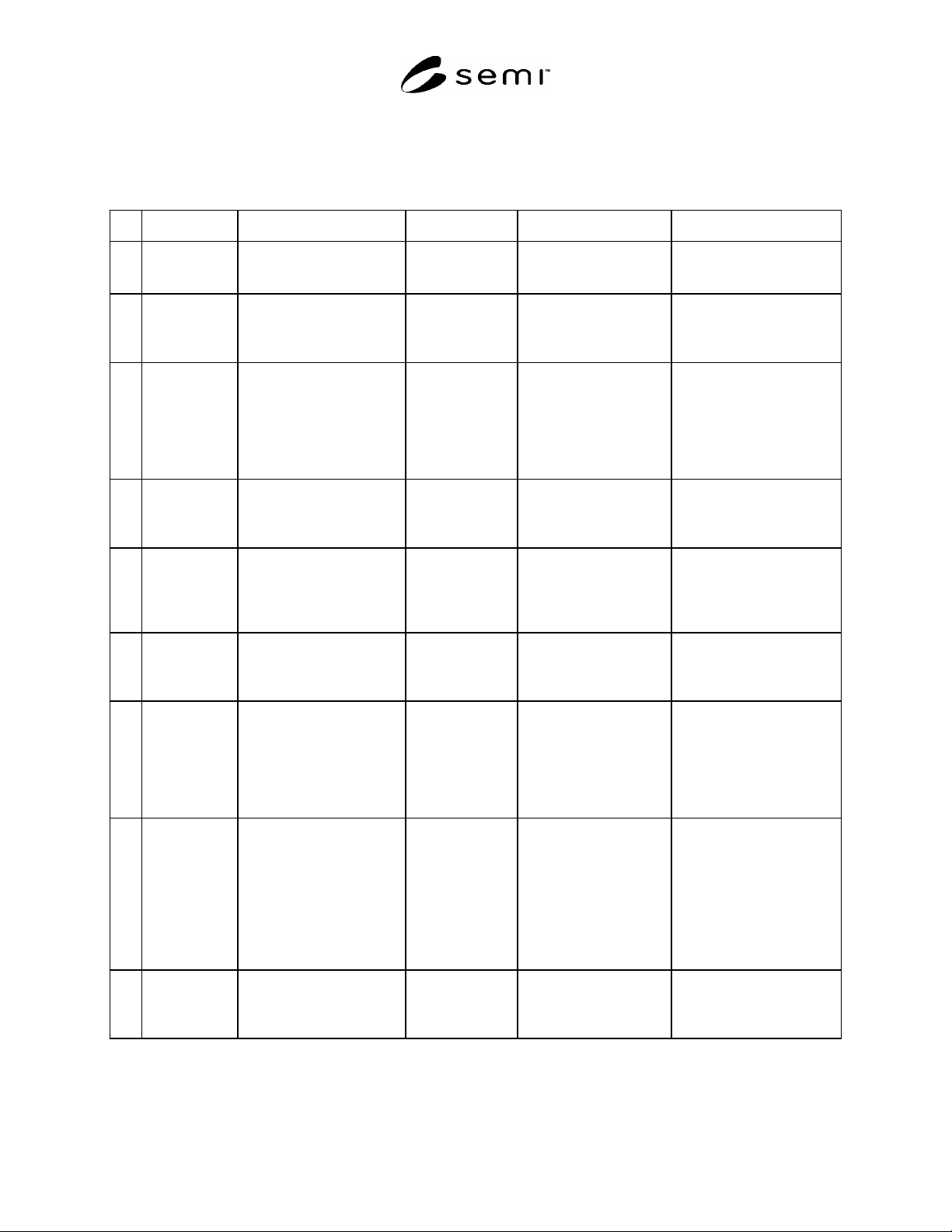
8.1.6 PSEM Processing State Transition Table
Table 1 PSEM Processing State Transition Table
#. Current State Trigger New State Action Comment
1 No state The processing resource has
become available for
processing.
IDLE There are no active process
jobs at this time.
2 IDLE A process job has been
dispatched into the
SETTING UP state.
SETTING UP Actions taken correspond
to preconditioning
activities within the SEMI
E40 Process Job.
3 SETTING UP A single Process Job is
active and has transitioned
from the SETTING UP state
to the PROCESSING state.
AWAITING
LOAD
The prober is awaiting
instructions from the host to
load a substrate on to the
main chuck. The Process
Job PRMtlNameList
contains the list of substrates
to be processed.
4 AWAITING
LOAD
Prober has received a
command from the host to
load a substrate on to the
main chuck.
HANDLING
MATERIAL
The equipment is loading
a substrate on the main
chuck.
None.
5 HANDLING
MATERIAL
The material handling task
completes leaving the main
chuck unoccupied. A
Process Job is in the
PROCESSING state.
AWAITING
LOAD
See Section 17 for a
description of the prober
behavior related to material
handling.
6 HANDLING
MATERIAL
The material handling task
completes leaving the main
chuck unoccupied. There
are no active Process Jobs.
IDLE
7 HANDLING
MATERIAL
The material handling task
completes leaving the main
chuck unoccupied. There
are no Process Jobs in the
PROCESSING state. A
Process Job is in the
SETTING UP state.
SETTING UP
8 HANDLING
MATERIAL
The material handling task
completes. A substrate
located on the main chuck
has been fully setup and is
ready to receive processing
as directed by the host.
AWAITING
COMMAND
All pre-processing steps
including profiling, aligning,
temperature soak, etc. have
completed.
See Section 22.4 for the list
of remote commands the
host can issue while the
prober is in the AWAITING
COMMAND state.
9 AWAITING
COMMAND
The host issued a material
handling related remote
command.
HANDLING
MATERIAL
The prober performs the
task as commanded by the
host.
See Section 17 for a
description of the commands
the host may issue relating to
material handling.