semi合集-English.pdf - 第3427页
SEMI E133-0705 © SEMI 2004, 2005 8 Figure 2 PCS Analysis Engine Common Input/Ou tput Structure 9.2.2.4 Note th at based on the simple data model shown in Figure 2, Inpu ts are available as an Output from an Analysis Engi…

SEMI E133-0705 © SEMI 2004, 2005 7
9 Process Control Systems Functional Group Capabilities and Interface Data Structures
9.1 Functional Group Partitioning
9.1.1 Process control systems are partitioned into functional groups using the criteria defined in §8. This standard
defines the interface data structures, services and behavior associated with these functional groups. In this section
the capabilities of the PCS functional groups are defined in more detail. First of all, the basic capabilities common
to all
functional groups are presented. Then the additional basic capabilities unique to each functional group are
presented. A high level description of the specifications of data structures, services and behavior are described in
§10.
9.1.2 It is important to note that the specific implementations of these various functional groups may differ greatly
in the level of capability delivered, performance, quality of service, and internal architecture. Moreover, in a given
factory, there may be multiple instances of the same functional group running concurrently, from one or more
suppliers. Some functional groups may be completely independent of other PCS functional groups (in other words,
they can operate in relative isolation, depending only on information from systems external to PCS); others may
depend heavily on other functional groups, collaborating closely to provide a higher level of capability than they
could on their own.
9.1.3 The goal of the PCS interface standards is to enable all of these implementation scenarios (and more) without
dictating internal product architectures.
9.2 PCS Analysis Engine
9.2.1 As defined in §8, all functional groups can be thought of as specializations of a PCS Analysis Engine and
therefore inherit the structure and behavior of a PCS Analysis Engine. This section defines the common capabilities
of a PCS Analysis Engine.
9.2.2 General Capability Description
9.2.2.1 All PCS Analysis Engines shall have inputs and outputs as shown in Figure 2. This means that the PCS
Analysis Engines shall support the consumption of the specified inputs and production of the specified outputs as
necessary to achieve the required capabilities of that analysis engine as specified in this standard. These inputs and
outputs are specified as aggregate data structures. The structures are aggregated into “collection types” according to
the category of data. A definition of these collection types is provided in Table 4. The PCS Analysis Engine shall
have the general behavior of utilizing specified inputs, performing tasks based to some degree on these inputs, and
generating outputs. Any additional structure and behavior of various PCS Analysis Engines are outlined in the
remainder of this section and specified in detail in ¶10.4.
9.2.2.2 Note that, in addition to limitations of specification defined in §4, the following are beyond the scope of
definition of the PCS Analysis Engine:
the level of synchronization of inputs with performance of tasks and/or generation of outputs, and
the specification of any internal states of the PCS Analysis Engine.
9.2.2.3 All PCS Analysis Engines belonging to this functional group shall have the capabilities listed in Table 5.
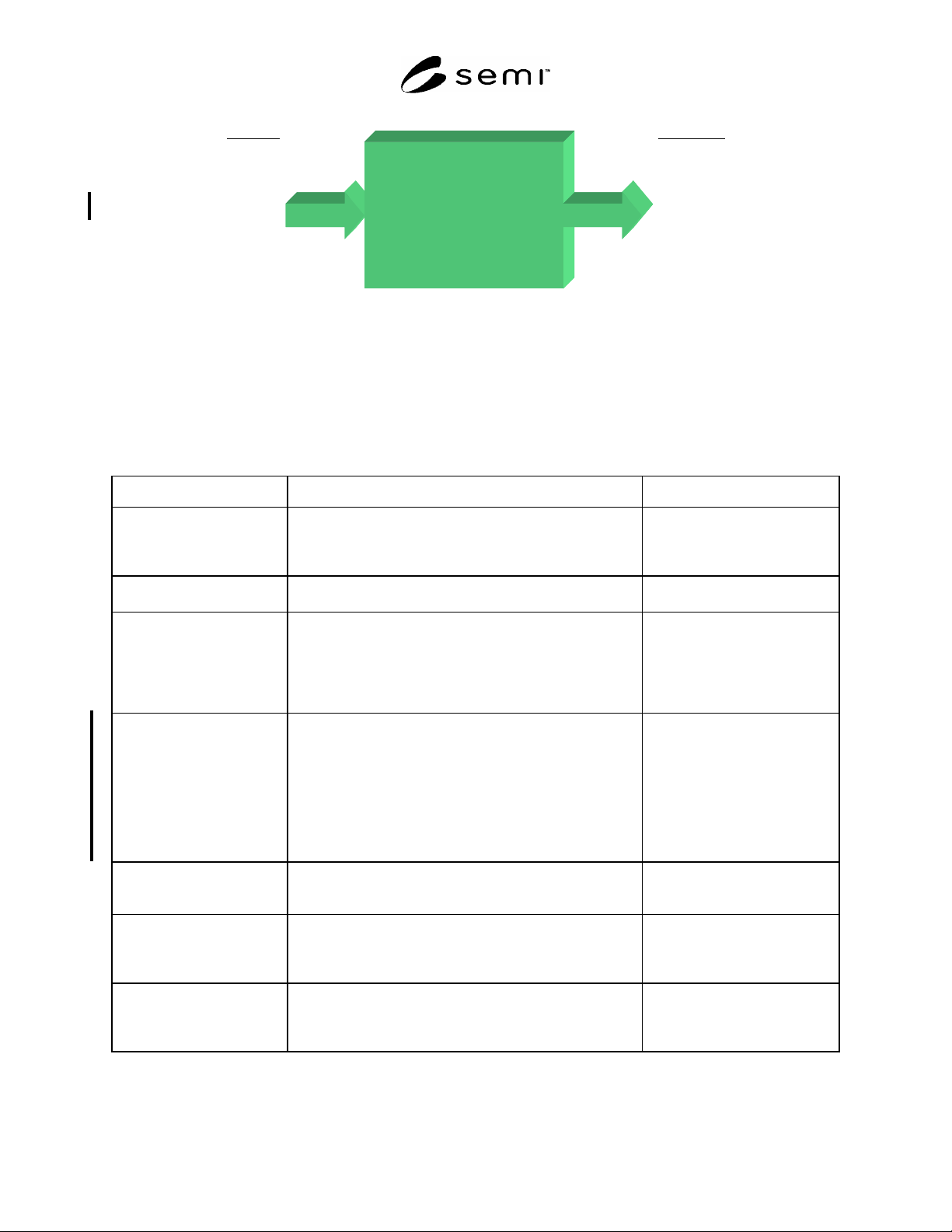
SEMI E133-0705 © SEMI 2004, 2005 8
Figure 2
PCS Analysis Engine Common Input/Output Structure
9.2.2.4 Note that based on the simple data model shown in Figure 2, Inputs are available as an Output from an
Analysis Engine. Data provided as input to an Analysis Engine should be accessible as output from the Analysis
Engine for historical purposes.
Table 4 PCS Analysis Engine Inputs and Outputs Collection Type Definitions
Collection Type Definition Comments
Globals
Information that applies globally across an entire job. A lot id, for example could be
specified once as a global so that
it would not have to be specified
with many other data sets.
AnalysisParameters
Information that identifies numeric data used by the Analysis
Engine to perform various calculations.
Equation coefficients,
feedforward data, etc.
CalculatedOutputs
Data representing the results of analysis from an Analysis
Engine.
A calculation derived from
various inputs to the Analysis
Engine indicating wafer state,
process state or model state
information, recommended
machine settings, etc.
LogMessages
Data describing the activity of an Analysis Engine as it
executes its tasks.
Data describing the activities of
the Analysis Engine. Note that
this does not include log
information on the
communication protocol with the
AE. An example that is
acceptable is “Algorithm #3 with
model parameters ‘A’, ‘B’, and
‘C’”.
ModuleData
Information representing the current or last known physical
state of a process module that will be used by an Analysis
Engine to process material.
Machine, or module E10 state,
RF hours, number of wafers
processed, etc.
ProcessData
Information representing the process itself, such as the name
and type of the process and the current or last known process
state based on measurements from sensors of the processing
environment.
Name of the process (CMP), in-
situ process measurements, trace
data, and summary statistics etc.
SubstrateData
Information about the substrate being associated with the
Analysis Engine. This could include data representing a
single wafer, multiple wafers, or one or more lots, as well as
attributes of the material.
Profile or topology data, and
other characteristics measured
physically or electrically.
PCS AE
Inputs
Globals
AnalysisParameters
CalculatedOutputs
Outputs
Globals
AnalysisParameters
CalculatedOutputs
PCS AE
Inputs
Globals
AnalysisParameters
LogMessages
ModuleData
ProcessData
SubstrateData
Outputs
Globals
AnalysisParameters
LogMessages
ModuleData
ProcessData
SubstrateData

SEMI E133-0705 © SEMI 2004, 2005 9
Table 5 PCS Analysis Engine Functional Group Capabilities
# Description Req’d Comments
3.1
Provide a PCS Analysis Engine capability
PCS Analysis Engine shall be capable of performing one or more of
R2R control, FD, FC, FP, SPC, or any future functionality defined in
this standard as a PCS functional group.
Y
3.2
Provide the required PCS Analysis Engine methods
The PCS analysis engine shall provide the required interface methods
as defined in this standard. See ¶10.4.1.
Y These include Execute and Update.
3.3
Provide the required PCS Analysis Engine method capabilities
The PCS analysis engine shall provide the required interface method
capabilities as defined in this standard. See ¶10.4.1.
Y These include Log Data, Exception
Handling, Get Topic List, Subscribe to
Topic, Get Topic Data.
3.4
Maintain models of selected process control system environment
The PCS Analysis Engine shall maintain explicit or implicit models
of the selected process control environment. These models shall be
utilized to provide the analysis or control capability of the Analysis
Engine.
Y The specific form and behavior of these
models is beyond the scope of this
standard.
3.5
Provide a mechanism to uniquely instruct the Analysis Engine to
perform an action
The PCS Analysis Engine shall support an input mechanism whereby
the analysis engine can be instructed to take a specific unique action.
Y The mechanism could be a single key
variable, e.g., model name or a
complex set of context data utilized
internally to perform context matching,
etc. The action could include application
of a specific model and generation of a
PCS result, update of a model, or
communication of model parameters.
3.6
Interface with multiple external systems
The PCS Analysis Engine shall be capable of accepting inputs from,
or generating outputs to multiple external systems.
Y The definition of these systems will be a
function of the application environment;
these could include process tool or
metrology systems, or user interfaces.
3.7
Edit configuration of models
The PCS Analysis Engine shall provide the capability to create/add,
edit configuration, and delete models.
Y This capability will be supported through
the Analysis Engine interface.
3.8
Interface with other Analysis Engines
The PCS Analysis Engine shall be capable of either accepting outputs
from other Analysis Engines as inputs, or producing outputs that are
utilized by other Analysis Engines.
N May be a requirement of Analysis
Engines belonging to a specific
functional group.
3.9
Advanced Model Management
The PCS Analysis Engine may provide advanced model management
capabilities including but not limited to: secure access to models, and
automatic updating of models based on process control environment
changes.
N
3.10
Provide the optional PCS Analysis Engine method capabilities
The PCS Analysis Engine shall provide all or a subset of the optional
interface method capabilities as defined in this standard. See ¶10.4.1.
N
9.2.3 Common Interface Data Structures
9.2.3.1 Common Data Model Overview — The common interface data structures from which all PCS functional
groups may inherit are shown in Figure 3. This figure shows the basic types of information (“classes” in object
terminology) that can be supported by the interface. This model applies to the structure of inputs as well as outputs
of a PCS analysis engine as shown in Figure 2. This model applies to a complete message associated with a PCS
Job. That is it applies to the complete set of information communicated to or from a PCS AE for a PCS job. Note
that a complete message into or out of a PCS AE may be broken into multiple application-to-application
communications as defined in ¶9.2.3.5.