semi合集-English.pdf - 第3693页
SEMI PR8-0703 © SEMI 2003 23 Example: OpSeg Event <EdaData> <EquipmentID> <Supplier>Some Supp lier</Supplier> <Model>8400</Mo del> <ImmutableID>9989 48< /Immu tab le ID> &l…
SEMI PR8-0703 © SEMI 2003 22
RELATED INFORMATION 1
OPERATIONAL SEGMENT EXTENSION TO EDA
NOTICE: This related information is not an official part of SEMI PR8. This related information is not intended to
modify or supersede the official proposed standard. Determination of the suitability of the material is solely the
responsibility of the user.
R1-1 Operational Segments
R1-1.1 Operational Segment Event — Operational segments are optional, at the discretion of the supplier, and can
be provided as an extension to the equipment events described in the specification. Operational Segment events are
provided for those suppliers that desire to model their tools in a more structured and hierarchical way than is
possible with simple events. The operational segment is a generalization of the task model defined in SEMI E116
(Equipment Performance Tracking).
R1-1.1.1 Operational Segments — An operational segment, or segment, is a persistent entity that is expected to
occur as part of normal or planned equipment operations. A segment always has only one start time and only one
complete time, so if a segment is viewed on a timeline or Gantt chart it literally occupies a segment of time. Most
segments of interest are general equipment operations that are expected to repeat on a regular basis. For example,
for an equipment robot that performs the act of loading a wafer into a chamber many times, the robot is the locator,
the “load” task is a segment, and each occasion that the equipment performs that task is an instance of that “load”
segment.
R1-1.1.2 Segment Instances — Segments of the same name repeat frequently over time. It is necessary to identify a
particular occurrence of a segment and to relate it to other segments involved in the same or dependant operations.
InstanceIDs perform this function. The network of operational segments can be reconstructed by connecting each
segment event to the segment that it describes and then relating each segment to its parent segment, if any. For
example, a wafer “get” might have a start and complete event, which are related via an InstanceID to describe the
“get” sub-task. The “get” sub-task might be part of a load wafer task. The “get” sub-task would be related to its
parent segment via the ParentInstanceID.
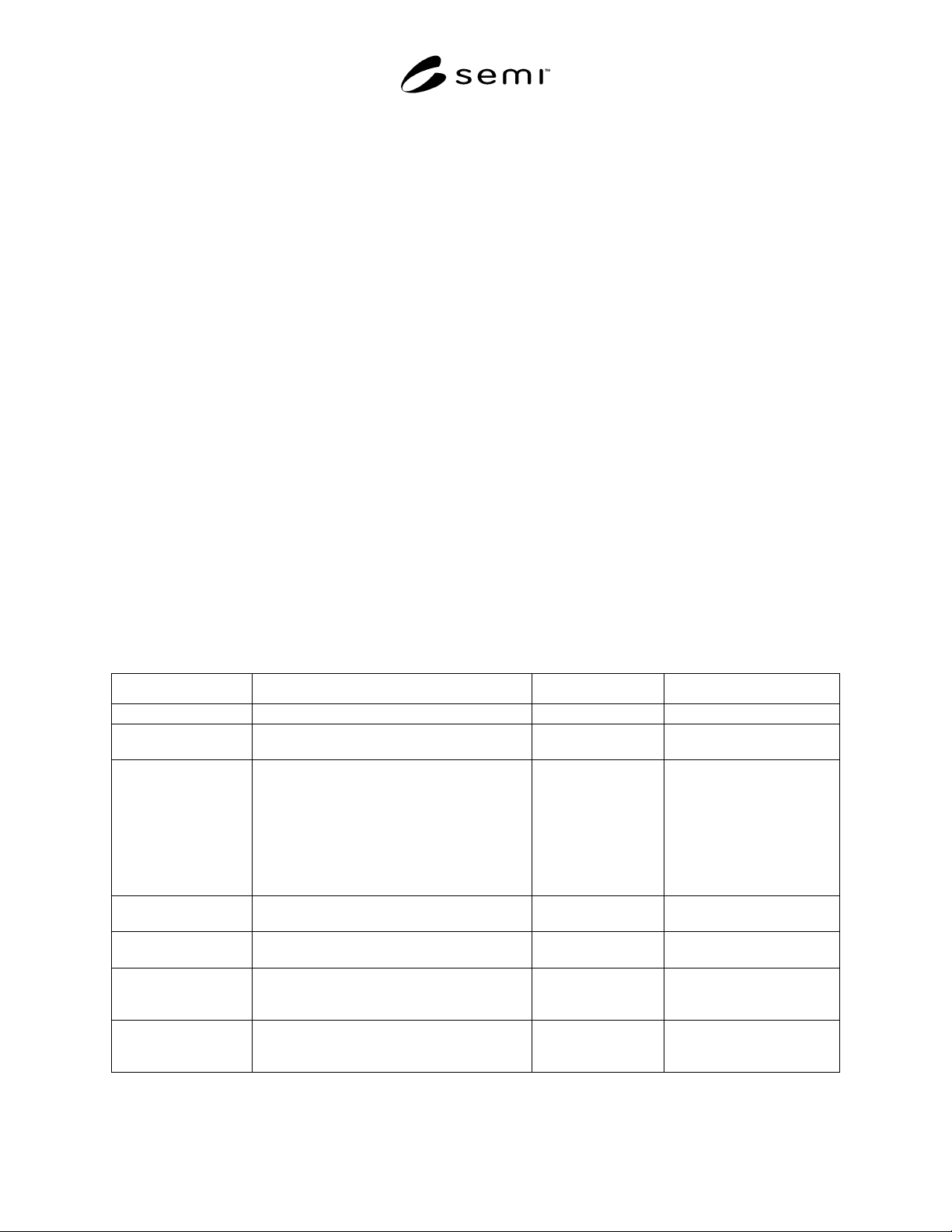
Table R1-1 Operational Segment Event
Tag Name Description XML Datatype Behavior
OpSegEvent Operation Name Complex Required
SegmentType Identifier for the type of segment being executed
(e.g. Process Job, Substrate, Task, etc.).
String Required
EventType Enum--
0 = Complete;
1 = Start;
2 = Suspend;
3 = Resume;
4 = InProgress;
5 = Transitional;
6–9 = Equipment Defined
NonNegative Integer;
Max inclusive = 9
Required
TaskName Name of Task String Optional, include if task or
sub-task
Purpose The intended use of the segment (e.g.
Production, Engineering, maintenance, etc.).
String Optional, include if task or
sub-task
SegInstID Unique identifier of the specific segment
instance to which the message applies. May be
UUID.
String Optional
ParSegInstID Unique identifier of the parent of the segment
instance that the message applies. May be
UUID.
String Optional, include if segment
start event
SEMI PR8-0703 © SEMI 2003 23
Example: OpSeg Event
<EdaData>
<EquipmentID>
<Supplier>Some Supplier</Supplier>
<Model>8400</Model>
<ImmutableID>998948</ImmutableID>
</EquipmentID>
<Event>
<EventTime>1999-05-31T13:20:00-05:00</EventTime>
<Locator> Inspector.robot.aligner </Locator>
<EventID>OpSegEvent</EventID>
<Extension>
<OpSegEvent xmlns=" urn:semi-org:schema:opseg_v0.0" >
<SegmentType>Task</SegmentType>
<EventType>1</EventType>
<TaskName>Align</TaskName>
<Purpose>Manufacturing</Purpose>
<SeglInstID>1999-05-31T13:00:00-05:00</SegInstID>
<ParSegInstID>1999-05-31T12:00:00-05:00</ParSegInstID>
</ OpSegEvent>
</Extension>
</OpSegEvent>
</EdaData>
R1-1.1.2.1 Note that the EventID child element of the Event element from the specification is used to identify the
extension as an operation segment extension. The additional information used for operational segments is contained
within the extension element, and resides in a different namespace than that used to define the EDA data types.
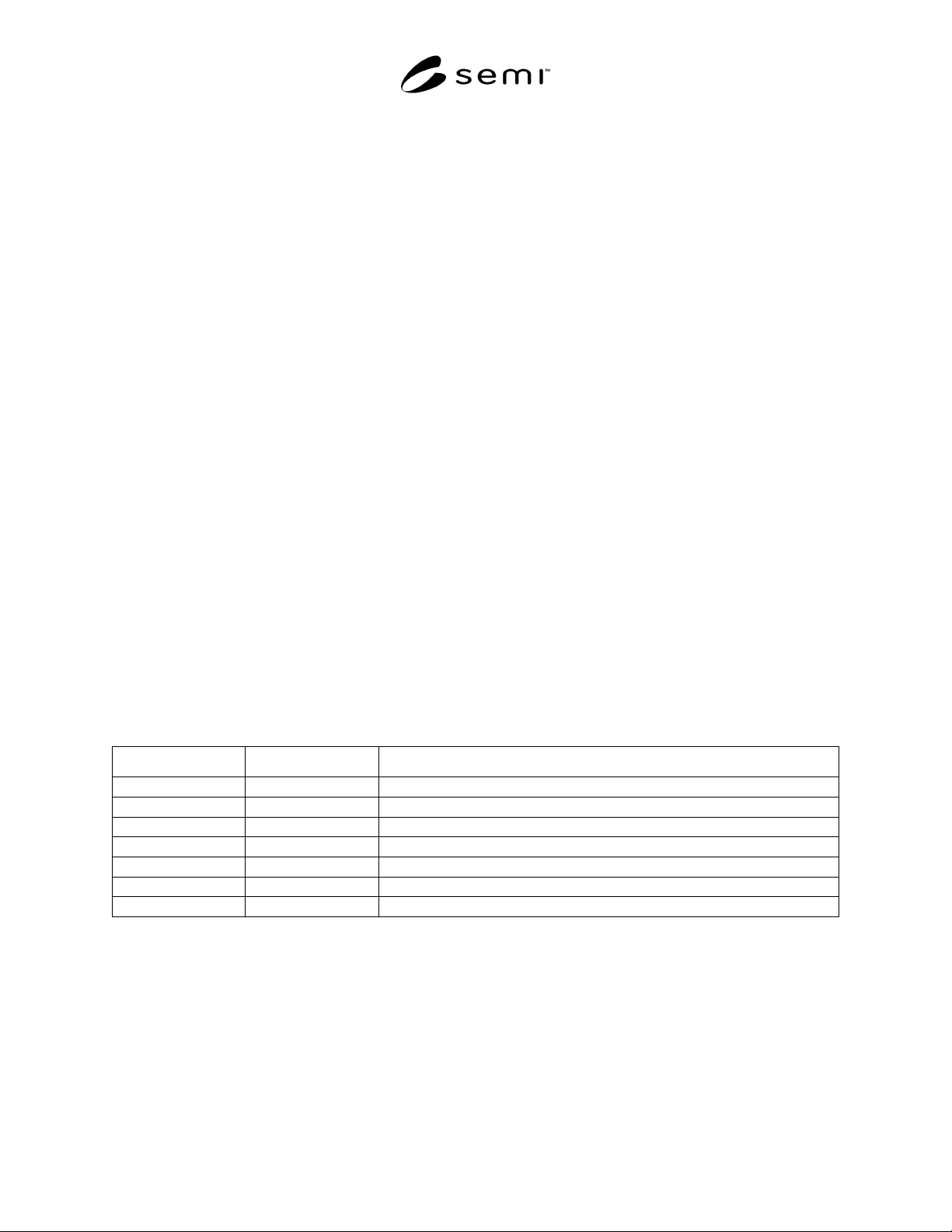
R1-1.1.3 Enumerations — Three enumerations are included in the Operational segment format for ease of parsing
and extraction from a database. These enumerations are: 1) SegmentType, 2) EventType, and 3) Purpose.
R1-1.1.4 EventType Enumeration — The EventType enumeration is a list of the types of events that may occur as
part of the execution of a segment. This list describes the different event types that naturally occur as part of the
execution of a segment. Six (6) common event types are defined and the equipment may add custom types as
required.
Enumeration Value Name Description
0 Complete The segment completes, either normally or abnormally
1 Start The segment begins
2 Suspend The segments stops, with the potential to resume
3 Resume The segment resumes execution after a suspend
4 In-Progress A milestone is reached, or a parametric report is issued
5 Transitional One segment ends and another begins simultaneously
6–9 Equipment Defined These enumerations can be defined by the supplier
R1-1.2 Schema Document
R1-1.2.1 A machine-readable XML Schema file is provided to help ensure interoperable usage of the operational
segment message described in this section of the Related Information for this specification.
R1-1.2.2 OpSeg.xsd
R1-1.2.2.1 This file is an XML Schema document that describes the structure of the XML document fragment
specified in Table R1-1 of this section of the Related Information. This file can be used in conjunction with the
schema and WSDL files provided with the primary specification to validate, or to facilitate, the serialization and
deserialization of, operational segment data enclosed in the Extension element of the Event message.

SEMI PR8-0703 © SEMI 2003 24
RELATED INFORMATION 2
EXAMPLE EDA CLIENT APPLICATIONS
NOTICE: This related information is not an official part of SEMI PR8. This related information is not intended to
modify or supersede the official proposed standard. Determination of the suitability of the material is solely the
responsibility of the user.
R2-1 Typical Users of Proposed EDA
Solutions
R2-1.1 This section provides a very basic overview of
the different classes of data collection clients that
proposed EDA implementations are intended to support
from the viewpoints of the types of data that are used,
and the basic dynamics of each client. The different
classes of data collection capabilities may be required
in a combination or separately depending on the
necessity.
R2-1.1.1 Equipment Utilization Tracking
R2-1.1.1.1 Scope of Utilization Tracking Applications
R2-1.1.1.1.1 Utilization tracking applications are
responsible for collecting information regarding the use
of the equipment in the factory. These applications
typically look for events and alarms/exceptions from
the to determine when the equipment is being
exercised, when it is idle, and when it is unable to
perform its intended function due to errors or alarms.
R2-1.1.1.2 Timeliness and Accuracy of Utilization
Data
R2-1.1.1.2.1 Such applications are not time-critical,
and can accept data off-equipment with very high
latencies (on the order of seconds to minutes or greater)
with no adverse effect on the ability of the application
to function. However, as these applications are meant
to calculate where the equipment is spending its time,
they require adequately accurate time stamping of all
events and alarms/exceptions. They also depend on the
equipment to properly communicate when tasks begin
and end, when alarms are set and when they are cleared,
etc. It is important for the equipment not to drop these
events, to double-count them, or to provide incorrect
timestamps for them.
R2-1.1.2 Equipment Health Monitoring
R2-1.1.2.1 Scope of Equipment Health Monitoring
Applications
R2-1.1.2.1.1 Equipment health monitoring applications
are responsible for collecting information regarding the
details of equipment operation, and to analyze
equipment operational data to detect or predict negative
trends in the performance of the equipment. These
applications will typically look for equipment
operational events describing the behavior of individual
subsystems, exceptions and alarms, trace data on select
parameters, and actuator status. The EDA interface
shall support a detailed level of equipment operations
that has not been conventionally supported so as to
achieve detailed equipment health monitoring or
diagnosis.
R2-1.1.2.2 Timeliness and Accuracy of Equipment
Health Data
R2-1.1.2.2.1 These applications are not time-critical,
and can accept data off-equipment with relatively high
latencies (on the order of seconds to minutes) with no
real adverse effect on the ability of the application to
function. They may be more reactive than utilization
tracking systems, looking for negative conditions on
which they may take some action (such as paging an
engineer, or warning of the need for a possible
maintenance run).
R2-1.1.3 Run-to-Run Control
R2-1.1.3.1 Scope of Run-to-Run Applications
R2-1.1.3.1.1 Run-to-Run applications are reactive
systems that collect process variable data from the
equipment (typically a metrology tool) at the end of a
run, and perform analysis on the results to determine if
any adjustments in control parameters shall be made to
future processing at the step that was measured. The
new settings are calculated and made accessible for
subsequent use at the corresponding process step.
R2-1.1.3.2 Timeliness of Run-to-Run Data
R2-1.1.3.2.1 These applications are not very time
critical in today’s systems, where control parameter
adjustments are performed on a lot basis. As it
becomes possible to collect measurement data on a
wafer basis, they will become more time-sensitive, and
may function properly with latencies on the order of
seconds.
R2-1.1.3.3 Run-to-Run Data Interests
R2-1.1.3.3.1 These applications are typically interested
in measurement result sets, events, exceptions, or
alarms.