semi合集-English.pdf - 第3784页
SEMI F7-92 © SEMI 19 92, 1999 4 A P PENDIX 1 SA M PLE TEST DATA SHEET NOTE: This related information i s not an official part of this SEMI test method and is not inte nded to modify or supercede the off icial te st metho…

SEMI F7-92 © SEMI 1992, 19993
14.1 Date tested.
14.2 Operator and test facility.
14.3 Description of items tested, including:
Tubing
manufacturer, O.D., wall thickness, part
number, and material type.
Fitting
manufacturer, type, size, part number, and
material type.
14.4 Maximum tensile force for each specimen.
14.5 Average and standard deviation of maximum
tensile forces.
14.6 Mode of failure for each specimen.
NOTE: A sample test data sheet is provided as
Appendix 1.
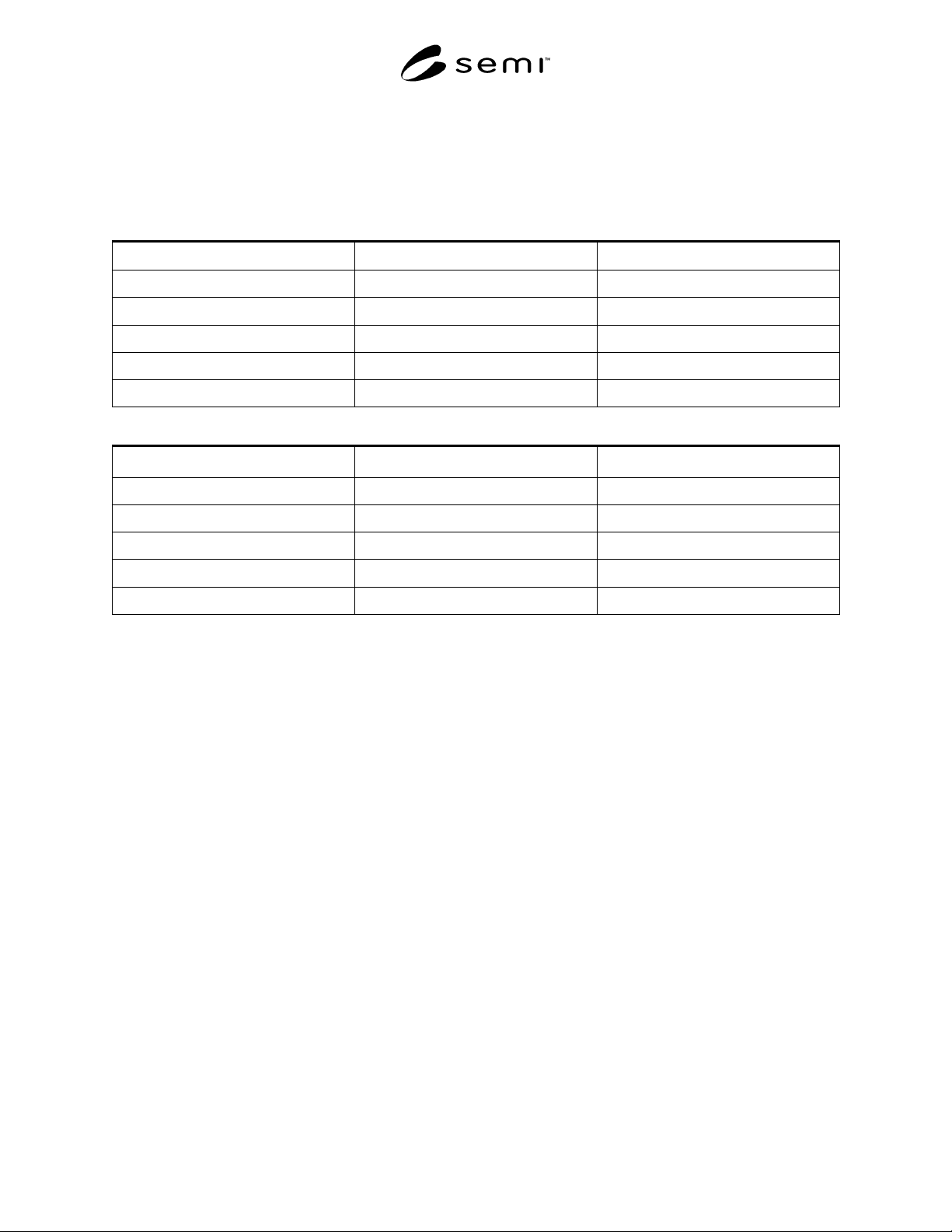
SEMI F7-92 © SEMI 1992, 1999 4
APPENDIX 1
SAMPLE TEST DATA SHEET
NOTE: This related information is not an official part of this SEMI test method and is not intended to modify or
supercede the official test method. It has been derived from industry specifications. Publication was authorized by
full letter ballot procedures. Determination of the suitability of the material is solely the responsibility of the user.
Test Date: Operator: Test Facility:
Tube Manufacturer: Fitting Manufacturer:
Tube O.D.: Fitting Type:
Tube Wall Thickness: Fitting Size:
Tube P/N: Fitting P/N:
Tube Material: Fitting Material:
Tensile Force Newtons
Sample Maximum Tensile Force Mode of Failure
1
2
3
Average =
Standard Deviation =
NOTICE: These standards do not purport to address safety issues, if any, associated with their use. It is the
responsibility of the user of these standards to establish appropriate safety and health practices and determine the
applicability of regulatory limitations prior to use. SEMI makes no warranties or representations as to the suitability
of the standards set forth herein for any particular application. The determination of the suitability of the standard is
solely the responsibility of the user. Users are cautioned to refer to manufacturer's instructions, product labels,
product data sheets, and other relevant literature respecting any materials mentioned herein. These standards are
subject to change without notice.
The user's attention is called to the possibility that compliance with this standard may require use of copyrighted
material or of an invention covered by patent rights. By publication of this standard, SEMI takes no position
respecting the validity of any patent rights or copyrights asserted in connection with any item mentioned in this
standard. Users of this standard are expressly advised that determination of any such patent rights or copyrights, and
the risk of infringement of such rights, are entirely their own responsibility.
Copyright by SEMI® (Semiconductor Equipment and Materials
International), 3081 Zanker Road, San Jose, CA 95134. Reproduction o
f
the contents in whole or in part is forbidden without express written
consent of SEMI.

SEMI F8-0998 © SEMI 1992, 19981
SEMI F8-0998
TEST METHOD FOR EVALUATING THE SEALING CAPABILITIES OF
TUBE FITTING CONNECTIONS MADE OF FLUOROCARBON
MATERIALS, WHEN SUBJECTED TO TENSILE FORCES
1 Purpose
1.1 This method provides a uniform procedure to
determine the sealing capabilities of tube fitting
connections made of fluorocarbon materials when the
connections are subjected to tensile forces.
2 Scope
2.1 This method can be used to characterize tube
fitting connections on the basis of test data developed
under the conditions described herein, but the results
are not intended to imply a performance rating.
2.2 Tube defined in this method has a circular cross
section and is made of fluorocarbon materials.
2.3 All parts of the tube fittings tested by this method
in contact with the internal fluid are made of
fluorocarbon materials.
2.3.1 Parts such as a nut or gripper are not limited to
being made of a fluorocarbon material.
2.4 Only the seal between the tube and tube fitting
being evaluated is within the scope of this document.
All other, threaded seals are beyond the scope of this
document.
2.5 When using this method for making comparisons
between various tube fittings and/or manufacturers, the
user must be specific in the selection of the tube and
tube fittings to be evaluated.
2.6 The International System of Units (SI) is used as
the standard unit of measure in this document. The U.S.
Customary units are in parentheses for reference
purposes only and have been rounded to the nearest
whole value.
3 Referenced Documents
3.1 ASTM Standards
1
D 3307 PFA — Fluorocarbon Molding and Extrusion
Materials
D 3296 — Standard Specification for FEP
Fluorocarbon Tube
1 American Society for Testing and Materials, 100 Barr Harbor
Drive, West Conshohoken, PA 19428-2959
4 Summary of Method
4.1 Subject tube fitting connections made of
fluorocarbon materials to extreme tensile forces, while
maintaining a specified pressure to the internal cavity of
the fitting and tube.
5 Significance and Use
5.1 In the manufacturing of semiconductor products,
many types of hazardous chemicals and solvents are
required. As a result, tubing and various fitting designs
made of fluorocarbon materials (which are chemically
resistant to these fluids) are used to transport those
fluids. It is important to control the testing process
when evaluating various fitting designs, so that accurate
comparisons of the sealing capabilities of tube fitting
connections can be made.
5.2 It is the intent of this method to provide a
procedure in which the air pressure and tensile force
will be applied to tube fitting connections made of
fluorocarbon materials. By using this method, accurate
comparisons of various tube fitting designs can be
achieved.
5.3 The results obtained when usin g this method are
applicable only to conditions that specifically duplicate
the procedures used within this method.
5.4 When using this test method, it is assumed that the
test specimens are truly representative of the material
and manufacturing process specified for that product.
Departure from this assumption could introduce
discrepancies that are greater than those introduced by
departure from the details of the procedure outlined in
this method.
6 Terminology
6.1 Acronyms
6.1.1 O.D. — Outside diameter
6.1.2 P/N — Part number
6.2 Definitions
6.2.1 characterize — To describe the quality of.
6.2.2 failure — Tube separation from a tube fitting
connection or tearing of the tube.
6.2.3 standard deviation — A measure of the variation
among the members of a statistical sample.