semi合集-English.pdf - 第3899页
SEMI F29-0997 © SEMI 1997, 1103 2 5.2.7 pigtail bleed — a pigtail bl eed is a reverse flow of purge gas from the pigtail to minimize atm ospheric intrusion into the gas panel. 5.2.8 purge cycle — following the initial pr…

SEMI F29-0997 © SEMI 1997, 1103 1
SEMI F29-0997 (Reapproved 1103)
TEST METHOD FOR PURGE EFFICACY OF GAS SOURCE SYSTEM
PANELS
This test method was technically approved by the Global Gases Committee and is the direct responsibility of
the North American Gases Committee. Current edition approved by the North American Regional Standards
Committee on September 3, 2003. Initially available at www.semi.org September 2003; to be published
November 2003. Originally published September 1997.
1 Purpose
1.1 This document defines the purge efficacy test
method recommended for determining the minimum
acceptable level of purge efficacy for gas source
systems used in semiconductor manufacturing. It is also
intended as an aid to the procurement of gas source
equipment.
NOTE 1: Users of this specification are encouraged to submit
suggested revisions or other comments to SEMI.
2 Scope
2.1 This specification applies to gas source equipment
used in semiconductor manufacturing facilities and
comparable research and development areas. It includes
contamination testing requirements for gas source
systems.
2.2 The tests covered by this document are as follows:
2.2.1 Purge efficacy with a non-interactive gas using
manufacturers’ standard purge sequence.
2.2.2 Purge efficacy with a non-interactive gas using
the test method specified purge sequence.
2.2.3 Purge efficacy with an interactive gas using
manufacturers’ standard purge sequence.
2.2.4 Purge efficacy with an interactive gas using the
test method specified purge sequence.
NOTICE: This standard does not purport to address
safety issues, if any, associated with its use. It is the
responsibility of the users of this standard to establish
appropriate safety and health practices and determine
the applicability of regulatory or other limitations prior
to use.
3 Limitations
3.1 The document is not intended to determine the safe
operation of a gas source system. The test method
described here is for determining the removal efficacy
of hazardous gas from the pigtail portion of the gas
panel during routine cylinder change operations (pre-
purge). It does not address the purge condition after the
change of the cylinder (post-purge) nor the purge of the
entire gas source system which is usually performed
following its initial installation or during maintenance
(maintenance purge).
3.2 Because the response time of moisture and oxygen
analyzers utilizing different technologies can differ
significantly, this can lead to the possibility that
different instruments will report different peak heights
when measuring identical contaminant spikes.
Therefore, results of tests should only be compared
when similar analyzers are used.
4 Referenced Standards
None.
5 Terminology
5.1 Abbreviations and Acronyms
5.1.1 ppb — Molar parts per billion, same as ppbv.
5.1.2 ppm — Molar parts per million, same as ppmv.
5.2 Definitions
5.2.1 clean dry air (CDA) — filtered air filtered to 0.02
mm and dried to a dew point of at least -80° C.
5.2.2 dry down — removal of residual moisture in a
gas delivery or distribution system, often accomplished
by flowing a stream of high purity dry inert gas
continuously through the system for an extended period
of time.
5.2.3 dwell time — the time for which vacuum or
pressure is applied during the evacuation or
pressurization steps of a purge operation.
5.2.4 interactive gas — a gas that will readily adsorb to
the surface of a vessel used to contain or transport it.
Examples of interactive gases are hydrogen chloride
and moisture.
5.2.5 non-interactive gas — a gas that will not adsorb
to the surface of a vessel used to contain or transport it.
Examples of non-interactive gases are oxygen and
nitrogen.
5.2.6 pigtail — the pigtail is the part of the gas source
equipment that is the flexible connection between the
cylinder and the gas panel.

SEMI F29-0997 © SEMI 1997, 1103 2
5.2.7 pigtail bleed — a pigtail bleed is a reverse flow
of purge gas from the pigtail to minimize atmospheric
intrusion into the gas panel.
5.2.8 purge cycle — following the initial process vent
step, a cycle is defined as a pressurization step followed
by an evacuation step.
5.2.9 purified nitrogen — nitrogen purified to meet the
following characteristics:
Moisture < 20 ppb
Oxygen < 10 ppb
Total hydrocarbons < 1 ppm
CO
2
< 1 ppm
CO < 1 ppm
6 Ordering Information
6.1 Orders for equipment or services requiring purge
efficacy testing in accordance with this test method
shall include the following:
6.1.1 This test method number and date of issue.
6.1.2 Test requirements as defined in the detailed
specifications for the specific product being purchased.
6.1.3 Whether certifications of tests and a report of the
test results is required.
7 Requirements
7.1 Personnel Qualification — Personnel performing
tests in accordance with this specification shall have
suitable training and experience. Such personnel
should, as a minimum,
7.1.1 be trained and experienced in operation of gas
source control equipment,
7.1.2 be trained and experienced in the use of oxygen
and moisture analyzers, and
7.1.3 be familiar with the operation and calibration of
the specific equipment used in performing the tests.
8 Apparatus
8.1 Oxygen Analyzer — The oxygen analyzer should
meet or exceed the following characteristics:
Limit of Detection 10 ppb
Accuracy ± 10 ppb
8.2 Moisture Analyzer — The moisture analyzer
should meet or exceed the following characteristics:
Limit of Detection 10 ppb
Accuracy ± 10 ppb
8.3 Pressure Transducer — The transducer should be
of a high-purity type with minimal dead volume and
meet or exceed the following characteristics:
Accuracy ± 3.4 kPa (0.5 psi)
Hysteresis ± 3.4 kPa (0.5 psi)
Non-Repeatability ± 0.7 kPa (0.1 psi)
8.4 Mass Flow Controller or Flow Meter — The mass
flow controller or flow meter should be accurate to ±
0.2 slpm.
8.5 Moisture Source — The moisture source must be
capable of providing a 2 slpm continuous flow of 2.0 ±
0.2 ppm moisture in nitrogen mixture at 138 kPa (g) [20
psi (g)] for a minimum of 30 minutes.
9 Procedure
9.1 Purge efficacy determination with non-interactive
gas at manufacturer’s recommended pressure, vacuum,
and dwell times.
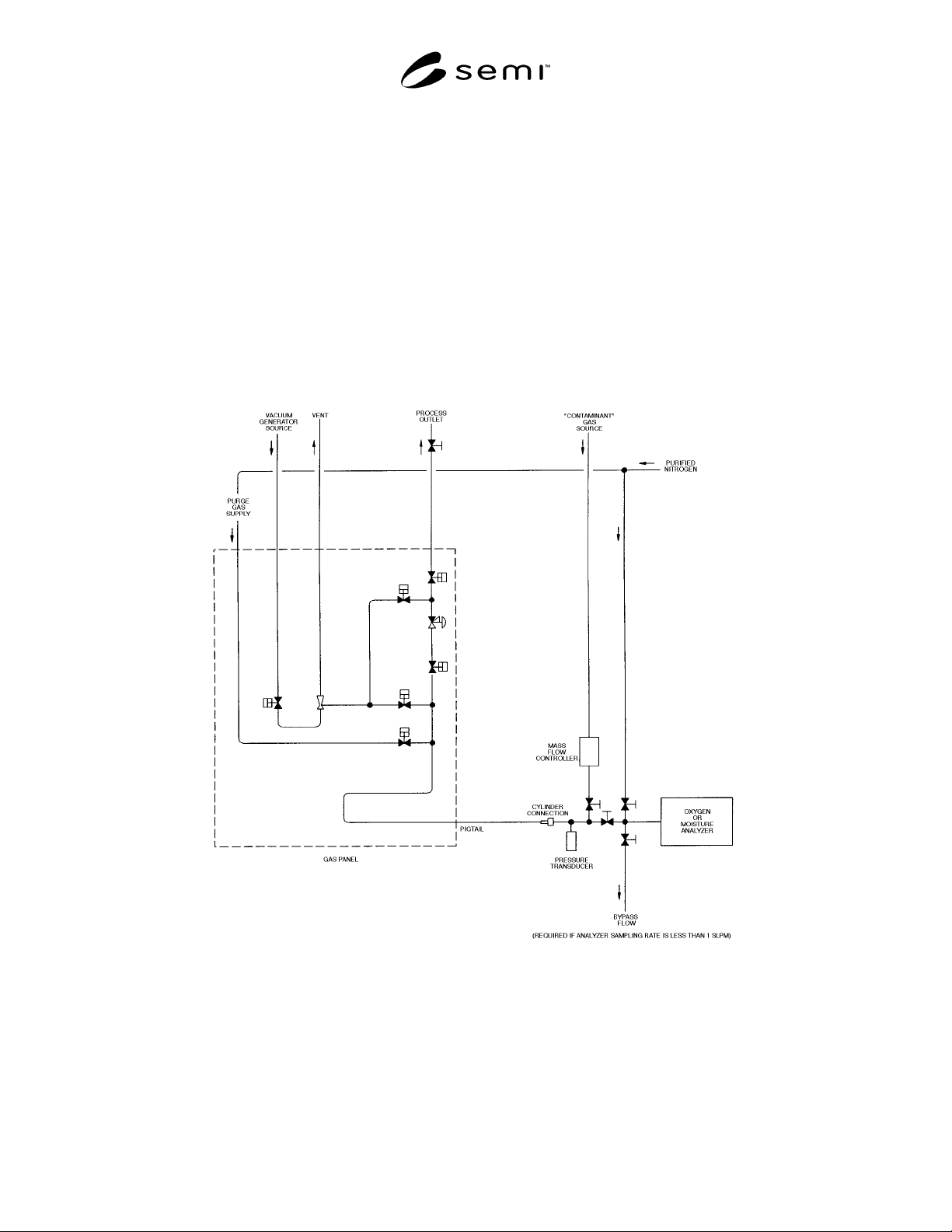
9.1.1 Connect gas source equipment as in Figure 1.
NOTE 2: To avoid biasing the test results by substantially
increasing piping volume to be purged, the dead space
between the cylinder connection and the valves isolating the
analyzer and the contaminant source must be small compared
to the total pigtail volume. The use of mono-block valve and
flow-through type pressure transducer is highly
recommended.
9.1.1.1 However, the pigtail is connected to the
cylinder valve during the purge in an actual cylinder
change operation. The small additional volume to be
purged in the test setup may be used to account for the
volume of the cylinder valve outlet cavity, which must
be purged during a cylinder change.
9.1.2 To challenge the gas panel with a known
contaminant gas, completely fill and pressurize the gas
source system to 207 kPa (g) [30 psi (g)] with CDA as
measured at the pigtail with the pressure transducer.
9.1.3 Using purified nitrogen as the purge gas,
complete one purge cycle at the manufacturer’s
recommended pressure, vacuum, and dwell times.
9.1.4 Flow purified nitrogen using a pigtail bleed at 1
slpm or at the oxygen analyzer manufacturer’s
recommended flow rate, whichever is higher, into the
oxygen analyzer for 10 minutes or until below the
detection limit of the oxygen analyzer.
SEMI F29-0997 © SEMI 1997, 1103 3
9.1.5 Record the pressure and peak oxygen concentration in Table 1. It is highly recommended that, in addition to
the peak oxygen concentration, the oxygen concentration readings also be recorded at regular intervals during the
measurement, so that a graph of the oxygen concentration level in the pigtail bleed gas versus time can be drawn if
necessary.
9.1.6 Repeat Sections 9.1.2–9.1.5 for 2, 5, 25, and 50 purge cycles at the manufacturer’s recommended pressure,
vacuum and dwell times. Additional tests using other purge cycle numbers are encouraged and may provide a more
complete characterization of the purge performance of the test piece.
9.1.7 Plot the peak residual oxygen concentration versus cycles as in Figure 2 for manufacturer’s recommended
pressure, vacuum, and dwell times.
9.2 Purge efficacy determination with non-interactive gas at standard pressure, vacuum and dwell times.
9.2.1 Connect the gas source equipment as in Figure 1.
Figure 1
Test Schematic
9.2.2 To challenge the gas panel with a known contaminant gas, completely fill and pressurize the gas source
system to 207 kPa (g) [30 psi (g)] with CDA as measured at the pigtail with the pressure transducer.