semi合集-English.pdf - 第4165页
SEMI F67-1101 © SEMI 2001 7 A P PENDIX 1 MFC SI ZING NOTE: The m aterial in this appen d ix is an off icial part of SEMI F67 an d w a s approved by full letter ballot procedures on August 27, 2001. A1-1 T o determ ine pu…
SEMI F67-1101 © SEMI 2001 6
Purge Gas
DUT
Pure Gas
(>9N Purity)
APIMS
or
Ultratrace
Analytical
Instrumentation
Impurity Analyzer
P1
Legend
DUT = Device Under Test
P1 = Test Pressure
R1 = Pure Gas 0–100 psig Regulator
R2 = Challenge Gas 0–100 psig Regulator
R3 = Vent Gas 0–100 psig Back Pressure Regulato
r
V1 = Pure Gas Source Isolation Valve
V2 = Pure Gas System Isolation Valve
V3 = Challenge Gas Source Isolation Valve
V4 = Challenge Gas System Isolation Valve
V5 = Challenge Gas Vent Isolation Valve
Challenge Gas
(~1% Impurity)
V4
V5
V6 V7
V8
V9
Vent
V10
V11
MFC1
R1
V1
V2
V
6 = DUT Inlet Isolation Valve
V7 = DUT Outlet Isolation Valve
V8 = DUT Bypass Inlet Isolation Valve
V9 = DUT Bypass Outlet Isolation Valve
V10 = Impurity Analyzer Sample Isolation Valve
V11 = Impurity Analyzer Purge Gas Isolation Valve
V12 = APIMS/UAI Sample Isolation Valve
V13 = APIMS/UAI Purge Gas Isolation Valve
MFC1 = Pure Gas Mass Flow Controller
MFC2 = Challenge Gas Mass Flow Controller
V13
V12
MFC2
R2
V3
R3
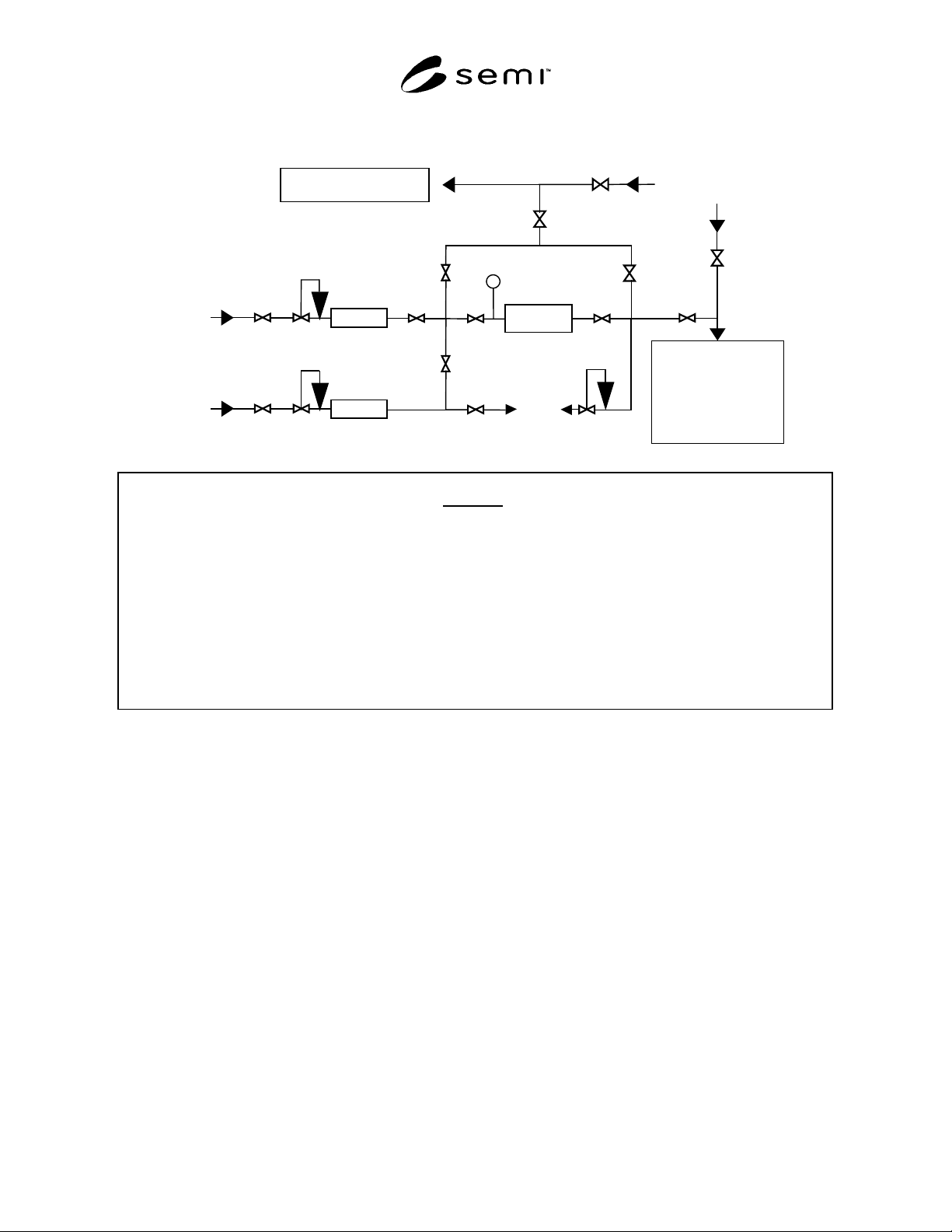
Figure 1
Suggested Point of Use Purifier Capacity Test Setup

SEMI F67-1101 © SEMI 20017
APPENDIX 1
MFC SIZING
NOTE: The material in this appendix is an official part of SEMI F67 and was approved by full letter ballot
procedures on August 27, 2001.
A1-1 To determine purifier efficiency, the
concentration of impurity entering the purifier and the
quantity of impurity downstream of the purifier must be
determined.
A1-2 Determine the manufacturer’s recommended
flow rate for the purifier. As an example, assume a
flow rate of 5 slpm.
A1-3 Determine the flow rate of challenge gas
required. As an example, 5 sccm of a 1% challenge gas
would be blended into 4,995 sccm of pure gas to
generate a 10 ppm test gas.
PPM 10
sccm 4,995sccm 5
sccm 5PPM 10,000
GasTest =
+
×
=
NOTICE: SEMI makes no warranties or
representations as to the suitability of the standard set
forth herein for any particular application. The
determination of the suitability of the standard is solely
the responsibility of the user. Users are cautioned to
refer to manufacturer’s instructions, product labels,
product data sheets, and other relevant literature
respecting any materials mentioned herein. These
standards are subject to change without notice.
The user’s attention is called to the possibility that
compliance with this standard may require use of copy-
righted material or of an invention covered by patent
rights. By publication of this standard, SEMI takes no
position respecting the validity of any patent rights or
copyrights asserted in connection with any item
mentioned in this standard. Users of this standard are
expressly advised that determination of any such patent
rights or copyrights, and the risk of infringement of
such rights, are entirely their own responsibility.
Copyright by SEMI® (Semiconductor Equipment and Materials
International), 3081 Zanker Road, San Jose, CA 95134. Reproduction o
f
the contents in whole or in part is forbidden without express written
consent of SEMI.

SEMI F68-1101 © SEMI 20011
SEMI F68-1101
TEST METHOD FOR DETERMINING PURIFIER EFFICIENCY
This test method was technically approved by the Global Facilities Committee and is the direct responsibility
of the North American Facilities Committee. Current edition approved by the North American Regional
Standards Committee on August 27, 2001. Initially available at www.semi.org September 2001; to be
published November 2001.
1 Purpose
1.1 The purpose of this document is to define a test
method to quantify the efficiency of a purifier for
removal of an active gaseous impurity from a matrix
gas.
2 Scope
2.1 To determine the efficiency of a gas purifier to
remove a given impurity species. Efficiency tests are
performed by adding ppm levels of gaseous impurities
to a pure matrix gas and monitoring the effluent of the
test purifier for active impurity species. Tests are done
at supplier recommended flow rate, operating
temperature and pressure.
2.2 To establish a method of determining instantaneous
purifier efficiency.
2.3 The test method applies to point of use (POU) and
large scale purifiers.
2.4 This method is for UHP efficient removal of low
level contaminants.
2.5 This standard does not purport to address safety
issues, if any, associated with its use. It is the
responsibility of the users of this standard to establish
appropriate and safety health practices and determine
the applicability of regulatory limitations prior to use.
3 Limitations
3.1 The inherent limitation to this method is the limit
of detection (LOD) of the analytical instrument
employed by the user.
3.2 This test method can only be used to compare
purifier efficiency results if the user application for
flow rate, pressure, and temperature are the same as the
test conditions. Different user and/or different
operating conditions may result in different purifier
performance results.
3.3 In testing mixtures of impurities, some impurities
may influence the efficiency results of other impurities.
Discussion with the manufacturer is highly
recommended prior to testing.
3.4 The test method does not apply to particulates.
3.5 This test method will provide efficiency
information only for impurities that are used in the
challenge gas.
4 Referenced Standards
4.1 SEMI Standards
SEMI E29 — Standard Terminology for the Calibration
of Mass Flow Controllers and Mass Flow Meters
SEMI F6 — Guide for Secondary Containment of
Hazardous Gas Piping Systems
SEMI F22 — Guide for Gas Distribution Systems
SEMI F33 — Method for Calibration of Atmospheric
Pressure Ionization Mass Spectrometer (APIMS)
4.2 ANSI Standards
1
ANSI B46.1 — Surface Texture (Surface Roughness,
Waviness, and Lay)
NOTE 1: Unless otherwise indicated, all documents cited
shall be the latest published versions.
5 Terminology
5.1 Abbreviations and Acronyms
5.1.1 APIMS — atmospheric pressure ionization mass
spectrometer
5.1.2 °C — degrees Celsius
5.1.3 DUT — device under test
5.1.4 °F — degrees Fahrenheit
5.1.5 in — inch
5.1.6 kPa — kiloPascal
5.1.7 LOD — limit of detection
5.1.8 m — meter
5.1.9 MFC — mass flow controller
5.1.10 NMHC — non methane hydrocarbons
5.1.11 POU — point of use
5.1.12 ppb — parts per billion, volume basis
1 American National Standards Institute, New York Office: 11 West
42nd Street, New York, NY 10036, USA. Telephone: 212.642.4900;
Fax: 212.398.0023 Website: www.ansi.org