semi合集-English.pdf - 第4460页
SEMI D15-1296 © SEMI 1996, 2003 5 APPENDIX 1 NOTICE : This ap pendix was approved as an offici al part of SEMI D15 by full lette r ballot proce dures. A1-1 Purpose A1-1.1 FPD waviness W fpd requires a l arge amount of ca…
SEMI D15-1296 © SEMI 1996, 2003 4
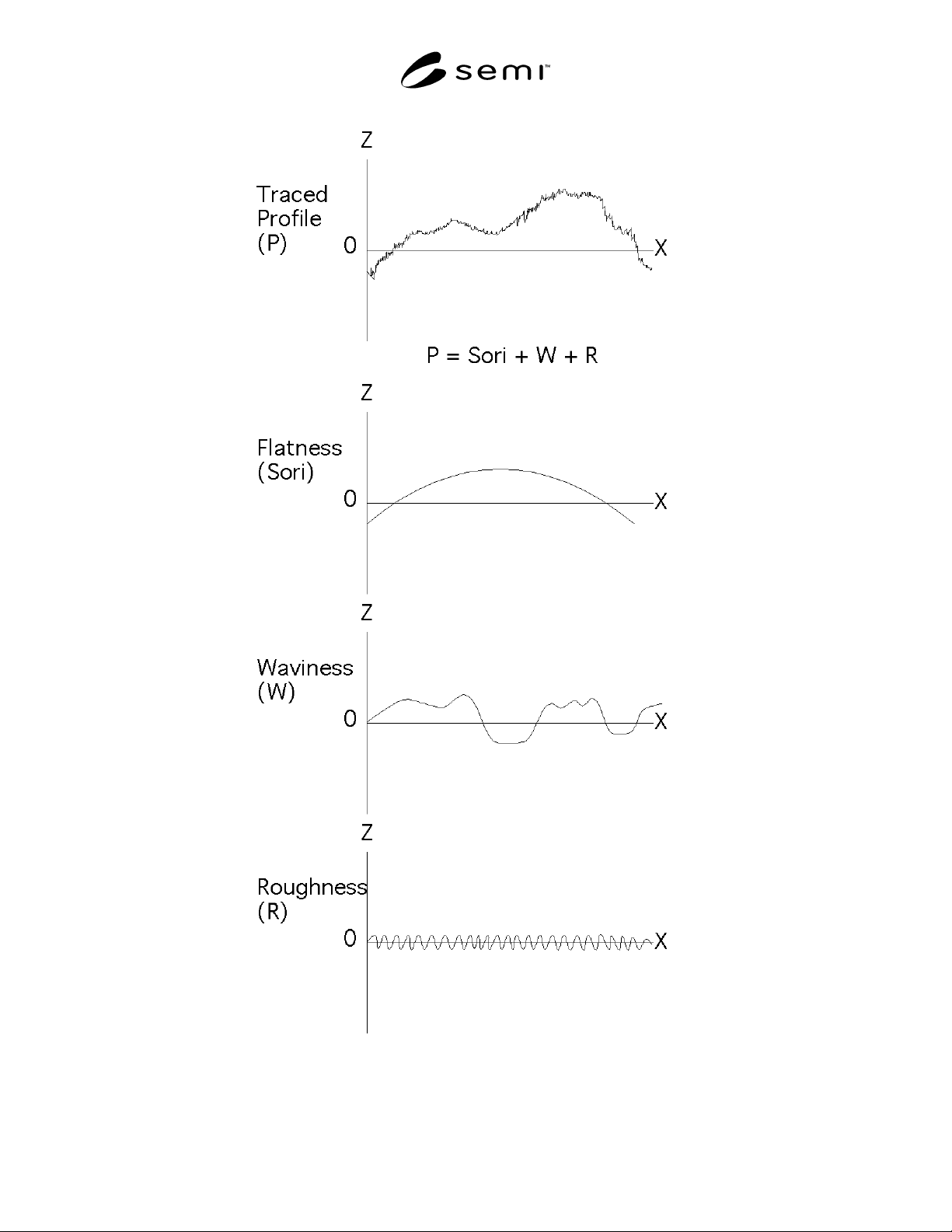
Figure 2
Explanation of Surface Profiles
SEMI D15-1296 © SEMI 1996, 2003 5
APPENDIX 1
NOTICE: This appendix was approved as an official part of SEMI D15 by full letter ballot procedures.
A1-1 Purpose
A1-1.1 FPD waviness W
fpd
requires a large amount of
calculation on this standard.
A1-1.2 Therefore, the approximate calculation method
shown below can be used instead.
A1-2 Terminology
A1-2.1 local peak of profile — the highest point of
profile between two adjacent minima of the profile.
A1-2.2 local valley of profile — the lowest point of
profile between two adjacent maxima of the profile.
A1-2.3 window — a sampling length for evaluation.
A1-3 Calculation Method
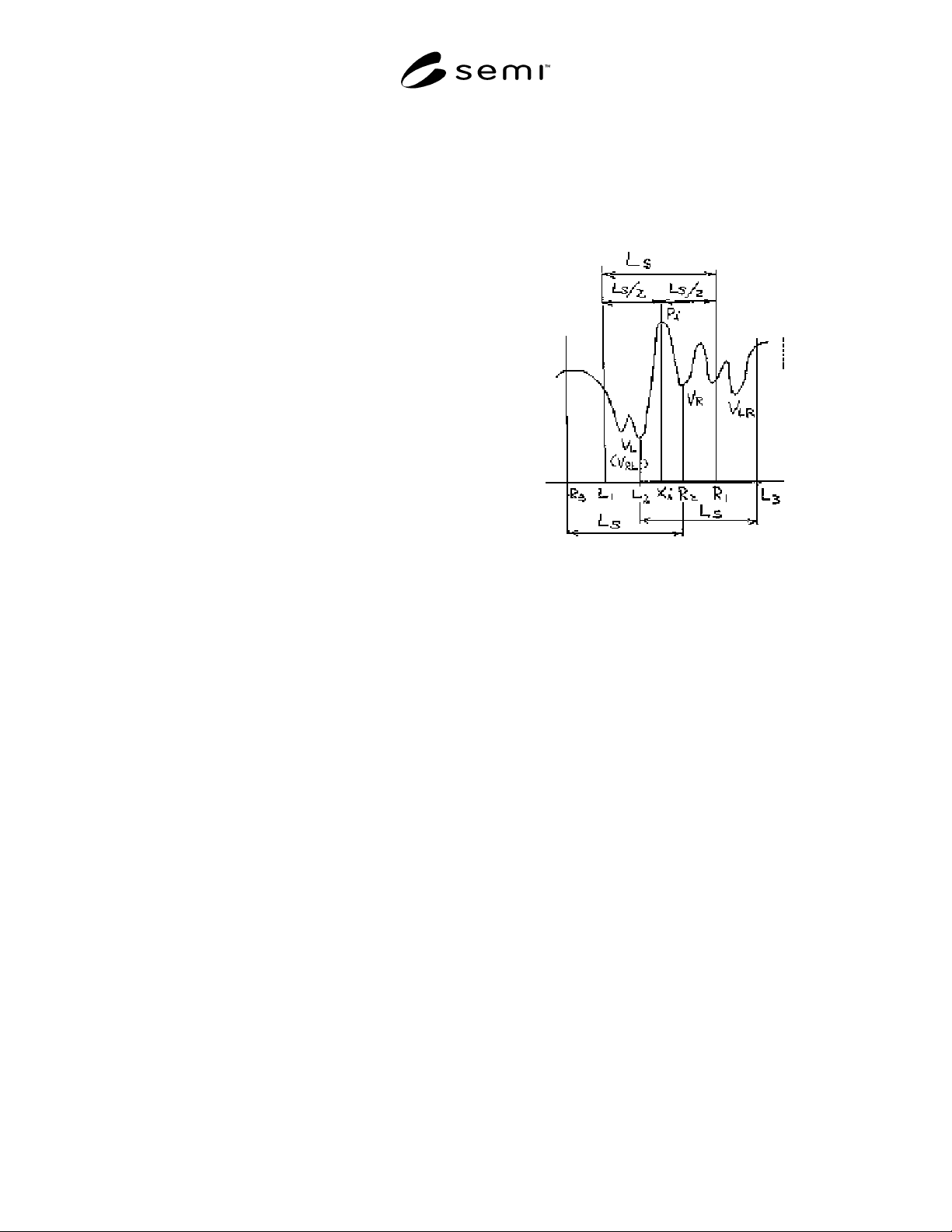
A1-3.1 Search all local peaks and local valleys within
the evaluation length.
A1-3.2 Calculation of a waviness value based on a
local peak.
A1-3.2.1 Calculation of a waviness value, W
iL
, based
in the left window of a local peak, P
i
(position X
i
).
1. Open the left window (L
1
− X
i
) with L
s
/2 width
from the local peak, P
i
.
2. Search the lowest point, V
L
(position L
2
), in the
window (L
1
− X
i
).
3. Find the point L
3
= L
2
+ L
s
and open the window
(X
i
− L
3
).
4. Search the lowest point, V
LR
, in the window
(X
i
− L
3
).
5. W
iL
= |Z
i
− (V
L
+ V
LR
) /2|
A1-3.2.2 Calculation of a waviness value, Wi
R
, based
in the right window of a local peak, P
i
.
1. Open the right window (X
i
− R
1
) with L
s
/2 width
from the local peak, P
i.
.
2. Search the lowest point, VR (position R
2
), in the
window (X
i
− R
1
).
3. Find the point R
3
= R
2
- Ls and open the window
(R
3
− X
i
).
4. Search the lowest point, V
RL
, in the window
(R
3
− X
i
).
5. W
iR
= |Z
i
− (V
R
+ V
RL
) /2|
A1-3.2.3 Calculate W
iL
and W
iR
on all local peaks, P
i
,
then calculate the maximum value, WP
max
.
WP
max
= max {W
iL
, W
iR
} (i = 1 to n)
Figure A1-1
Calculation Points of a Local Peak
A1-3.3 Calculation of a waviness value based on a
local valley.
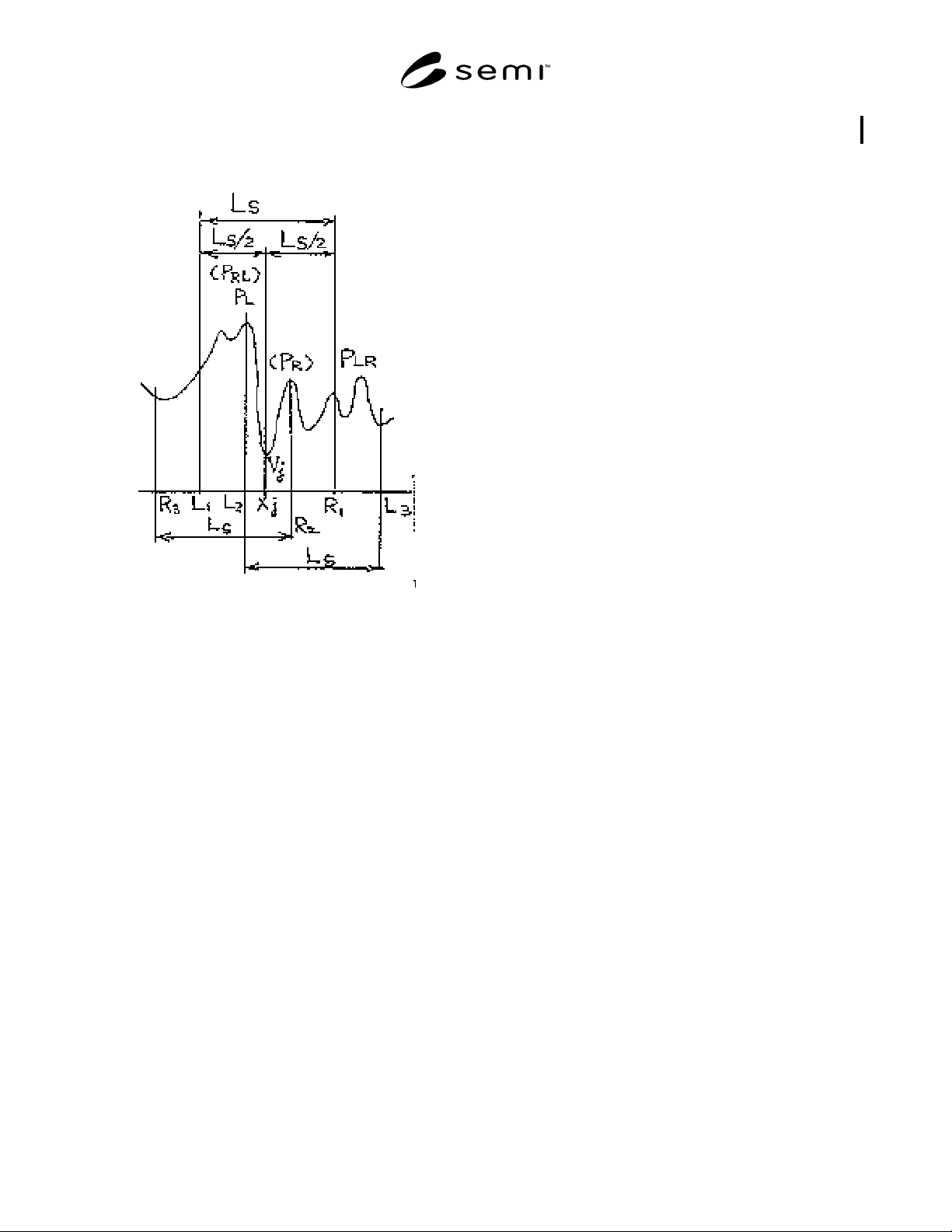
A1-3.3.1 Calculation of a waviness value, W
jL
, based
in the left window of a local valley, V
j
(position X
j
).
1. Open the left window (L
1
− X
j
) with L
s
/2 width
from the local valley, V
j
.
2. Search the highest point, P
L
(position L
2
), in the
window (L
1
− X
j
).
3. Find the point L
3
= L
2
+ L
s
and open the window
(X
j
− L
3
).
4. Search the highest point, P
LR
, in the window
(X
j
− L
3
).
5. W
jL
= |Z
j
− (P
L
+ P
LR
) /2|
A1-3.3.2 Calculation of a waviness value, W
jR
, based
in the right window of a local valley, V
j
.
1. Open the right window (X
j
− R
1
) with L
s
/2 width
from the local valley, V
j
.
2. Search the highest point, P
R
(position R
2
), in the
window (X
j
− R
1
).
3. Find the point R
3
= R
2
− L
s
and open the window
(R
3
− X
j
).
SEMI D15-1296 © SEMI 1996, 2003 6
4. Search the highest point, P
RL
, in the window
(R
3
− X
j
).
5. W
jR
= |Z
j
− (P
R
+ P
RL
) /2|
Figure A1-2
Calculating Points of a Local Valley
A1-3.3.3 Calculate W
jL
and W
j
R on all local valleys,
V
j
, then calculate the maximum value, WV
max
.
WV
max
= max {W
jL
, W
jR
} (j = 1 to n)
A1-3.4 Calculation of FPD Waviness, W
fpd
—
Calculate the maximum value among all maximum
values calculated in Sections 3.2.3 and 3.3.3.
W
fpd
= max {WP
max
, WV
max
}
NOTICE: SEMI makes no warranties or
representations as to the suitability of the standards set
forth herein for any particular application. The
determination of the suitability of the standard is solely
the responsibility of the user. Users are cautioned to
refer to manufacturer’s instructions, product labels,
product data sheets, and other relevant literature
respecting any materials mentioned herein. These
standards are subject to change without notice.
The user’s attention is called to the possibility that
compliance with this standard may require use of
copyrighted material or of an invention covered by
patent rights. By publication of this standard, SEMI
takes no position respecting the validity of any patent
rights or copyrights asserted in connection with any
item mentioned in this standard. Users of this standard
are expressly advised that determination of any such
patent rights or copyrights, and the risk of infringement
of such rights, are entirely their own responsibility.
Copyright by SEMI® (Semiconductor Equipment and Materials
International), 3081 Zanker Road, San Jose, CA 95134. Reproduction o
f
the contents in whole or in part is forbidden without express written
consent of SEMI.