semi合集-English.pdf - 第4745页
SEMI C6.4-90 © SEMI 1990, 2002 1 SEMI C6.4-90 (Reapproved 1102) PARTICLE SPECIFICATION FOR GRADE 20/0.02 NITROGEN (N 2 ) AND ARGON (Ar) DELIVERE D AS PIPELINE GAS This specification was technically approved b y the Globa…
SEMI C6.3-89 © SEMI 1989, 2003 2
6.4 Determine the background count for the particle
counter by using the standard method recommended by
the instrument manufacturer using hydrogen gas.
7 Specification
7.1 Maximum permissible total concentration: 20
particles per SCF equal to or larger than 0.2
micrometers, after subtracting background count as
defined in Section 4.1.1.
7.2 The specification will be considered as met, if the
particle concentration does not exceed 20 particles per
SCF in any five consecutive sampling periods as
defined in Section 4.1.5.
8 Report
8.1 Report each of the five consecutive sampling
periods to read as total number of particles per SCF7 of
gas, equal to or larger than 0.2 micrometers optical
equivalent diameter, without reference to any specific
size distribution function. The background count shall
be reported as defined in Section 4.1.1.
9 Calibration
9.1 The optical particle counter is normally calibrated
using latex spheres of a known diameter suspended in a
gas. Since the gas density and refractive index enter
into the amount of scattering detected by the
instrument, hydrogen should be used for calibration.
10 Safety
10.1 The lower explosive limit (LEL) for hydrogen in
air is 4%; therefore, proper precautions should be taken
to insure that the maximum possible concentration of
hydrogen in air does not exceed 2%. The particle
counter and any other ancillary equipment must be
checked for leaks and the hydrogen exiting the
equipment must be disposed of appropriately to insure
that its concentration in air at any point does not exceed
2%.
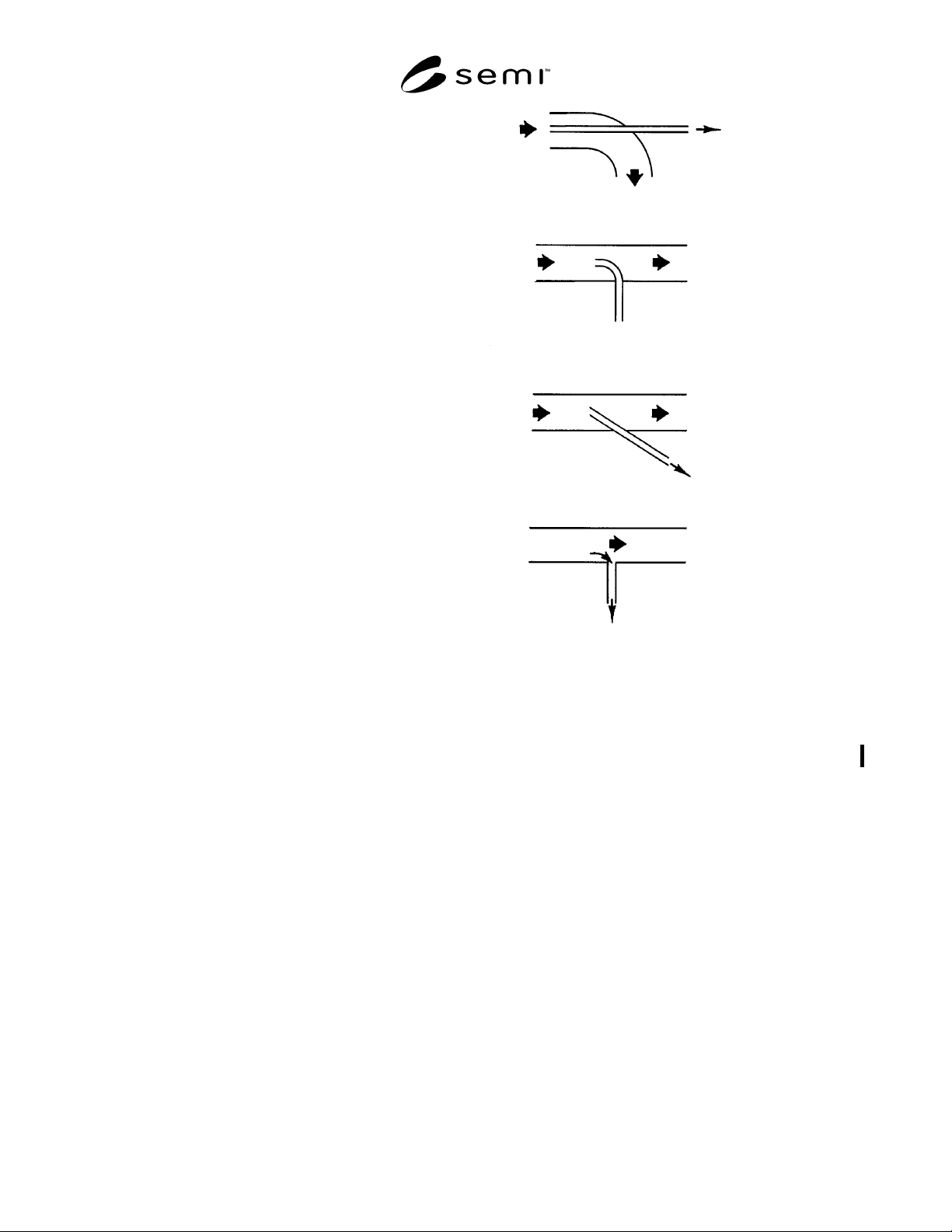
(a)
(b)
(c)
(d)
Figure 1
Schematic Diagrams of Configurations of
Different Merit for Obtaining Particle Samples
from Pipelines
NOTICE: SEMI makes no warranties or
representations as to the suitability of the standards set
forth herein for any particular application. The
determination of the suitability of the standard is solely
the responsibility of the user. Users are cautioned to
refer to manufacturer' s instructions, product labels,
product data sheets, and other relevant literature,
respecting any materials or equipment mentioned
herein. These standards are subject to change without
notice.
By publication of this standard, Semiconductor
Equipment and Materials International (SEMI) takes no
position respecting the validity of any patent rights or
copyrights asserted in connection with any items
mentioned in this standard. Users of this standard are
expressly advised that determination of any such patent
rights or copyrights, and the risk of infringement of
such rights are entirely their own responsibility.
Copyright by SEMI® (Semiconductor Equipment and Materials
International), 3081 Zanker Road, San Jose, CA 95134. Reproductio
n
of the contents in whole or in part is forbidden without express writte
n
consent of SEMI.
SEMI C6.4-90 © SEMI 1990, 2002 1
SEMI C6.4-90 (Reapproved 1102)
PARTICLE SPECIFICATION FOR GRADE 20/0.02 NITROGEN (N
2
) AND
ARGON (Ar) DELIVERED AS PIPELINE GAS
This specification was technically approved by the Global Gases Committee and is the direct responsibility of
the North American Gases Committee. Current edition approved by the North American Regional Standards
Committee on July 21, 2002. Initially available at www.semi.org October 2002; to be published November
2002. Originally published in 1990.
1 Purpose
1.1 The purposes of this document are: (1) to set a
maximum permissible particle concentration for
20/0.02 grade nitrogen and argon bulk supply gases,
and (2) to describe a reference method for its
verification.
2 Scope
2.1 This document applies only to nitrogen gas and
argon gas delivered through pipelines; it is not
applicable to cylinder gases or gases in their liquid
state.
2.2 This standard does not purport to address safety
issues, if any, associated with its use. It is the
responsibility of the users of this standard to establish
appropriate safety health practices and determine the
applicability or regulatory limitations prior to use.
3 Terminology
3.1 Variables
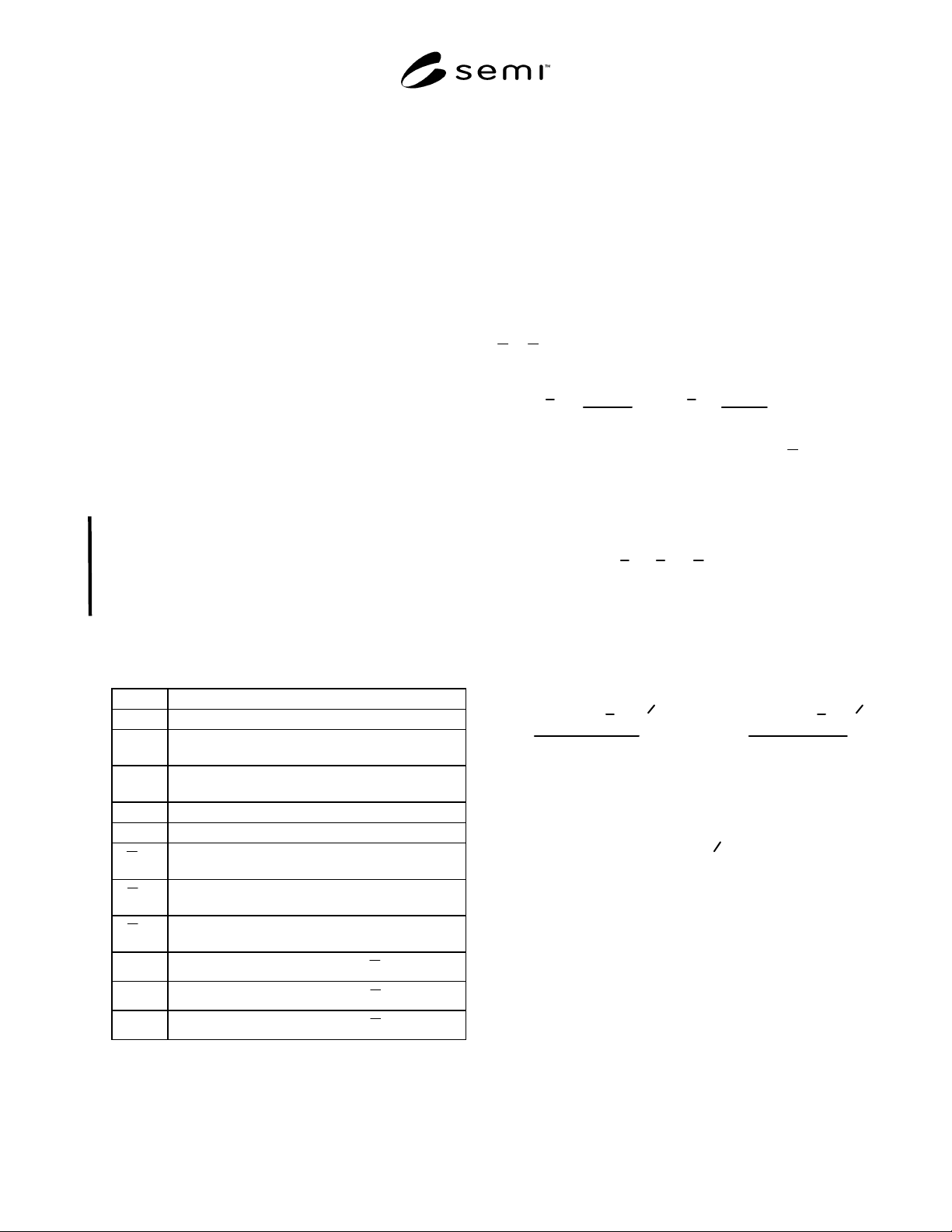
V
Mi
= Volume of the i
th
sample interval of the pipeline gas
V
Bi
= Volume of the i
th
sample interval of the background
X
Mi
= Concentration of particles observed in the i
th
sample
interval of the pipeline gas
X
Bi
= Concentration of particles observed in the i
th
sample
interval of the background
N
M
= Number of sample intervals of the pipeline gas
N
B
= Number of sample intervals of the background
M
X=
Average observed concentration of counts in the
pipeline gas sample
B
X=
Average observed concentration of background
counts
C
X=
Calculated concentration of particles in the pi
p
eline
gas
S
M
=
Standard deviation of
M
X
S
B
=
Standard deviation of
B
X
S
C
=
Standard deviation of
C
X
3.2 Gas Sample Volume (V
Mi
, V
Bi
) — The volume of
the sample interval, expressed in standard liters at
standard conditions, 0° C (32° F) and 1.00° atmosphere
pressure. Standard Cubic Feet (SCF) is defined at
21.1° C (70° F) and 1.00° atmosphere pressure.
3.3 Average Observed Concentration of Counts
(
M
X ,
B
X ) — The average concentration of counts, i.e.:
X
M
=
X
Mi
∑
N
M
X
B
=
X
Bi
∑
N
B
3.4 Calculated Concentration of Particles (
C
X ) —
The concentration of particles in the pipeline gas
obtained by correcting the observed concentration in
the pipeline gas for the observed concentration in the
background, i.e.:
X
C
=
X
M
− X
B
3.5 Standard Deviation (S
M
, S
B
, S
C
) — A statistical
measure of the spread of the concentration of the counts
or particles. The first two are obtained from the interval
and average concentrations and the number of intervals,
i.e.:
S
M
=
X
Mi
−
X
M
()
2
∑
N
M
− 1
()
1
2
S
B
=
X
Bi
−
X
B
()
2
∑
N
B
− 1
()
1
2
The third is obtained from the first two, i.e.:
S
C
= S
M
2
+ S
B
2
(
)
1
2
NOTE 1: These expressions are derived from an assumption
of a Gaussian (Normal) distribution.
4 Apparatus
4.1 Particle Counter — An instrument suitable for
counting particles in gaseous nitrogen or argon with a
minimum detection efficiency of 90% at 0.02
micrometers as determined by the manufacturer of the
particle counter. Condensation nucleus counters
(CNCs) typically satisfy this requirement.
4.2 Pressure Reducer — An accessory required for
counters operated at atmospheric pressure, it should
SEMI C6.4-90 © SEMI 1990, 2002 2
preferably use expansion of the gas through a critical
orifice.
5 Test Method
NOTE 2: The details of sampling configuration,
measurement procedure, and instrument calibration procedure
and frequency must be agreed upon by the user and supplier,
taking into account good engineering practice.
5.1 Determine the average observed concentration of
counts in the background (
B
X ) by passing air, nitrogen
or argon, believed to be free of particles of 0.02
micrometers or more in diameter, through the
instrument and recording the total number of counts.
Count a minimum of 8 sample intervals, each at least
25 standard liters (0.95 SCF) or 30 minutes, whichever
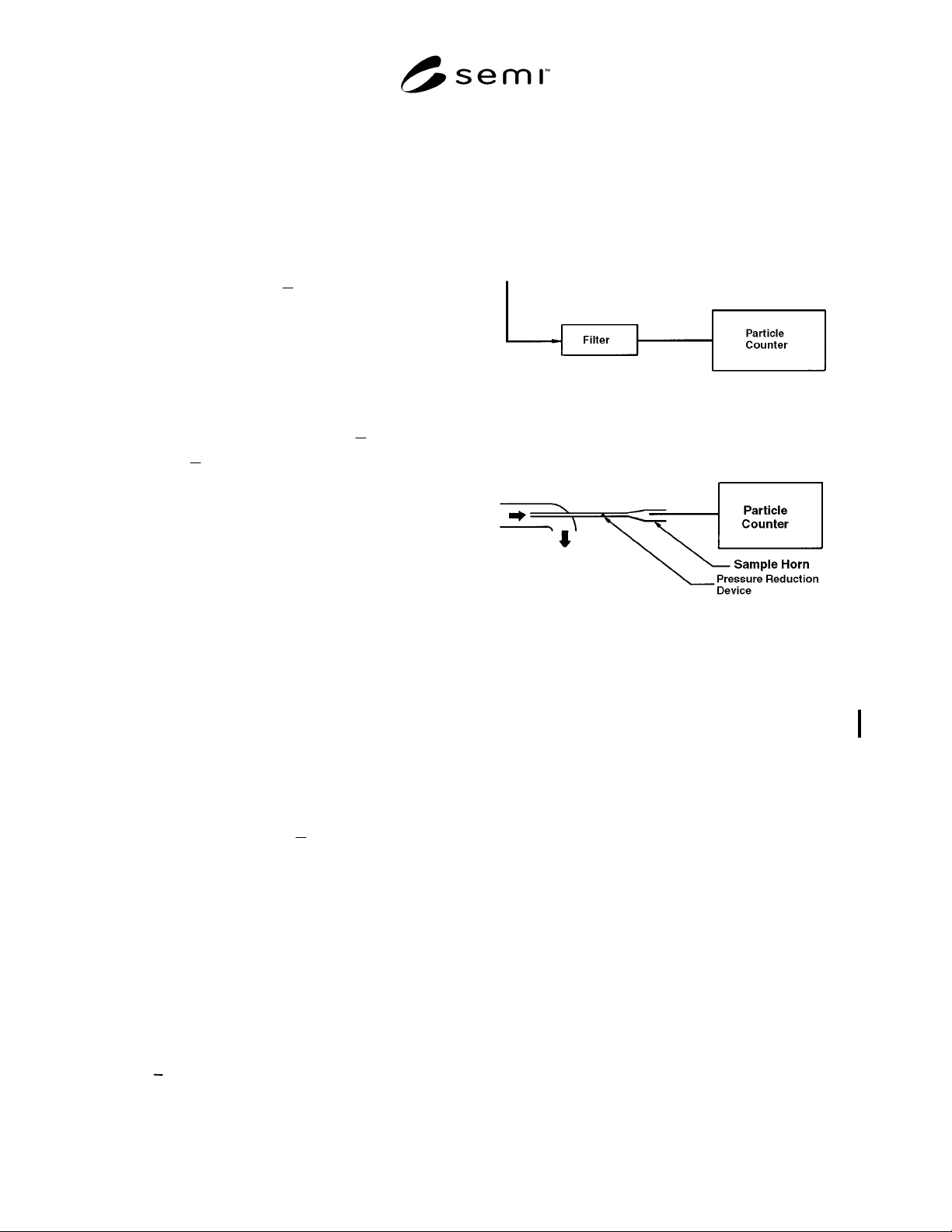
is greater. A suggested assembly for performing this
test, using a filter which removes particles in this size
range, is shown in Figure 1. Calculate
B
X as defined in
Section 3.
B
X must not exceed 2 particles per 25
standard liters.
5.2 The sampling point should be at outlet of system,
and sampling lines should be as short as possible.
5.3 A suggested sampling probe configuration for
turbulent main line flow is shown in Figure 2. The flow
rate in the sampling tube at pipeline pressure should be
set so that the mean sampling flow velocity at the probe
inlet matches as closely as possible the axial flow
velocity in the pipeline. The pitot sampling tube ID
should be no less than 2 mm (0.08 inch). The orifice
and sampling horn should be sized so that the mean
flow velocity at the particle counter probe inlet matches
the axial flow velocity in the horn as closely as
possible.
5.4 Count the particles in each of at least 8 sample
intervals. Each sample interval must be at least 25
standard liters or 30 minutes, whichever is greater.
Record the number of counts and the sample volume
for each interval. Calculate
C
X and S
C
, as defined in
Section 3.
6 Specification
6.1 Maximum Permissible Particle Concentration —
20 particles per 25 standard liters as determined by the
instrument specified in Section 4.
6.2 The specification will be considered met if the
calculated concentration of particles plus two standard
deviations does not exceed 20 particles per 25 standard
liters, i.e.:
X
C
+
2
∗
S
C
≤
20
p
articles/25 standard
7 Report
7.1 The report shall contain the values of all the
variables defined in Section 3.
8 Precision
8.1 This test procedure defines the requirements to
satisfy the specification at the 95% confidence level.
Figure 1
Suggested Assembly for Determining Particle
Counter Background
Figure 2
Schematic Diagram of Configuration for Obtaining
Particle Samples from Pipelines
NOTICE: SEMI makes no warranties or
representations as to the suitability of the standards set
forth herein for any particular application. The
determination of the suitability of the standard is solely
the responsibility of the user. Users are cautioned to
refer to manufacturer’s instructions, product labels,
product data sheets, and other relevant literature
respecting any materials mentioned herein. These
standards are subject to change without notice.
The user’s attention is called to the possibility that
compliance with this standard may require use of
copyrighted material or of an invention covered by
patent rights. By publication of this standard, SEMI
takes no position respecting the validity of any patent
rights or copyrights asserted in connection with any
item mentioned in this standard. Users of this standard
are expressly advised that determination of any such
patent rights or copyrights, and the risk of infringement
of such rights, are entirely their own responsibility.
Copyright by SEMI® (Semiconductor Equipment and Materials
International), 3081 Zanker Road, San Jose, CA 95134. Reproduction o
f
the contents in whole or in part is forbidden without express written
consent of SEMI.