semi合集-English.pdf - 第4772页
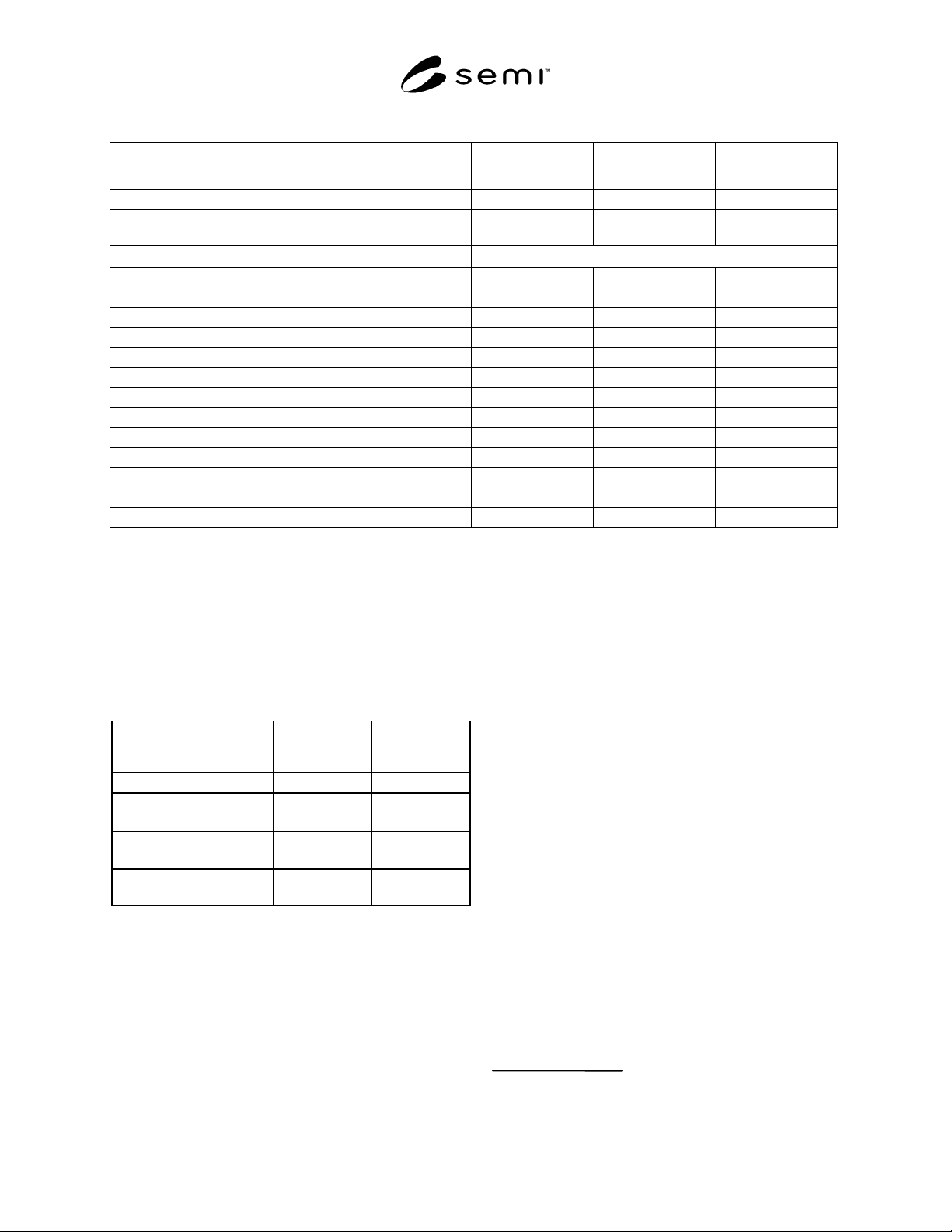
SEMI C54-1103 © SEMI 2003 2 Table 1 Impurity a nd Other Requirements for Various Grades of Ox ygen Previous SEMI Reference # C3.22-1000 (Specification) C3.23-1000 (Specification) C3.41-0697 (Specification) Grade 2.5 3.8 …

SEMI C54-1103 © SEMI 2003 1
SEMI C54-1103
SPECIFICATIONS AND GUIDELINES FOR OXYGEN
This specification was technically approved by the Global Gases Committee and is the direct responsibility of
the North American Gases Committee. Current edition approved by the North American Regional Standards
Committee on July 27, 2003. Initially available at www.semi.org October 2003; to be published November
2003.
1 Purpose
1.1 The purpose of this document is to provide a series
of specifications for different grades of Oxygen (O
2
)
that are used in the semiconductor industry.
2 Scope
2.1 This document covers requirements for all standard
grades of oxygen used in the semiconductor industry.
NOTICE: This standard does not purport to address
safety issues, if any, associated with its use. It is the
responsibility of the users of this standard to establish
appropriate safety and health practices and determine
the applicability of regulatory or other limitations prior
to use.
3 Description
3.1 Oxygen is an odorless, tasteless, noncombustible
diatomic gas comprising approximately 22% of the
earth’s atmosphere; at cryogenic temperatures it is a
light blue liquid. Noncombustible; a cryogenic gas
derived from liquid air by fractional distillation. Even
though O
2
is non-combustible, it is a strong oxidizer
that can make other materials combustible depending
on its concentration.
4 Limitations
4.1 None.
5 Referenced Standards
5.1 SEMI Standards
SEMI C1 — Specifications for Reagents
SEMI C3 — Specifications for Gases
NOTICE: Unless otherwise indicated, all documents
cited shall be the latest published versions.
6 Terminology
6.1 Terminology appropriate to this standard is defined
in SEMI C3.
7 Requirements
7.1 Purity and other requirements for the various
grades of oxygen are given in Table 1.
SEMI C54-1103 © SEMI 2003 2
Table 1 Impurity and Other Requirements for Various Grades of Oxygen
Previous SEMI Reference #
C3.22-1000
(Specification)
C3.23-1000
(Specification)
C3.41-0697
(Specification)
Grade 2.5 3.8 5.8
Purity 99.5% 99.98% 99.9998% (See Note
1.)
Impurities Maximum Acceptable Level (ppm) (See Note 2.)
Carbon Dioxide and Carbon Monoxide (CO
2
+ CO) 5 N/A N/A
Carbon Dioxide (CO
2
) N/A 1 0.1
Carbon Monoxide (CO) N/A 1 0.1
Hydrogen (H
2
) N/A N/A 0.1
Nitrogen (N
2
) 100 30 0.5
Nitrous Oxide (N
2
O) 2 1 N/A
Argon (Ar) N/A 100 1.0
Krypton (Kr) N/A 10 N/A
Water (H
2
O) (ppmv) 1 1 0.1
Total Hydrocarbons expressed as Methane (THC) 25 1 0.1
TOTAL IMPURITIES INCLUDING RARE GASES 5000 N/A N/A
TOTAL IMPURITIES N/A 145 2.0
Particles (See Note 3) (See Note 3) (See Note 3)
Note 1: A purifier is allowed to be used to meet this specification.
Note 2: An analysis of significant figures has not been considered. The number of significant figures is based on analytical accuracy and the
precision of the provided procedure.
Note 3: To be determined between supplier and user.
8 Physical Constants
8.1 The physical constants of oxygen are given in
Table 2 (for information only).
Table 2 Physical Constants of Oxygen (for
information only)
Metric Units US Units
Molecular weight 31.999 31.999
Boiling point at 1 atm −183°C −297.4°F
Density of gas at 21.1°C
(70°F) and 1 atm
1.309 kg/m
3
0.082 lb/ft
3
Specific gravity of gas at
21.1°C and 1 atm (air = 1)
1.1049 1.1049
Density of liquid at boiling
point
1142 kg/m
3
71.27 lb/ft
3
9 Analytical Procedures for Grade 2.5 Oxygen
9.1 Carbon Monoxide, Carbon Dioxide, and Nitrous
Oxide — This procedure is for the determination of
carbon monoxide, carbon dioxide and nitrous oxide
concentration in oxygen using infrared
spectrophotometry.
9.1.1 Detection Limits — 0.5 ppm carbon monoxide,
0.1 ppm carbon dioxide, and 0.2 ppm nitrous oxide.
9.1.2 Instrument Parameters
9.1.2.1 10 meter variable path infrared gas cell.
9.1.2.2 Grating infrared spectrophotometer.
9.1.2.3 Bourdon Vacuum Gauge.
9.1.3 Calibration Standards — 10 ppm carbon
monoxide, 10 ppm carbon dioxide and 10 ppm nitrous
oxide, balance oxygen.
9.1.4 Operating Procedure
9.1.4.1 Pressurize the evacuated gas cell to 50 psia
with the calibration standard. Scan the following wave
numbers for absorbance: carbon monoxide 2172 cm
-1
,
nitrous oxide 2235 cm
-1
, and carbon dioxide 2360 cm
-1
.
9.1.4.2 Evacuate the cell and pressurize to 50 psia with
the oxygen sample. Scan the appropriate wave numbers
as in Section 9.1.4.1.
9.1.4.3 Compare the absorbance of the calibration
standard to that of the oxygen sample being tested.
Calculate the concentrations of carbon monoxide,
carbon dioxide and nitrous oxide, using the formula
below. The results may not exceed the specifications in
Section 7 of this standard.
Sample Absorbance
Standard Absorbance
×
Concentration
of Standard
=
Concentration
of Sample

SEMI C54-1103 © SEMI 2003 3
9.2 Nitrogen — This procedure is for the determination
of nitrogen in oxygen using a gas chromatograph with a
thermal conductivity detector.
9.2.1 Detection Limit — 10 ppm.
9.2.2 Instrument Parameters
9.2.2.1 Column: 5A molecular sieve, 4.6 m (15 ft) by
3.2 mm (1/8 in) stainless steel or equivalent.
9.2.2.2 Carrier Flow: 30 mL/min helium.
9.2.2.3 Sample Volume: 2.0 mL.
9.2.2.4 Temperatures:
Detector 200°C
Column Oven 21°C
9.2.3 Calibration Standard — 100 ppm nitrogen in
oxygen.
9.2.4 Operating Procedure
9.2.4.1 Inject the calibration standard into the column
using a gas-sampling valve. Record the retention time
and peak area. (See Note 1.)
NOTE 1: Introduce the calibration standard as many times as
necessary to achieve the desired precision.
9.2.4.2 Inject the sample to be tested in same manner
as the calibration standard. Record the retention time
and peak area.
9.2.4.3 Repeat Section 9.2.4.2.
9.2.4.4 Compare the average peak area of the
calibration standard to that of the oxygen sample being
tested. Calculate the concentration of nitrogen, using
the formula below. The result may not exceed the
specification in Section 7 of this standard.
Sample Peak Area
Standard Peak Area
×
Concentration
of Standard
=
Concentration
of Sample
9.3 Total Hydrocarbons — This procedure is for the
determination of total hydrocarbons (THC) in oxygen
using a continuous flow flame ionization detector
equipped total hydrocarbon analyzer. (See Notes 2, 3,
4.)
NOTE 2: The 0-1 range can be used provided that zero and
span gas standards in oxygen with known levels of
hydrocarbons between 0-1 ppm are used in the calibration of
the analyzer.
NOTE 3: As the flow rate and heat capacity of the matrix gas
affect the instrument output, the zero and span gas matrices
must coincide with that of the sample gas.
NOTE 4: The effective response of a flame ionization
detector-equipped total hydrocarbon analyzer to different
hydrocarbons can vary and must be approximated. However,
the response of the most common hydrocarbon impurities in
oxygen can be accurately totaled and compared to methane.
9.3.1 Detection Limit — 0.1 ppm.
9.3.2 Flow Requirements
9.3.2.1 High purity, hydrocarbon-free (less than 1.0
ppm) hydrogen: 35–40 mL/min or 40% hydrogen in
either helium or nitrogen matrix at 75–80 mL/min.
9.3.2.2 Dry, hydrocarbon-free (less than 1.0 ppm) air:
350–400 mL/min.
9.3.2.3 Set sample flow rates in accordance with the
instrument manufacturer’s instructions.
9.3.3 Calibration Standards
9.3.3.1 Zero oxygen with known quantity of
hydrocarbons at less than 0.5 ppm level.
9.3.3.2 The upper level span gas must be in oxygen and
the CH
4
level must not exceed 4 times the concentration
of the specification.
9.3.4 Operating Procedure
9.3.4.1 Do not change the flow settings for hydrogen,
air, and sample once established.
9.3.4.2 Introduce the zero oxygen with known quantity
of hydrocarbons and, using the 0–10 ppm range, set the
needle (or output) to read the correct level using the
zero adjust knob.
9.3.4.3 Introduce the span gas standard in oxygen and,
using the span adjust knob, set the needle (or output
reading) to match the level of hydrocarbons in the span
gas.
9.3.4.4 Introduce oxygen sample into the analyzer and
read the quantity of hydrocarbons on the analyzer
meter. The result may not exceed the specification in
Section 7 of this standard.
9.4 Water — This procedure is for the determination of
trace moisture (water) in oxygen using a continuous
flowing, cooled-surface condensation, dewpoint/frost-
point hygrometer. (See Notes 5, 6, 7.)
NOTE 5: The sampling system and hygrometer must be
designed to operate under the sample pressure, or the sample
pressure must be reduced (by a regulator with a diaphragm of
stainless steel or other suitable material) to accommodate the
pressure restrictions of the analytical hygrometer.
NOTE 6: The National Institute of Standards and Technology
(NIST) provides calibration services for the thermometers
used in dewpoint/frostpoint hygrometers.
NOTE 7: This method is not applicable if other constituents
in the gas will condense before water vapor, e.g., carbon
dioxide and/or oil contamination.