semi合集-English.pdf - 第4786页
1 SEMI C55-1104 © SEMI 2004 SEMI C55-1104 SPECIFICATION FOR LIQUID CARBON DIOXIDE (CO 2 ) USED IN NEAR CRITICAL, CRITICAL AND SU PERCRI TICAL APPLICATIONS, ≥ 99.99 % QUALITY This specification was technically approved b …

SEMI C54-1103 © SEMI 2003 15
NOTICE: SEMI makes no warranties or representations as to the suitability of the standards set forth herein for any
particular application. The determination of the suitability of the standard is solely the responsibility of the user.
Users are cautioned to refer to manufacturer's instructions, product labels, product data sheets, and other relevant
literature, respecting any materials or equipment mentioned herein. These standards are subject to change without
notice.
By publication of this standard, Semiconductor Equipment and Materials International (SEMI) takes no position
respecting the validity of any patent rights or copyrights asserted in connection with any items mentioned in this
standard. Users of this standard are expressly advised that determination of any such patent rights or copyrights, and
the risk of infringement of such rights are entirely their own responsibility.
Copyright by SEMI® (Semiconductor Equipment and Materials
International), 3081 Zanker Road, San Jose, CA 95134. Reproduction o
f
the contents in whole or in part is forbidden without express written
consent of SEMI.
1 SEMI C55-1104 © SEMI 2004
SEMI C55-1104
SPECIFICATION FOR LIQUID CARBON DIOXIDE (CO
2
) USED IN NEAR
CRITICAL, CRITICAL AND SUPERCRITICAL APPLICATIONS, ≥ 99.99%
QUALITY
This specification was technically approved by the Global Gases Committee and is the direct responsibility of
the North American Gases Committee. Current edition approved by the North American Regional Standards
Committee on July 11, 2004. Initially available at www.semi.org September 2004; to be published
November 2004.
1 Purpose
1.1 The purpose of this document is to provide a
specification for liquid carbon dioxide (CO
2
) that is
used in near critical, critical and supercritical
applications in the semiconductor industry.
2 Scope
2.1 This document provides purity requirements for all
grades of liquid carbon dioxide that are used in near
critical, critical and supercritical applications in the
semiconductor industry.
2.2 If analytical methods are not complete, the
requirements are presented as a guideline.
NOTE 1: Minimum purity requirements. Some applications
may require higher purity.
NOTICE: This standard does not purport to address
safety issues, if any, associated with its use. It is the
responsibility of the users of this standard to establish
appropriate safety and health practices and to determine
the applicability of regulatory or other limitations prior
to use.
3 Description/Definition
3.1 Carbon dioxide is a non-flammable, colorless,
odorless compound that is stable at ambient conditions
(25
o
C, 1 bar). Supercritical carbon dioxide exists at a
temperature and pressure that exceeds the critical point
of carbon dioxide. Near critical carbon dioxide exists
in the liquid phase at a pressure that meets or exceeds
the critical pressure and a temperature that is below its
critical temperature but above a reduced temperature
(absolute temperature divided by absolute critical
temperature) of approximately 0.75.
4 Terminology
4.1 None.
5 Specifications
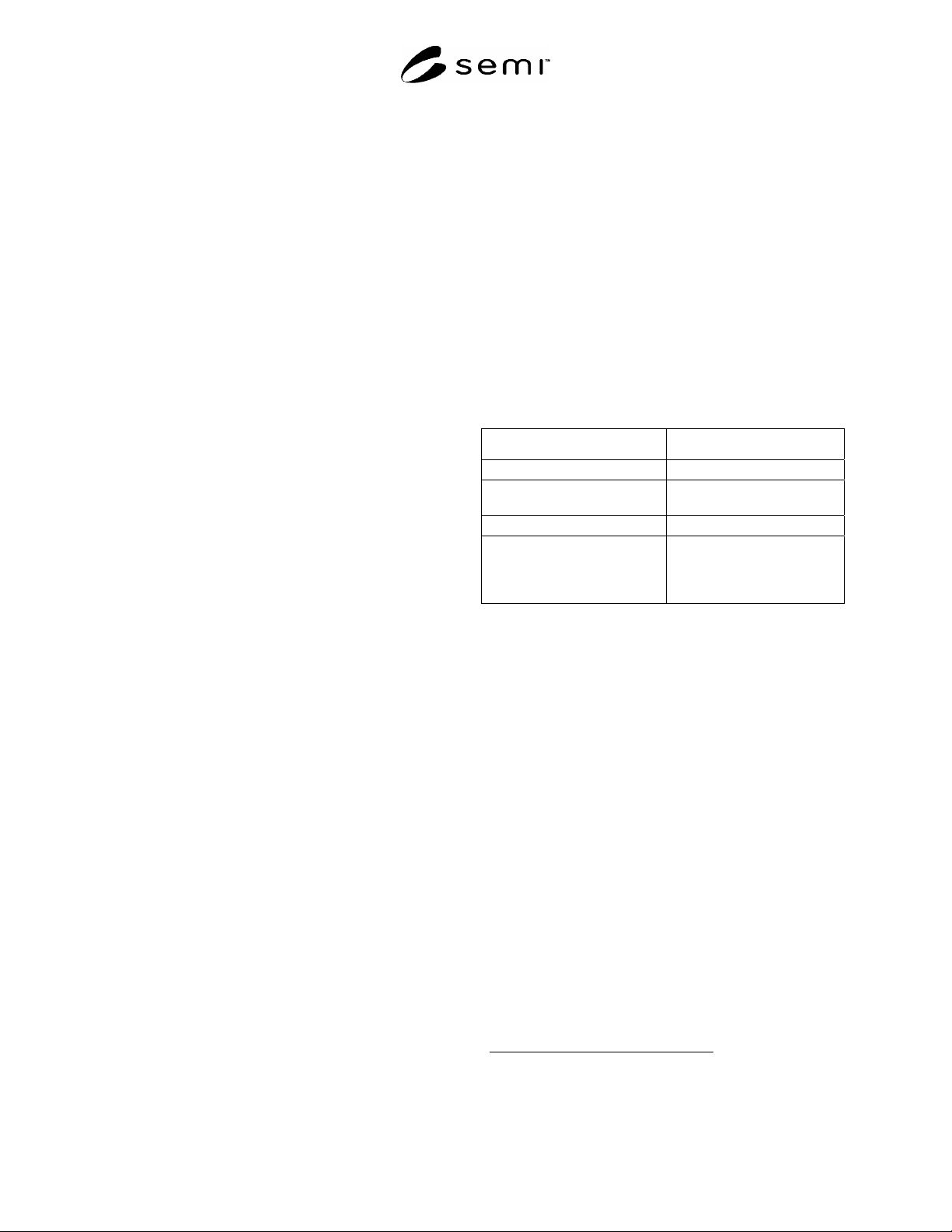
Table 1 Quality: ≥99.99%
Impurities Maximum Acceptable Level
Water 20 ppmv
Total Hydrocarbons
expressed as Methane (THC)
50 ppmv
Particles
#1
Soluble and Insoluble
Compounds Containing
Metals (Na, Fe, Ni, Cu, Cr,
Co, Ca, Mn, W, Mo) (each)
0.1 ppmw
#1: To be determined between supplier and user.
6 Referenced Standards
6.1 SEMI Standards
SEMI C10 — Guide for Determination of Method
Detection Limits
SEMI C15 — Test Method for ppm and ppb Humidity
Standards
SEMI F33 — Method for Calibration of Atmospheric
Pressure Ionization Mass Spectrometer (APIMS)
6.2 ASTM Standard
1
E 1747-95(2000) — Guide for Purity of Carbon
Dioxide Used in Supercritical Fluid Applications
NOTICE: Unless otherwise indicated, all documents
cited shall be the latest published versions.
1 American Society for Testing and Materials International, 100 Barr
Harbor Drive, West Conshohocken, Pennsylvania 19428-2959, USA.
Telephone: 610.832.9585, Fax: 610.832.9555, Website:
www.astm.org.
SEMI C55-1104 © SEMI 2004 2
7 Physical Constants
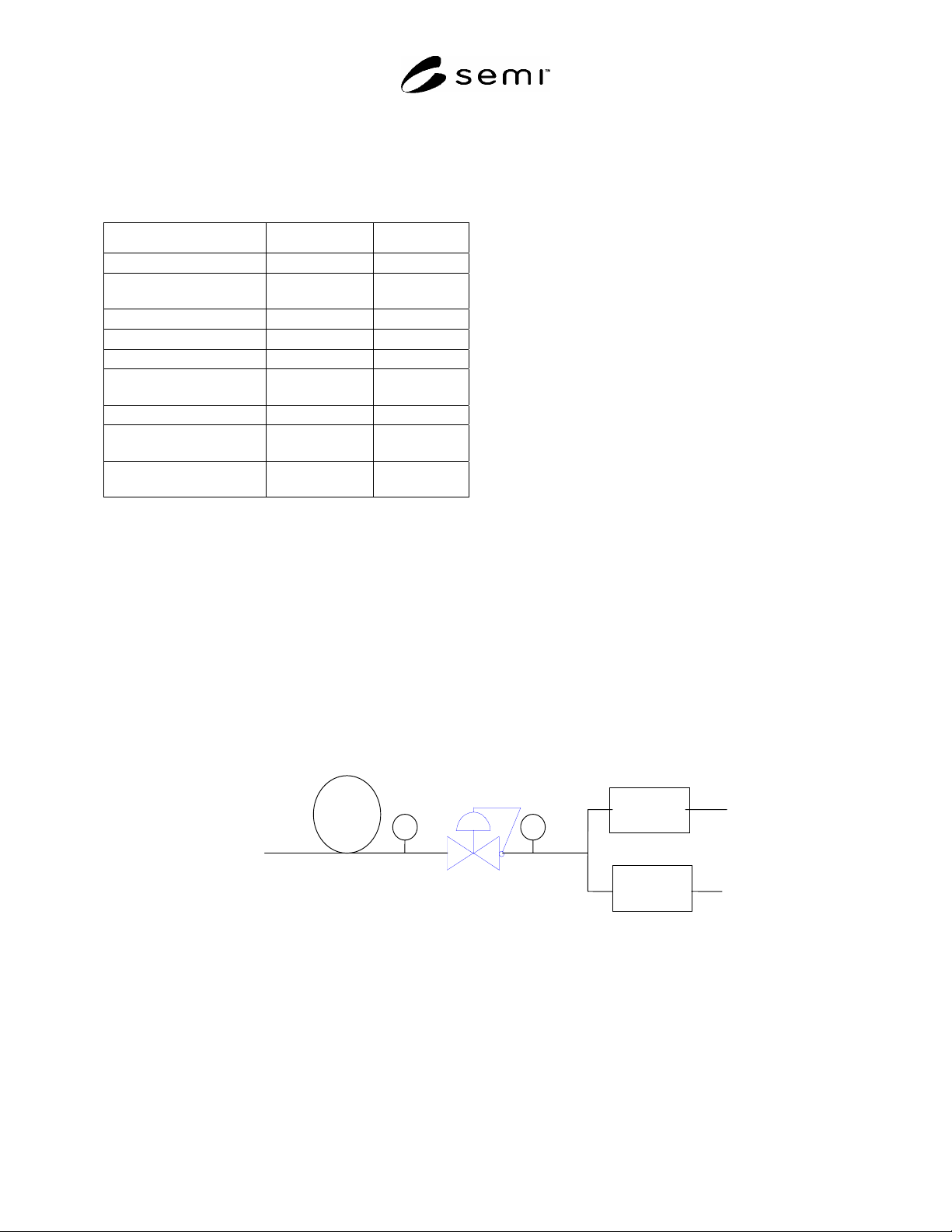
7.1 The physical constants of carbon dioxide are given
in Table 2 (for information only).
Table 2 Physical Constants (for information only)
Metric Units US Units
Molecular Weight 44.01 44.01
Sublimation Point at 1
atm (14.7 psia)
-78.5
o
C -109.3
o
F
Triple Point Temperature -56.6
o
C -69.9
o
F
Triple Point Pressure 5.1 atm 75.1 psia
Critical Temperature 31
o
C 87.8
o
F
Minimum Near Critical
Temperature
-45.0
o
C -49.1
o
F
Critical Pressure 73 atm 1070 psia
Density of gas at 21.1
o
C
(70
o
F) and 1 atm
1.823 kg/m
3
0.1138 lb/ft
3
Density of Saturated
Liquid at 25
o
C
713 kg/m
3
44.5 lb/ft
3
8 Analytical Procedures
8.1 Water — This procedure is for the determination of
trace moisture (water) in carbon dioxide using an
analyzer, such as a continuous flowing phosphorus
pentoxide hygrometer.
8.1.1 Detection Limit — 100 ppbv or better
8.1.2 Instrument Parameters
8.1.2.1 Flow Requirements — Use appropriate flow, as
recommended by manufacturer.
8.1.3 Calibration Standard — The analyzer shall be
calibrated by reference to a standard gas calibration
mixture containing a moisture content close to the
expected value of the gas under test, in accordance with
the instrument manufacturer’s instructions. This
calibration standard may be prepared using the
procedure described in SEMI F33, Sections 13.2.2 and
13.2.3 and tested using the procedure described in
SEMI C15.
8.1.4 Sample System
8.1.4.1 The sample line and associated valves must be
clean and moisture free. They must be constructed
from high cleanliness materials, such as electropolished
stainless steel. The sample line should be purged dry if
exposed to ambient moisture. The baseline moisture
level should be less than 0.1 ppm.
8.1.4.2 Draw a continuous liquid sample from the
source. The sample line should be insulated so that the
sample does not boil due to heat infiltration. The
distance between the sample point and the analyzer
should be as small as possible to minimize boil-off.
8.1.4.3 Heat the sample so that it is completely
vaporized, leaving absolutely no liquid or solid carbon
dioxide or water residue.
8.1.4.4 Maintain the sample temperature at the
analyzer inlet above its condensation point. A sample
temperature of 40
o
C is recommended.
8.1.4.5 Figure 1 illustrates one potential sampling
configuration.
FROM
LIQUID
CO2
SYSTEM
VENT
VENT
HEATED
TUBING
THERMOCOUPLE
FORWARD
PRESSURE
REGULATOR
PRESSURE
GAGE
THC
DETECTOR
MOISTURE
A
NALYZE
R
Figure 1
Potential Hydrocarbon and Water Sampling System